
The HANS device: how motorsport ignored the fix for twenty years before making it mandatory
Two hundred and fifty units in a decade. Then Earnhardt died.
Picture a small Georgia office in February 2001. Two men have been hand-building head-and-neck restraints for a decade. They have sold about 250 units in ten years. They have not drawn a salary. They have plowed every bit of margin back into research. They are convinced their device prevents a specific category of racing fatality, and the racing world has, broadly, told them to go away.
February 18, 2001. Daytona 500. Last lap.
Dale Earnhardt — seven-time NASCAR Cup champion, the Intimidator, the most beloved stock-car driver in America — brushes doors with Sterling Marlin and slides into the Turn 4 wall. The car looks intact from the outside. Earnhardt does not climb out. The medical examiner’s report would later identify a basilar skull fracture among the causes of death.
The Monday after Earnhardt’s death the phones at Hubbard/Downing Inc. in Chamblee, Georgia, do not stop. In a single week the company sells roughly 300 HANS devices — more than its entire previous decade combined. By the end of 2001 they are past 3,000. NASCAR mandates a head-and-neck restraint (allowing both the HANS and the competing Hutchens device) in October 2001. CART mandates the HANS for ovals in 2001 and all circuits in 2002. The FIA mandates FHR devices for Formula 1 in 2003. The WRC and V8 Supercars follow in 2005.
The device had been on the market since 1991. The science was published in peer-reviewed form from 1989. The patent was filed in 1985. It took until 2001 for motorsport to listen.
This is the story of those wasted years, and of what the HANS actually does and does not do inside your neck.
A son-in-law and a brother-in-law
The HANS starts where family conversations do not usually go: at Thanksgiving dinner in the United States in the early 1980s.
Jim Downing is an American sports-car racer. Five-time IMSA champion, long-time Mazda factory driver, a road racer’s road racer. In 1980 he survives a heavy crash at Mosport. The following year, his close friend Patrick Jacquemart dies testing a Renault Le Car Turbo at Mid-Ohio. Jacquemart does not die from the impact itself. He dies from the kind of head-and-neck injury that motorsport medicine of the era lumped under “basilar skull fracture” — a family of trauma patterns to the base of the skull and the craniocervical junction that concentrate crash loads in the most vulnerable region of the human skeleton when a body is restrained by harnesses but the head is free.
A quick note on terminology, because mixing it up leads straight to nonsense. A basilar skull fracture, strictly speaking, is a fracture of the bones that form the base of the skull (occipital, temporal, sphenoid). An atlanto-occipital dislocation or disarticulation is the separation of the skull from the first cervical vertebra, the atlas. These are distinct injuries, they can coexist, and both are frequently fatal in violent frontal impacts with the body restrained. Sports medicine literature and the racing industry have for decades used “basilar skull fracture” (BSF) as the umbrella shorthand, but it pays to know what sits under the term.
Downing goes to the funeral and takes a question home: how the hell do you stop this?
He brings it to his brother-in-law at Thanksgiving. His brother-in-law is Robert Hubbard. Not a racer. A professor of biomechanical engineering at Michigan State University, a former General Motors crash safety researcher, a man who spends his working life studying how humans fail under acceleration.
Hubbard listens and comes back with the obvious insight: if the harnesses restrain the body and the head is free, you need to give the deceleration force an alternative path to the head — one that does not push the entire inertial load through the neck. It is not about “clamping the head to the body” like a cervical collar. It is about sharing the load: giving the energy an additional physical route (helmet → tethers → yoke → harness) so the neck does not have to carry all of it on its own.
That idea, turned into hardware, is the HANS. The next twenty years were spent making it work while motorsport ignored them.
What actually happens in a frontal impact
Let’s do the biomechanics properly, because it matters, and because it is usually told badly.
When a race car crashes head-on and decelerates sharply, the harness restrains the driver’s torso against the seat. So far so good. But the head, with helmet on, weighs between four and five kilograms and is attached to nothing but the neck. Inertia pushes it forward. The only path connecting the head to the body is the cervical spine with its seven vertebrae, its ligaments, and the craniocervical junction (where the base of the skull sits on the atlas).
All of the force needed to decelerate that inertial mass of the head has to travel through the neck. How much force, exactly, depends on multiple factors that cannot be reduced to a single number: the deceleration pulse (how deceleration evolves over time, not just its peak value), the direction of impact, its duration, the presence of other contact points (steering wheel, roll cage, seat back), the angle of the neck at the moment of impact, and the physical characteristics of the driver.
The biomechanics literature of the 1970s and 1980s established reference thresholds for base-of-skull fracture in controlled testing: approximately 3,300 N of vertical neck tension (around 740 lbf) and 3,100 N of forward shear (around 700 lbf). These numbers come from specific tests with specific geometries and pulse shapes. They are not a universal line beyond which any neck will fail: they are test references, not death sentences. In the real world, two impacts with the same peak loads can produce very different injuries depending on how they distribute in time and on the occupant.
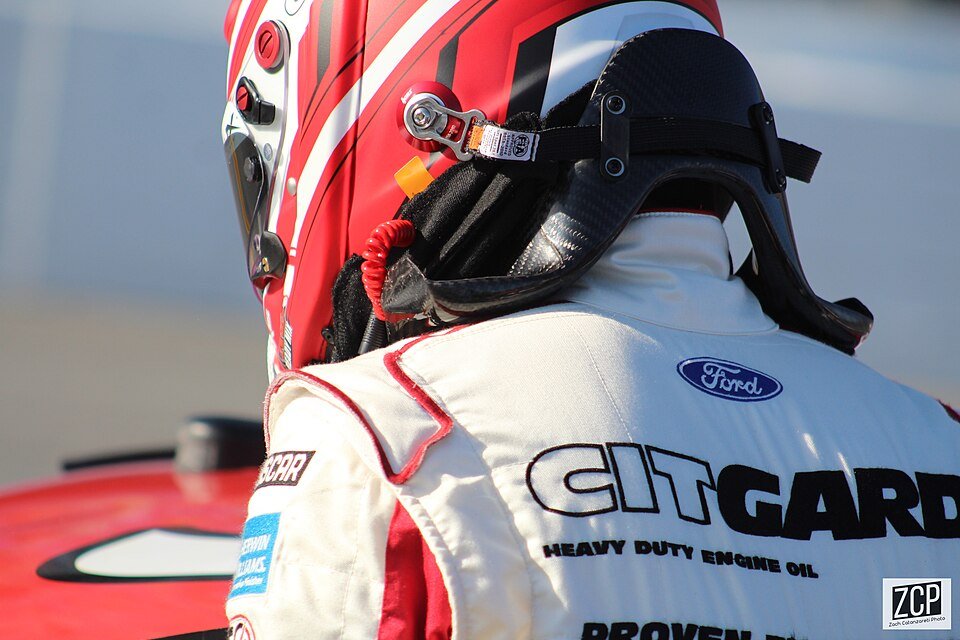
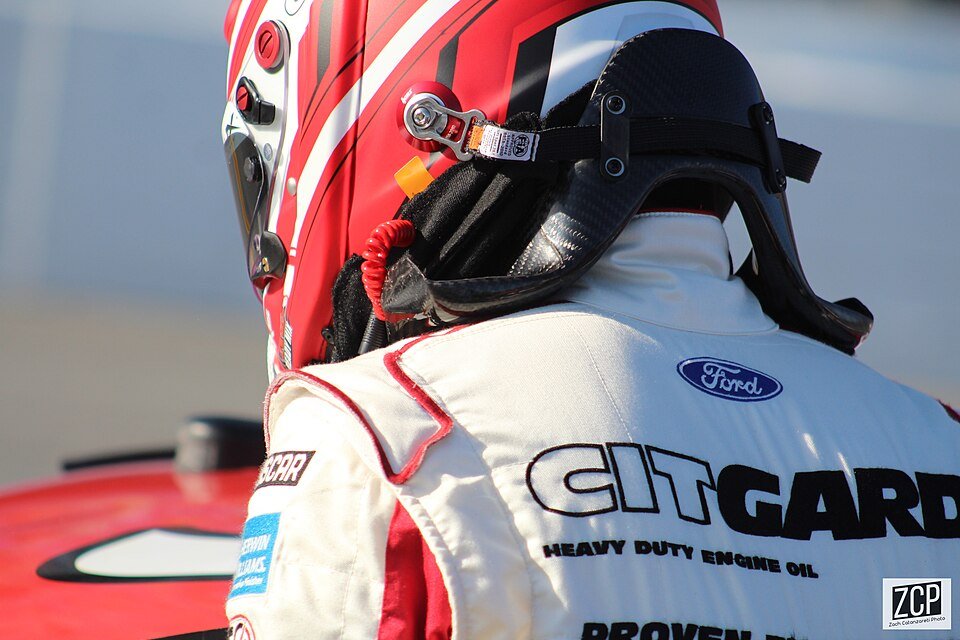
The HANS does not “eliminate head inertia,” which is physically impossible. What it does is provide a load-sharing path parallel to the neck: tethers (not elastic — a resistant, length-calibrated webbing) connect the helmet to a composite yoke resting on the driver’s shoulders. The yoke sits beneath the restraint harness (which FIA regulations allow at five or six attachment points depending on the applicable rulebook). When the car decelerates, the harness restrains the torso. The yoke, captured by the harness, decelerates with the torso. And the tethers route part of the head’s inertial force directly to the yoke, instead of making all of it pass through the neck.
Result: the neck still works, but it carries a fraction of what it would carry alone. In sled tests published by Hubbard and by academic groups from 1989 onward, the HANS reduced measured peak neck loads by very significant margins. The exact figures vary by test configuration, by deceleration pulse, and by variable measured (tension, shear, bending moment, head acceleration). The widely quoted “80% reduction” refers to specific parameters in specific tests and should not be treated as a universal truth.
What matters, what does not change, is the idea: share the load. The idea works. And there were working prototypes to prove it from 1985 onward.
The early years: 250 units in a decade
The first HANS prototype dates to 1985, the year Hubbard filed his first patent. A fiberglass collar with two tethers connecting the helmet to a yoke on the driver’s shoulders.
On November 30, 1986, Downing wears the prototype at the final IMSA event of the season at Daytona — not at the 24 Hours (which run early in the year). He describes it himself as comically large. People look at him sideways. He is the first driver in the world ever to race wearing a head-and-neck restraint. The second will be Paul Newman.
In 1989, the first proper sled tests with crash dummies and real racing harnesses confirm that the principle works and that neck loads drop substantially relative to the published reference thresholds. The data is published. Peer-reviewed papers exist.
Nobody cares.
Twenty years in the wilderness
Here is the part regulators do not like to remember. Hubbard and Downing spend the 1980s and 1990s trying to sell the HANS to anyone who will buy it. Motorsport’s general response is a collective yawn.
Drivers think it looks ugly. Bulky. They complain it chafes. They say it limits peripheral vision. They do not want it in tight cockpits. NASCAR — where head-and-neck injuries have been killing drivers periodically — isn’t interested. The major safety-equipment manufacturers Hubbard and Downing approach for production all say no.
In 1990 they found Hubbard/Downing Inc. because nobody else will build it. The first commercial unit ships in 1991. Total sales across the entire 1990s come to roughly 250 units. Two hundred and fifty units in ten years. Two per month on average. Financially impossible. Hubbard and Downing reinvest the little they do earn into continuing development.
In those twenty years there are names. Funerals. Widows. Each one a driver killed by the kind of injury the device was built to prevent.
1994. Imola. The crack opens.
The San Marino Grand Prix weekend at Imola, April 29–30 and May 1, 1994, is the moment that splits the history of motorsport safety in two.
Friday, April 29. Free practice. Rubens Barrichello, Brazilian Jordan driver, strikes a kerb at the Variante Bassa and is launched into the tire barrier. The impact registers 95 g. Barrichello is knocked unconscious but survives with a sprained wrist and broken nose. The weekend already feels wrong.
Saturday, April 30. Qualifying. Roland Ratzenberger, Austrian F1 rookie with Simtek-Ford. Approaching the Villeneuve corner his car’s front wing fails. With the front downforce gone the car is thrown radically out of balance, Ratzenberger can neither steer nor brake effectively, and he hits the concrete wall at approximately 225 km/h. He dies on the spot from massive craniocervical injuries.
Sunday, May 1. Race. Lap seven. Ayrton Senna, three-time world champion, leading in the Williams-Renault FW16. He loses the car at over 300 km/h at Tamburello and slams into the concrete barrier. A front suspension component penetrates his helmet. Senna dies from head injuries caused by that penetration, not from the typical no-penetration craniocervical injury mechanism the HANS was designed to address. This distinction matters: the HANS is designed to protect against inertial loads on the neck, not to prevent an object punching through a helmet. Senna’s death was part of the political trigger that forced F1 to prioritize safety, but his specific injury pattern is not the textbook example of what the HANS would have prevented.
Two drivers dead in 24 hours. A third seriously injured the previous day. Sid Watkins, F1’s chief medical officer, leans on the FIA. The war on head injuries begins in earnest. Mercedes is tasked with researching driver protection. The German company tests cockpit airbags, collapsible steering columns, and at some point someone remembers there is an American device called the HANS that has been on the market for ten years and sold around 250 units.
Mercedes runs HANS vs. airbag tests between 1996 and 1998. The HANS performs better on the parameters they measure. In 1997 Mercedes shuts down its F1 airbag project and shifts resources to optimizing the HANS. The second-generation device, developed with Mercedes engineers in 1999, is smaller and finally fits inside an F1 cockpit.
But the FIA still takes years to mandate it. Politics, driver inertia, cost. Nothing moves at the speed it should.
February 18, 2001. Daytona. The industry gives in.
Last lap of the Daytona 500. The #3, Dale Earnhardt, seven-time Cup champion. Earnhardt was not wearing a HANS. In the eight months leading up to his death NASCAR had already lost several drivers to the same mechanism of injury: Adam Petty (May 2000, New Hampshire), Kenny Irwin Jr. (July 2000, same track), Tony Roper (October 2000, Texas). Three drivers in eight months, none wearing a HANS, and NASCAR still did not mandate one.
Within hours of Earnhardt’s death the Hubbard/Downing offices in Chamblee, Georgia, collapse under phone traffic. The week after the crash they sell more units (about 300) than in the entire 1990s combined. HANS sales for 2001 jump from the 250 accumulated to more than 3,000 by year end.
In October 2001 NASCAR mandated the use of a head-and-neck restraint device, allowing both the HANS and the Hutchens device (a competing design by Bobby Hutchens). Only in 2005 did NASCAR specifically mandate the HANS, after the Hutchens device was effectively withdrawn following worse test results.
CART mandated the HANS for ovals in 2001 and all circuits in 2002. Formula 1, under FIA regulation 8858 (written in 2002), mandated FHR devices for the 2003 season. Felipe Massa became the first driver to race with a HANS in F1, at the 2002 Italian Grand Prix, before the mandate took effect. The WRC and V8 Supercars mandated FHR in 2005. The NHRA had adopted the HANS earlier, in 1996, and mandated it in 2004.
Today the market for frontal head restraints (FHR — Frontal Head Restraint, the technical category defined by FIA 8858 that includes the HANS but also other homologated designs) is broad. FHR is not merely the neutral name for the HANS; it is the wider technical category. The HANS is by far the most widely known and sold FHR, but homologated alternatives exist under the same standard. When one reads that “more than 275,000 competitors use the HANS,” the figure traces back to the 2020 launch presentation for the book CRASH! and should be read as a historical cumulative order of magnitude, not as an active 2026 user census.
Nine dead men and an unanswered question
If the HANS had been on the market since 1991, with published and peer-reviewed data showing significant reductions in craniocervical loading, why did Ratzenberger, Adam Petty, Kenny Irwin, Tony Roper, Gonzalo Rodríguez, Greg Moore, Blaine Johnson and Dale Earnhardt have to die before any organizer made it mandatory?
Careful here, so we don’t fall into the trap we’re calling out. The HANS is not designed to prevent every motorsport fatality. An impact with helmet penetration (like Senna’s), an impact against an obstacle entering the driver’s zone above the helmet (like Bianchi’s at Suzuka in 2014), or a massive side impact directly compromising the survival cell, lie outside the protection envelope the HANS was built for — which is inertial frontal loading on the neck in impacts the survival cell survives.
But within the perimeter it is designed for (violent frontal impacts with the body restrained by harness, head free, injury from inertial load on the craniocervical junction), the HANS has published studies supporting its effectiveness. And the FIA, through Nuno Costa, head of Competitor Safety, has publicly identified specific accidents in which it considers an FHR to have been decisive for survival. Robert Kubica at Canada 2007 and Felipe Massa at Monaco 2004 are frequently cited in this context, though survival of any racing accident never depends on a single piece of equipment: helmet, seat, harness, FHR, survival cell, impact barriers, and medical response all work together.
Why it took so long has several layers, and all of them reflect badly on someone.
Driver culture. Motorsport was built on the image of the driver as a tough man accepting risk. Wearing what looked like an orthopedic collar contradicted the image. Earnhardt, at an Indianapolis test in 2000, told Mike Helton — soon to be NASCAR’s president — that he wanted nothing to do with the HANS. He was dead eight months later.
Sanctioning body culture. NASCAR lost Adam Petty, son of Kyle and grandson of Richard, one of the most sacred dynasties in the sport, in May 2000. It did not mandate the HANS. It lost Kenny Irwin Jr. two months later. Did not mandate it. It lost Tony Roper in October. Did not mandate it. It took Dale Earnhardt, the national icon, for the organization to act.
Economic. A hand-made HANS in the 1990s cost a non-trivial sum, though exact initial pricing is not reliably documented. In professional categories it was not a barrier. In amateur and club racing it was, at least until industrial production later brought costs down.
Regulatory. The FIA took nearly a decade from Imola to mandate it in F1. Mercedes put the data on the table in 1998. The FHR 8858 rule was written in 2002. The F1 mandate took effect in 2003. Nine years between the Imola deaths and the mandate.
What you wear if you race
If you race in any FIA-sanctioned category, your FHR must be homologated under FIA 8858 (in its 8858-2002, 8858-2010, or later variants). In the United States there is also the SFI 38.1 standard. These are two distinct homologation systems, not equivalent, and your racing category determines which you must comply with.
Specific numbers (yoke weight, dimensions, tether length, available collar angles, fitting procedure) depend on the model, the manufacturer and the intended use. There is no such thing as “the modern HANS” as a single object with fixed measurements. There are different models for different applications: F1 (more reclined), rally (intermediate), stock car or GT (more upright), with collar angles typically between 10° and 40° per catalog. Standard tethers work for many applications; at the top of the sport they are customized to driver height and helmet geometry.
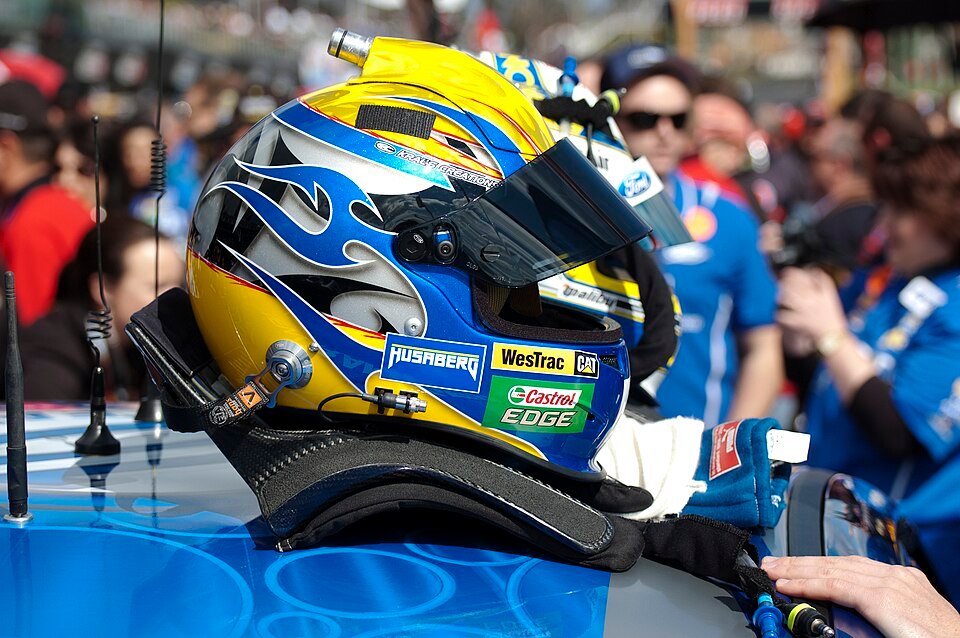
Retention tethers have a service life specified by the manufacturer (on current HANS devices, approximately five years under normal conditions, or sooner if wear is detected or after a significant impact). The yoke itself must be inspected after severe impacts and follow the manufacturer’s recommendations. Helmet attachments must use approved terminals (typically in M6 thread configuration) and the helmet must be FHR-prepared, with the homologated metal inserts installed.
If you fit it wrong or wear it loose, it does not work. Published procedures, instructor schools, and pre-grid technical scrutineers exist for a reason.
For the exact numbers that apply to your gear, consult the manufacturer’s manual, the technical regulations of your category, and the corresponding FIA guide. I am not your scrutineer.
The present silence
Today, in F1, in NASCAR, in IndyCar, in WRC, in Le Mans, in GT3, in F2, F3, Formula Regional, in Le Mans Hypercar and LMP2, in Super Formula and Super GT, the FHR is invisible and mandatory. It does not show up on TV. It does not make noise. It almost never breaks.
The last F1 death was that of Jules Bianchi from injuries sustained in the Suzuka accident of October 5, 2014. Bianchi died on July 17, 2015. The injury that killed him was a diffuse axonal injury — a form of traumatic brain damage caused by the internal shearing of nerve fibers during violent acceleration or deceleration. It was not a basilar skull fracture in the sense Earnhardt’s was. The 396-page official FIA report puts the impact against the recovery vehicle at 126 km/h (the 213 km/h figure that circulates online corresponds to an earlier phase of the accident, before loss of control, not to the collision with the crane). The recovery vehicle, a tractor-crane, weighed approximately 6,500 kg.
The FIA report concluded that, given the impact type (a racing car striking a stationary heavy vehicle with aggressive geometry above the helmet line), the most effective preventive route was not improving car protection but preventing that scenario from happening in the first place. From that came the Virtual Safety Car and reinforced double-yellow-flag and vehicle-recovery procedures.
Hubbard died in 2019 at 75. Downing is still alive. Both were inducted into the Motorsports Hall of Fame of America in 2024 under the technical category. Their book CRASH!, written with journalist Jonathan Ingram, sits in the Smithsonian’s permanent collection.
They spent twenty years in obscurity. They sold 250 units in a decade. They reinvested nearly everything. Plenty of professional drivers laughed in their faces. They watched more than one friend die from exactly the injury pattern their device was designed to prevent.
In the end, they won. The entire industry wears their device, or a homologated FHR equivalent. The next time you see a Formula 1 driver climb out of the car with a dark collar visible between helmet and shoulders, remember Patrick Jacquemart, dead at Mid-Ohio in 1981. The brother-in-law professor who turned the problem over at Thanksgiving the following year. And the twenty years motorsport took to listen.
There is a lesson here that nobody comes out of clean. Motorsport is an industry that prides itself on leading the world in technology. Carbon monocoques, telemetry sensors sampling at one kilohertz, aerodynamics solved in multi-million-dollar wind tunnels, materials that do not exist anywhere else. And then a university professor walks in with a fiberglass yoke and two tethers, shows it to them, and they tell him it looks ugly. For twenty years. Until Dale Earnhardt crashes into the Turn 4 wall at Daytona in front of millions of viewers live on television.
It is not a failure of the device. It is not a failure of the engineers. It is not a failure of the data. It is a failure of the adults in the room. The same adults who, when something has a catchy brand name and the backing of a works team, adopt it in six months. When an outsider brings it from a Georgia garage, it takes a generation. And drivers get buried along the way.
The HANS is not a miracle. It is honest engineering applied to a known problem. What is abnormal is the time motorsport needed to look at it head-on. That part of the story is not engineering. It is political. And it is worth remembering the next time someone insists the motor industry “self-regulates well.” It does not self-regulate well. It reacts when the dead body is famous enough.
Check you’re still alive.