ITV and Homologation: The Via Crucis of Modifying Your Car in Spain

The Sin of Touching What’s Yours
You bought a car. It’s yours. It’s in your name. You pay the insurance, the road tax, the periodic ITV inspection, and even the registration tax if you bought it new. It belongs to you legally and financially. And yet, the moment you decide to change the wheels for ones that don’t appear on its technical sheet, you’ve crossed an invisible line that turns you into a suspect under Spain’s homologation system.
This isn’t hyperbole. In Spain, any modification to an already-registered vehicle that alters any of its original characteristics is legally considered a “reforma de importancia” — a reform of significance. And reforms of significance require homologation. Not a suggestion, not a recommendation: a legal obligation. Fail to comply and you risk fines between €200 and €500, vehicle immobilisation, and — worst of all — your insurance company washing their hands of you if you have an accident. Even if you’ve been religiously paying your comprehensive policy for years.
This is what awaits you when you decide to touch your car in Spain. And this article is the guide nobody gives you before you open your wallet.
The Legal Framework: RD 866/2010 and the Reform Manual
It all starts with Real Decreto 866/2010, the regulation governing the processing of vehicle reforms after definitive registration in Spain. This decree establishes the general procedure, but the real substance lies in the Manual de Reformas de Vehículos (Vehicle Reform Manual), a technical document drafted by Spain’s Ministry of Industry in collaboration with regional government ITV authorities.
The Manual classifies every possible modification using reform codes (CR). The codes range from group 1 to group 10, covering absolutely everything: from identification modifications (group 1) to powertrain changes (group 2), transmission (group 3), axle and wheel configuration (group 4), suspension (group 5), steering (group 6), brakes (group 7), bodywork and chassis (group 8), lighting and signalling (group 9), and other reforms (group 10).
Each reform code specifies what documentation is required, whether a technical engineering project is needed, and the criteria the ITV will verify during physical inspection.
The seventh revision of the Reform Manual became mandatory in November 2022, and corrections and updates have been published since. Because this isn’t a static document: it changes, it evolves, and what was legal yesterday may require additional paperwork tomorrow.
The Step-by-Step Process: From Idea to Technical Sheet
Let’s break down the complete homologation process in Spain, without shortcuts or fantasy.
Step 1: Consult the Reform Manual. Before touching anything — I repeat, before buying a single part — you need to identify which reform code corresponds to what you want to do and what documentation you’ll need. The Manual is available at all ITV stations and reference versions can be found through the Ministry of Industry’s website.
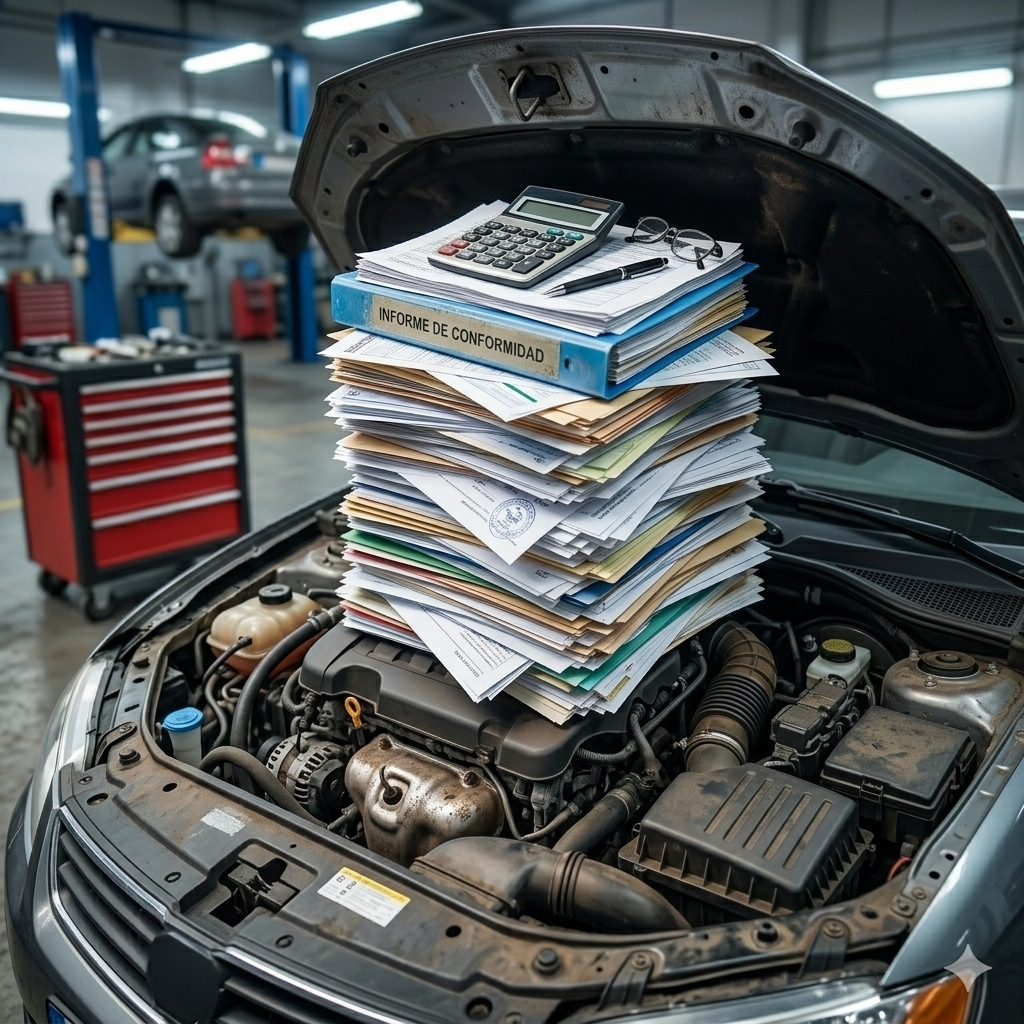
Step 2: Determine if you need an engineering project. This is where the path splits. Reforms are divided into two categories: without project and with project. Simpler reforms (tow bars, non-equivalent tyres on passenger cars, exterior elements like snorkels or running boards, windows, lighting devices) require a conformity report and a workshop certificate. More complex reforms (engine swaps, substantial bodywork modifications, classification changes) additionally require a technical project signed by a certified engineer and a final works certificate.
Step 3: Execute the reform at a workshop. The workshop performing the modification must issue a workshop certificate confirming the reform was correctly executed. This document is fundamental.
Step 4: Obtain the conformity report. The conformity report is issued by an authorised Technical Reform Service — a laboratory accredited by the Ministry of Industry. This document certifies that the vehicle, post-reform, complies with current regulations. Companies like CIMALab, Fixlab, TH Homologaciones, and IMB Homologaciones operate in this space. The conformity report is mandatory in all cases.
Step 5: Submit documentation to the ITV. With all paperwork ready — engineering project (if applicable), workshop certificate, final works certificate (if applicable), and conformity report — everything is submitted to the ITV station. Typically, documentation is reviewed first, then an appointment is scheduled for physical vehicle inspection.
Step 6: Physical inspection at the ITV. An inspector verifies that the physical modifications match the documentation, that they were performed according to regulations, and that the vehicle remains fit for road use. If everything checks out, the reform is recorded on the vehicle’s technical inspection card.
Step 7: Update the registration document (if applicable). If the reform involves changes affecting the registration document — such as an engine change that alters fiscal power — there’s an additional trip to the DGT (traffic authority) to reflect the modifications.
Seven steps. Minimum. If everything goes smoothly. If the ITV doesn’t request clarifications, if the conformity report has no errors, and if the traffic authority doesn’t add its own layer of bureaucracy.
What It Actually Costs: A Real Economic Breakdown
This is where most people get the shock. Because the cost of the physical modification — the engine, the parts, the workshop labour — is only part of the total budget. The legalisation process can match or exceed the cost of the reform itself.
Conformity reports from authorised technical services start at €100-150 for simple reforms without project, and can reach €400-800 for complex ones. If you need an engineering project, that document can cost an additional €150-800 depending on complexity. Technical laboratory reports — required when you need to demonstrate compliance with emissions, noise, or structural resistance standards — range from €300 to €800 and can exceed that for complex cases.
Add ITV inspection fees for reforms, which vary by autonomous community. Add the workshop certificate. Add, where applicable, traffic authority fees for updating the registration document. And add the cost of your time: because between gathering documentation, waiting for appointments, and potential back-and-forth with the ITV, you’re talking weeks or months.
For a complex reform like an engine swap, the total legalisation cost can easily sit between €500 and €3,000. Depending on the case, there are projects where the legalisation has cost more than the actual engine being installed. That’s the reality nobody mentions on internet forums.
What Happens If You Don’t Homologate?
Driving with a non-homologated reform is playing Russian roulette with your assets. The financial fine — €200 to €500 — is the least of it. The serious consequence is vehicle immobilisation: police can pull your car off the road at a routine checkpoint if they detect modifications not recorded on the technical sheet. And the gravest consequence is insurance: if your insurer determines your vehicle has non-legalised reforms, they can refuse to cover damages. Yours and third parties’. Even if you’ve been paying the policy for twenty years.
This isn’t theory. It’s established case law. Insurance companies have entire departments dedicated to finding reasons not to pay, and a non-homologated reform is a gift wrapped in cellophane.
Spain vs. The World: How They Do It Elsewhere
To understand the scale of Spain’s labyrinth, it’s worth looking at how other countries handle vehicle modifications.
United Kingdom. In the UK, an engine swap basically requires updating the V5C (the equivalent of the registration document) with the DVLA, providing a purchase receipt for the engine or a letter from a garage confirming the installation. For the MOT (equivalent to the ITV), the vehicle is inspected against the emissions criteria of the installed engine, not the original car. If modifications are extensive — such as a swap that alters chassis or structure — an IVA test (Individual Vehicle Approval) may be required. But for a standard engine swap in a car that retains its identity, the process is relatively straightforward: update paperwork, pass MOT, drive.
Germany. The German TÜV has a reputation for strictness, and it’s earned. But it also has a clear, technically rigorous procedure: the Einzelabnahme (individual approval) under §21 of the StVZO. A TÜV or DEKRA engineer inspects the vehicle, verifies the modifications comply with technical standards, and issues a certificate to update the vehicle documents. The base cost of an Einzelabnahme is approximately €150, with roughly €100 per additional component inspected. What’s interesting about the German system is that you can sit down with the TÜV engineer before starting your project, explain what you want to do, and receive technical guidance on how to execute it to pass inspection. It’s a collaborative approach that seems almost unimaginable in Spain.
United States. In most American states, an engine swap requires updating the vehicle registration and complying with state emissions regulations, which vary enormously. California, the strictest state, demands the replacement engine be from the same year or newer and retain all original emissions controls. Inspection takes place at a BAR Referee Station and costs less than $40. If it passes, an identification tag is placed on the door jamb and you drive legally. In many other states there’s no emissions inspection at all, and a swap is resolved with an engine number change on the vehicle title. In states like Florida or Texas, you could literally put a helicopter engine in a Miata and the only question would be whether it has insurance.
The difference isn’t just about cost. It’s about philosophy. In Spain, the system presumes any modification is suspicious until proven otherwise. In other countries, the system presumes the owner has the right to modify their vehicle, as long as verifiable safety and emissions standards are met.
The UK’s 8-Point System: A Different Approach to Vehicle Identity
A particularly revealing detail of the British system is the DVLA’s 8-point rule for modified vehicles. To retain a car’s original registration, the vehicle must retain at least 8 points from a total assigned to its main components: 5 points for the original chassis or monocoque, 2 for suspension, 2 for axles, 2 for transmission, 1 for steering, and 1 for the engine. This means you can change your car’s engine and transmission and still maintain its legal identity, as long as the chassis and suspension remain original. It’s a system that recognises an obvious reality: a car is its structure, not its engine.
Spain has no equivalent. Each modification is treated as an isolated case within reform codes, without a holistic view of what constitutes a vehicle’s identity. This generates absurd situations: you can change a car’s wheels, suspension, exhaust, seats, and lighting — each with its own separate homologation — and still have the same vehicle. But if the documentation for just one of those reforms fails, the entire vehicle falls into legal limbo.
What You Need to Know Before Starting
If you’ve read this far without running, congratulations. You’re made of the right stuff. But before launching into your project, there are some truths you need to internalise.
Budget the legalisation from minute zero. It’s not an expense you’ll “figure out later.” It’s a line item as real as the engine you’re buying. If the engine costs €1,500 and legalisation will cost another €1,500, your project costs €3,000. Full stop.
Find a trusted laboratory or engineering firm before buying the first part. Talk to them about your project, get guidance on what’s legally viable and what isn’t, and make sure what you’re planning has a realistic homologation path.
Document everything. Every invoice, every receipt, every donor engine chassis number, every certificate. Documentation is your armour.
Don’t do the reform first and try to legalise it after. The correct order is: plan, consult, execute, legalise. If you do it backwards, you may find that what you’ve done isn’t homologable, and then you have an expensive car that can’t be driven on public roads.
And finally: don’t trust “I’ve never been stopped.” The first time you get stopped with a non-homologated reform could be the last time you see your car for a very long time.
The Root Problem
Spain’s homologation system isn’t inherently bad. Road safety is a legitimate goal, and verifying that vehicle modifications don’t compromise structural integrity or braking capacity makes perfect sense.
The problem is that the system is designed to hinder, not to help. It’s built on layers of bureaucracy that disincentivise legal modification, pushing many people toward illegality. And that’s exactly the opposite of what an effective regulatory system should do: a good system makes it easy to do the right thing, not force you to choose between financial ruin and clandestinity.
While in Germany you can sit with a TÜV engineer to plan your swap, and in the UK you update a form online and pass the MOT, in Spain you need a certified engineer, an accredited laboratory, a registered workshop, an ITV that reviews documentation and then does a physical inspection, and potentially a trip to the traffic authority. For each modification.
We’re not asking for controls to be eliminated. We’re asking for them to be modernised. We’re asking for a system that facilitates legalisation instead of punishing it. Because a legally modified car is infinitely safer than one modified in secret. And right now, the Spanish system incentivises exactly the latter.
Welcome to the via crucis. At least now you know the path.
1 thought on “SWAPS vs HOMOLOGATION”