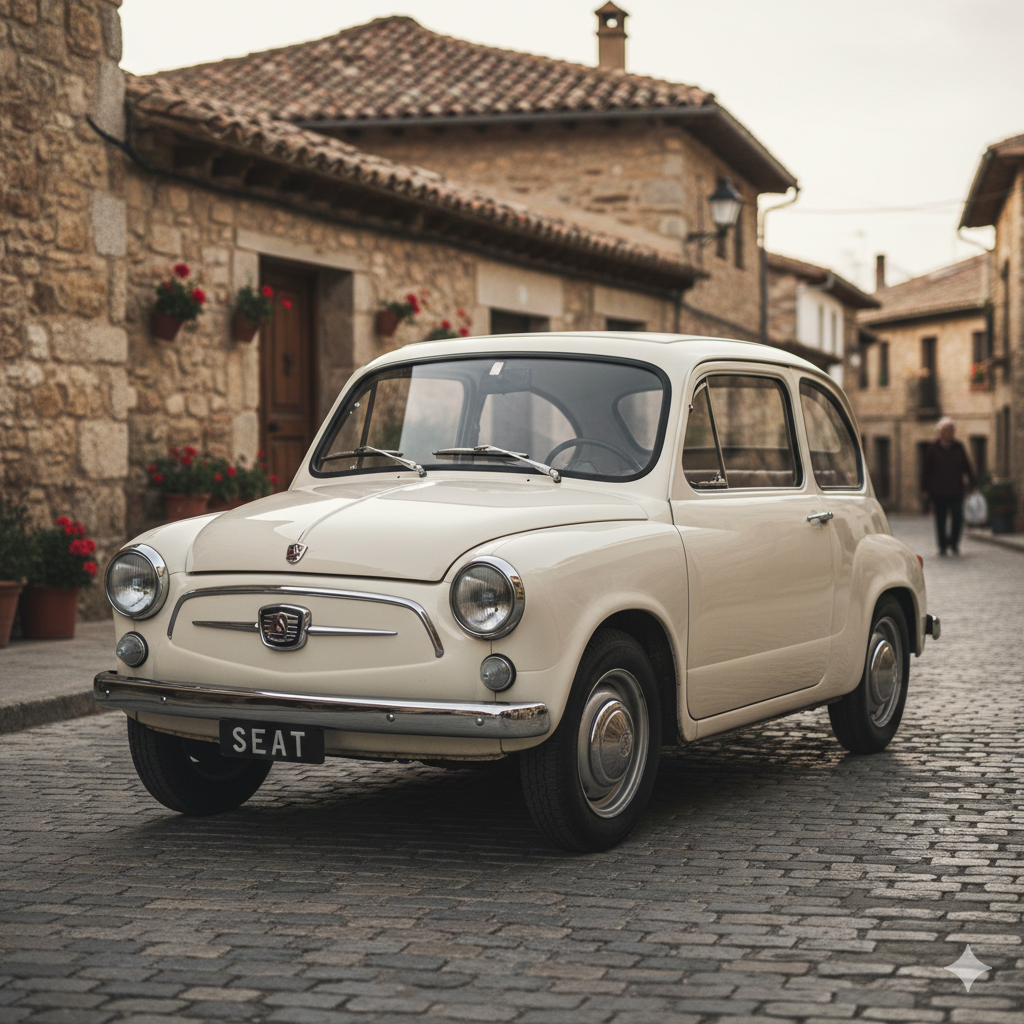
SEAT 600: The Car You’ve Never Heard Of That Did for Spain What the Beetle Did for Germany

The People’s Car You’ve Never Heard Of
Every major economy has one: the car that put the nation on wheels.
Germany had the Volkswagen Beetle. Britain had the Mini. France had the Citroën 2CV. Italy had the FIAT 500. America had the Ford Model T.
Spain had the SEAT 600. And unless you’re Spanish, you’ve probably never heard of it.
That’s a shame, because the story of the SEAT 600 is one of the most fascinating chapters in automotive history—a tale of dictatorship, economic transformation, and how 633cc of engine displacement changed 40 million lives.
Spain, 1957: A Country Stuck in Time
To understand why the SEAT 600 matters, you need to understand what Spain looked like in 1957.
While America was building the Interstate Highway System and Europe was recovering from World War II, Spain was frozen in a different era. Francisco Franco’s dictatorship had kept the country isolated for nearly two decades. The economy was closed, industry was primitive, and the standard of living lagged decades behind Western Europe.
In 1957, Spain had 1 car per 100 inhabitants. The United States had 1 per 3. France had 1 per 12. Spain was motorized at the level of developing nations.
The streets were dominated by donkeys, bicycles, and the occasional battered truck. The few cars that existed were imported, impossibly expensive, and completely out of reach for the vast majority of the population.
Spain didn’t need a sports car. Spain needed a miracle.
Enter FIAT (Through the Back Door)
SEAT —Sociedad Española de Automóviles de Turismo— had existed since 1950, manufacturing FIAT models under license. But their cars were luxury items, costing the equivalent of 10 years of a worker’s salary.
In 1955, FIAT launched two revolutionary utility vehicles in Italy: the Nuova 500 and the 600. Small, economical, simple enough for mass production. Perfect for post-war Europe.
SEAT negotiated the license to build the 600 at their Barcelona factory. FIAT provided the blueprints, machinery, and know-how. SEAT provided the labor and the market.
On June 27, 1957, the first SEAT 600 rolled off the Barcelona production line.
Price: 65,000 pesetas. Approximately 2-3 years of an industrial worker’s salary. Expensive, but not impossible. For the first time in history, a Spanish middle-class family could dream of owning a car.
The Specs: Tiny But Complete
The original SEAT 600 (called “600 N” for Normal) had modest but functional specifications:
Engine:
- Type: 4-cylinder inline, water-cooled
- Position: Rear-mounted, overhung
- Displacement: 633cc (38.6 cubic inches)
- Power: 21.5 HP @ 4,600 rpm
- Torque: 29 lb-ft @ 2,800 rpm
Transmission:
- Gearbox: 4-speed manual, unsynchronized 1st gear
- Drive: Rear-wheel
Dimensions:
- Length: 10.6 ft (3.22 m)
- Width: 4.5 ft (1.38 m)
- Height: 4.6 ft (1.41 m)
- Weight: 1,290 lbs (585 kg)
Performance:
- Top speed: 59 mph (95 km/h)
- Fuel consumption: 39 mpg (6 L/100km)
Capacity: 4 people (officially). An entire family of 6 with kids piled on top (unofficially).
For context: this car was slightly shorter than a modern Smart ForTwo, had less power than a riding lawnmower, and somehow fit entire Spanish families plus luggage for two-week vacations.
The Evolution: From N to E
SEAT 600 N (1957-1963) The original model. 633cc engine with 21.5 HP. “Suicide doors” (front-hinged, opening backwards). Spartan but functional equipment.
SEAT 600 D (1963-1970) The best-selling version. Engine increased to 767cc and 25 HP. Normal doors (rear-hinged). Better interior equipment. Top speed of 68 mph.
SEAT 600 E (1970-1973) The final model. 767cc engine with 28 HP. Improved brakes. Updated finishes. Produced until 1973, when it was replaced by the SEAT 133.
SEAT 600 L (1972-1973) “Luxury” version of the E model with premium equipment: improved upholstery, chrome moldings, door trim panels.
How the 600 Transformed Spain
The SEAT 600 didn’t just motorize Spain. It changed how Spanish people lived.
Before the 600, vacations were a foreign concept for most Spaniards. People traveled on foot, by donkey, or in overcrowded third-class train cars. The beach was for the rich and fishermen.
With the 600, suddenly a family from Madrid could go to the coast. A family from Zaragoza could visit grandparents in their village. A couple from Barcelona could explore the Costa Brava.
Sunday in Spain changed forever. Roads that had been empty filled with 600s packed to the roof with families, mattresses strapped to the roof rack, children’s faces pressed against windows.
Benidorm, Torremolinos, the Costa del Sol—Spain’s famous beach resorts—owe much of their early development to the SEAT 600. Without an affordable car, Spanish mass tourism wouldn’t have existed.
The 600 became a tool of social transformation:
- Courtship changed: Young couples could escape parental supervision
- Commerce changed: Small businessmen could deliver goods
- Rural isolation ended: Villages connected to cities for the first time
- The middle class emerged: Car ownership became the marker of “having made it”
The Numbers: 800,000 Units of Revolution
SEAT 600 Production (1957-1973):
- Total: 794,406 units
- Best year: 1966 with 91,564 units
Global FIAT 600 Production (1955-1969):
- Total: approximately 2,695,000 units
- Spain was the second-largest producer after Italy
The 600 in Spain today:
- Estimated 15,000-20,000 surviving examples
- Approximately 3,000-5,000 in running condition
Curiosities and Anecdotes
- The original air conditioning: The 600 had no A/C, but Spaniards invented their own: a porous clay water jug (“botijo”) hung from the window. The water evaporated in the wind and cooled the interior. Folk engineering at its finest.
- The front trunk: Since the engine was in the rear, the small trunk was in front. It was tiny, but Spanish families learned to pack like professionals. A family of 4 could fit two weeks of luggage in that space.
- The suicide doors: The first 600s (N model) had doors that opened backwards. They were called “suicide doors” because if they opened while the car was moving, the wind would rip them off. SEAT changed them in 1963.
- The starting ritual: The 600’s engine was notoriously difficult to start cold. Expert drivers knew you had to “choke” the engine with the starter and then release quickly. It was a ritual, almost a relationship.
- The “special” heating: The 600’s heater worked by channeling hot air from the engine. It was so effective that in winter the car was a sauna, and in summer there was no way to completely turn it off.
- The occupant record: The unofficial record for people inside a 600 is 23 university students. Obviously, the car didn’t move.
- The Police interceptors: The Spanish Gendarmerie used 600s as highway patrol cars in rural areas. They were the only affordable vehicles that could catch smugglers on narrow mountain roads.
The 600 in Spanish Culture
The SEAT 600 transcended its function as transportation to become a cultural icon:
In language:
- “Packed like a 600” became the Spanish equivalent of “packed like sardines”
- “Fits like a 600 in a garage” meant something was impossibly small
In collective memory:
- Nearly every Spaniard over 50 has a story involving a 600
- It’s probably the most photographed car in Spanish history
- The phrase “my grandfather’s 600” is a cultural touchstone
In social history:
- It represented the transition from donkey to automobile
- It symbolized Franco-era development (for better or worse)
- It marked the birth of the Spanish middle class
The Controversy: Symbol of Progress or Backwardness?
The 600 generates passionate debates among historians and enthusiasts.
Those who celebrate it say:
- It democratized transportation in Spain
- It was the first car for millions of families
- It symbolizes hard work and aspiration
- It represents Spain’s transition toward modernity
Critics argue:
- It was an Italian copy, not Spanish innovation
- It kept Spain with outdated technology (1950s design until 1973)
- Franco’s regime used it as propaganda for “development”
- There were better cars Spain couldn’t build due to protectionist policies
The uncomfortable truth: Both perspectives have merit. The 600 was simultaneously a real advancement for Spanish families AND a product of limiting economic policies. We can recognize its social impact while understanding its political context.
What It’s Like to Drive a 600 Today
If you’ve never driven a SEAT 600, the experience is… unique.
Starting: Requires technique. Lots of choke, quick release, wait. If you “flood” it, you wait 10 minutes.
The gear lever: First gear isn’t synchronized on older models. You have to wait for the car to be completely stopped or double-clutch.
Steering: Direct, unassisted, but light because the car weighs 1,290 lbs. You feel every pebble on the road.
Brakes: Drums on all four wheels. You need to anticipate. A lot.
Speed: 60 mph in a 600 N feels like 120 mph in a modern car. Everything vibrates, everything roars, everything seems at the limit.
Noise: The engine is behind your head. Above 45 mph, conversation is difficult.
Comfort: Non-existent by modern standards. Glorious by adventure standards.
Is it worth it? Absolutely. Driving a 600 is time travel. Not just to the past, but to a different way of understanding transportation.
The Market Today: Affordable Nostalgia
The SEAT 600 remains one of the most accessible classics on the European market.
2024 Prices:
| Condition | 600 N | 600 D | 600 E/L |
|---|---|---|---|
| Concours | €15K-€25K | €12K-€18K | €10K-€15K |
| Driver | €8K-€12K | €6K-€10K | €5K-€8K |
| Project | €2K-€5K | €1.5K-€4K | €1K-€3K |
Note: The 600 N models (suicide doors) are the most valued for their rarity. Original convertibles (rare) reach premium prices of €30,000+.
Maintenance cost: Surprisingly low. Mechanical parts are compatible with the Italian FIAT 600, and spares are still available. A competent mechanic can keep a 600 running indefinitely.
Why Americans Should Care About This Car
“Okay, interesting history lesson, but why should I care about a Spanish economy car from the 1950s?”
Because the SEAT 600 story is universal.
Every country has its “people’s car” moment—the vehicle that democratized mobility. In America, it was the Model T. In Germany, the Beetle. In Spain, the 600.
These cars share common traits:
- Affordable enough for the working class
- Simple enough for mass production
- Durable enough for rough conditions
- Small enough for infrastructure that wasn’t ready for cars
The 600 is fascinating precisely because most Americans don’t know it. It’s a window into how motorization happened in a country that was decades behind—and how a tiny car can reshape an entire society.
The SEAT 600 proves that sometimes the most important cars aren’t the fastest, most beautiful, or most advanced. Sometimes they’re just the ones that show up when a country needs them most.
Conclusion: A Monument to a Generation
The SEAT 600 wasn’t the best car of its era. It wasn’t the fastest, most comfortable, or most advanced.
But it was THE car that changed Spain.
794,406 families bought a 600 between 1957 and 1973. For the vast majority, it was their first car. For many, it was their only car for decades.
The 600 took them to the beach for the first time. It allowed them to visit relatives in other towns. It gave them freedom of movement they had never had before.
It’s not just a car. It’s a monument to a generation.
The generation that rebuilt Spain after the Civil War. That worked in factories and fields. That saved peseta by peseta to buy “the 600.” That learned to drive on narrow streets in that tiny car.
The 600 deserves its place in history, not because it was a great car, but because it did great things for the people who drove it.
Question for debate: Every country has its “people’s car” story. The Model T, the Beetle, the Mini, the 2CV, the 600. What made these particular cars succeed where others failed? Was it engineering, timing, price, or something else entirely?
3 thoughts on “SEAT 600”