
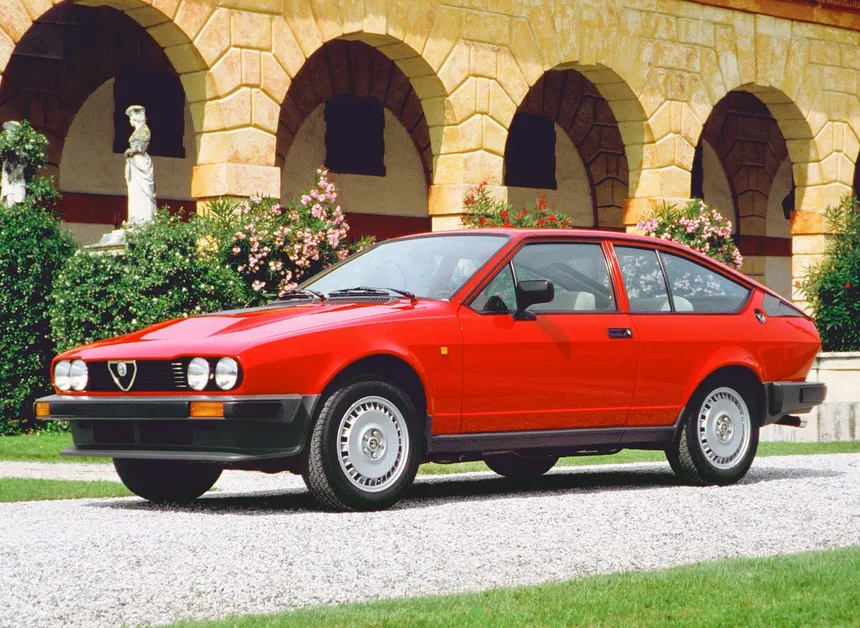
The Alfa Romeo GTV6: The Last True Alfa Before the Dark Ages

When Italy Still Built Driver’s Cars
In 1980, Alfa Romeo did something that seems impossibly romantic in hindsight: they took a perfectly good sports coupé and installed one of the greatest engines ever built.
The engine was Giuseppe Busso‘s 2.5-liter V6. The car was the GTV6. And together, they created what many consider the last pure expression of Alfa Romeo’s sporting philosophy before Fiat’s accountants took over.
This is the story of a car that arrived too late to save its maker, too early to be properly appreciated, and too good to ever be forgotten.
The Busso V6: A Symphony in Aluminum
Before discussing the GTV6, we must discuss its heart.
Giuseppe Busso designed the Alfa V6 in the late 1970s, and it remained in production until 2005—a quarter century of continuous evolution. The engine that debuted in the GTV6 was its first application, and many argue it remained the best.
The specifications read conventionally enough: 2,492cc, 60-degree V6, single overhead cam per bank, 160 horsepower at 5,600 RPM. Nothing about those numbers suggests transcendence.
Then you hear it.
The Busso V6 produces a sound that automotive journalists have spent four decades failing to adequately describe. It’s a mechanical aria—part Ferrari wail, part turbine whistle, with an organic quality that suggests something alive rather than assembled. At idle, it chatters with purpose. At full throttle, it sings.
No other production engine sounds quite like it. None ever will.

The Alfetta Platform Perfected
The GTV6 was based on the Alfetta GT, which itself traced lineage to the Alfetta sedan—a car designed in the early 1970s with genuine engineering ambition.
The Alfetta featured rear-mounted transaxle (gearbox and differential combined at the rear axle), giving near-perfect 50/50 weight distribution. Independent rear suspension via De Dion tube maintained precise wheel geometry under all conditions. Inboard rear brakes reduced unsprung mass.
These weren’t marketing gimmicks. They were genuine attempts to build a better driver’s car using technologies borrowed from racing.
The GTV6 inherited this foundation and added the V6. The combination was remarkable: a front-engine coupé that handled with the balance of a mid-engine sports car, powered by one of history’s great engines.
The Competition It Embarrassed
In 1980, the GTV6’s natural competitors included the Porsche 924, BMW 323i, and various British sports cars in their death throes.
Against the Porsche, the Alfa offered more power, better sound, and arguably superior handling. The 924’s Audi-derived four-cylinder couldn’t match the V6’s character.
Against the BMW, the Alfa gave nothing away in refinement while offering a far more exotic driving experience. The BMW was more reliable—but everyone already knew that.
The British? By 1980, British sports car manufacturing was essentially finished. The GTV6 represented what MG and Triumph could have built if they’d had competent management and adequate investment.
For enthusiasts who cared about driving above all else, the GTV6 was the obvious choice. Which explains why it never sold particularly well.

The Driving Experience
Approaching a GTV6 today requires recalibration. Modern cars have trained us to expect certain things: instant throttle response, perfectly weighted controls, ergonomics designed by people who actually sit in cars.
The GTV6 offers none of these things.
The gearshift, with its linkage running the length of the car to the rear transaxle, requires deliberate inputs. Rush it, and you’ll find false neutrals or grinding protests. Learn its preferences, and the shift action becomes satisfying in a way modern transmissions cannot match.
The throttle has mechanical lag—inevitable with carburetors or early fuel injection. You must anticipate rather than react. But when you do, the engine rewards you with that impossible sound and linear power delivery that builds relentlessly to redline.
The steering communicates everything happening at the front tires. Bumps, surface changes, grip levels—all transmitted directly through the wheel. This feedback, so rare in modern cars, makes the GTV6 feel alive in ways that faster, “better” cars simply don’t.
The handling balance is neutral tending toward oversteer—exactly what driving enthusiasts prefer. The rear transaxle keeps weight distribution honest, and the De Dion rear suspension maintains composure through corners that would have contemporary competitors scrambling for traction.
The Problems Nobody Denies
Owning a GTV6 requires accepting certain truths:
Electrical systems were suggestions rather than guarantees. Italian wiring of this era treated electron flow as a creative exercise. Dashboard lights illuminate randomly. Connections corrode mysteriously. The car will strand you at least once per year of ownership.
Rust is not a possibility but a certainty. Alfa Romeo’s rust protection in this era was essentially philosophical—they believed in the concept without actually implementing it. Any GTV6 surviving today has either been extensively repaired or spent its life in Arizona.
Parts availability ranges from difficult to impossible. While engine components remain findable through specialist suppliers, body panels and interior trim require networking, patience, and occasionally divine intervention.
Maintenance demands attention. The transaxle requires regular service. The engine needs valve adjustments. The carburetors (on earlier models) demand tuning. This is not a car for people who want to simply drive without thinking.
Those who accept these compromises discover a car that rewards dedication with an experience unavailable from more sensible choices.
The Racing Pedigree
The GTV6 wasn’t just a road car—it was a genuinely successful racing machine.
In European Touring Car Championship competition, the GTV6 proved surprisingly capable against theoretically superior machinery. The car’s excellent weight distribution and responsive chassis allowed skilled drivers to punch above its weight class.
In the United States, the GTV6 dominated SCCA Showroom Stock racing during the mid-1980s. Its combination of power, handling, and relative affordability made it the weapon of choice for privateer racers.
This racing success validated what owners already knew: beneath the electrical gremlins and rust problems lurked a fundamentally excellent sports car.
The Market Today
After decades of being undervalued, the GTV6 market has finally awakened.
Clean examples now command €25,000-€40,000, with exceptional specimens exceeding €50,000. The market has recognized what enthusiasts always knew: the GTV6 represents the last flowering of Alfa Romeo’s sporting tradition before corporate rationalization took hold.
The challenge is finding good examples. Most GTV6s led hard lives—driven enthusiastically, maintained indifferently, and left to rust when repairs exceeded value. Survivors often require significant investment to become truly usable.
For buyers willing to search and spend, the GTV6 offers remarkable value compared to contemporary Porsches and BMWs that command significantly higher prices with arguably less character.
The End of an Era
The GTV6 remained in production until 1986, by which point Alfa Romeo was already circling the drain that would eventually empty into Fiat ownership.
What came after—the 164, the 155, the cost-cut platform sharing that would define modern Alfa—never quite recaptured the GTV6’s magic. The Busso V6 survived in various forms through 2005, but never again in a chassis as perfectly suited to its character.
The GTV6 represents a moment when Alfa Romeo still believed that driving pleasure justified engineering extravagance. The rear transaxle cost more than conventional layouts. The De Dion suspension was complex and expensive. The V6 engine was over-engineered for its power output.
None of these decisions made commercial sense. All of them made the GTV6 magnificent.
The Final Verdict
The Alfa Romeo GTV6 is simultaneously one of the best and worst cars you can buy.
Best because nothing else offers this combination of engine sound, handling balance, and visual elegance. The GTV6 is a genuine sports car from an era when that term actually meant something.
Worst because Italian build quality of this era was genuinely problematic. Owning a GTV6 requires accepting that the car will fight you—electrically, structurally, logistically.
Whether the GTV6 suits you depends on a simple question: do you want a car, or do you want an experience?
If you want reliable transportation, buy a Porsche 944. If you want German precision, buy a BMW E30. If you want a machine that demands your attention and rewards your devotion with one of the great automotive sound experiences, the GTV6 has no peer.
Just bring a fire extinguisher. And a backup plan. And a very understanding mechanic.
Have you ever driven a GTV6? Or any car with the Busso V6? Share your stories of electrical failure and acoustic transcendence in the comments.
3 thoughts on “ALFA ROMEO GTV6”