
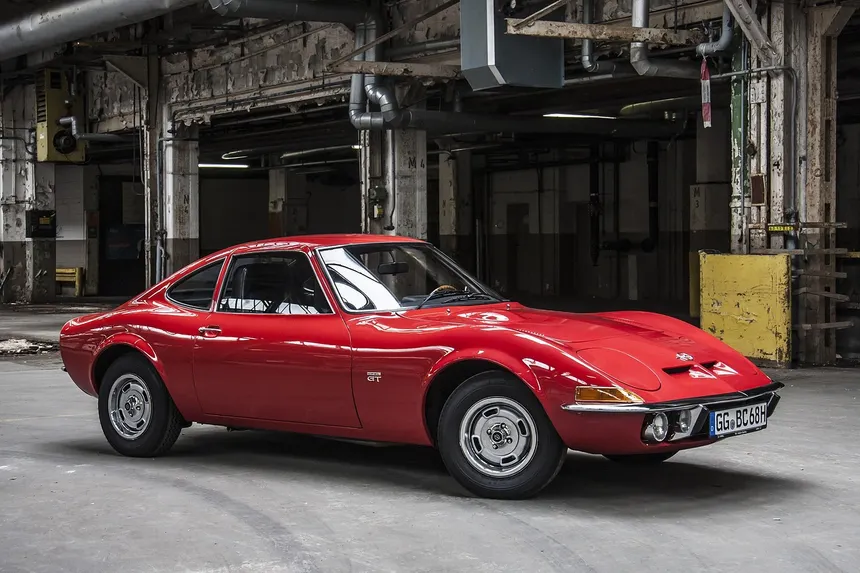
Opel GT: the baby Corvette that was never actually a copy
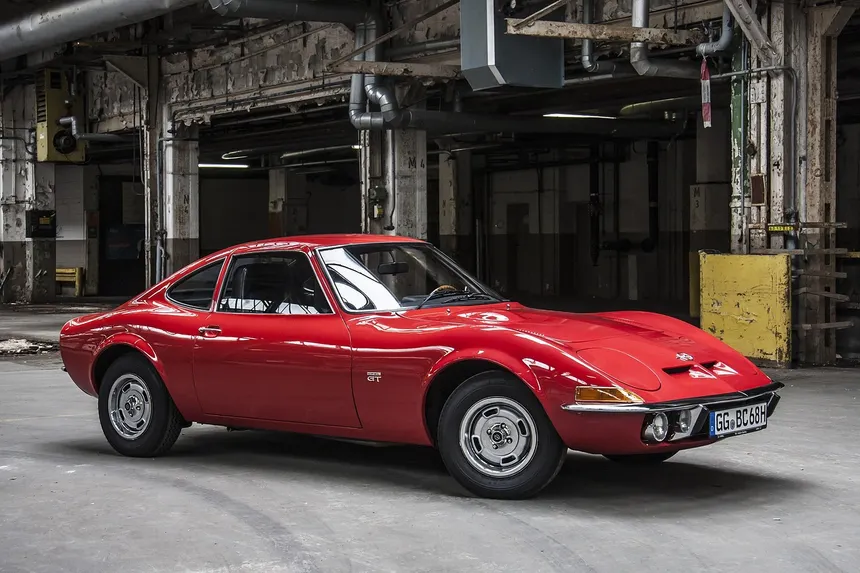
Everybody who clapped eyes on an Opel GT in 1968 thought the same thing: somebody shrank a Corvette. The nickname wrote itself. Mini-Vette. Baby Corvette. And for fifty years that lazy shorthand has buried the far better truth, which is that this little German two-seater was no imitation at all. It was the purest concept-to-production car Europe had ever built, rescued from mediocrity by a future Detroit legend who insisted on moving the engine sixteen inches, and along the way it broke speed records on electricity and diesel, won its class at the Targa Florio and got driven by a fictional secret agent. Pour a coffee. This one’s good.
A sports car Opel wasn’t supposed to build
Roll back to the early sixties. General Motors ships Clare MacKichan to Germany to drag Opel’s stuffy, provincial design studio into the modern age. The brief, in Chuck Jordan’s own words, was to make Opel “less of a German farmer’s car.”
Inside that freshly minted studio sat Erhard Schnell, a Frankfurt-born designer who’d been with Opel since the early fifties and who kept sketching gorgeous sports cars on the side. MacKichan gave him room to run. From autumn 1962, Schnell and a small crew started shaping clay and fibreglass models of a production sports car. The thing was so hush-hush it carried a code name, Projekt 1484, and senior management didn’t even lay eyes on it until well into 1963.
For a company that hadn’t built a sports car in forty years, this was close to heresy. Opel made solid, sensible, dull machines: Kadett, Rekord, Kapitän. Cars for serious men. Nobody expected a genuine sports car to crawl out of Rüsselsheim.
The concept the public refused to let die
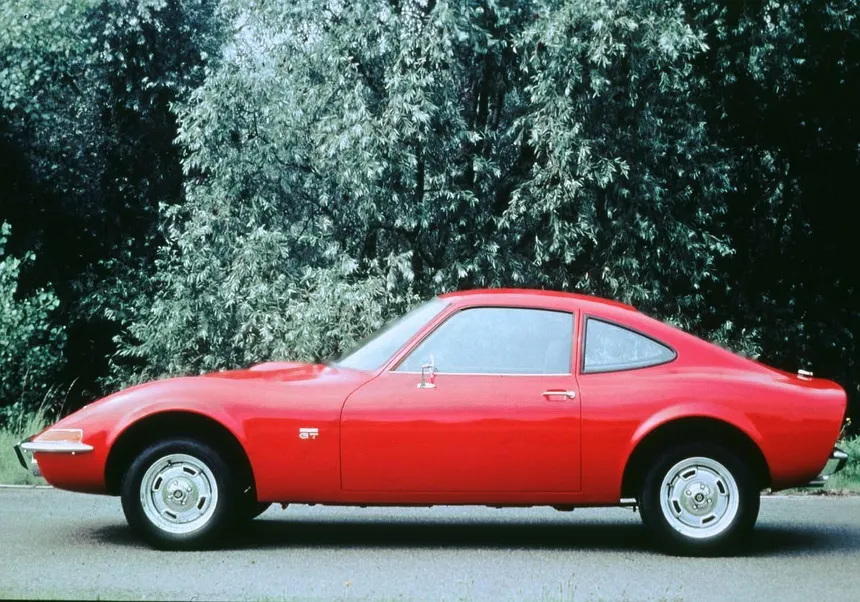
At the 1965 Frankfurt motor show, Opel pulled a stunt nobody had tried. It rolled out a full-size concept, the Experimental GT, without admitting it meant business. The crowd reaction was so feverish it rewrote the brand’s future.
Here’s the detail the textbooks fumble: the Opel GT was the first car in Europe to debut as a concept and reach production essentially unchanged. Today that’s routine. Show a prototype, gauge the reaction, build it. In 1965 it simply wasn’t done. Opel invented the playbook on this side of the Atlantic. Three years later, in 1968, the car hit the road.
And yes, let’s deal with the Corvette in the room. Everyone called it the baby Corvette. But the usual story runs backwards. The cliché says Opel copied the C3. Wrong. Both cars launched the same year, 1968, and both drew from the same GM concept, the Mako Shark II. This wasn’t a son copying his father. It was two brothers sharing one. The Opel GT wasn’t a late knock-off, it was a parallel creation from the same well. That’s the gap between parroting a cliché and telling the truth.
The call that saved the car
This next bit lands instantly with anyone who’s ever built a car, and it’s what turns the GT from a pretty styling exercise into a real driver’s machine.
To keep costs down, the GT rode on the humble Kadett B platform. So far, just another parts-bin coupé. The snag: Opel’s own engineers and bean-counters wanted the Kadett floorpan untouched, which left the engine sitting right over the front axle. That would have wrecked the car’s proportions and turned it into a nose-heavy understeering lump.
Enter Bob Lutz. Yes, that Bob Lutz, the Detroit legend, then a manager at Opel. Lutz and MacKichan dug in. Schnell’s 1965 show car had set the engine back nearly sixteen inches to give the nose that long, tapered line. They wanted the same in the production car.
To prove the point, they built two Kadett mules, one with the engine in stock position and one with it shoved back sixteen inches. Then they handed the keys to Porsche test driver Hans Herrmann and champion racer Eberhard Mahle. The verdict was unanimous: the set-back car was streets ahead. The engineers caved. The production GT went out with its engine relocated 15.75 inches behind the axle line.
The payoff? A front-mid-engine layout and 54/46 weight distribution. In a car based on an economy hatchback, that’s a small miracle. It’s the difference between the GT being a dressed-up Kadett and a proper sports car. Without Lutz fighting that corner, the GT would have been a beautiful failure. With it, the thing actually drove.
It’s worth explaining why those sixteen inches matter so much, because it’s the engineering heart of the whole tale. By pulling the engine’s mass toward the centre of the car, you bring the heaviest component closer to the middle. The result is a car that changes direction more eagerly, that doesn’t wash wide at the nose through a corner under the inertia of the block, and that spreads the workload more evenly across all four tyres. It’s the same principle that makes true mid-engined berlinettas feel magic, applied to a front-engined car at almost no cost. Against most of its contemporaries, which carried their weight over the front axle like any economy car, the GT felt planted, balanced and alive. Anyone who drove one back then got a surprise they never expected from a company like Opel: this thing moved like a car shaped by someone who understood dynamics, not by an accountant with a spreadsheet.
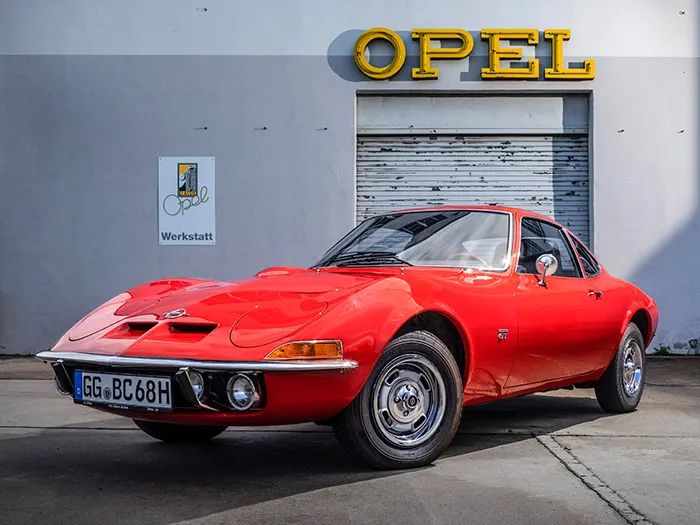
Headlamps you flipped by hand and a windscreen they sawed off
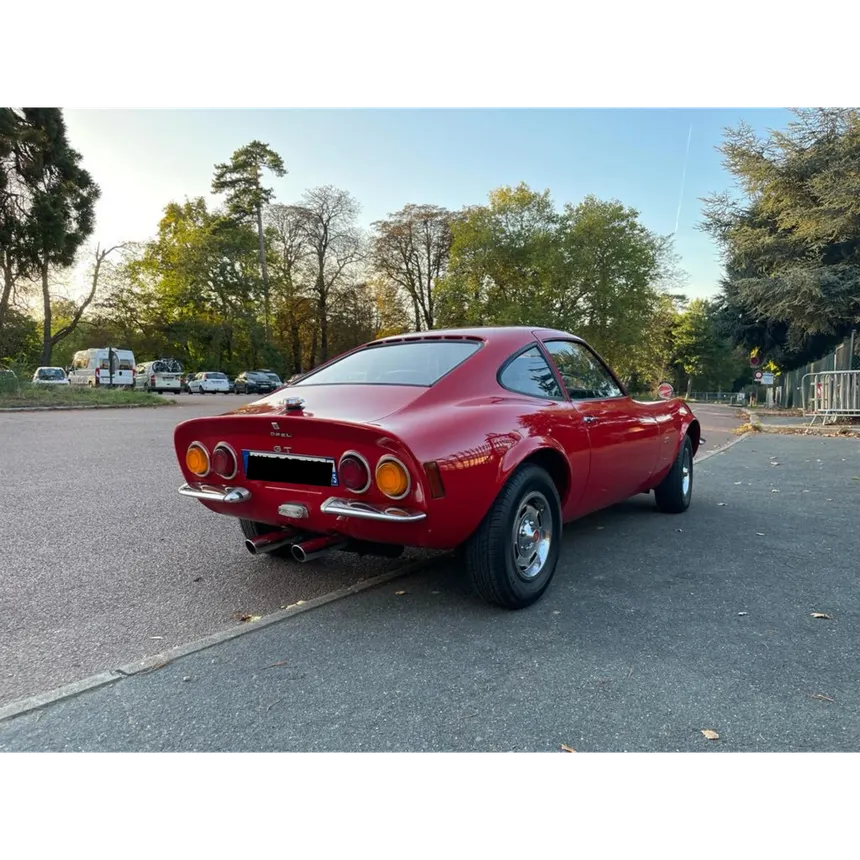
The GT was riddled with details that would give a modern safety engineer a coronary. The pop-up headlamps rotated on their long axis, but no motors did the work. You flipped them yourself, by hauling on a big lever in the centre console. Pull the lever, the lamps roll over. Pure mechanism, zero electronics.
The body had no boot lid. For rigidity, you loaded the luggage area from inside the cabin. The 1.9 engine was crammed in so tight that the bonnet needed a bulge, the famous “power dome,” which wasn’t decoration, it was there to clear the cylinder head.
Mechanically it was period-typical: a 1.1 making 67bhp, or the 1.9 making anywhere from 90 to 102bhp depending on market and year. Between 845 and 940kg. The 1.9 cracked 0-62mph in 10.8 seconds and nudged 115mph. For the late sixties, that saw off most things.
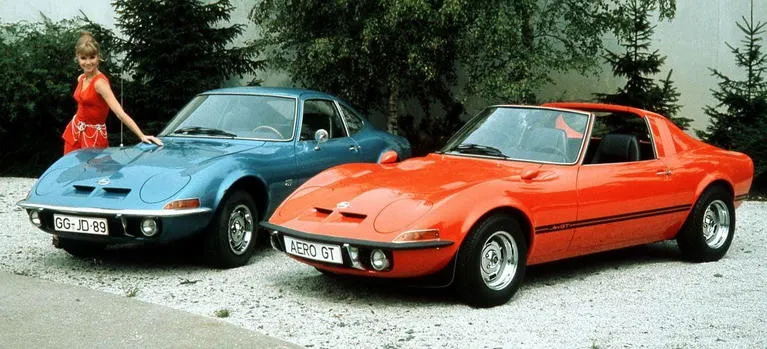
Speed records on electricity and diesel, half a century early
Now the part that’ll knock you sideways, because the GT lived a secret double life as a record car nobody remembers.
In May 1971, the founder’s grandson, Georg von Opel, took a GT and turned it electric. Not a toy: fighter-jet batteries packed into the cabin, two electric motors where the petrol four used to live, a rear spoiler. At Hockenheim he set four world records for electric cars at nearly 117mph. The attempt at 100km averaging over 62mph died at 44km when the nickel-cadmium batteries gave up. That was Opel’s first-ever electric car. The direct ancestor of today’s Corsa-e. In 1971, the very year Apollo 15’s crew were rolling around the Moon in an electric rover, an Opel was proving an EV could run like a sports car.
The following year, 1972, they did it again on diesel. A GT with reworked aero bodywork and a 2,068cc turbodiesel four. At Opel’s Dudenhofen proving ground it set twenty international records and hit 122mph, staggering for a diesel of the era. And here’s my favourite line in the whole saga, from Schnell himself, on how they got the body so low: “We didn’t have a big budget. So we took a car that was meant to be a convertible and simply cut the windscreen off.” That’s garage engineering at its finest. That’s doing a lot with nothing.
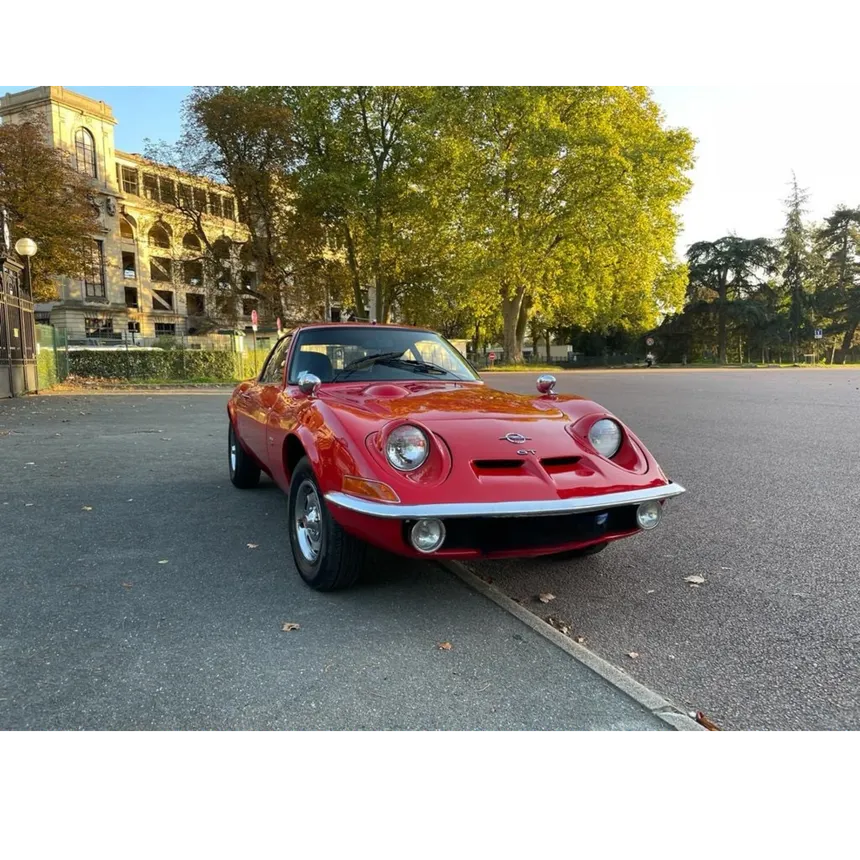
Italy, the Targa Florio and a secret agent
The GT raced, too, and here the Italian flavour kicks in. In 1970, Opel’s Italian dealers talked Turin tuner Virgilio Conrero, the wizard behind countless competition Alfas, into prepping the GT for Group 4. The Conrero cars ran ZF five-speeds, flared arches, wider wheels, upgraded suspension and engines bored to 1,979cc making around 185bhp. Their finest hour came at the 1971 Targa Florio, where a Conrero Squadra Corse GT driven by Salvatore Calascibetta and Paolo Monti won the under-two-litre GT class and finished ninth overall. A humble Opel scrapping at Sicily’s most mythical race. Not bad at all.
Consider what that result actually meant. The Targa Florio wasn’t a circuit race in the modern sense. It was a savage run across the mountain roads of the Madonie, the most dangerous and mythical event Italy ever staged, the same tarmac that made legends of Alfa Romeo, Porsche and Ferrari. To finish ninth overall there, in a car whose bones came from an economy Opel, tells you two things at once: that the base was far better than its reputation suggested, and that a great tuner’s hands could turn almost anything into a weapon. Conrero didn’t need a supercar. He needed a sound coupé and his own expertise, and the GT gave him exactly that. It’s the kind of unlikely result that never makes the history books, which is precisely why it belongs in this one.
And for the pop-culture file: the GT was Maxwell Smart’s car in the final season of Get Smart. A provincial German sports car turned American TV icon.
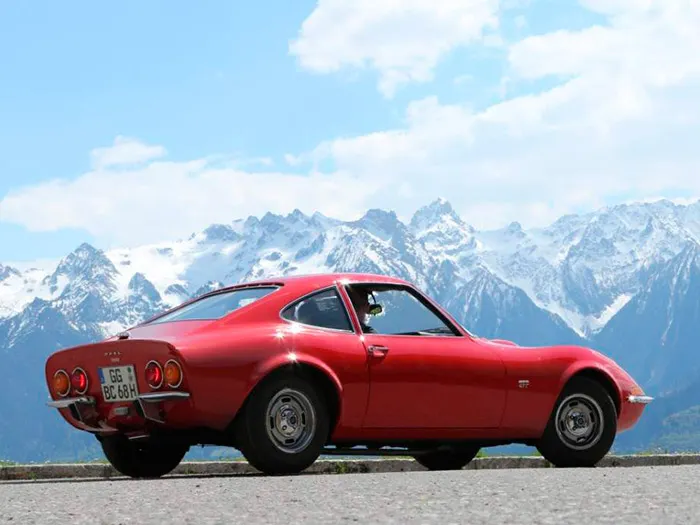
How its own brother killed it
The GT’s ending is the kind that only happens inside a family. Because the GT wasn’t killed by an outside rival. It was killed by the Opel Manta.
The Manta arrived in 1970 with everything the GT lacked: actual rear seats, better handling thanks to a new suspension with anti-roll bars at both ends, comparable performance and, crucially, a much lower price. Suddenly, inside Opel’s own showroom, the GT was the expensive impractical toy next to the sensible Manta. Even in Europe it was hard to argue for the GT over its sibling.
Circumstance did the rest. The 1973 oil crisis turned sports cars into an absurd luxury overnight. And the killer blow: Renault bought France’s Brissonneau & Lotz, who built the GT’s bodies, and the contract ended. Add the United States, its biggest market, demanding chunky safety bumpers that ruined the car’s lines, and it was too many fronts at once.
Production closed in August 1973. A total of 103,463 had been built, 85% exported, around 70,000 to the States alone, sold through Buick dealers because Opel had no network of its own there. Tellingly, the GT outsold Opel’s big saloons in America precisely because it looked like a Corvette. The world upside down once again.
The Opel GT was never the fastest or most powerful sports car of its day. It was something rarer and lovelier: proof that a maker of sensible cars could build a dream, that an economy car could hide a real sports car if someone fought to move the engine sixteen inches, and that with no budget and a sawn-off windscreen you could set world records. Only flying was more exciting. But only just.
Check you’re still alive.