
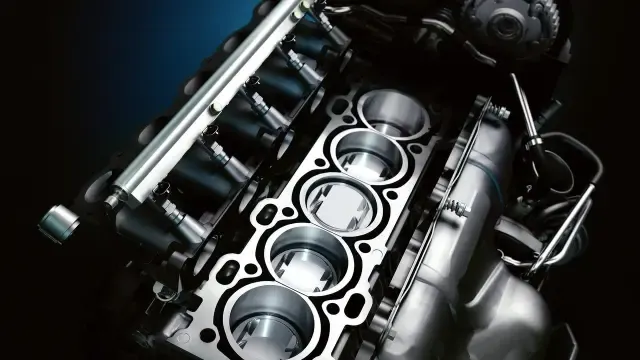
Volvo’s Five-Cylinder Engine: The Story of the Motor That Gave a Brand Its Soul
By Not Enough Cylinders

Some engines move cars. Others define entire brands for decades. Volvo’s five-cylinder is firmly in the second category. It wasn’t the most powerful, the most efficient, or the most refined engine of its era. But it was the most Volvo engine that ever existed. And in the automotive world, that’s worth more than any figure in a brochure.
This is the story of how Sweden decided to ignore the conventions of the four-cylinder and the straight-six, and take a road almost nobody else wanted to travel.
The Project That Changed Everything: The Volvo Modular Engine
To understand Volvo’s five-cylinder, you first need to understand the project that created it. In the late 1970s, Volvo internally launched what was called Project Galaxy: the development of a completely new family of modular engines that would share architecture, components, and manufacturing lines across different cylinder configurations.
The concept was as ambitious as it was pragmatic: design an aluminium DOHC 20-valve block from which they could manufacture four, five, and six-cylinder engines sharing up to 70-80% of components. Same pistons, same camshafts, same engine management. The manufacturing savings and lineup flexibility were enormous.
Project Galaxy’s first result arrived in 1990: the six-cylinder B6304F, which debuted in the Volvo 960. One year later, in June 1991, with the launch of the Volvo 850, the first five-cylinder of the family arrived: the B5254F.
It wasn’t a four-cylinder with an extra piston bolted on. It was a new all-aluminium block engine, dual overhead camshafts, 20 valves, designed from scratch as part of a modular family. First-class industrial engineering.
Why Five Cylinders. Why Not Four. Why Not Six.
The logic of internal combustion engines has always followed very defined paths: four cylinders for ordinary people, six for those who want something more, eight for those who can’t get enough of six. Five cylinders didn’t fit into any slot. It was odd. Literally odd.
And yet Volvo arrived at that configuration through very concrete reasoning.
Project Galaxy sought a complete lineup that could serve from entry-level models to premium flagships. A four-cylinder for volume, a five for the premium middle ground, a six for the luxury saloon. All three sharing architecture. The choice of five wasn’t a whim: it was the natural step between four and six within a modular family designed to share manufacturing costs to the maximum.
The result was that Volvo had, for approximately the same development cost, three completely different engines in displacement and character, with an enormously efficient production chain.
The Sound. That Damn Sound That Changes Everything.
If you’ve ever started a Volvo five-cylinder and not felt goosebumps, either you don’t have ears or you don’t have a soul. Probably both.
The physics of a straight five produces an asymmetric firing sequence. The cylinders don’t fire at equal intervals like a four or a six. The result is a sound with an irregular, almost syncopated rhythm — something organic, alive, that more “perfect” engines simply don’t have.
It’s the same principle by which certain jazz musicians sound more interesting than a perfectly tuned symphony orchestra. Controlled imperfection has its own beauty.
Audi understood this too — the 2.5 five-cylinder turbo is another iconic case — but Volvo got there first with a five-cylinder in an accessible D-segment saloon. An 850 T-5 with 225hp and that irregular growl coming out of the exhaust was, and remains, an experience that has no price.
The Timeline
1990 — Project Galaxy’s first fruit The six-cylinder B6304F debuts in the Volvo 960. First engine of the Modular Engine family. The five-cylinder follows one year later.
1991 — The B5254F: the first five-cylinder With the launch of the Volvo 850 in June 1991 comes the first Volvo five-cylinder in production. Aluminium block, DOHC, 20 valves, 2.4 litres, 170hp naturally aspirated. Equipped with Volvo’s V-VIS (Variable Intake System) to improve response between 1,500 and 4,100rpm. Proof that Project Galaxy had worked.
1993 — The B5234T: the turbo arrives In December 1993 the 850 T-5 is presented with the B5234T: 2.3 litres, turbocharged, 225hp at 5,200rpm, 300Nm from 2,000rpm. Among the fastest front-wheel drive saloons of its time. A 225hp front-wheel drive Volvo in 1993 was the last thing anyone expected from the brand. It was exactly the opposite of what was expected from Volvo.
1994 — The 850 T-5R: 240hp limited edition The T-5R carried the same block with an overboost function raising power to 240hp. Available in yellow or black with sport interiors. 5,000 units total. One of the most brutal Q-cars of the nineties.
1994-1996 — The BTCC and the estate car madness Tom Walkinshaw Racing enters an 850 Estate — a wagon, a grocery-getter — into the British Touring Car Championship. The competition five-cylinder turbo produced over 300hp. The image of that white estate with wings overtaking BMWs is one of the great moments of European motorsport in the nineties.
1998 — The RN family: second generation With the 1999 S80 comes the Revised N (RN) family. The five-cylinders evolve with variable valve timing, improved engine management and greater efficiency. The modular architecture remains the foundation.
2003-2007 — The B5254T4: the S60R and V70R 300hp, KKK K24 high-pressure turbo, twin intercoolers and Haldex AWD. The most sporting Volvo in history to that date. 0-100 in under 5.5 seconds in a Swedish estate.
2016 — End of production The last series-production car with a five-cylinder was the V70 T5 AWD of 2016. 25 years after the first B5254F in the 850. A family of engines that powered the 850, S70, V70, C70, S60, S60R, V70R, first-generation XC90 and dozens more variants.
The Most Important Volvo Five-Cylinders in History
Volvo 850 T-5 (1993-1997) The one that changed everything. A front-wheel-drive family saloon with the 2.3-litre turbocharged B5234T producing 225hp. It shattered all expectations of what Volvo was supposed to be.
Volvo 850 T-5R (1994-1995) 240hp with overboost, yellow or black sport interiors. 5,000 units. One of the most brutal Q-cars of the nineties.
Volvo C70 T5 (1997-2005) The five-cylinder in coupé and convertible body. Perhaps the best-looking Volvo of its generation.
Volvo S60R / V70R (2003-2007) 300hp, Haldex AWD, B5254T4 with high-pressure turbo and twin intercoolers. The most sporting Volvo in history to that date.
Volvo XC90 T6 (2002-2014) Five-cylinder turbo plus supercharger in T6 versions. 272hp in a seven-seat SUV.
Why It Disappeared and Why That Matters
Volvo’s Drive-E four-cylinders are well-engineered units. The T8 Twin Engine is impressive on paper. But something was lost with the five-cylinder that goes beyond technical specifications.
Engines with their own character are the ones that build owner communities. They’re the ones that make people talk about their car in almost affectionate terms. Volvo’s five-cylinder had that. It had a voice.
An engine isn’t just a means of propulsion. It’s the part of the car that communicates most directly with the driver — through the steering wheel, the pedals, and the sound. When that component has personality, the car has personality. When you lose it in the name of efficiency, the car might be better on paper but harder to love.
The Legacy Lives in the Used Market
The good news is that Volvo five-cylinders are practically immortal with proper maintenance. A well-maintained B5254 can reach extraordinary mileages with documented reliability. There are records of engines exceeding 500,000 kilometres without rebuild.
The classic market for nineties and early 2000s Volvos is in full bloom. A good-condition 850 T-5 already exceeds €10,000 without difficulty. The first-generation S60R is beginning to trade as a collector’s piece.
People don’t pay that for the safety. They pay it for the engine. For that sound.
Conclusion: The Engine Volvo Shouldn’t Have Abandoned
Technically, Volvo’s decision to move to four cylinders made sense. Emissions regulations, market electrification, CO2 targets… everything pointed in that direction.
But there are brands that have found ways to maintain their sonic identity even through the transition to electrification. There are engines that are technical heritage as much as exterior designs. And Volvo’s five-cylinder was exactly that: not just an engine, but the acoustic signature of an entire brand for twenty-five years.
Sweden lost one of its strongest selling points the day it shut off the last series-production five-cylinder. And it did so without almost anyone noticing.
Until you start one. And then you understand everything.
Do you own or have you owned a Volvo five-cylinder? Which version is your favourite? Tell us in the comments.
If you enjoyed this article, don’t miss our Swedish universe series: SAAB 900 Turbo , Why Swedes design such strange cars, Koenigsegg: the third Swede nobody mentions.
3 thoughts on “VOLVO FIVE-CYLINDER”