
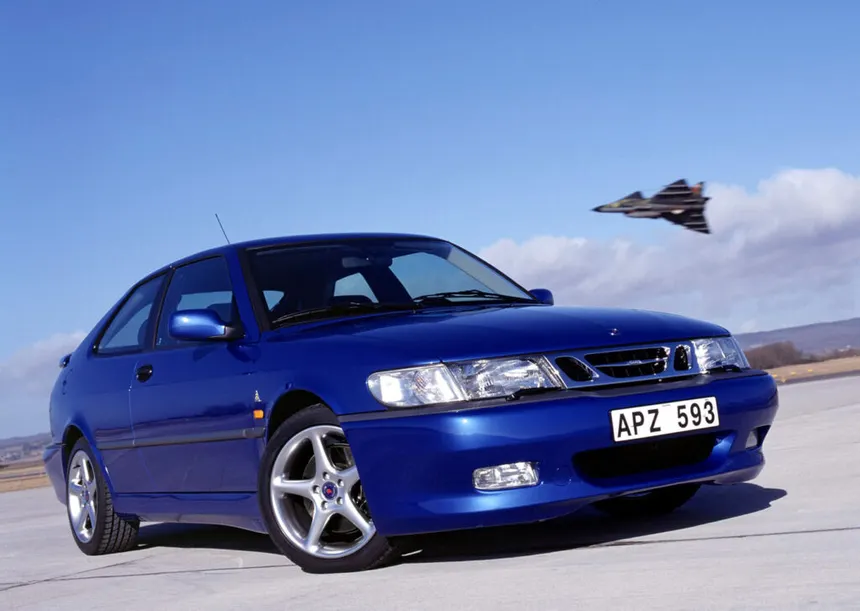
SAAB 9-3 Viggen: The Last Scream Before the Abyss
By Not Enough Cylinders
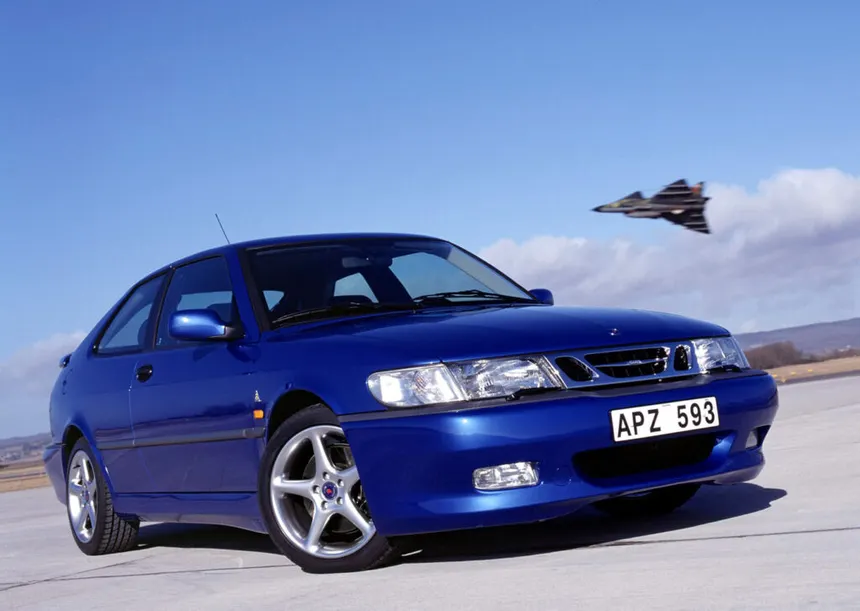
Some cars arrive at the wrong moment. Some cars arrive when the company building them already has one foot over the edge. And some cars do both at once, with such intensity that forty years later they’re still impossible to ignore.
The SAAB 9-3 Viggen is all three.
It arrived in 1998. SAAB had been under GM’s partial guardianship for nine years. The brand was already losing definition. The cars were starting to look less like SAABs and more like Opels with pretensions. And then, as if Trollhättan’s engineers had decided to make one last exercise in radical honesty before being put on a leash, the Viggen appeared.
Viggen. The name of Sweden’s supersonic fighter jet. The SAAB 37 Viggen, one of the most advanced military aircraft of the 1970s. Not a coincidence. A declaration of intent.
What the Viggen Was and Why It Matters
The 9-3 Viggen was the high-performance version of the first-generation 9-3 — itself the successor to the 900. Three-door hatchback body. Two-litre turbocharged engine. And here’s where it gets interesting.
230hp. Front-wheel drive. No traction control.
Read that again. 230 horsepower. Everything going to the front wheels. Nothing helping you manage the chaos when you open the throttle mid-corner.
In 1998, that was a declaration of war on the physics of vehicle dynamics.
SAAB’s engineers had worked the chassis with an intensity not seen from the brand since the original 900 Turbo. The Torsen limited-slip differential was fundamental: it could distribute torque more intelligently between the front wheels, reducing the endemic understeer of high-powered front-wheel-drive vehicles. The Sachs dampers were specifically calibrated. The steering was direct to the point of feeling like the car wanted to tell you something personal through every bend.
The engine: the B235R. A two-litre four-cylinder with a fast-spooling Mitsubishi turbo and Trionic 7 engine management that was, at the time, one of the most advanced control systems in a production saloon. It produced its peak torque — 350Nm — at just 2,500rpm. The thrust was brutal, immediate, with almost no lag.
0-100km/h in 6.3 seconds. Top speed electronically limited to 250km/h. In 1998, with front-wheel drive, those numbers were a direct provocation to Audi, BMW, and anyone who thought you needed rear or all-wheel drive to go fast.
The Understeer Controversy: The Elephant in the Room
It would be dishonest not to address this.
The Viggen was hard to drive. Intentionally hard. The level of torque it sent to the front wheels when you opened the throttle mid-corner generated an outward pull that demanded active correction from the driver. If you were good, the car rewarded you with surprising agility. If you weren’t good, the Viggen made it very clear, very quickly, that you weren’t good.
The specialist press of the era was divided. Those coming from a motorsport background — used to managing cars that ask something of the driver — loved it. Those looking for a fast, comfortable GT found it exhausting under committed driving.
That division of opinion was, in retrospect, perfectly coherent with SAAB’s philosophy: we don’t make cars for everyone. We make cars for those who want more than transport.
The Production: Scarce, Deliberate, Almost Secret
SAAB built the Viggen only for the North American, Swedish, and UK markets. It didn’t reach many other markets officially. A total of 4,600 units were built across all versions: 764 three-doors, 863 five-doors, and 1,305 convertibles.
That scarcity wasn’t a mistake. It was a decision.
The Viggen was an engineering exercise showing what SAAB could do when it set its mind to it. It wasn’t a mass-market product. It was a manifesto with a number plate.
And like all good manifestos, it wasn’t understood by enough people at the time. Now, with the perspective of years, it’s exactly the kind of car people pay to own — not because it’s practical, but because it’s authentic.
The Name: More Than Marketing
It deserves its own paragraph because the choice of “Viggen” wasn’t accidental or cheap marketing.
The SAAB 37 Viggen was the multi-role fighter Sweden developed in the 1960s-70s for its Air Force. It was an aircraft designed to operate from ordinary roads in the event of conflict — the Swedes, with their characteristic Nordic pragmatism, planned for the scenario where airfields would be the first targets in war. The Viggen could take off and land in 500 metres of straight motorway.
It was an aircraft that took the conventional limits of what was considered possible and ignored them.
Exactly what the 9-3 Viggen attempted to do with the conventional limits of front-wheel drive.
The connection between the aviation brand and the automotive brand — which shared the same name but were separate companies — was an identity thread that GM never fully understood, and whose disappearance left SAAB without part of its DNA.
Viggen vs the Competition: The 1998 Context
To understand how radical the Viggen was, you need to place it in its era.
In 1998, if you wanted 230hp in a car you could buy at a normal dealer, your options were:
BMW M3 E36: 321hp, rear-wheel drive, straight-six. More powerful, more refined, more expensive, more conventional in its dynamic approach.
Audi S4 B5: 265hp, quattro, 2.7-litre twin-turbo V6. The segment reference for all-wheel-drive traction. Safe, fast, effective, but without the Viggen’s edge.
Honda Integra Type R: 190hp, front-wheel drive, naturally aspirated. The benchmark for high-performance front-wheel-drive handling. Sharper on track, less torque, less road presence.
The Viggen positioned itself in a strange space: more powerful than the Type R, more accessible than the M3, more dynamically risky than the S4, with an identity none of the three had.
It wasn’t the best in any individual category. It was the most interesting in all of them.
The Viggen’s End and What Came After
The Viggen had a short life. It was available at dealers from mid-1999 until 2002. When the second-generation 9-3 arrived in 2002 — now on the Epsilon platform shared with Opel — there was no Viggen. There was an Aero with 210hp that was a competent, well-made car that any GM group brand could have built.
The Viggen’s spirit had no heir.
The 9-3 Viggen was the last SAAB that truly behaved like a SAAB in the deepest sense of the word: a car designed by engineers who had decided to ignore conventions not because they were rebels without cause, but because they had solid technical reasons for every unconventional decision.
After it came better cars according to standard metrics. But they weren’t real SAABs anymore.
The Current Market: The Viggen as Cult Object
The production scarcity and project authenticity have done what they always do with special cars that didn’t sell enough in their time: turned the Viggen into a growing object of desire.
A Viggen in good condition — properly maintained, no accidents, documented history — can reach €20,000-25,000 in the current European market. Ten years ago they were selling for half that.
Viggen owners form one of those enthusiast communities where technical knowledge is high and emotional attachment to the car is completely disproportionate in the best possible sense. There are active forums. Specialist workshops. Parts networks.
The car GM couldn’t understand, the used market is rediscovering. With the usual time delay the market applies to everything that was too interesting for its era.
Conclusion: The Scream Nobody Heard
The SAAB 9-3 Viggen was the last moment SAAB spoke with its own voice, without corporate filters, without shared-platform compromises, without the background music of Detroit’s accountants.
It was a difficult car. It was a scarce car. It was a car that demanded something from the driver to give its best.
It was, in short, exactly what SAAB had always been.
And nobody at GM listened.
Four years after the Viggen, the Epsilon platform. Four years after that, the 9-7X on a Chevrolet chassis. And nine years after the Viggen, bankruptcy.
The Viggen wasn’t a warning sign. It was a final scream.
That arrived too late to change anything, and too early for enough people to understand it.
Did you know about the Viggen? Did you ever drive one? Tell us in the comments.
Full Swedish universe series: Volvo’s Five-Cylinder Engine | SAAB 900 Turbo and Who Killed SAAB | Why Swedes Design Such Strange Cars | Koenigsegg: The Third Swede Nobody Mentions
1 thought on “SAAB 9-3 VIGGEN”