VOLKSWAGEN GOLF RALLYE G60 (1989–1991)
Volkswagen Golf Rallye G60: The Most Radical Golf That Never Won a Rally (And Became a Legend Anyway)
Some cars are born with a specific purpose and die without ever fulfilling it. The Volkswagen Golf Rallye G60 is, in a sense, exactly one of those cars. It was conceived to compete in the World Rally Championship under Group A regulations, designed to challenge the Lancia Delta HF Integrale, the Ford Sierra RS Cosworth, and the Toyota Celica. And yet, the Golf Rallye never won in the WRC. It failed as a rally car. But it became a road car legend.
There is something poetically just about that.
The Context: The Group A Wars
In the late 1980s, the WRC was experiencing one of its most competitive periods. Group A regulations required manufacturers to build at least 2,500 road-going versions of any car they wanted to homologate for competition. Volkswagen, which until that point had used the Golf GTI as the basis for its rally efforts with moderate success, decided to escalate with something far more serious.
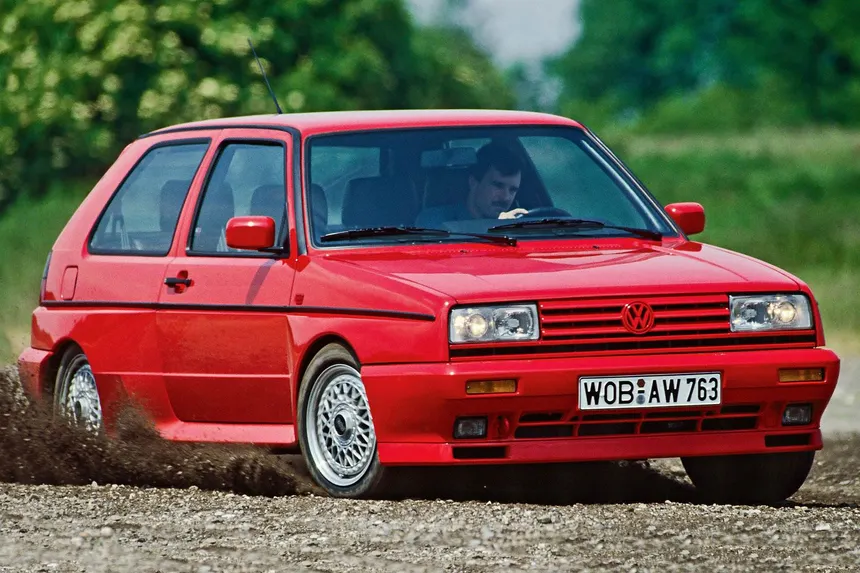
The answer was the Golf Rallye G60, unveiled at the start of 1989 as the most exclusive and expensive model in the entire Golf II lineup. Its launch price in Germany was 46,500 Deutschmarks — almost exactly double that of a Golf GTI at the same time. To validate the Group A homologation, Volkswagen needed to produce exactly 5,000 units. So that is precisely what was built, mostly by hand at the Forest plant in Belgium, between 1989 and 1991.
Technology: The G60 Supercharger and Syncro AWD
The technical centrepiece of the Golf Rallye was the G60 volumetric supercharger, a forced induction system developed by Volkswagen that used a distinctive spiral-shaped rotor — hence the G designation, from “Spiralader” in German — rather than a conventional vane-style rotor. This supercharger, applied to the 1,763 cc eight-valve engine carried over from the Golf GTI, pushed power to 160 bhp at 5,600 rpm, with a peak torque of 225 Nm.
Drive was delivered to all four wheels via Syncro all-wheel drive, developed in collaboration with Steyr-Daimler-Puch, using a viscous coupling to distribute torque between axles according to traction requirements. The combination of the G60 supercharger and four-wheel drive was the technical soul of the Rallye, and set it apart from every other Golf variant available at the time.
The Golf Rallye also sat 20 mm lower than the standard GTI, featured disc brakes on all four corners — while the GTI still used rear drums — and rolled on BBS 6.5J x 15-inch alloy wheels. The power-to-weight ratio was not spectacular on paper — the car weighed approximately 1,200 kg — but the all-wheel drive system compensated tremendously in wet and low-grip conditions.
Claimed top speed was 209 km/h (130 mph), and the 0 to 100 km/h sprint took 8.6 seconds. Figures that might seem modest today, but in 1989 they placed the Golf Rallye ahead of the vast majority of its direct rivals.
The Look: Pure Visual Aggression
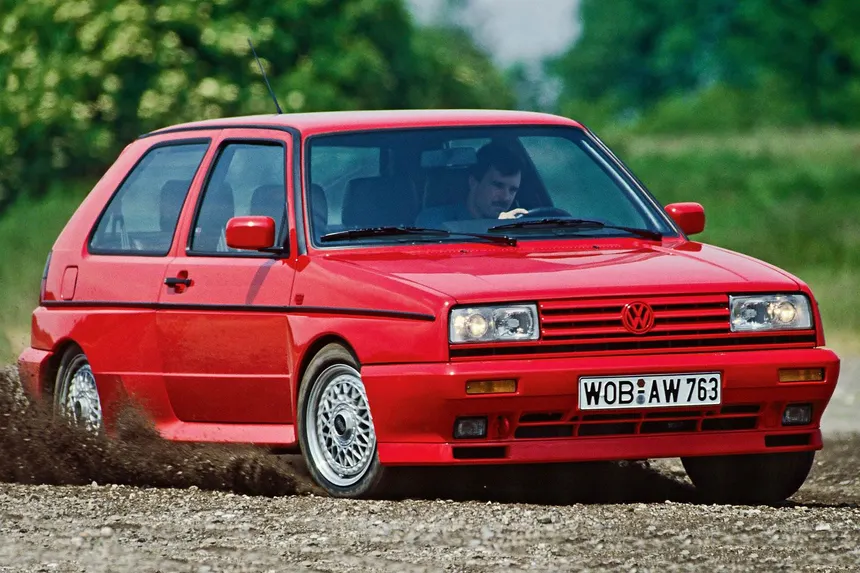
The Golf Rallye G60 was unmistakable. While the standard Golf II used its characteristic round headlights, the Rallye adopted rectangular headlights borrowed from its cousin the Jetta, giving the nose an entirely different personality. The widened wheel arches — directly inspired by the Audi Quattro rally car — added visual muscle to the silhouette, complemented by specific front and rear bumpers, side sill extensions, and G60 badges on the front wings.
It was a Golf. But no one would ever mistake it for a standard Golf.
Inside, Recaro seats with red “Rallye” embroidery and a specific instrument cluster completed a sporting atmosphere that partially justified the model’s stratospheric price tag.
Rally Failure and the Version Nobody Knows About
Volkswagen Motorsport entered the WRC in 1990 and 1991 with the Golf Rallye as its primary weapon. The results were disappointing: the best result achieved was a third place on the 1990 Rally New Zealand. The limitations of the G60 supercharger’s rev range, the reliability of the Syncro system under extreme conditions, and the technical inferiority compared to Lancia’s Delta Integrale made it clear that the Golf Rallye was a superb road car but not a serious threat to the specialists of the era.
Volkswagen withdrew its official WRC participation at the end of the 1990 season. The Rallye’s story as a competition car was over.
But there is a chapter of this story that very few people know. Volkswagen Motorsport hand-built, at its Hanover headquarters, 12 special Golf Rallye units fitted with the G60 engine equipped with the 16-valve cylinder head, raising power to 210 bhp. These cars — reaching 235 km/h and improving the 0 to 100 km/h time by approximately one second compared to the standard Rallye — were originally built for private competition teams, but ultimately never competed in rally. They are, to this day, arguably the most exclusive Golf IIs in existence.
The Golf G60 Limited: 71 Units of Pure Discretion
Running in parallel to the Rallye, also in 1989, Volkswagen Motorsport hand-built 71 examples of the Golf G60 Limited, combining the 16-valve G60 engine — rated at 207 bhp in production specification — with Syncro all-wheel drive, every luxury option available on the Golf II (leather interior, sunroof, ABS, electric windows, power steering) and BBS RM012 alloy wheels. Unlike the Rallye, the Limited had no body kit and no widened arches. Externally it was almost indistinguishable from a standard Golf GTI — making it the ultimate wolf in sheep’s clothing of its era. Top speed reached 229 km/h.
Rumour has it that the majority of those 71 units ended up in the private garages of Volkswagen executives.
Thirty Years Later: The Golf Rallye as a Classic Investment
The Golf Rallye G60 is today one of the most sought-after Golfs on the modern classic market. Its limited production — 5,000 units for all of Europe, many of them in poor condition after decades of use — makes it a genuine rarity. Well-documented examples in good condition now command prices that in some markets exceed 40,000 euros, figures that would have seemed absurd fifteen years ago.
That is historical justice for a car born to win, that ended up losing on the stage but winning on the roads of Europe for thirty years.
Conclusion (With Bite)
The Golf Rallye G60 was the first car to carry the Volkswagen Motorsport badge to the road in any significant volume — “significant” here meaning all of 5,000 units — and laid the conceptual groundwork for what would eventually become the Golf R family. Without the Rallye, the R32, the Golf R, and the entire tradition of high-performance all-wheel-drive Golfs probably would not exist.
The fact that the car never won a rally can be seen as failure. Or it can be seen as the necessary sacrifice to build a road legend that endures to this day. The problem is that in the automotive industry, people remember winners. And the Golf Rallye was a spectacular loser that everyone should know far better than they do.