Chevrolet Monte Carlo: The Luxury Coupe That Became NASCAR’s Most Winning War Machine

There are cars that are born with one purpose and die fulfilling a completely different one. The Chevrolet Monte Carlo is the most extreme example of that paradox in the entire history of the American automobile.
It was born in 1970 as a personal luxury coupe. A car for gentlemen who wanted Cadillac elegance without the size or the price tag. Faux wood trim everywhere. Vinyl interior. Big but civilized engines. The antithesis of a race car.
And yet, the Monte Carlo accumulated 396 victories in the NASCAR Cup Series. It contributed to 24 of Chevrolet’s 31 manufacturer’s championships. It served as the platform for 16 of the 23 driver’s championships won by Chevrolet pilots. It was the car Dale Earnhardt drove during his era of dominance. It was the car Jeff Gordon piloted to change NASCAR forever.
396 wins. From 1971 to 2007. Thirty-six consecutive years as a front-line weapon in the toughest competition in American motorsport.
If there’s one car that embodies the modern history of NASCAR, it’s not a muscle car from the aero era or a laboratory prototype. It’s a middle-class luxury coupe that somebody decided to throw around an oval at 190 mph.
1970: A Luxury Coupe, Not a Race Car
The Chevrolet Monte Carlo debuted in 1970 as an answer to the Ford Thunderbird and Pontiac Grand Prix. General Motors had established a unified wheelbase policy for its intermediate platforms, and Chevrolet saw an opportunity: take the Chevelle platform, stretch the nose four inches for more elegant proportions, and dress it with an interior that suggested luxury without the price of a Buick.
The result was an immediate success. Chevrolet sold 145,975 units in the first year. The Monte Carlo found its audience: buyers who wanted a handsome, comfortable, and relatively affordable car. It wasn’t fast. It wasn’t trying to be. The SS 454 model existed briefly with a 7.4-liter V8, but it was an anomaly that disappeared in 1971 with emissions regulations.
Nobody looked at the Monte Carlo and thought about NASCAR.
1971: Chevrolet Returns to Racing
But in General Motors’ boardrooms, something was changing. Chevrolet had officially abandoned racing in 1963, under federal pressure due to its market dominance and antitrust concerns. For eight years, America’s best-selling brand was absent from the country’s most important racing series.
In 1971, Chevrolet wanted back in. And the vehicle they chose was the Monte Carlo. Not because it was the most aerodynamic or the fastest. But because it was the two-door coupe they had in production that met NASCAR’s homologation requirements.
Junior Johnson — racing legend, former moonshine runner, and one of the shrewdest owners in history — prepared a Monte Carlo with a 427 engine for Charlie Glotzbach. On July 11, 1971, Glotzbach won the Volunteer 500 at Bristol, Chevrolet’s first NASCAR victory after years of self-imposed exile. Glotzbach and his relief driver, Friday Hassler, dominated the race, beating second-place Bobby Allison and third-place Richard Petty by three full laps.
That victory was the first of the 396 the Monte Carlo would accumulate over the next three and a half decades.
The Third Generation (1978-1988): Where Everything Changed
The Monte Carlo went through several incarnations. The second generation (1973-1977) adopted the “Colonnade” style with fixed rear windows and federal crash-protection requirements. It was bigger, heavier, and less elegant.
But it was the third generation, built on the G-body platform from 1978, that transformed the Monte Carlo from an anonymous coupe into NASCAR’s most feared war machine.
The downsizing was radical: a foot shorter and 800 pounds lighter than its predecessor. The new silhouette was compact, aerodynamically efficient, and perfect for high-speed tracks. On the street, it was a modest car with a 3.8-liter V6 as its base engine. On the track, it was a monster.
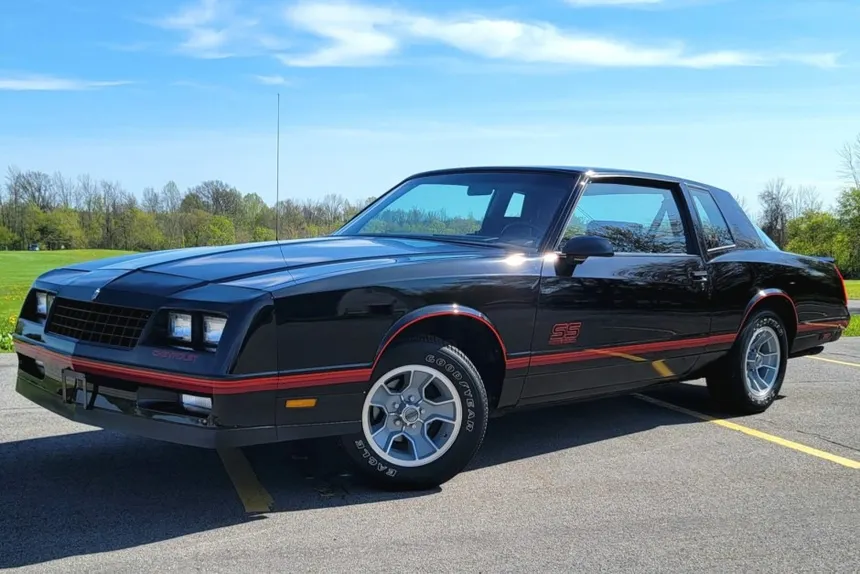
In 1983, Chevrolet revived the SS badge for the Monte Carlo. The street package included a 305 cubic-inch High Output V8 with 190 horsepower, sport suspension, and distinctive exterior graphics. Only 4,714 SS units were built in 1983. But the real impact was in competition.
NASCAR Monte Carlos carried 358 cubic-inch engines generating over 450 horsepower. Bodies were modified with functional air dams, rear spoilers, and window configurations optimized for competition. Between 1981 and 1988, Monte Carlo drivers accumulated 47 Cup Series wins and three manufacturer’s championships.
1986-1987: The Aerocoupe and the Thunderbird Response
By the mid-’80s, Ford was winning the aerodynamic war with the Thunderbird, whose more rounded design cut through the air better than the Monte Carlo. Chevrolet responded with one of the most interesting homologation specials in history: the Monte Carlo SS Aerocoupe.
The modification was simple but effective: a curved, more steeply angled rear window that significantly improved aerodynamics, especially on superspeedways. Cars & Concepts, in Michigan, handled the conversion. In 1986, only 200 units were built, all in white with burgundy interior. In 1987, production expanded to 6,052 Aerocoupes out of a total of 33,199 Monte Carlo SS models.
Dale Earnhardt piloted the Monte Carlo SS Aerocoupe during his 1987 championship campaign — the season of 11 victories. The race version was radically different from the street car, but homologation required they share the basic silhouette.
The Earnhardt Era: The Black Number 3
The Monte Carlo and Dale Earnhardt are inseparable in NASCAR’s collective memory. The black GM Goodwrench No. 3 Chevrolet, prepared by Richard Childress Racing, dominated the Cup Series for over a decade.
Earnhardt won six of his seven championships driving Monte Carlo variants (1986, 1987, 1990, 1991, 1993, 1994). His aggressive, intimidating style found the perfect partner in a car that was tough, reliable, and competitive on every type of track.
When Chevrolet briefly replaced the Monte Carlo with the Lumina between 1989 and 1994 in the Cup Series, Earnhardt kept winning championships, but Chevy fans never fully accepted the Lumina as a replacement. When the Monte Carlo returned to competition in the mid-’90s, it was welcomed home like a returning hero.
The Gordon Era: The Rainbow Takes Over
Jeff Gordon never drove a third-generation Monte Carlo in competition. But the fourth and fifth generation Monte Carlo (redesigned for the street in 1995 as a front-wheel-drive car with a V6 engine) was his weapon on the track during his most dominant years.
The contrast was absurd and defining of what NASCAR had become: the street Monte Carlo was a front-wheel-drive coupe with 200 horsepower. The race version was rear-wheel-drive with over 700 horsepower and wind-tunnel-designed fiberglass body panels. They shared the name. They vaguely shared a silhouette. Nothing else.
Gordon piloted Monte Carlos painted in the DuPont rainbow scheme to all 93 of his victories. The car was the platform on which he built four championships and transformed NASCAR into a mainstream sport.
2007: The End of an Era
The Monte Carlo raced its final Cup Series season in 2007, after 36 years of virtually uninterrupted competition. It was replaced by the Chevrolet Impala SS starting in 2008.
The final tally is staggering: 396 Cup Series wins. More than any other model in NASCAR history. 24 manufacturer’s championships. 16 driver’s championships. Six generations of road car. Four generations of race car. From a personal luxury coupe to the most successful war machine in American stock car history.
Chevrolet Monte Carlo in NASCAR: The Numbers
The record: 396 NASCAR Cup Series wins (record by model). First win: Charlie Glotzbach, Bristol, July 11, 1971. Final season: 2007. Contributed to 24 of Chevrolet’s 31 manufacturer’s championships. 16 of 23 Chevrolet driver’s titles were won in Monte Carlos. Champion drivers include: Dale Earnhardt (6 titles), Jeff Gordon (4 titles), Terry Labonte (1 title), among others. Generations in competition: 1st (1971-1972), 3rd (1981-1988), variants (1995-2007). Special homologations: SS (1983), Aerocoupe (1986-1987). Total civilian production: over 4.7 million units (1970-2007).
My Final Word
The Chevrolet Monte Carlo is the definitive proof that NASCAR stopped being a “stock car” sport a very, very long time ago.
A street car with front-wheel drive and a V6 engine has absolutely nothing in common with a rear-wheel-drive race car running a 700-horsepower V8. They shared a name and an approximate silhouette. Period. The relationship between the street Monte Carlo and the competition version was purely cosmetic — a fiction that NASCAR maintained because the illusion of “stock” sold tickets and justified marketing agreements with manufacturers.
And here’s the part that drives me insane as a mechanic: everyone knows it. The fans know it. The teams know it. NASCAR knows it. The manufacturers know it. But nobody says anything because the fiction works too well commercially to admit the truth.
The truth is that the last truly “stock” car that raced in NASCAR disappeared in the mid-1970s. Everything that followed has been purpose-built race cars wearing street-car costumes. And the Monte Carlo, with its transformation from a retirement-community luxury coupe to a circuit beast with over 400 victories, is the most outrageous example of that reality.
But you know what? I don’t care. Because that fiction gave us Earnhardt terrorizing fields in the black No. 3. It gave us Gordon dazzling in the rainbow No. 24. It gave us 396 wins spread across 36 years of the most brutal competition in the world.
If that’s not the most improbable and magnificent legacy of a personal luxury coupe, automotive history makes no sense.