Americans used to build these by the million. In the 1950s and ’60s, the two-door hardtop was everywhere: Chevy Bel Airs, Ford Galaxies, Buick Rivieras, all with no post between the front and rear side windows, so you could roll everything down and get a clear open line from windshield to backlight. By the late ’70s, Detroit had mostly given up on them. Fear of proposed federal rollover rules in the early ’70s is usually blamed, along with cost and changing tastes.
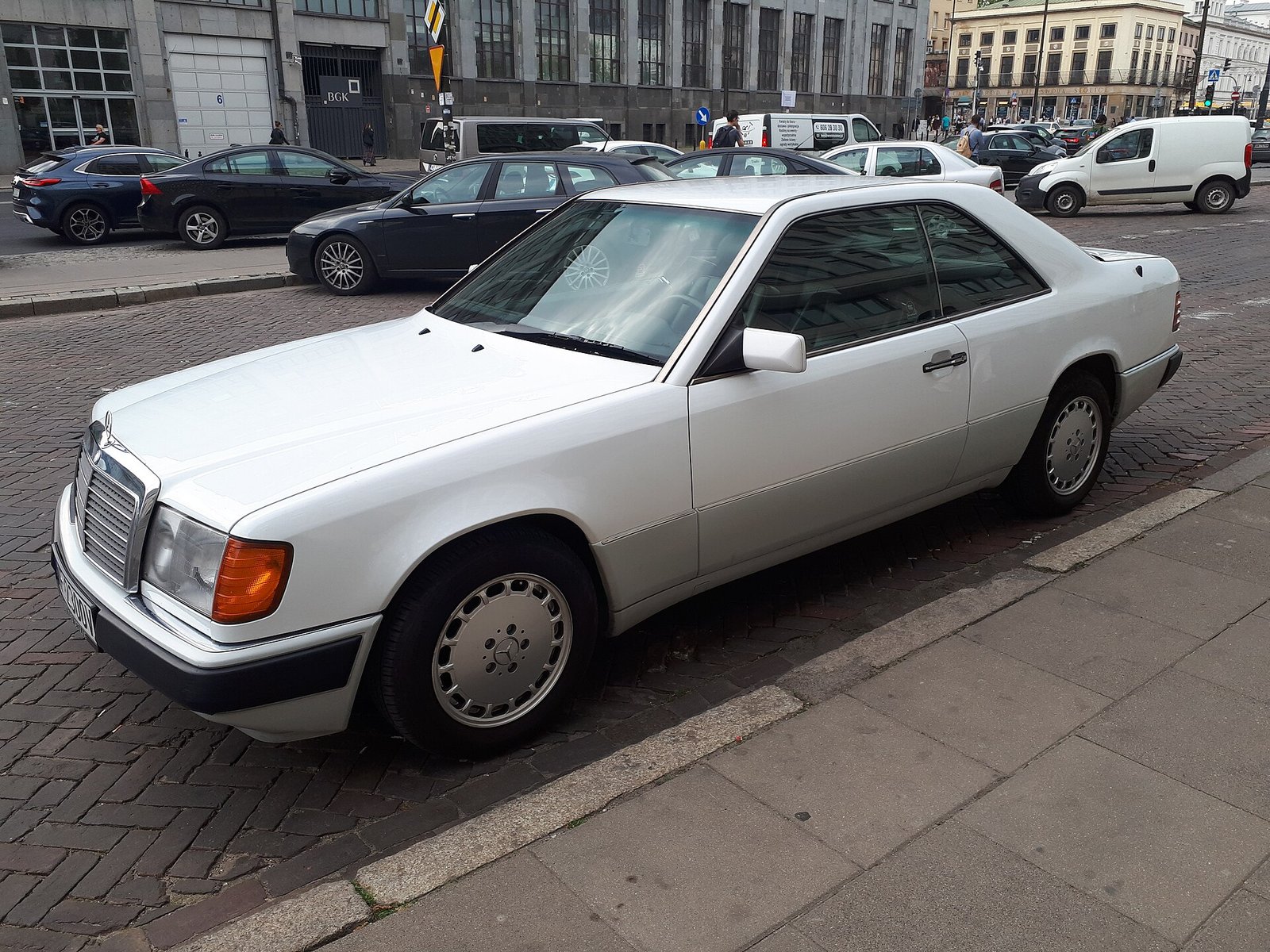
Mercedes-Benz didn’t give up. And the car that best explains why is the C124, sold in the US as the 300CE from 1988 and later as the E320 Coupe. Lower all four windows on one and there’s nothing between the windshield and the rear glass. It’s a closed car that feels like a convertible, built on what many people still call the best sedan Mercedes ever made.
Here’s the part that usually gets lost: Mercedes kept building pillarless coupes long after this one, all the way to 2023. What finally killed the idea wasn’t a regulation. It was a product decision.
In short: the Mercedes-Benz C124 is the coupe version of the W124, sold in the US as the 300CE from 1988 and later as the E320 Coupe. Mercedes built 141,498 between April 1987 and March 1996. Its pillarless design, with nothing between the windshield and the rear glass when the windows are down, kept alive an American hardtop idea Detroit had abandoned.
How America invented the hardtop, then walked away
The pillarless idea is as American as tailfins. General Motors brought it into the mainstream for 1949 with the Buick Roadmaster Riviera, the Cadillac Coupe de Ville and the Oldsmobile 98 Holiday: closed cars with a steel roof, but side windows that dropped away completely like a convertible’s. Buyers loved it. By the mid-’50s, GM had gone a step further with four-door hardtops, and through the ’60s nearly every American brand sold a two-door hardtop version of its big cars.
Then it faded. Through the ’70s, Detroit moved toward pillared coupes and "opera windows," and by the end of the decade the true hardtop was close to extinct in the US. Safety rules, cost and plain fashion all get some of the blame. Meanwhile, in Stuttgart, Mercedes kept quietly building cars this way for its most expensive customers, which is a big reason a pillarless Mercedes coupe felt so special to American buyers in the ’80s. It was a piece of their own automotive past, done with German engineering.
The sedan underneath: the W124
To get the C124, start with the W124, Mercedes’ midsize sedan of the 1980s, the car Americans knew as the 300E. Mercedes unveiled the range to the international press in November 1984 in Seville, Spain. The car that would become the taxi of half the world was first driven by journalists on Andalusian roads.
In America, the W124 arrived at exactly the right moment. Before Lexus launched the LS 400 in 1989, Mercedes was the default answer for anyone who wanted an imported luxury sedan that would last, and the 300E was the car doctors and lawyers parked in the driveway as proof they’d made it.
The W124 was engineered with the kind of obsession accountants don’t allow anymore: corrosion protection well beyond the norm, the multi-link rear suspension Mercedes had introduced on the smaller 190, and build quality that turned these cars into mileage machines. Across sedan, wagon, coupe, convertible and a long-wheelbase limousine, Mercedes built more than 2.7 million of them.
The coupe: not just a sedan minus two doors
Mercedes launched the coupe in early 1987 and built it from April 1987 to March 1996, 141,498 in total. It rode on a 106.9-inch wheelbase, 3.3 inches shorter than the sedan. The roof was lower, the beltline changed, and the doors were much longer so rear passengers could actually get in. In back there was no bench, just two individual seats split by an armrest. A four-seater, on purpose.
And then there’s the gap. No B-pillar. The rear side windows drop all the way, and with all four down the whole side of the car opens up. To keep the body stiff without that pillar, Mercedes had to reinforce it elsewhere. It’s harder and more expensive to build than a normal coupe, which is exactly why so few carmakers bothered.
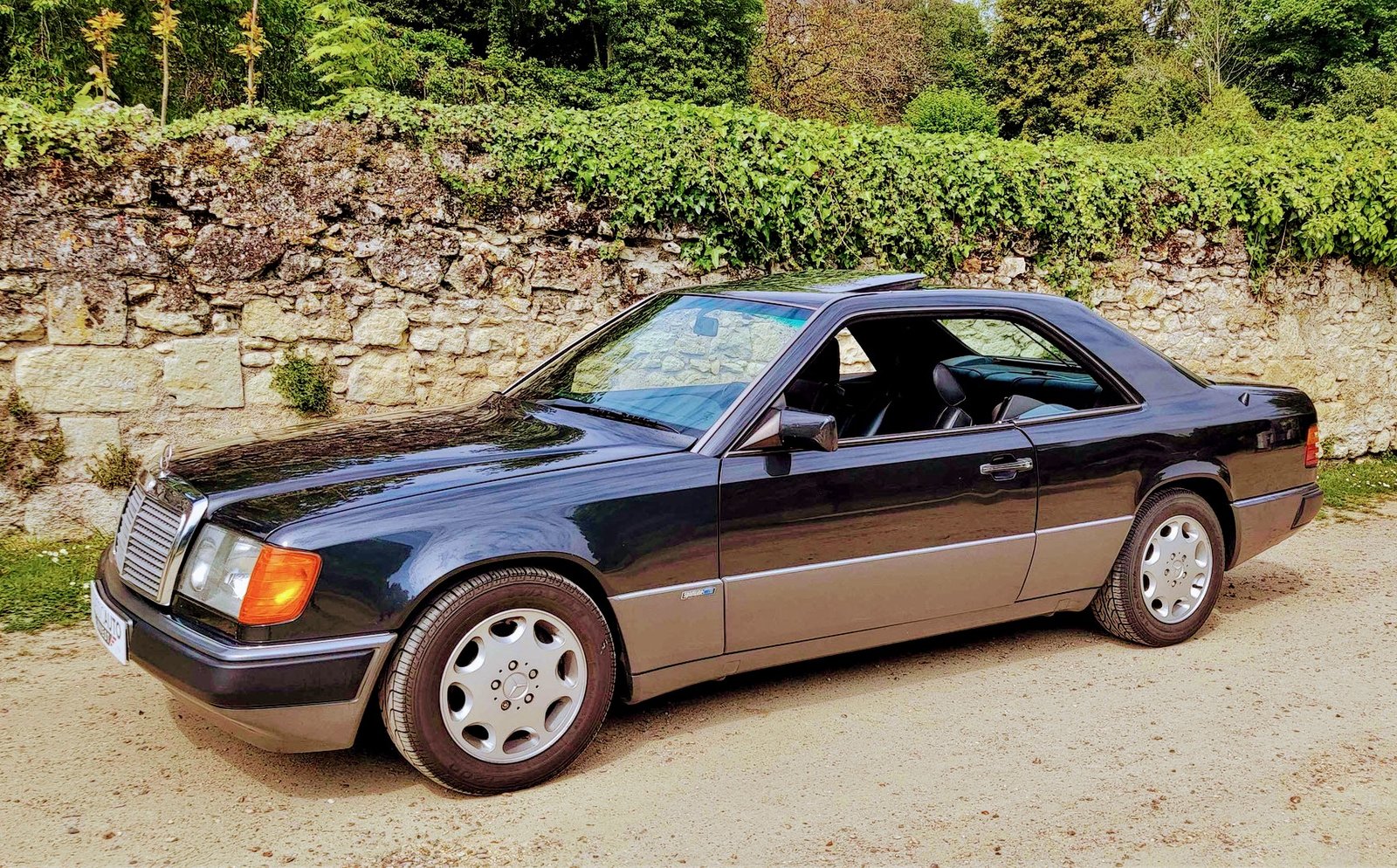
The coupe also became the base for the family’s convertible, the A124, launched in 1991. Mercedes hadn’t sold a four-seat convertible since the early ’70s, and it built this one on the C124 body, stiffened even further.
The Bruno Sacco look
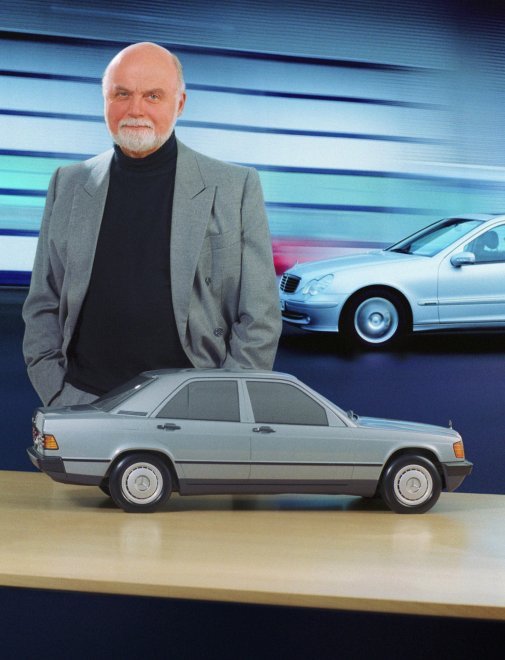
The design came from the studio of Bruno Sacco, the Italian who ran Mercedes design from 1975 to 1999. His rule was easy to say and brutal to execute: a Mercedes had to look right on launch day and still look right twenty years later. No fashion, no gimmicks that would date in two model years. He talked about every new model fitting into the family without making the previous one look old overnight.
Park a C124 next to most late-’80s coupes and they look like they’re wearing costumes from their era. The Mercedes just looks correct.
The engines, and the one to get
In the US, the coupe came as the 300CE, first with the 12-valve M103 straight-six, then from 1990 with the 24-valve M104. In 1993, Mercedes renamed its midsize range the E-Class, and the coupe became the E320, with a 3.2-liter M104. Other markets got four-cylinder 200, 220 and 230 CE models that never crossed the Atlantic.
The M104 is the heart of the story. A straight-six is naturally balanced, its internal forces mostly cancel each other out, so it spins with a smoothness a V6 of the era couldn’t match. The 3.0-liter 24-valve version in the 300 CE-24 made 220 PS in European spec, about 217 hp, and 265 Nm of torque, around 195 lb-ft, delivered in one long, clean pull to redline. In Europe you could even get it with a five-speed manual.
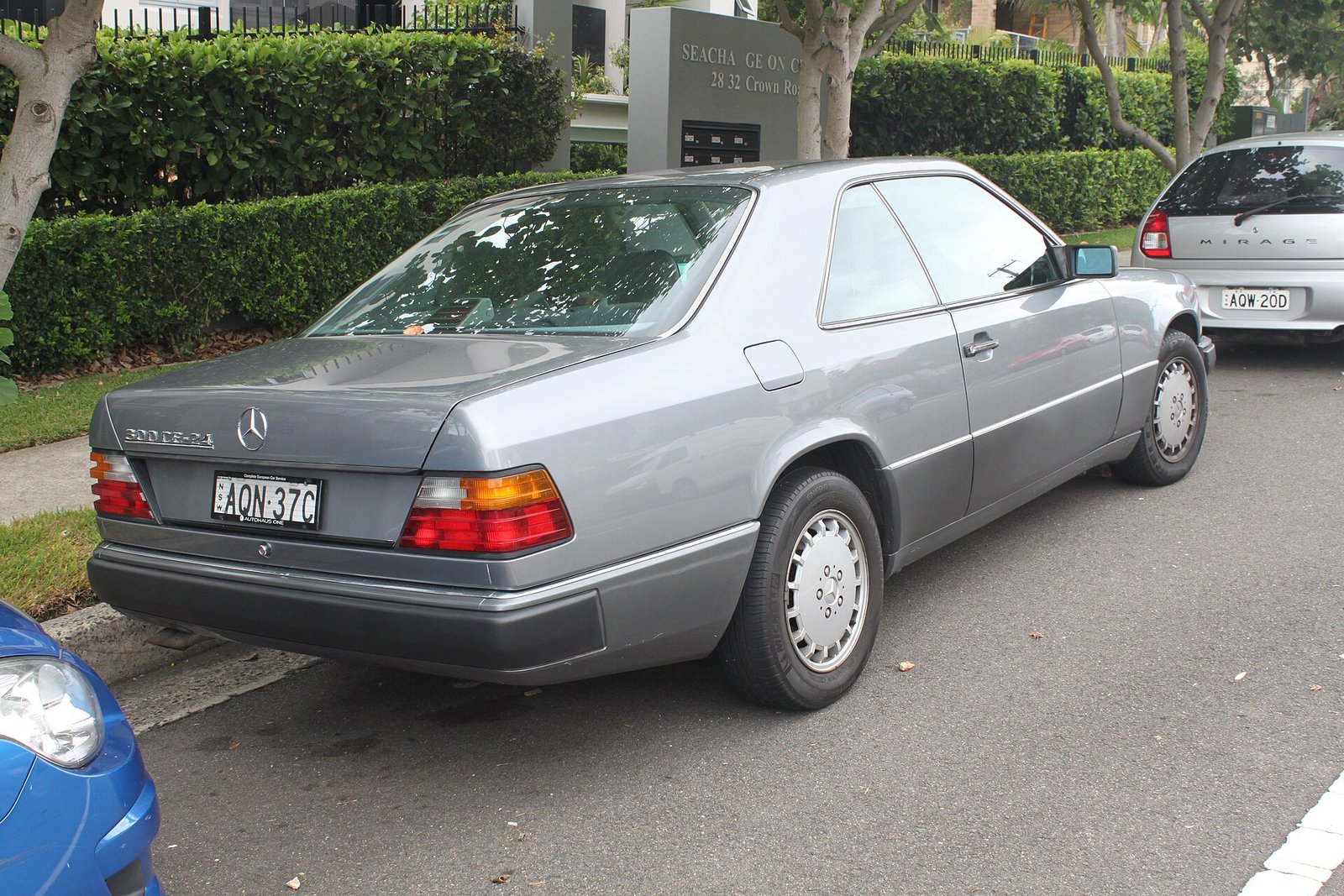
What did it compete with? In 1991, Toyota’s luxury arm launched the Lexus SC 400, a Japanese two-door with a 4.0-liter V8 aimed squarely at buyers like this. BMW still had its aging 635CSi, a design that dated back to 1976. The Mercedes was quieter than the BMW and more substantial than the Lexus, and it had something neither offered: no pillar.
The AMG versions
AMG worked on the C124 too, back when it was still an independent tuner founded by Hans Werner Aufrecht and Erhard Melcher. Mercedes didn’t take a majority stake until 1999. If you want that story, there’s the history of AMG and our piece on its founder, Hans Werner Aufrecht.
There was a 300 CE 3.4 AMG built from the 24-valve car and, later, the E 36 AMG, with the six bored out to 3.6 liters and a 0 to 100 km/h time of about 7 seconds. Exact production numbers for AMG cars of this era are hard to pin down, since many were built to order. They’re rare, and they’re the ones collectors fight over today.
What breaks
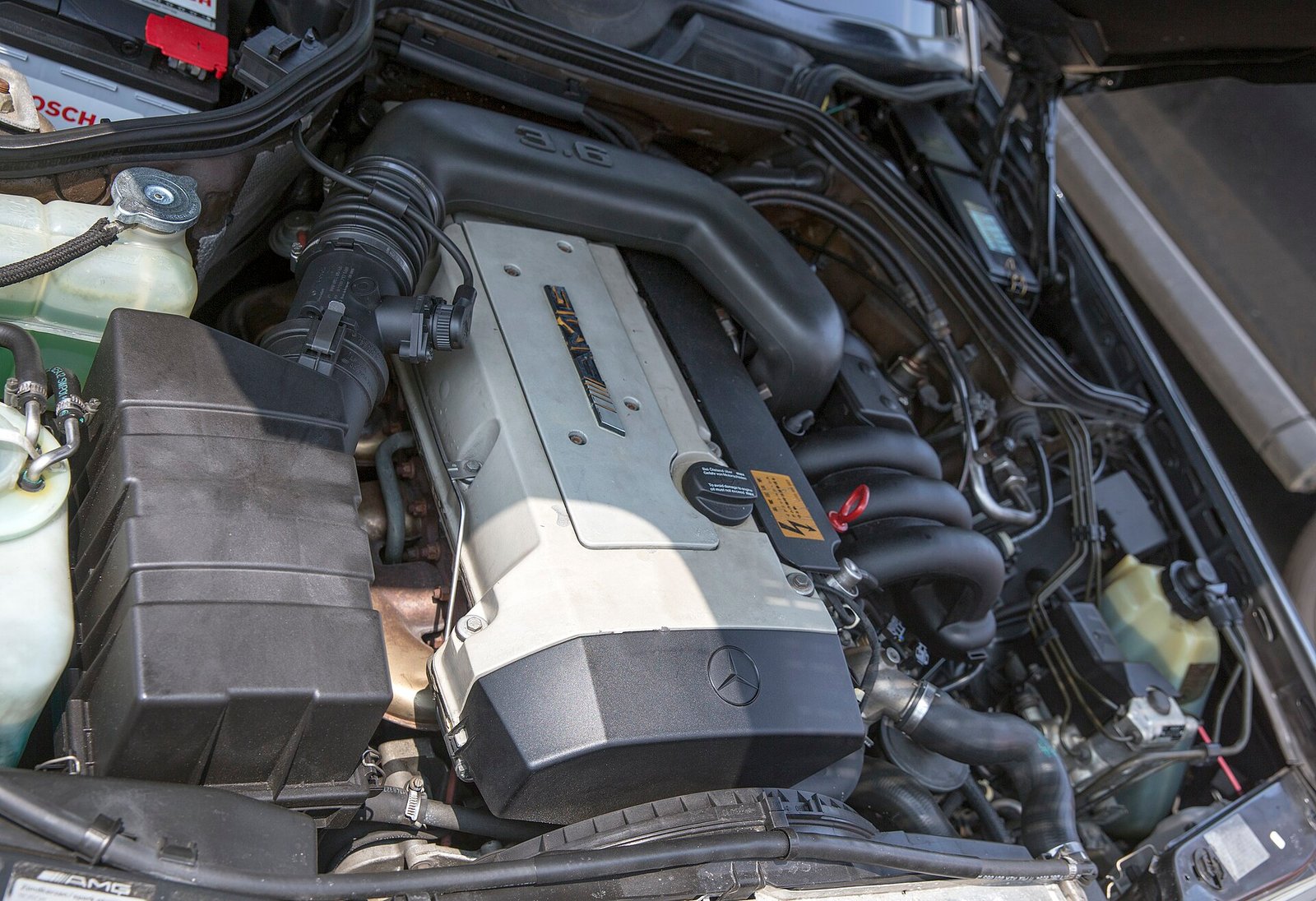
No Mercedes of this era is indestructible, whatever the legend says. The M104 has two well-known weak spots. One is the head gasket, which tends to weep oil on the outside of the engine as it ages. The other is nastier: on mid-’90s cars, Mercedes used an engine wiring harness with insulation that breaks down with heat and crumbles. Exposed wires on a fuel-injected engine make for faults that are hard to trace and expensive to fix. Anyone shopping for a 300CE or E320 should look at that harness before they look at the paint.
The rest is what you’d expect on a car more than thirty years old: rust underneath on cars from wet climates, tired suspension, and window seals that need real care. Frameless glass with no pillar only works if the seals are good. If they’re not, you get wind noise and water.
How it drives
It isn’t fast by today’s standards, and that’s not the point. The steering is a recirculating-ball setup with hydraulic assist, more relaxed than precise. The suspension swallows bad pavement like it isn’t there. It’s a car for long highway runs with the windows down and your elbow resting where any other coupe would have a pillar. Few closed cars feel this much like a convertible.
The pillarless coupe didn’t die by law
Back to the myth. The C124 was not the last pillarless Mercedes. It followed the W123 coupe of the late ’70s and the big S-Class coupes, and others came after it. The last two E-Class Coupes, the C207 from 2009 to 2016 and the C238 from 2017 to 2023, kept the pillarless side glass and were certified to the crash rules of their day.
What ended it was the CLE. In 2023, Mercedes merged its C-Class and E-Class coupes into one model, the CLE, and gave it a B-pillar and fixed rear side windows, like the C-Class coupe. That was a product and cost decision, not a federal mandate. The CLE Cabriolet still has no pillar. The coupe does.
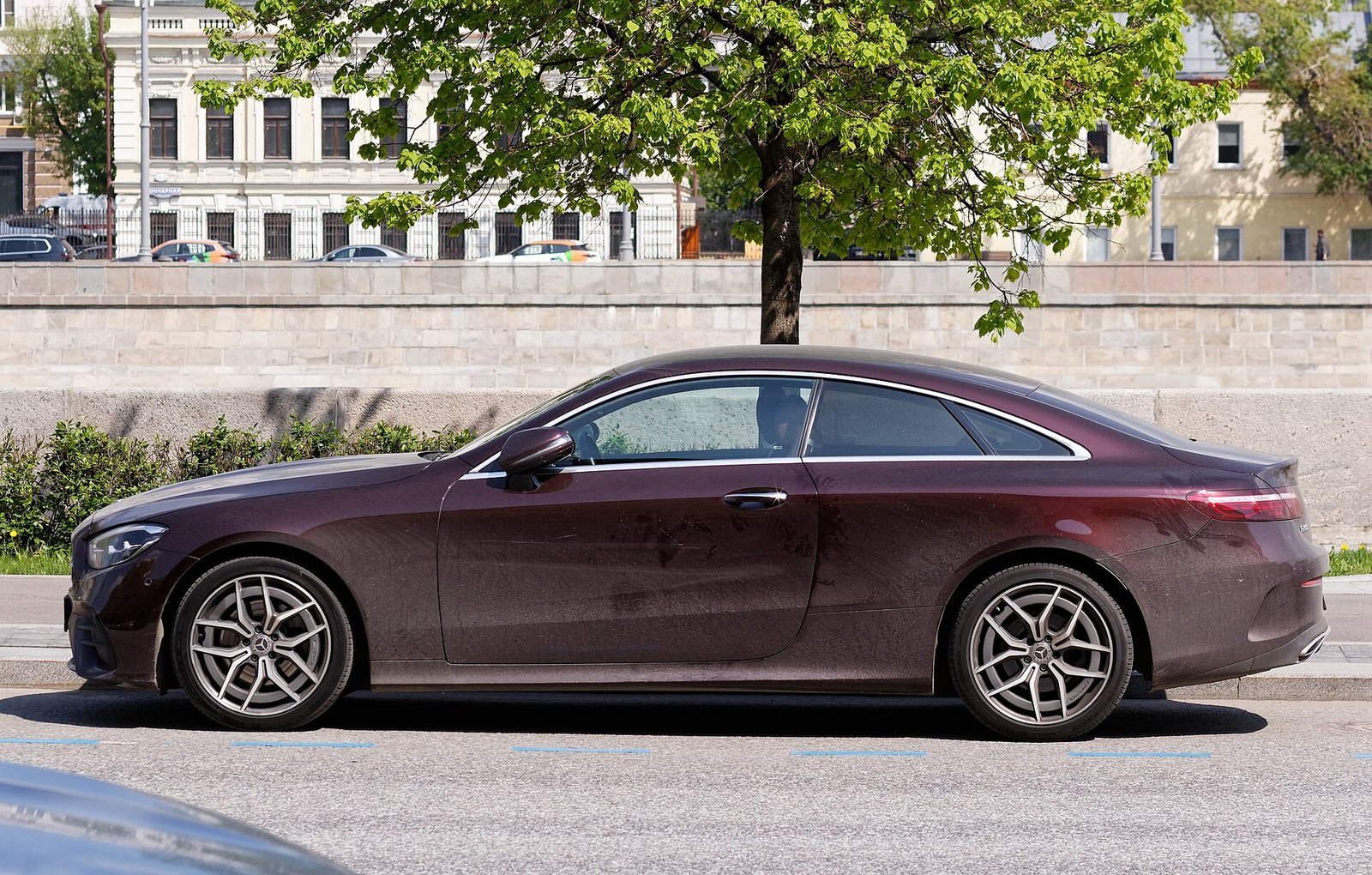
So the C124 matters more now than it did ten years ago. It isn’t the last of its kind at Mercedes, but it’s the one that best explains why the idea deserved to live. If you like Mercedes built with no eye on the calendar, look at the R107 SL, in production for eighteen years, and the 190E Evolution II, the little brother that went racing in the DTM.
Buying one now
Prices have started climbing, but the C124 is still nowhere near the craziness of other German classics from its time. Four-cylinder European cars are cheap. Clean six-cylinder cars, especially a 300 CE-24 or E320 with documented history, are a different league. Genuine AMG cars with paperwork to prove it are firmly collector territory.
As always, history is everything. A C124 with every receipt, a replaced wiring harness and good window seals is worth what the seller asks. One without paperwork is a lottery ticket with frameless windows.
A quick checklist before you hand over money. Lower and raise all four windows, more than once, and listen to the motors: on a car with no pillar, those windows and their seals are the whole point. Look under the hood for oil weeping down the side of the block from the head gasket. Ask whether the engine wiring harness has ever been replaced, and if the seller doesn’t know what you’re talking about, assume it hasn’t. Check the jacking points and wheel arches for rust. On an automatic, make sure the shifts are smooth, cold and hot. And drive it on the highway with the windows down, because if that doesn’t sell you on the car, nothing will.
It isn’t loud, it isn’t flashy and it isn’t fast. But it’s one of the most elegant cars Mercedes ever built, from a time when the company still did hard things just because they were right.
Mercedes C124 coupe FAQ
How many Mercedes C124 coupes were built?
141,498, built from April 1987 to March 1996. The wider W124 family, including sedan, wagon, coupe, convertible and limousine, passed 2.7 million.
What is a pillarless coupe?
A closed car with no B-pillar between the front and rear side windows. On the C124, with all four windows down, there is a clear opening from windshield to rear glass, like a convertible with a steel roof.
Why did Mercedes stop making pillarless coupes?
Not because of a law. Mercedes kept building pillarless coupes until 2023, and the end was a product decision rather than a regulation, as the article explains.
What was the C124 sold as in America?
As the 300CE from 1988, with the 3.0-litre inline-six, and later as the E320 Coupe.
Check you’re still alive.
Photos: Raf24 (CC BY-SA 4.0); Mikekar777 (CC0); DaimlerChrysler AG (CC BY-SA 3.0); Jeremy from Sydney, Australia (CC BY 2.0); Mr.choppers (CC BY-SA 3.0); Retired electrician (CC0). Via Wikimedia Commons.