The BMW M50B25: The Cast Iron Engine That Refused to Die
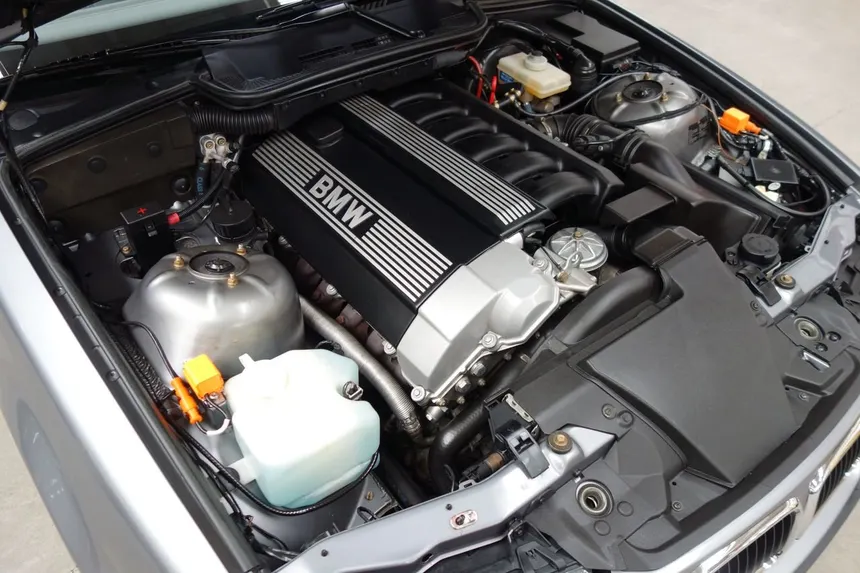
When enthusiasts talk about indestructible engines, the Toyota 2JZ dominates the conversation. But in Munich, BMW was building something equally special: an inline-six with a cast iron block that would become the foundation for one of the most reliable tuning platforms ever created. The M50B25 didn’t need an introduction among those who knew it. It just needed someone to give it the recognition it deserves.
An Engine Born in Transition
The M50B25 appeared in 1990, initially mounted in the E34 (5 Series) and shortly after in the E36 (3 Series). It represented a significant evolution from the M20B25 that preceded it, incorporating dual overhead camshafts (DOHC) and a more modern architecture while retaining something many consider its greatest virtue: a cast iron engine block.
At a time when the industry was beginning to migrate toward aluminum blocks seeking weight reduction, BMW bet on grey cast iron for the M50. This apparently conservative decision turned out to be one of the engine’s greatest strengths. Cast iron offers structural rigidity and thermal absorption capacity that aluminum simply cannot match under the same conditions. The cylinders maintain their geometry under extreme thermal stress, the block walls withstand elevated combustion pressures without deforming, and wear resistance is notably superior.
The M50B25 produced 192 hp from the factory in its non-VANOS version, a modest figure by today’s standards but perfectly calibrated for the E36’s weight and chassis. What those numbers don’t tell you is the way that power was delivered: linear torque, immediate throttle response, and a smoothness that made the engine seem capable of spinning forever.
The Architecture That Makes It Special
The inline-six is, by design, one of the most mechanically balanced layouts in existence. Primary and secondary forces cancel naturally, eliminating the need for additional balance shafts. This translates to fewer vibrations, less stress on internal components, and an inherent longevity that few architectures can match.
The M50B25 takes advantage of these benefits with a displacement of 2,494 cc, a bore of 84 mm, and a stroke of 75 mm. This slightly oversquare bore/stroke ratio favors a more rev-happy character, allowing the engine to climb through the rev range with enthusiasm while maintaining acceptable mid-range torque.
The M50 cylinder head is a notable piece of engineering. With four valves per cylinder and intake ports designed to optimize airflow, the head already offers excellent volumetric efficiency in stock form. When BMW introduced the M50TU (Technical Update) version in 1992, it added the single VANOS system on the intake camshaft, improving low-rpm torque without sacrificing top-end power. This version, commonly known as the M50B25TU, raised output to 192 hp while maintaining the same reliability characteristics.
The Bosch Motronic electronic management system fitted to the M50 was advanced for its time but simple enough to be understood and modified. This technical accessibility opened the doors to a tuning community that quickly discovered the engine’s enormous hidden potential.
The Inevitable Comparison: M50B25 vs. 2JZ-GE
The comparison with the Toyota 2JZ isn’t arbitrary. Both engines share a fundamental philosophy: inline-six, cast iron block, overbuilt construction, and an almost absurd capacity to absorb additional power.
The 2JZ-GE, the naturally aspirated version of Toyota’s famous engine, produced 220 hp from its 3.0 liters. The M50B25, with half a liter less displacement, generated 192 hp. Proportionally, the BMW engine had nothing to be ashamed of. But where the comparison becomes truly interesting is in modification potential.
The M50’s cast iron block withstands significant boost pressures without requiring internal reinforcement. There are countless documented examples of turbocharged M50B25s producing between 400 and 600 hp on stock internals, using only a turbo kit, adequate injectors, and a remapped engine management system. The most extreme examples, with forged internals and full preparation, exceed 1,000 hp while maintaining surprising reliability.
This ability to absorb power without breaking is exactly what made the 2JZ famous. The difference is that while the 2JZ had the fortune of being associated with the Supra and the entire Japanese tuning culture that Hollywood amplified, the M50B25 did its work quietly, inside circuit E36s and drift projects that never received the same media attention.
The E36: The Perfect Chassis for the Perfect Engine
The BMW E36 is one of those cars that automotive history has treated unfairly. For years it was considered simply “the cheap 3 Series,” the one you could buy for little money when the E30 had already become a classic and the E46 was too new to be affordable. But that accessibility is precisely what made it an extraordinary tuning platform.
With a kerb weight of approximately 1,350 kg in 325i form, the E36 offered an already competitive power-to-weight ratio in stock trim. Its rear multilink suspension, inherited in concept from the E30 but significantly refined, provided a balance between comfort and dynamic capability that made the car a surprisingly capable track companion.
The combination of the M50B25 with the E36 chassis created a balanced package where each component complemented the other. The engine, mounted longitudinally and positioned as far back as possible in the engine bay, contributed to a weight distribution close to the 50/50 split that is BMW’s trademark. This balance, combined with rear-wheel drive and the communicative hydraulic steering of the era, made the 325i a car that rewarded skilled drivers in ways that few modern cars can replicate.
Reliability: Endless Kilometres
If there’s one thing that defines the M50B25 beyond its tuning potential, it’s its near-legendary reliability. It’s common to find examples with over 300,000 kilometres that continue running with Swiss watch precision, provided maintenance intervals have been respected.
The M50’s known weak points are few and well documented. The valve cover gasket tends to harden and leak oil over time, a cosmetic rather than mechanical problem solved with a new gasket and an afternoon’s work. The cooling system, as with almost all BMWs of the era, requires periodic attention: water pump, thermostat, and hoses should be renewed preventively at regular intervals to avoid overheating.
The timing chain, unlike the belts used by many competitors of the era, is practically eternal. With proper oil maintenance, the chain and its guides can last the engine’s entire lifetime without needing replacement. This eliminates one of the most significant maintenance costs and one of the most common sources of catastrophic failure in competing engines.
The forged crankshaft, robust connecting rods, and pistons oversized for the stock power output create an engine that always operates within extremely wide safety margins. BMW, known for its conservative engineering of critical components, designed the M50 to handle much more than what was asked of it from the factory. That deliberate over-engineering is what allows the engine to accept power levels far above the original figures without complaint.
The M50B25’s Legacy
The M50B25 wasn’t the last great BMW inline-six with a cast iron block, but it was perhaps the purest. Its successor, the M52B25, migrated to an aluminum block with Nikasil (and later Alusil) liners, gaining lightness but losing some of the robustness that made the M50 a virtually indestructible engine.
In the world of amateur motorsport and European tuning, the M50B25 remains a reference. Turbocharged E36s with M50 engines are a regular presence at drift events, track days, and drag competitions across Europe. Parts availability, accumulated community knowledge, and the relatively low cost of the platform make it a viable and attractive option for high-performance projects.
The M50B25 is proof that you don’t need million-dollar marketing or Hollywood movies to create a legend. Sometimes, you just need a cast iron block, six inline cylinders, and the engineering to do it right. Let the 2JZ take the headlines. Those who know, know what the M50 has.
2 thoughts on “BMW M50B25”