
PSA XUD: The Indestructible Atmospheric Diesel That Moved an Entire Continent

If any engine deserves the title “workhorse of Europe,” it’s the PSA XUD. It wasn’t glamorous. It wasn’t powerful. It had no turbo, no sophisticated electronic injection, nothing that could be considered remotely exciting. But it had something worth more than all of that combined: it was practically indestructible. And with that single quality, it literally flooded the European fleet of vans and utility vehicles for more than two decades.
When we talk about the XUD, we’re talking about an engine that defined an era. The era when diesel stopped being the domain of trucks and tractors and became the smart choice for millions of Europeans who needed a vehicle that worked every single day, without excuses, without drama, and with fuel consumption that defied all logic.
Origins: The XUD Family
The XUD engine family was developed by PSA Peugeot Citroën in the late 1970s and early 1980s. The technical nomenclature can be confusing, so let’s clarify.
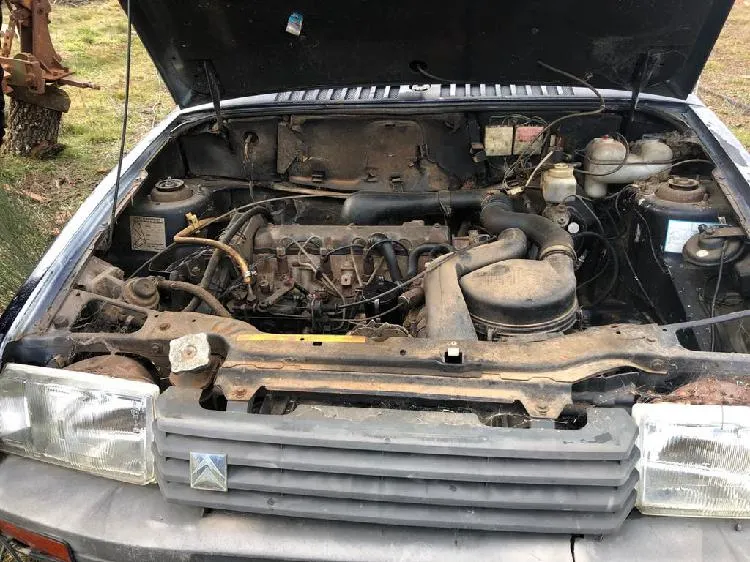
The XUD7 was the 1.8-litre version (1,769 cc to be exact). The XUD9 was the 1.9-litre version (1,905 cc). Both shared the same basic architecture: inline four-cylinder, cast iron block, aluminium alloy cylinder head, indirect diesel injection with pre-chamber and, in their original versions, natural aspiration. No turbo. No electronics. No complications.
The XUD7, the 1.8 that particularly concerns us here, was the engine that truly flooded Europe. It appeared in the Peugeot 205, the Peugeot 305, the Citroën BX, and crucially, in the mythical Citroën C15 — the van that became the quintessential work vehicle across half of Europe.
The Citroën C15: The XUD’s Best Friend
It’s impossible to talk about the XUD without talking about the C15. That van, based on the Citroën Visa platform, with its utilitarian design making zero concessions to aesthetics and its surprising cargo capacity for its size, was the delivery vehicle, the work car, the transport of choice for blacksmiths, plumbers, electricians, bakers, and farmers across all of Mediterranean Europe.
And at its heart beat an XUD that simply refused to surrender. There were C15s with 500,000 kilometres on the odometer still starting every morning without complaint. Some had 600,000. And legends circulate — some verified — of units that exceeded one million kilometres on the original engine, having received little more than regular oil changes and the occasional set of injectors.
The secret? Absolute simplicity.
Anatomy of Indestructibility
The XUD was an indirect injection engine with a pre-chamber. This means the fuel wasn’t injected directly into the main combustion chamber, but into a small pre-chamber where combustion initiated before expanding into the cylinder. This system, although less efficient than the direct injection that would come later, had an enormous advantage: much lower injection pressures.
Where a modern common rail system operates at 2,000 bar or more, the XUD system worked at comparatively modest pressures. This meant less mechanical stress on the injectors, on the injection pump, and on the engine block itself. Less stress, less wear, longer service life.
The cast iron block was thick, heavy, and robust. It won no awards for lightness, but it certainly won for durability. Cylinder wall thicknesses were generous, allowing multiple rebores if ever needed — which they rarely were.
The injection pump was a Bosch or Lucas/CAV mechanical unit, depending on the market and version. These components could be repaired indefinitely by any village workshop specialising in diesel injection. No computer was needed to diagnose anything. An experienced mechanic with a stethoscope, a timing light, and their own hands could tune an XUD in an afternoon.
The Peugeot 205 Diesel: With You to the End of the World
If the C15 was the work vehicle, the Peugeot 205 diesel was the car that democratised diesel among private buyers. The 205 was already an exceptional car in its petrol versions — the GTI remains one of the finest hot hatches ever made — but with the XUD engine, it became something different: a machine for covering kilometres at a running cost that bordered on the ridiculous.
A Peugeot 205 GRD with the 1.8-litre XUD7 engine and 60 horsepower excited nobody at a traffic light. Reaching 100 km/h was an exercise in patience and faith. But once on the open road, that small diesel engine purred at 3,000 rpm and the 205 became a discreet arrow capable of covering Barcelona to Madrid on less than half a tank. Real-world consumption of 4-5 litres per 100 kilometres was standard. At a time when diesel was significantly cheaper than petrol, the economic equation was devastating.
And the car didn’t break down. It simply didn’t break down. The typical problems of a 205 diesel were bodywork issues (rust, especially on the sills and wheel arches), suspension, and normal wear items. The engine was the last thing to fail, if it ever failed at all.
The Impact on the European Vehicle Fleet
The XUD wasn’t just a popular engine — it was an engine that transformed the market. Its extreme reliability and low operating costs created a phenomenon that competing manufacturers took years to understand and counter.
In countries like Spain, France, Portugal, and Italy, the XUD triggered a massive migration towards diesel in segments where it had previously been unthinkable. Small cars, light vans, urban commercial vehicles — all became dieselised because PSA had demonstrated that a diesel engine could be cheap to buy, cheap to maintain, and virtually eternal.
The C15, in particular, created a used market that defied all economic logic. Units with hundreds of thousands of kilometres maintained surprising residual values because buyers knew the engine would deliver just as many more without flinching. There was a saying among professionals: “C15s don’t die, they get inherited.”
The delivery fleets of half of Europe were built on C15 chassis with XUD engines. Postal services, courier companies, local businesses, agricultural cooperatives — the XUD literally moved the real economy.
The Turbo Versions: XUD9 Turbo (XUD9TE)
When PSA finally added a turbo to the XUD9, creating the XUD9TE, the result was impressive for its time. From the 64-71 horsepower of the atmospheric XUD9, it jumped to 90 horsepower with the turbo — a figure that may seem modest today but which in a car like the Peugeot 405 SRdt or Citroën ZX Turbodiesel delivered more than adequate performance for any use.
The turbo didn’t significantly compromise reliability, though it did add one more component that could fail. Well-maintained turbo XUD9 engines equally exceeded 400,000-500,000 kilometres routinely.
The Weaknesses (Because It Had Some)
Not everything was perfect. The XUD had its weak points, though none were truly serious.
The head gasket could cause problems, especially in turbo versions subjected to continuous heavy loads. It was a known maintenance point and the repair, while not cheap, was within the capabilities of any general workshop.
The glow plug pre-heating system was essential for cold starts. When glow plugs failed — and eventually they did — starting the engine in winter could become a ritual of patience.
The mechanical injection pump required periodic adjustment and could suffer internal wear at very high mileages. But as we’ve noted, any diesel injection workshop could rebuild one for a fraction of the cost of a modern electronic component.
And then there was the noise. The XUD was noisy. Not unpleasant by the standards of its era, but compared to a modern diesel, the XUD’s idle rattle was unmistakable. It was the sound of classic diesel — the same sound that made petrol purists wrinkle their noses. For those who drove them, it was the sound of reliability.
The End of an Era
The XUD was gradually replaced by the DW family from the late 1990s onwards. The new HDi common rail direct injection engines offered more power, less consumption, lower emissions, and far less noise. They were, objectively, better engines in almost every respect.
But none of them would ever have the XUD’s reputation for indestructibility. Electronics, exhaust treatment systems, extreme injection pressures, and ever-increasing complexity conspired to make modern engines more efficient but also more expensive to repair and, generally, with shorter service lives before the first significant failure.
The Legacy
The PSA XUD is one of those engines that transcends mechanics to become a cultural phenomenon. In Spain and France, mentioning “the C15 engine” provokes immediate smiles of recognition. It’s the engine of the delivery driver, the farmer, the self-employed worker who needed their tool to work every morning without fail.
It wasn’t fast. It wasn’t quiet. It wasn’t sophisticated. But it was reliable to levels that today seem like science fiction. And that, in the real world, is worth more than any power figure or cutting-edge technology.
The XUD proved that real engineering isn’t about making things complicated — it’s about making them work. Always. Without excuses.
1 thought on “PSA XUD”