The Great Electric Horsepower Scam: When Adding Power Is as Easy as Turning Up the Volume
There’s an elephant in the electric car showroom, and nobody wants to talk about it. The automotive industry has been selling horsepower for over a century as though each one costs blood, sweat, and thousands of hours of engineering. And for that century, it was true. Every extra horse wrung from an internal combustion engine represented a thermodynamic battle against physics, metallurgy, and fuel chemistry. But now, in the electric era, they’re still charging you as if each HP came from the guts of a naturally aspirated V8, when in reality it comes from a line of code.
Welcome to the greatest horsepower inflation in automotive history.
The Internal Combustion Engine: 150 Years Fighting Thermodynamics
To understand the scam, you first need to understand what it took — and still takes — to build a powerful combustion engine. An internal combustion engine is, essentially, a machine that converts controlled explosions into linear motion, then into rotary motion. Sounds simple. It isn’t.
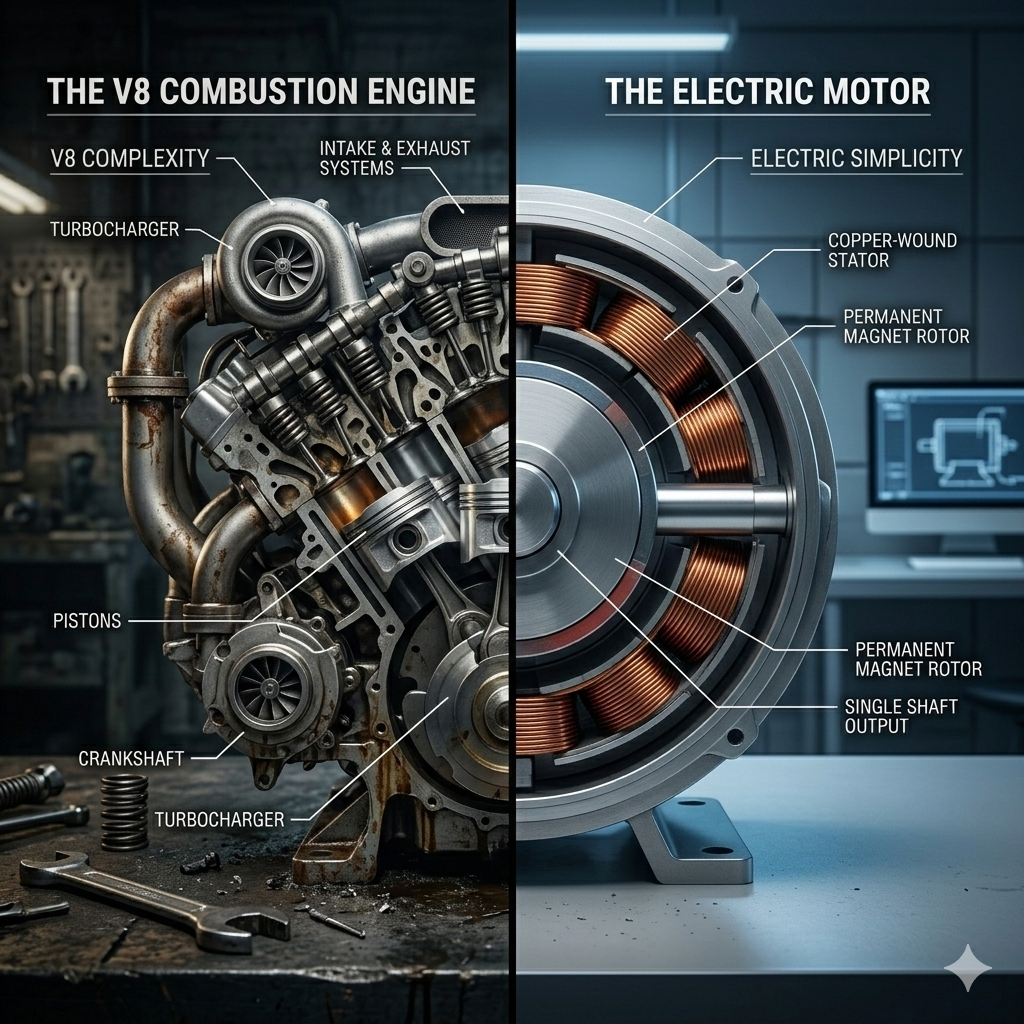
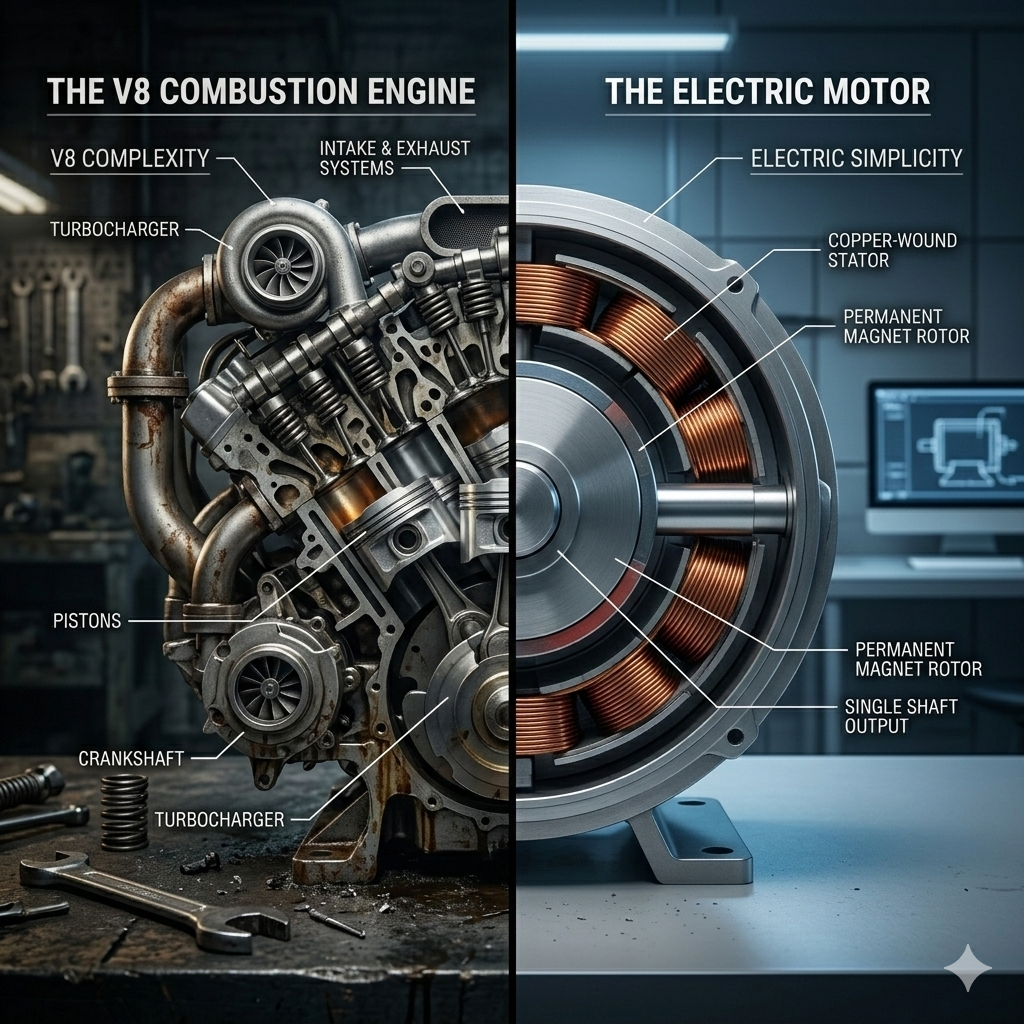
A conventional four-cylinder engine has at least 40 moving parts. A modern V8 easily surpasses 200. The entire drivetrain of an ICE vehicle can contain between 200 and over 2,000 moving components, depending on the source and system complexity. Each of those parts must coexist with combustion temperatures exceeding 2,000°C in the chamber, constant vibration, and tolerances measured in microns.
Extracting more power from a combustion engine means fighting on every front simultaneously. Want more HP from a naturally aspirated engine? You need to improve volumetric efficiency: manifold design, cam profiles, variable valve timing. Want to add a turbo? You need to manage exhaust temperatures, backpressure, intercoolers, injection maps, and pray the pistons can handle the boost pressure without detonation. Want it to be reliable too? You need stronger materials, better lubrication, oversized cooling systems.
All of this has required over 30 years of R&D in recent decades alone, reducing NOx and particulate emissions by over 99% to meet regulations while continuing to improve power and torque output. Volkswagen allocated a significant portion of its planned €180 billion investment to combustion engine development, even in the middle of the electric transition. Mercedes-Benz has announced 19 new gasoline-powered models through the end of 2027. BMW has filed patents for pre-chamber ignition systems to improve gasoline engine efficiency.
That’s billions of euros and decades of work to extract every extra horse from a thermal machine.
The Electric Motor: The Elegant Simplicity Nobody Wants to Admit
And now, the electric motor.
An electric motor has two moving parts. Two. Rotor and bearings. That’s it. There are no camshafts to profile, no valves to time, no exhaust manifolds to design, no catalytic converters to optimize, no EGR systems to calculate, no piezoelectric injectors to calibrate, no variable valve timing to program. None of that.
Tesla’s complete drivetrain has approximately 17 moving parts. An equivalent combustion car’s drivetrain has around 200. Electric vehicles have 90% fewer moving parts than ICE vehicles. An electric motor converts over 85% of electrical energy into mechanical motion. A combustion engine manages about 40% at best. According to the U.S. Department of Energy, in an EV roughly 59-62% of electrical energy from the grid reaches the wheels; in a gasoline car, only 17-21%.
So how do you get more power from an electric motor? More amperage. More voltage. Different winding. Stronger magnets. Or, the industry’s favorite: a software update. Without touching a single part.
Manufacturers limit their electric motors’ output through software to meet reliability and warranty requirements, and they’re usually overly cautious. The hardware already has the capability. You just need to change some parameters in the firmware, and voilà: 60 HP more. No calibration engineer. No 10,000-hour test bench. No emissions certification. Nothing.
The Horsepower Subscription: The Most Obscene Business Model in Automotive History
This is where things go from questionable to outright insulting.
Mercedes-Benz charges $1,200 per year — or between $1,950 and $2,950 as a one-time payment — to unlock power that’s already in your car. They call it “Acceleration Increase.” In the Mercedes EQE 350 4MATIC, you go from 288 HP to 348 HP. Those extra 60 HP were there from day one. The motor could do it. The inverter could do it. The battery could do it. But Mercedes decided that no, you need to pay first.
In the EQS 450 4MATIC, the increase is 80 HP: from 355 to 435 HP. Through a software update. No hardware modification. Zero bolts. Zero new parts. Just a parameter change in the motor controller.
And it’s not just Mercedes. Tesla had already paved the way by selling acceleration unlocks for the Model 3. BMW tried charging $18 per month for heated seats in South Korea. Toyota attempted to charge $8 per month for remote start. Zero Motorcycles charges $1,800 to unlock more power in their electric bikes.
The pattern is clear: they build the car with full capability, cripple it through software, and then sell it back to you as a “premium extra.” In a world where each horse cost real engineering, this would have been unthinkable. You can’t mechanically cripple a V8 and then sell the customer the key to unlock the remaining cylinders. But with an electric motor, it’s as easy as changing a value in a database.
Peak Power: The Biggest Marketing Trick in the EV World
Let’s talk about the second great deception: peak power.
When a manufacturer tells you their EV has 1,020 HP, what they don’t tell you is how long it can maintain those 1,020 HP. In a combustion engine, maximum power is reached at a specific RPM and maintained as long as you hold those revs. It’s sustained power. The engine is thermally designed to operate at full load continuously — it has cooling, oil, ventilation — everything sized to function at the limit for hours if necessary.
In an EV, peak power is a sprint. A flash. Tesla has documented thermal throttling issues in its vehicles: the original Model S could only manage a lap or two on a circuit at pace before the battery overheated and the system cut power. The Model 3 improved the battery cooling system but still suffers power degradation from excess heat.
Porsche took note. They knew that if they entered the EV market, it wasn’t enough to be fast; it had to be repeatable. The Taycan Turbo GT, with its 800V architecture, can complete three flat-out laps at Laguna Seca before thermal management intervenes to cut power. Impressive for an EV, but still just three laps. A Porsche 911 GT3 with a combustion engine can lap for hours without losing a single horse.
The Taycan’s 800V architecture reduces heat generated during charging and discharging by operating at lower amperage for the same power output (through the relationship P=V×I), meaning less heat from Joule effect. But even so, thermal management remains the Achilles’ heel. The peak power you see in the brochure is what your car can deliver for a few seconds. Sustained power — the kind that actually matters — rarely appears in the spec sheet.
Thermal Management: Where the Real Engineering Lives (and Where Few Excel)
If there’s one area where EV manufacturers have to do genuine engineering, it’s in battery thermal management. And it’s ironically the area with the worst marketing.
A lithium-ion battery is a temperamental beast. Too hot and it degrades, loses capacity, can even enter thermal runaway. Too cold and the chemistry slows down, losing performance and efficiency. The optimal operating range is narrow, and keeping thousands of cells within that range while demanding hundreds of kilowatts of power is a genuine engineering challenge.
Tesla’s first-generation Model S used a serpentine cooling loop through the battery module with limited contact surface area and uneven temperature distribution between cells. They improved in later iterations by adding more parallel cooling channels for the Model 3, significantly improving both track performance and charging speed.
Porsche, with its 800V system in the Taycan, addressed the problem from the electrical architecture: by doubling the voltage compared to 400V systems, they halve the current needed for the same power output. Since Joule heating is proportional to the square of the current, the Taycan generates roughly half the heat of a 400V system at the same power level. It’s elegant engineering, and it’s the closest thing to “real work” you’ll find in an electric powertrain.
But the big question remains: does this justify the prices consumers are paying? Because the motor itself — the component that generates power — remains trivially simple. The complexity lies in the battery and its management, not the motor. And yet, marketing sells HP as if each one were a mechanical engineering achievement comparable to those of a combustion engine.
The Real Cost of a Horsepower: ICE vs. EV
The numbers don’t lie. According to Oliver Wyman, the manufacturing cost of the E-drive (electric motor and inverter) in a C-segment electric vehicle is approximately €2,000. The combustion engine with its auxiliaries costs about €3,000. The actual manufacturing cost difference is modest.
But development cost is where the gap becomes an abyss. A modern combustion engine requires years of development, thousands of hours of bench testing, emissions certification across multiple markets, calibration of injection maps for different fuels and conditions, development of aftertreatment systems (catalytic converter, DPF, SCR, EGR), durability validation under extreme conditions… the list is endless.
An electric motor needs proper winding dimensioning, permanent magnet selection (or induction/reluctance motor design), inverter sizing, and controller programming. The bulk of development work in an EV goes into the battery, BMS (Battery Management System), and power electronics — not the motor.
And yet, the industry sells you a 500 HP EV at the same price — or higher — than a 500 HP ICE that cost infinitely more to develop. The battery explains part of the premium (about €8,000 according to Oliver Wyman), but the price inflation per HP is disproportionate to the actual engineering effort.
No Soul, Just Numbers
There’s something deeper in this discussion that transcends costs. A combustion engine has character. It has a torque curve that’s the result of deliberate engineering decisions: where to place peak power, how to shape torque delivery, what compromise to make between response and thrust. A PRV V6 doesn’t sound like a Porsche flat-six, which doesn’t sound like an American V8, which doesn’t sound like a Ferrari V12. Each architecture is a philosophy.
An electric motor delivers maximum torque from 0 RPM. All of them. Always. In the same way. There’s no curve to shape, no character to design. The difference between a 300 HP electric motor and a 600 HP one is basically scale. More copper, more magnets, more amps. There’s no mechanical genius, no thermodynamic compromise, no elegant solution to an impossible problem. Just more of the same.
An electric motor is efficient. It’s clean. It’s quiet. It’s practical. But it has no soul. And charging a premium price for something that doesn’t require the art, science, and compromise of thermal engineering is, at minimum, questionable. And at maximum, a scam.
The Elephant in the Showroom
The electric car industry has an honesty problem. It sells power as if it were engineering, when it’s actually electronics. It sells HP as if each one costs the same as in a combustion engine, when the marginal cost of an electric HP is a fraction. It sells peak power as if it were real power, when thermal throttling cuts it back after a few seconds of hard use.
And worst of all: it sells subscriptions to unlock capability that’s already in your car. Capability you’ve already paid for with the hardware. Capability that costs exactly zero additional euros to manufacture.
Want 1,000 electric HP? Fine. But don’t pretend those 1,000 HP cost the same as those from a combustion engine that needed a decade of development, millions in testing, and the brilliance of engineers who fought thermodynamics every day of their working lives.
Electric horses are horses. But they’re cheap horses dressed up as thoroughbreds.
And here at NEC, we say it with grease on our hands and no filter on our mouths.
What do you think? Should the EV industry be more transparent about the real cost of electric power? Leave us your opinion and join the NEC Tribe.