The Subaru Boxer Engine: Not Too Reliable, But Tremendously Effective

Some engines earn your respect through their reliability. Some earn it through their performance. And then there’s the Subaru boxer, which earns your respect despite everything, because what it does well, it does so extraordinarily well that you forgive everything else.
Subaru’s horizontally-opposed engine — the “flat four,” the “boxer,” the “H4” — is one of the most singular mechanical propositions in the automotive industry. In a world where virtually every manufacturer uses inline or V engines, Subaru has spent decades faithful to a configuration most abandoned long ago. That loyalty has powerful technical reasons, but also a price its owners know well.
What Exactly Is a Boxer Engine?
A boxer engine — or horizontally-opposed engine — is one where the cylinders are arranged in two flat banks on either side of the crankshaft, forming a 180 degree angle between them. Unlike inline engines (cylinders in a vertical row) or V engines (cylinders in two angled rows), the boxer has its cylinders laid flat horizontally, moving laterally like two boxers throwing alternate punches. Hence the name.
And here is an important distinction connecting to our article on Ferrari flat V12s: the Subaru boxer IS a true boxer. Each piston has its own independent crankpin on the crankshaft, and opposing pistons move like a boxer’s fists — both outward and both inward simultaneously, reaching top dead centre at the same time. This differs from Ferrari’s 180-degree engine, where opposing pistons share a crankpin and travel laterally in the same direction, with one at TDC when the other is at BDC.
This configuration has profound mechanical consequences that define the entire character of the engine and the car housing it.
The Advantages: Why Subaru Will Not Change It
Low centre of gravity. This is the headline advantage and the primary reason Subaru maintains the configuration. A boxer engine is flat, wide, and low. It sits much closer to the ground than an inline or V engine, significantly reducing the complete vehicle centre of gravity. In a car with all-wheel drive — like virtually every Subaru — this translates to superior dynamic stability, especially in corners, where the car stays more planted with less body roll tendency.
Inherent balance. In a four-cylinder boxer, primary inertia forces naturally cancel thanks to the opposing piston movement. This means the engine vibrates less than an equivalent inline four-cylinder, without needing additional balance shafts. The result is a smoother ride and reduced vibration transmission to the chassis.
Symmetry with AWD. The boxer horizontal layout aligns perfectly with Subaru Symmetrical All-Wheel Drive system. The engine sits in line with the transmission and driveshafts, creating a laterally balanced propulsion system that improves traction and dynamic predictability.
Passive safety. In a frontal collision, a boxer engine tends to slide under the cabin rather than penetrating it, as can happen with taller vertical engines. This characteristic contributes to the recognised passive safety of Subaru vehicles.
The Boxer Sound: The Unmistakable Rumble
If anything acoustically identifies a Subaru boxer, it is the characteristic sound: an uneven, asymmetric burble that enthusiasts call the boxer rumble. It is a sound unlike any other four-cylinder engine, one that Subaru owners love with almost religious devotion.
Where does that sound come from? Unequal-length exhaust headers. In classic Subaru boxers (especially the EJ family), exhaust headers from each bank had different lengths, creating a temporal offset in exhaust pulses. This offset produces that irregular rhythm, that bup-bup-bup-bup that sounds like a miniature V8 running on three and a half cylinders.
Engineers know unequal-length headers are less efficient than equal-length ones. But for years, Subaru deliberately maintained them because the sound had become such a strong identity marker that changing it would have been like asking Harley-Davidson to make quiet motorcycles.
With the arrival of the FA engine family (direct injection, equal-length headers), Subaru partially sacrificed the classic rumble for efficiency. The new boxers sound more conventional, smoother, less Subaru. It is a constant debate topic in the enthusiast community.
The EJ Family: Legend and Calvary
The EJ engine family cemented Subaru reputation for both good and bad. Produced from 1989 well into the 2020s (the WRX STI EJ25 was maintained until 2021), the EJ series includes variants ranging from 1.6-litre naturally aspirated to the 2.5-litre turbocharged STI units.
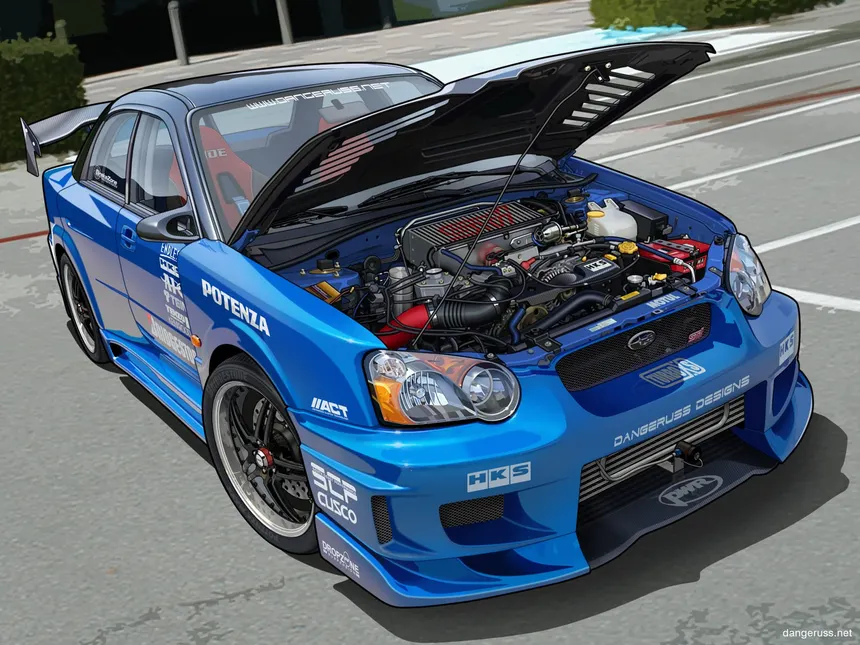
The turbo EJ20, in particular, is the engine that made the Impreza WRX famous. With relatively straightforward modifications — a revised ECU map, a larger turbo, a freer-flowing exhaust — these engines could go from their factory 220-280 horsepower to over 400 with reasonable reliability, and above 600 with more serious builds.
In rallying, the EJ20 demonstrated brutal resistance. Subaru Imprezas in Group A and Group N, equipped with EJ20 variants, won the World Rally Championship with Colin McRae, Richard Burns, and Petter Solberg. The engine withstood the extreme abuse of off-road competition with a resilience that belied its reputation for fragility in civilian use.
But here is the paradox: the same engine that could win a rally could also leave you stranded on your commute.
The Problems: The Boxer B-Side
Let us be honest: the Subaru boxer has well-documented reliability issues. These are not urban legends or forum exaggerations — they are real defects that have affected a significant percentage of units.
Head gaskets. This is the classic Achilles heel of the Subaru boxer, especially in naturally aspirated EJ25 (2.5-litre) versions. The horizontal cylinder layout means gravity works against head gasket sealing. In a vertical engine, gravity helps keep coolant and oil in their circuits. In a boxer, fluids tend to press laterally against the gaskets, especially when the engine cools and materials contract unevenly.
The problem was particularly severe in models manufactured between 1999 and 2010, where Subaru used single-layer head gaskets that proved insufficient for the engine operating conditions.
Oil consumption. The EJ engines and, to a lesser extent, the FA engines, are known for consuming oil above what would be considered normal. This is partly due to the boxer configuration: piston rings work in a horizontal orientation that does not scrape oil from cylinder walls as effectively as in a vertical engine.
Rod bearings. In high-power turbo versions, especially the WRX STI EJ25, rod bearings can fail under stress, particularly if the engine is subjected to hard acceleration with cold oil or has been modified to produce significantly more than factory power.
Maintenance complexity. The horizontal layout makes certain maintenance tasks more complicated than in conventional engines. Spark plugs, for example, sit in lateral positions that impede access. A plug change that takes 20 minutes on an inline engine can take an hour on a boxer.
Why Do We Forgive It Then?
Because when a Subaru boxer works well — and most work well most of the time — the driving experience is extraordinary.
An Impreza WRX STI with its turbo EJ25 is one of the most fun cars ever built for daily use. The symmetrical AWD combined with the boxer low centre of gravity creates dynamic behaviour that is addictive. The car feels connected to the ground in a way few cars at its price can match. In wet conditions, snow, or gravel, the Subaru boxer AWD is a revelation of traction and control.
On track, Subaru boxers are faster than their specifications suggest. The low centre of gravity allows cornering speeds superior to cars with more powerful but less well-balanced engines.
And then there is the emotional factor. The exhaust rumble. The sense of mechanical solidity. The passionate community of owners and enthusiasts. Subaru has built a culture around the boxer that transcends technical specifications.
Evolution: From EJ to FA and Beyond
The FA family (and FB for naturally aspirated versions) represents the modernisation of Subaru boxer. Direct injection, equal-length headers, improved materials, and tighter tolerances have addressed many of the EJ chronic issues.
The FA20, which powered the Subaru BRZ and Toyota 86, proved the boxer could also be a high-revving engine, with an almost sporty character that surprised sceptics. With 200 horsepower from just 2.0 naturally aspirated litres and a rev limit above 7,000 rpm, the FA20 offered a visceral driving experience more reminiscent of a motorcycle engine than a car four-cylinder.
The turbo FA24, powering the current WRX, delivers 271 horsepower and a more linear, less explosive power delivery than the old turbo EJ25. It is objectively a better engine: more efficient, smoother, more reliable. But many purists feel it has lost part of the character that made the Subaru boxer special.
Subaru in Competition: Where the Boxer Shines
It is in competition that the Subaru boxer proves its advantages vastly outweigh its weaknesses. The WRC rallies of the 1990s and 2000s are the perfect showcase: cars subjected to the most extreme punishment imaginable — jumping, sliding, impacting terrain, running at maximum revs for thousands of kilometres in conditions that would destroy most engines.
And the EJ20 held up. It did not just hold up — it won. Subaru three constructors championships (1995, 1996, 1997) were achieved with boxer engines that demonstrated astonishing mechanical resistance in motorsport most hostile conditions.
Colin McRae, the most spectacular driver ever to sit behind a rally steering wheel, trusted his life to a Subaru boxer. And that says more about the engine than any technical specification.
The Verdict: Character Over Perfection
The Subaru boxer engine is not perfect. It never has been and probably never will be. It has known issues that other manufacturers have avoided simply by using more conventional configurations. Maintaining it costs more time and money than an equivalent inline engine.
But it is tremendously effective at what it was designed to do: provide a low centre of gravity, natural balance, perfect symmetry with all-wheel drive, and a driving experience few engines can replicate.
It is an engine with character. With personality. With flaws that its owners accept as part of the package, much as you accept the flaws of someone you love.
The Subaru boxer is not for everyone. But for those who understand it, for those who appreciate what makes it different, there is nothing quite like it.
And that, in a world of increasingly homogeneous engines, is worth more than you imagine.