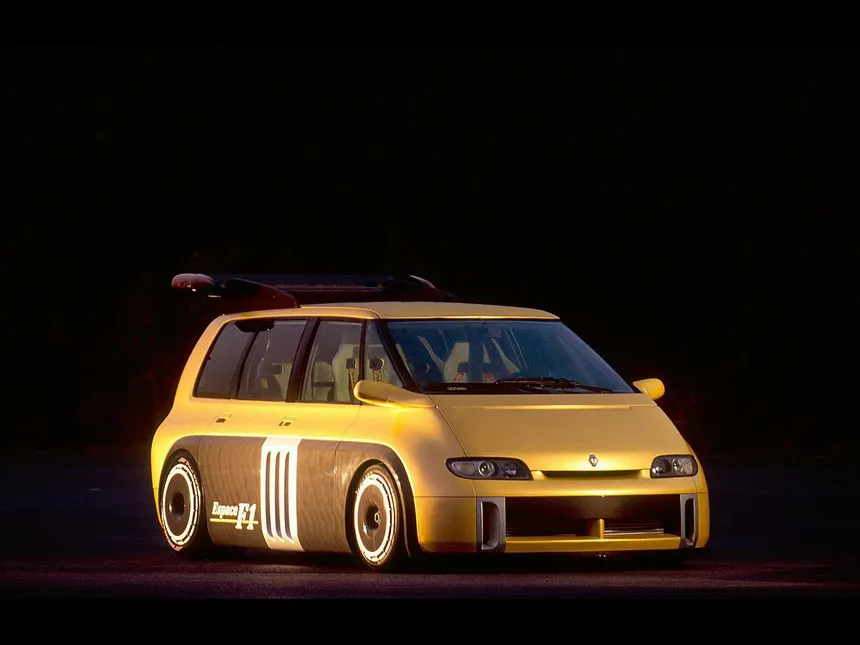
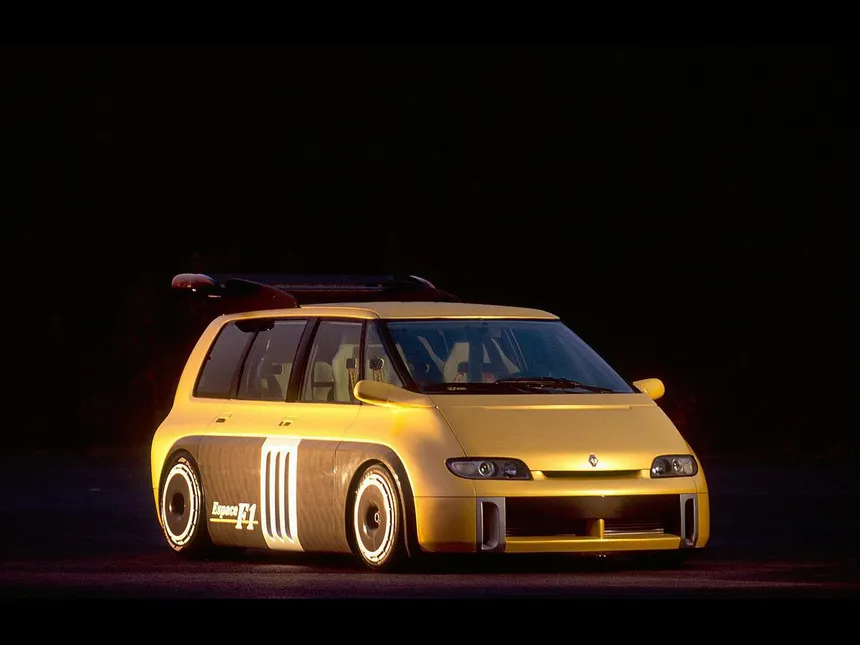
The Renault Espace F1: The Minivan That Was Faster Than a Ferrari F40
Americans have a complicated relationship with minivans. We need them but we don’t want to admit it. The Chrysler Voyager saved road trips. The Honda Odyssey saved soccer practice. But nobody — absolutely nobody — has ever called a minivan exciting.
Except once. In 1994, Renault took their Espace — Europe’s answer to the minivan — and dropped a Formula 1 engine inside it. Not a “Formula 1 inspired” engine. Not a “performance variant.” The actual V10 from the Williams FW15C that won the 1993 F1 World Championship. Into a minivan.
The result was faster than a Ferrari F40, louder than a NASCAR stockcar, and shaped like the vehicle you’d use to haul your kids to Little League. Welcome to the most insane concept car ever built.
Why This Exists
To appreciate the Espace F1, you need some European context. In 1994, Renault was the dominant engine supplier in Formula 1. Their 3.5-liter V10 had powered Williams to consecutive Constructors’ Championships in 1992 and 1993, with Nigel Mansell and Alain Prost winning the Drivers’ titles respectively.
Simultaneously, the Renault Espace was one of Europe’s best-selling family vehicles. Launched in 1984, it essentially created the European MPV (Multi-Purpose Vehicle) segment — think of it as France’s Chrysler minivan. It was everywhere.
Renault had two crown jewels in completely different worlds: an unbeatable F1 engine and a wildly popular family hauler. Someone in the company — likely fueled by equal parts ambition and wine — asked the obvious question: what if we put one inside the other?
The project was developed jointly by Renault Sport and Matra (the company that manufactured the Espace bodywork). This wasn’t a marketing stunt built from duct tape and dreams. It was a serious engineering project with a real budget.
The Numbers That Make No Sense
Here’s where things get genuinely ridiculous:
- Engine: Renault RS6 V10, 3.5 liters, naturally aspirated
- Power: Approximately 820 hp at 13,000 rpm
- Torque: ~229 lb-ft
- Weight: 2,866 lbs (1,300 kg) — full carbon fiber body
- Power-to-weight ratio: 3.5 lbs per hp
- 0-60 mph: Approximately 2.6 seconds
- 0-125 mph: 6.9 seconds
- Top speed: ~194 mph
Read those numbers again. A minivan. 2.6 seconds to 60. 194 mph top speed. Shaped like a family bus.
For context: a Ferrari F40 did 0-60 in about 3.8 seconds. A Porsche 959 managed 3.6. The McLaren F1 — the fastest production car on the planet at the time — did 3.2. The Espace F1 destroyed all of them to 125 mph.
If this were an American project, it would be like someone dropping a Top Fuel dragster engine into a Dodge Grand Caravan. Except the French actually built it.
How They Actually Did It
This wasn’t a simple engine swap. You can’t just unbolt a four-cylinder from a family car and drop in a Formula 1 V10. That would be like replacing a ceiling fan motor with a jet turbine — theoretically possible but practically suicidal without a complete redesign.
The foundation was a brand-new chromoly steel tubular chassis inspired by competition prototype construction. Nothing from the original Espace survived structurally. The RS6 V10 — identical to the unit that powered Prost to his fourth World Championship — was mounted longitudinally in a mid-rear position. Behind the seats. In what looks like a minivan.
The transmission was a six-speed sequential gearbox derived from competition applications. Suspension was double-wishbone at all four corners with adjustable dampers. Brakes were carbon-ceramic discs — the same technology used in F1 cars. Wheels were 18-inch with Michelin competition tires.
The bodywork maintained the Espace’s recognizable silhouette — that was the entire point — but was manufactured entirely from carbon fiber and Kevlar. Windshield and windows were polycarbonate. Everything was designed to minimize weight while preserving the minivan appearance.
The finished product weighed 2,866 pounds — remarkably, the standard Espace of that era weighed about 3,086 pounds with its 150-hp gasoline engine. The F1 version weighed less than stock but made more than five times the power.
The interior was equally absurd: four individual racing bucket seats with four-point harnesses, a steering wheel with a digital display, full competition instrumentation. All in carbon fiber. Somewhere between a Le Mans prototype and your neighbor’s carpool vehicle.
The Demonstration Runs
The Espace F1 debuted at the 1994 Paris Motor Show. The media reaction was immediate and massive. Nobody had ever seen anything like it. This wasn’t a rendering or a clay model — it was a functional vehicle that could be started and driven.
Renault proved this by taking journalists as passengers on circuit. The footage from those rides is legendary: a vehicle with the silhouette of a family car cornering like a racing prototype while the ear-splitting howl of a V10 at 13,000 rpm echoes off the grandstands. Journalists who rode in it described the experience as terrifying. Imagine sitting in what looks like a normal people carrier and being launched to 125 mph in under seven seconds while it sounds like the end of the world is happening behind your headrest.
Eric Bernard, then an F1 driver for Ligier, was one of the demonstration pilots. He reportedly described the experience as “fun but completely crazy” — a vehicle with a much higher center of gravity than an F1 car but identical power.
Why Americans Should Care
You might be thinking: this is a European story about a European car. Why should anyone in Topeka or Tampa care about a French minivan with a race engine?
Because the Espace F1 represents something universal: the absolute best version of doing something nobody asked for. America has a rich tradition of this — dropping big-blocks into anything with wheels. Hellcat-swapped Jeep Grand Cherokees. LS-swapped Miatas. The Dodge Viper, which was essentially a V10 truck engine in a two-seat roadster.
The Espace F1 is the French equivalent of that spirit, cranked up to eleven. It’s proof that the impulse to take something mundane and make it unreasonably fast transcends nationality. That instinct lives equally in Detroit garages and Parisian engineering labs.
Also, 820 horsepower in a minivan. If that doesn’t make you smile, check your pulse.
The RS6 Engine: Formula 1 Royalty
The Renault RS6 deserves special attention because it’s one of the most successful engines in F1 history. This 3.5-liter naturally aspirated V10 produced between 780 and 820 horsepower depending on specification, revving to 14,000 rpm in full race configuration. For the Espace F1, it was slightly limited to 13,000 rpm for durability reasons — exploding with journalists aboard would have been bad PR.
The RS6 powered Williams to F1 dominance in 1992-1993. Mansell won 9 of 16 races in 1992 with this engine. Prost won 7 of 16 in 1993. It was so superior that rival teams spent millions trying to match its performance without success.
Installing it in a minivan wasn’t just an engineering exercise — it was a statement. Renault was saying: our F1 engine is so good it can make a family bus faster than every supercar on earth.
Where Is It Now?
The Espace F1 is a one-of-one creation. Only a single example was ever built. It currently resides in Renault’s heritage collection and is occasionally displayed at events and automotive museums. It was never sold, never auctioned, and likely never will be. It’s a relic of an era when automakers could afford to be creatively insane without worrying about social media backlash or shareholder meetings.
The Bottom Line
The Renault Espace F1 is what happens when someone asks “what if?” and nobody has the common sense to say no. It’s an absurdity on wheels. A contradiction with a steering wheel. And one of the most brilliant ideas any automaker has ever had.
820 horsepower in a minivan. Faster than an F40. Shaped like a family hauler. In America, we respect anyone with the audacity to build something this gloriously unnecessary. The French don’t get enough credit for their automotive madness, but with the Espace F1, they earned permanent respect.
In a world where every concept car is a pretty rendering with no soul, the Espace F1 was real. It started, accelerated, and terrified everyone who rode in it. And that, my friends, is priceless.
Greasy hands, no filter. That’s NEC.
1 thought on “RENAULT ESPACE F1”