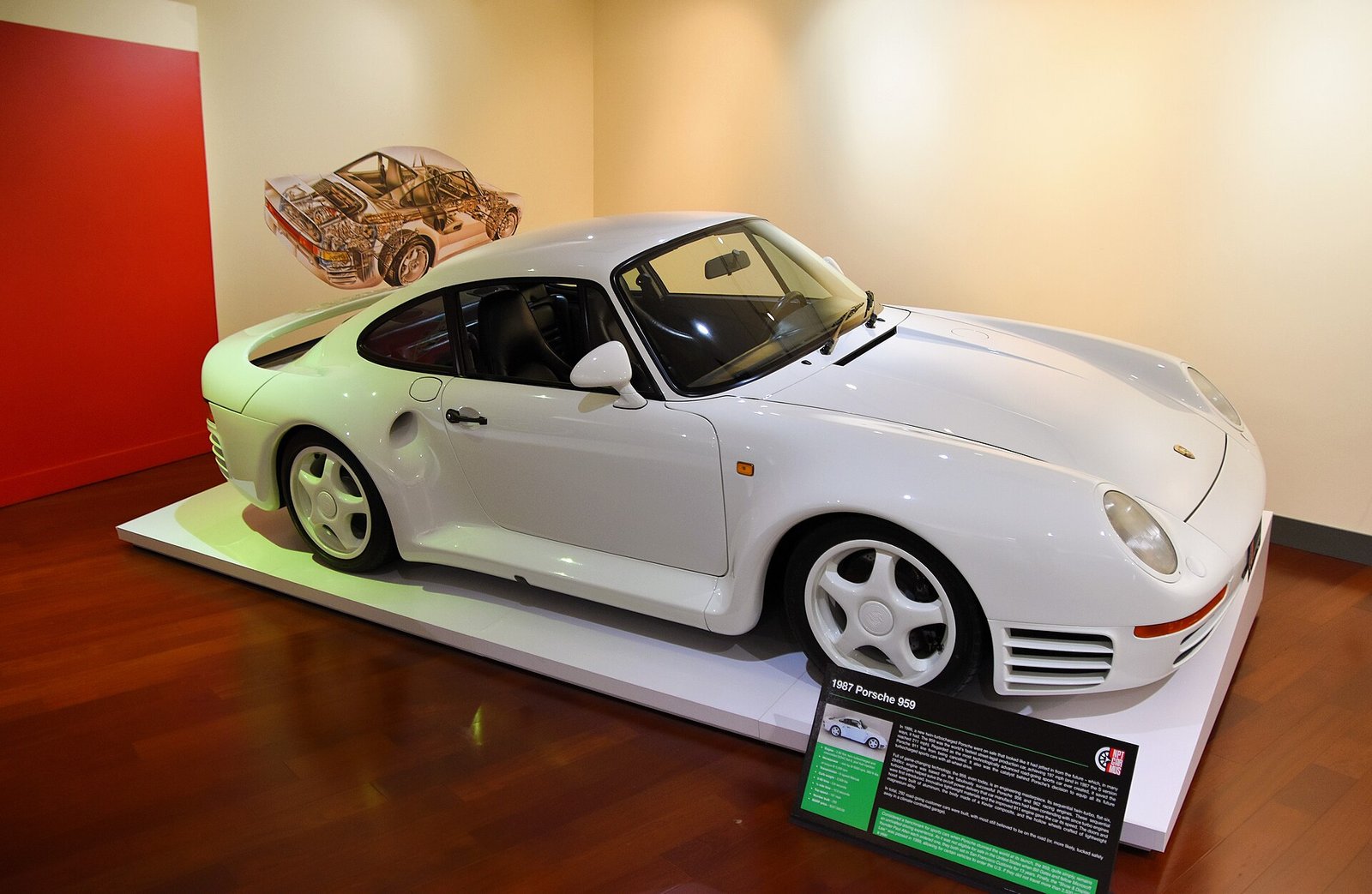
In the late 1980s, Bill Gates bought one of the most advanced cars on earth and shipped it to the United States. It never made it onto the road. U.S. Customs impounded it, because the Porsche 959 had never been certified to meet American emissions or crash standards, and it sat in storage for years. Gates wasn’t alone; Microsoft co-founder Paul Allen owned a 959 too. Owners and collectors pushed Washington for a way out, and in 1999 Congress created the "Show or Display" exemption, which lets certain historically or technologically significant cars be imported and driven in limited numbers of miles per year.
A Porsche changed federal law. That tells you how special it was, and why, almost four decades later, people still talk about it as the car that showed everyone else the future.
Built for a racing class that died
The 959 started in the early 1980s as Porsche’s answer to Group B, the rally category that let manufacturers homologate near-race cars by building just 200 road versions. The "Gruppe B" concept appeared at the 1983 Frankfurt show. But Porsche, being Porsche, didn’t settle for a rally car with license plates. It turned the project into a rolling laboratory. The driving force was Helmut Bott, Porsche’s head of research and development, who saw Group B as an excuse to build the technological showcase he wanted anyway: a car that would show the world, and Porsche’s own management, where the sports car was heading. At a time when some at Porsche thought the 911 had run its course, the 959 was also an argument that the 911’s basic shape still had a future.
From the outside it looked like a 911 that had been to the gym. Underneath, almost everything was new. The body used Kevlar, other composites and aluminum. The suspension let the driver adjust ride height and damping from the cabin, and lowered itself automatically at speed. In 1986, years before most luxury sedans offered anything like it.
Then Group B was canceled after the fatal crashes of 1986, and the 959 never raced in the World Rally Championship it was designed for. While Porsche was refining its masterpiece, the lighter and simpler mid-engined, all-wheel-drive Peugeot 205 T16 won the 1985 and 1986 titles. The 959 found other proving grounds: the desert, and Le Mans.
The engine: 2.85 liters of cleverness
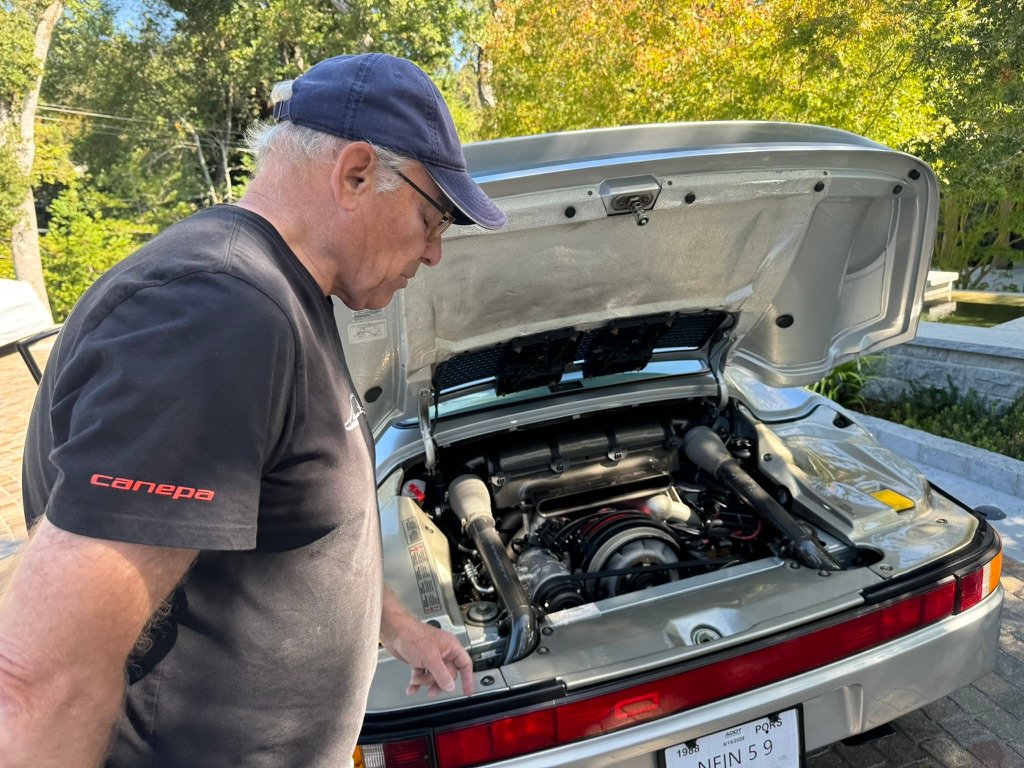
At the heart of the 959 was a 2,849 cc twin-turbo flat-six with sequential turbocharging. A small turbo did the work at low rpm for quick response, and a second, larger one came in higher up for peak power. The result was 450 hp and 500 Nm, about 369 lb-ft, delivered with a smoothness unheard of in an era when turbo engines did nothing, then everything at once.
A word on why sequential turbos mattered. A turbocharger is a small turbine spun by exhaust gas, which drives a compressor that forces extra air into the engine. A big turbo makes big power but needs a lot of exhaust flow to get spinning, so at low rpm nothing happens, and then the boost arrives all at once. That delay is turbo lag, and in the early ’80s it made turbo cars notoriously tricky. Using a small turbo first and a large one later gave the 959 strong response low down and huge power up top, without the on-off switch effect.
The cylinder heads were water-cooled while the cylinders stayed air-cooled, a hybrid solution that sounds crazy but kept the hottest parts of a highly stressed engine under control without giving up Porsche’s traditional layout.
Top speed was 197 mph, about 317 km/h, making it the fastest production car in the world until the Ferrari F40 arrived the following year. Zero to 60 took well under four seconds. With mid-’80s technology, no launch control and nothing like modern traction control.
For context, the Ferrari 288 GTO, another Group B road car, had 400 hp and rear-wheel drive. The Lamborghini Countach of the day was rear-drive too, with a V12. Ferrari bet on lightness and rawness. Porsche bet on all-wheel drive and electronics. The 959 was the most radical answer to the big debate of the era.
The F40 rivalry
The 959’s great rival arrived in 1987, and it couldn’t have been more different. The Ferrari F40 had a twin-turbo V8 with 478 hp, rear-wheel drive, almost no comfort features and a curb weight hundreds of pounds lighter than the Porsche. It was the first production car to top 200 mph. The 959 was the engineer’s answer; the F40 was the racer’s. One was built to make speed accessible, the other to make it frightening, and both succeeded spectacularly. Fans have argued ever since about which was the better car, and the answer depends on the road and the weather. On a dry track, the Ferrari scared you and thrilled you. On a wet mountain road, the Porsche would simply leave it behind.
The secret weapon: smart all-wheel drive
The PSK all-wheel-drive system, from the German Porsche-Steuer-Kupplung, was the 959’s most revolutionary feature. Instead of a fixed mechanical center differential, it used an electronically controlled multi-plate clutch that decided how much torque to send to the front axle depending on conditions: most of it went to the rear in normal driving, with more shifted forward under hard acceleration or on slippery surfaces. The driver could pick programs for dry, wet, snow and maximum traction.
Combined with the adjustable suspension and ABS, it made the 959 not just fast but easy to drive fast. At a time when the 911 Turbo had a well-earned reputation for trying to kill its owners in the rain, the 959 was a revelation. That idea, intelligent all-wheel drive, later spread to everything from sports cars to family crossovers, as we explain in our piece on whether you really need all-wheel drive.
The desert and Le Mans
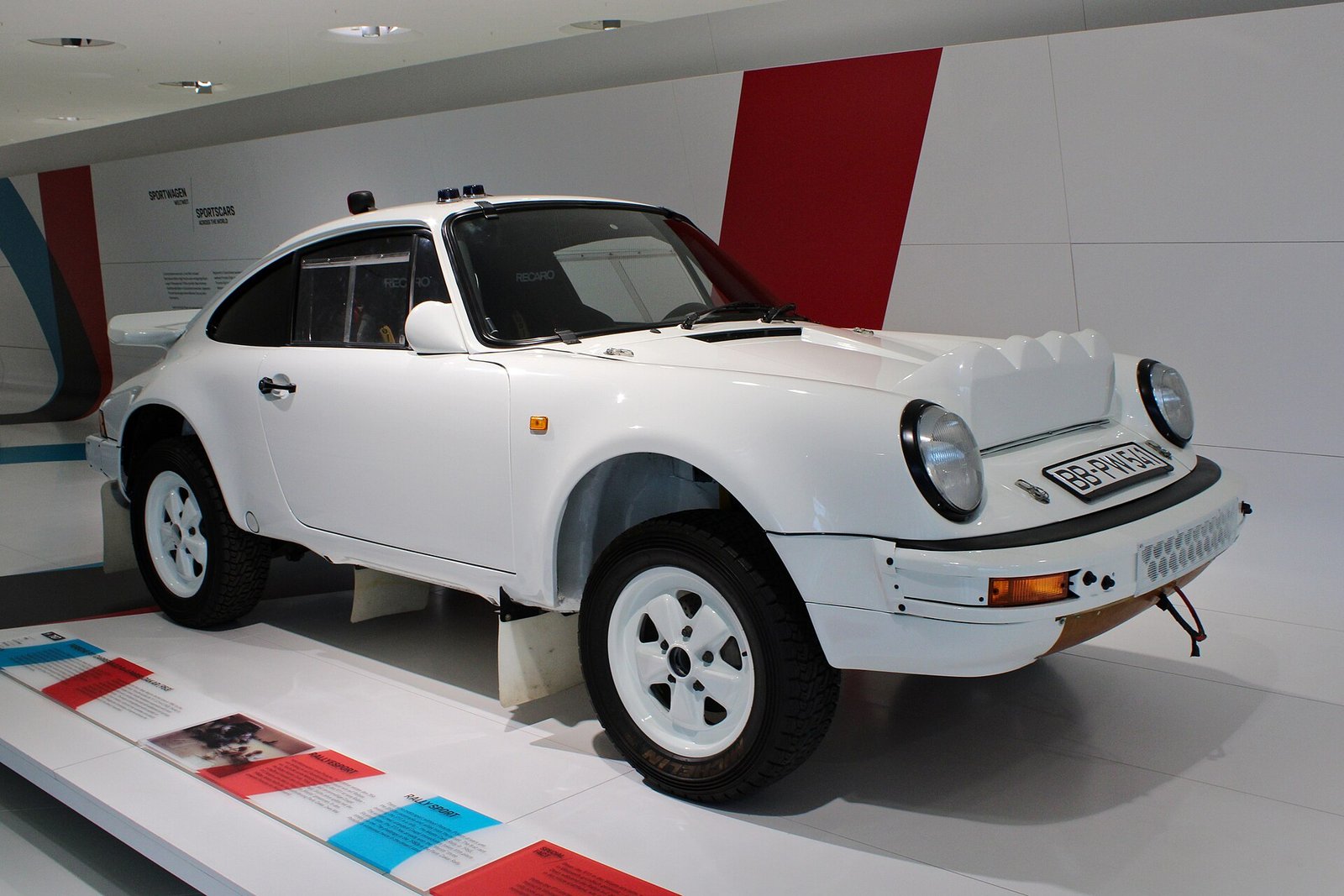
Porsche already knew how to win the Paris-Dakar. In 1984, René Metge and Dominique Lemoyne won it in the 953, a four-wheel-drive 911 that served as a first draft of the 959’s system. In 1985 the first 959-based rally cars entered and none reached Dakar. In 1986, with the system matured, Porsche entered three and finished first, second and sixth. Metge and Lemoyne won again; Jacky Ickx and Claude Brasseur were second. One of those Dakar cars later sold at auction for more than €5 million.
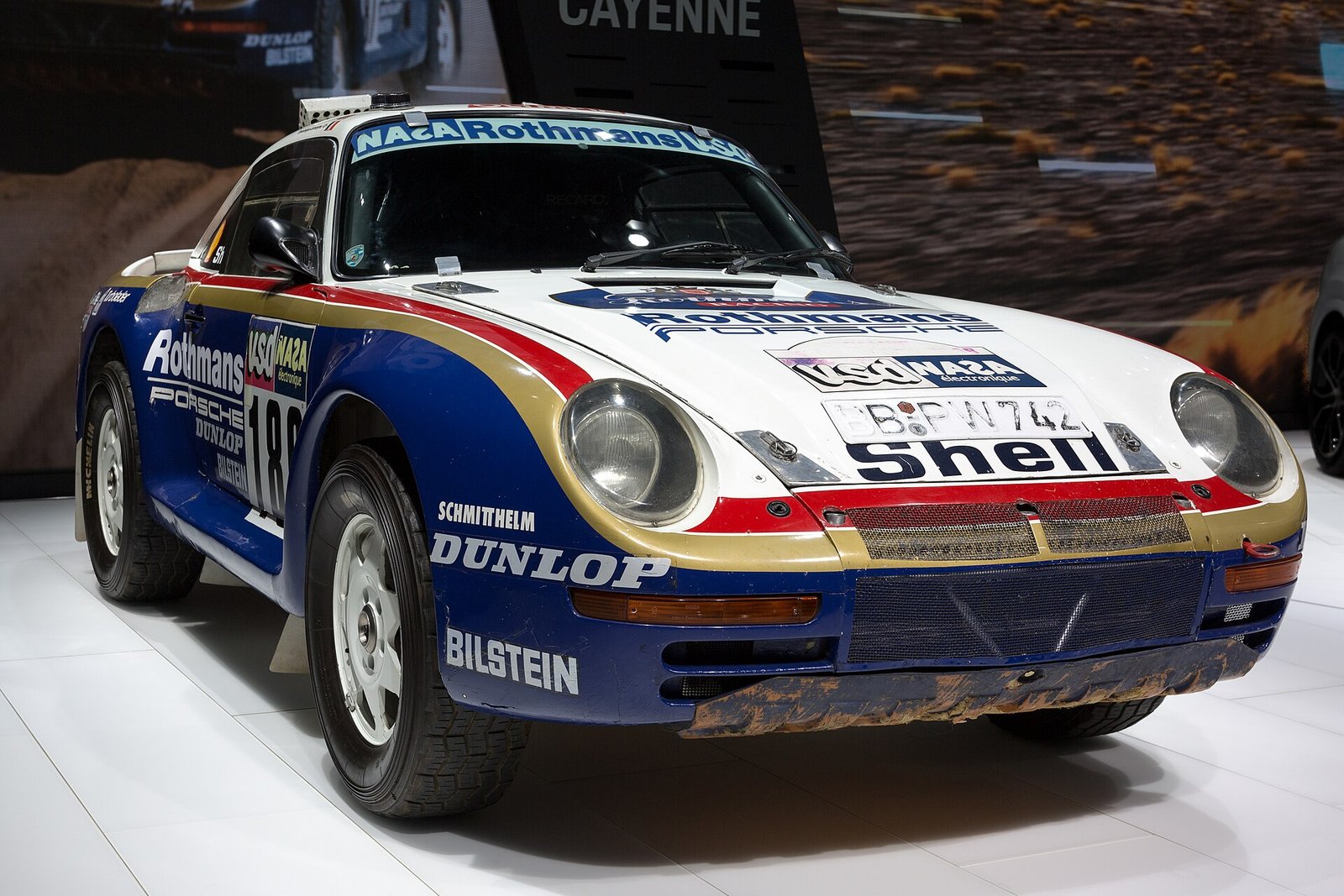
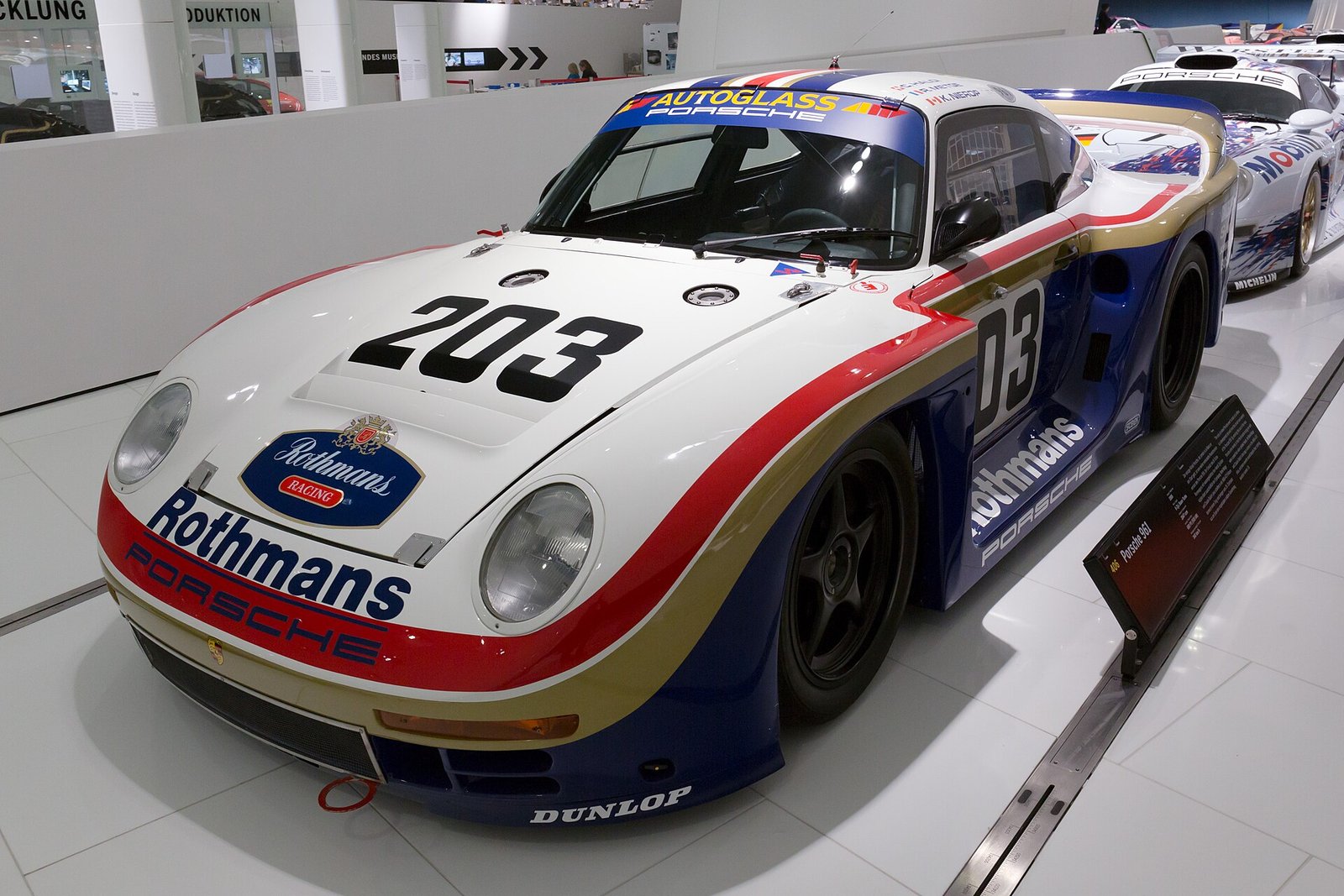
The circuit version, the 961, ran at the 24 Hours of Le Mans in 1986 and finished seventh overall, winning its class. An all-wheel-drive car at Le Mans, among Group C prototypes built purely for the track. The same technology worked in sand, mud and at full speed down the Mulsanne Straight.
Few, expensive and sold at a loss
Production figures vary by source: around 292 road cars for customers, and somewhere between 337 and 345 units in total if you count prototypes and pre-production cars. Most cars were the Komfort version, with rear seats and more equipment; a lighter Sport version, without rear seats, was built in much smaller numbers and is even more sought after today. It’s widely accepted that Porsche lost money on every one. The price, about 420,000 German marks, roughly $225,000 at the time, didn’t come close to covering development costs. For perspective, a 1986 Corvette cost well under $30,000.
But profit was never the point. Sequential turbos, electronically managed all-wheel drive, composite body panels and tire-pressure monitoring, built into hollow-spoke wheels, all spread into Porsche’s production cars over the following decades. The wheels alone were a small engineering project: hollow-spoke magnesium rims paired with a tire-pressure monitoring system, so the car could warn the driver of a slow puncture before it became a disaster at nearly 200 mph. Today almost every new car has tire-pressure monitoring. In 1987, it was exotic. The 959 was a lab that happened to be the fastest car in the world.
A Spanish 959 that ended up in Arizona
From Spain, where we write, there’s a footnote that ties the whole story together. According to Spanish outlet Diariomotor, only 12 Porsche 959s came to Spain. One of them, a 959 Komfort registered in Madrid in the late ’80s with the plate M-1854-LL, spent nearly two decades with its first owner, a Spanish businessman, who sold it in 2006. Its second owner, a Spain resident, moved to the United States in 2011 and took the car with him to New York through a specialist importer. It was later sold at RM Auctions in Arizona.
That trip was only possible because of the law Bill Gates and his fellow owners had fought for.
In America, the 959 also inspired a cottage industry. California specialist Bruce Canepa became famous for re-engineering 959s to meet US requirements and to make them faster and more reliable than when they left Stuttgart. The car that was once banned from American roads became one of the most celebrated restoration and upgrade projects in the American collector world. A car that couldn’t legally enter the US when new crossed the Atlantic two decades later as a recognized piece of automotive history.
Twenty years ahead
Look at any modern performance car: electronically managed all-wheel drive, twin turbos with minimal lag, adaptive suspension, composite body panels, tire-pressure monitoring. Today it’s all normal. In 1986, it all existed together in exactly one car.
The Nissan GT-R, the Bugatti Veyron and Porsche’s own 911 Turbo S all owe something to the 959’s proof that technology and electronics could make a car faster, safer and easier to drive at the same time. Even its spiritual successor, the hybrid Porsche 918 Spyder, followed the same logic: use the most advanced technology of the moment to redefine what a road car can do.
The numbers
- Engine: twin-turbo flat-six, 2,849 cc.
- Power: 450 hp.
- Torque: about 369 lb-ft.
- Top speed: about 197 mph.
- Weight: around 1,450 kg, about 3,200 pounds.
- Drive: all-wheel drive with the PSK system.
- Price when new: about 420,000 German marks.
What it left behind
The 959 is the moment Porsche stopped asking how much faster it could make a 911 and started asking how far it could push automotive technology. The answer turned out to be about twenty years into the future.
Few were built. Every one lost money. None of that matters, and nobody who has ever driven one has complained about the bill Porsche paid. The 959 won the Dakar, set records, rewrote the blueprint for the supercar and, along the way, changed American import law. With six cylinders, by the way, which is sometimes more than enough to change the world.
The 959’s full-width taillight bar turned up again on a car Porsche never acknowledged: the Schuppan 962CR, a road-legal 962 that cost 195 million yen in 1992.
How the sequential turbos the 959 introduced actually work, and why Mazda claimed the first three years later, is in twincharging and twin-turbo explained.
How the Diablo stacked up when it was sold as the world’s fastest production car is in Gandini’s lost Diablo design.
Check you’re still alive.
Photos: Charles from Port Chester (CC0); CarizmaGuy (CC0); Alexander Migl (CC BY-SA 4.0); Matti Blume (CC BY-SA 4.0); Morio (CC BY-SA 3.0). Via Wikimedia Commons.