Lamborghini Diablo and Gandini’s Lost Design: Seven Tries, Seven Catches
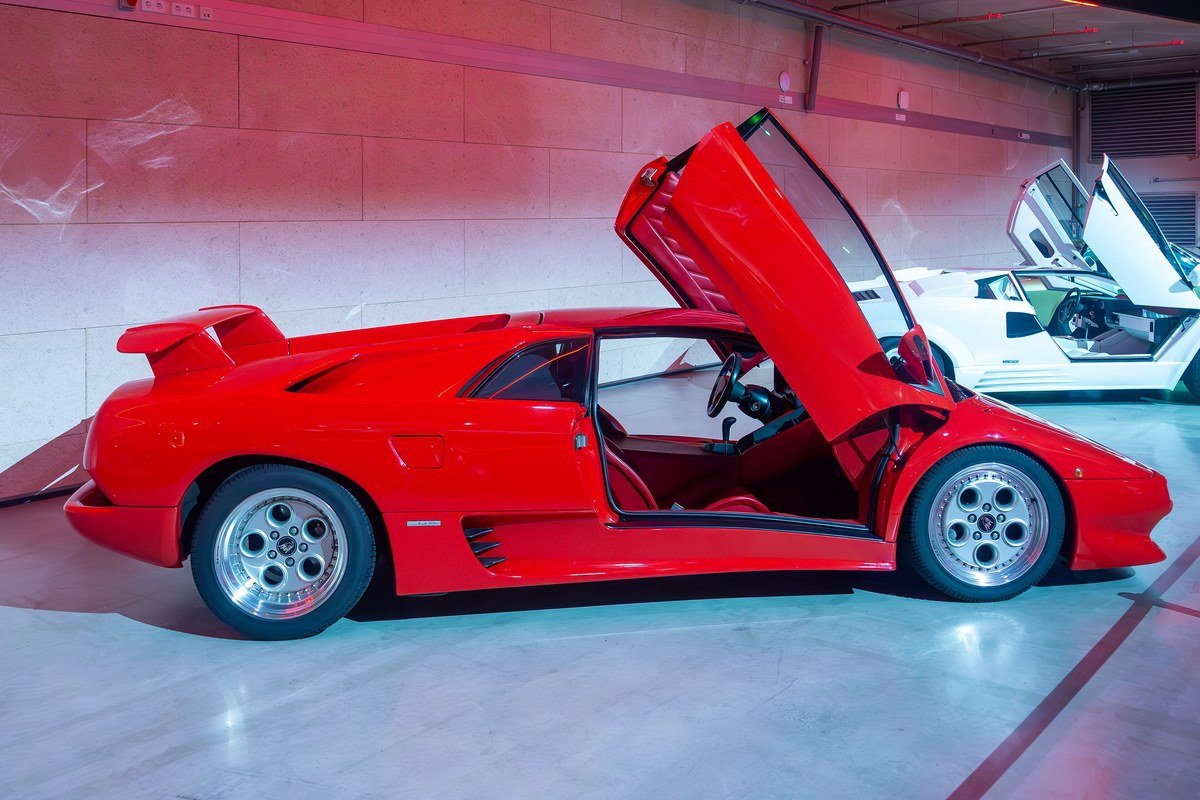
Detroit bought a fighting bull in 1987 and spent the next three years filing down its horns. Everything that came after, a V16 bankrolled by the king of disco, a Zagato with a fighter-jet canopy, a race car nobody raced, a French one-off, a Mexican Lamborghini the factory pretends doesn’t exist and a $1.3 million restomod, is the bull trying to grow them back.
Start at the end. August 2024, The Quail, the most polite lawn party of Monterey Car Week. Between the Paganis and the pre-war Bugattis sits a carbon-fiber Lamborghini Diablo with a gated six-speed shifter, built in San Marino and priced at about $1.3 million before you hand over your own Diablo to be cut up. The crowd loves it. Grown men take selfies with it. Almost none of them know that the shape they’re photographing is the version its designer refused to call his.
Brendan Fraser made the same deal in Bedazzled in 2000. Seven wishes from Elizabeth Hurley’s devil, every one of them granted, every one of them rigged. The car business has been running that script since 1985.
The drawing Detroit didn’t want
In June 1985, Lamborghini was owned by the Mimran brothers, Jean-Claude and Patrick, Swiss-based financiers whose family money came from sugar and flour in Senegal. They had picked the company out of receivership in 1980, and they needed a replacement for the Countach, the car on every teenage bedroom wall in America. They called it Project 132. The brief asked for at least 196 mph.
There was only one man to call. Marcello Gandini had drawn the Miura at 27 and the Countach a few years later. Between those two cars he had more or less invented the visual language of the mid-engined supercar. His proposal for Project 132 was pure Gandini: sharp, angry, all edges.
Then, in April 1987, Chrysler bought Lamborghini for something like $25 million. Lee Iacocca had just pulled Chrysler back from the dead with K-cars and minivans, and an Italian supercar brand looked like a nice ornament for the lobby. Chrysler money also sent Lamborghini into Formula 1 as an engine supplier, which ended with 49 starts and no wins. You could argue Detroit was generous. You could also argue it had no idea what it had bought.
The new owners looked at Gandini’s drawing and didn’t like it. Lamborghini had already softened it once; Chrysler ordered another pass, done by the Chrysler Styling Center under Tom Gale. This is the same design boss whose studio produced the Dodge Viper concept in 1989 and, later, the Chrysler Atlantic. Gale’s people were good. That wasn’t the point. The point was that a Michigan design department was rounding off the edges of the man who drew the Miura, so that the car would go down easier with American buyers. It's also said, though we found nothing on paper to back it up, that the cabin Gandini had drawn was redone from scratch in Michigan.
By the end, Gandini’s silhouette was still there. Almost everything that made it his was gone. He never made a secret of how little he liked the result, and what he did next proves it.
A car that was briefly the fastest thing you could buy
The Lamborghini Diablo went public on January 21, 1990: a 5.7-liter V12 with 485 hp and 428 lb-ft, rear-wheel drive in its first form, and a claimed top speed of 202 mph. It was the first production Lamborghini past the 200 mph mark, and the company sold it as the fastest production car in the world.
That claim deserves a footnote. Ferrari quoted 201 mph for the F40 in 1987, so the Diablo’s edge was one mile per hour, on paper. The Porsche 959 topped out at 197. And the crown didn’t last: the Bugatti EB110 GT of 1991 claimed 213 mph, and the Jaguar XJ220 of 1992 went past 212. The Diablo was the fastest car on sale for exactly as long as it took the competition to show its next one.
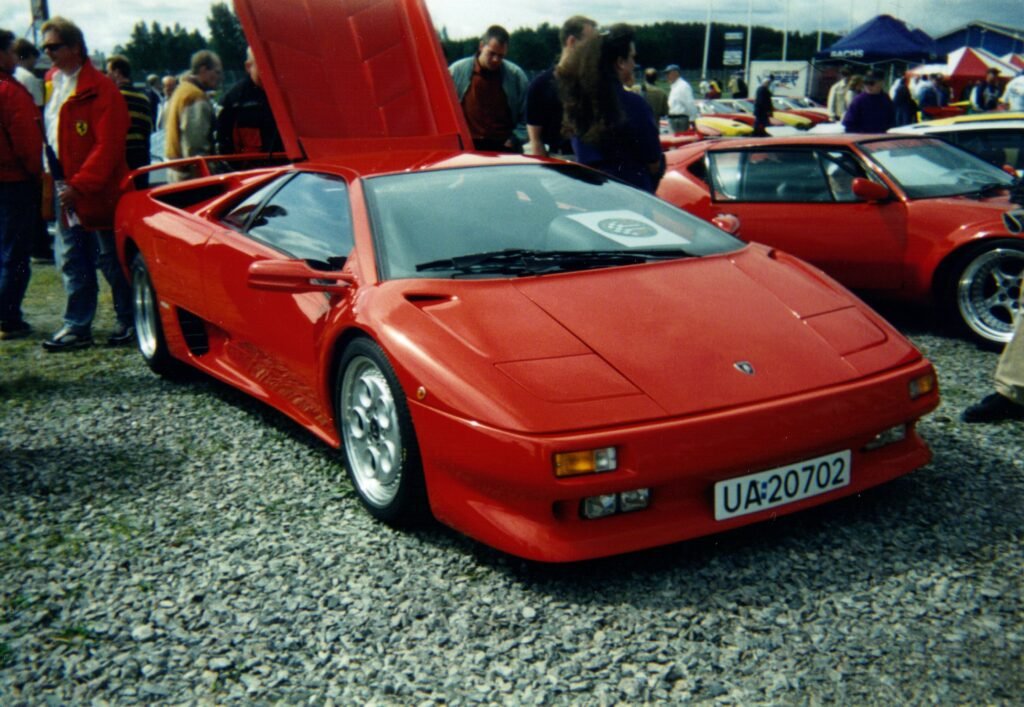
In the US, a 1991 Diablo listed at around $211,000. Lamborghini built 2,903 of them by the time production ended in 2001, and for a whole generation of American kids the Diablo was the Lamborghini, the one they first drove in the original Need for Speed in 1994.
Named after a Spanish bull nobody can find
Here’s a detail Lamborghini loves to tell and almost nobody checks. The Diablo isn’t named after the devil. It’s named after a bull.
According to the factory, Diablo was a fighting bull from the ranch of the Duke of Veragua that fought an epic battle against a matador called “Chicorro” in Madrid on July 11, 1869. Chicorro was real: José Lara, a bullfighter raised in Jerez whose biography sits in Spain’s Royal Academy of History. The Duke of Veragua that year was Cristóbal Colón de la Cerda, a direct descendant of Christopher Columbus. So the supercar Chrysler paid for and sanded down in Michigan carries the name of a bull raised on the land of the family of the man who landed in America. It took four centuries for that one to come full circle.
It gets better. The Duke of Veragua was a close friend of Antonio Miura, the Seville breeder whose family name was already on Gandini’s first supercar. The two cars that bookend Gandini’s career at Lamborghini are named after two Spanish cattle ranches whose owners argued about bulls at the same table.
And here’s the part that nobody seems to have looked at: every website on the planet repeats the story of the bull Diablo, citing each other. In the Spanish bullfighting chronicles we were able to search, the bull and the afternoon don’t show up. The matador existed. The ranch existed. The bull, so far, lives only in Lamborghini’s press kit. Fitting, for a car whose real design never quite existed either.
One more name story, and this one is pure rumor. It says that in Mexico the Diablo was sold from 1993 to 2000 as the Lamborghini Costanga, detuned to 440 hp, because "Diablo" didn't sit well in a deeply Catholic country. Nobody has ever produced a photo of a Costanga or its badge, so file it under bar talk until someone does.
Wish two: Gandini takes his drawing to Los Angeles
Gandini didn’t sulk. He took the rejected drawing to Claudio Zampolli, a former Lamborghini test and development engineer who had moved to Los Angeles and built a business selling and servicing exotic cars. One of his customers brought in a Countach for service. His name was Giorgio Moroder.
Yes, that Moroder. The Italian producer who invented the sound of disco with Donna Summer, scored Midnight Express, wrote the Flashdance and Top Gun hits and took home three Oscars. He had money, he had Hollywood, and he had the appetite for excess that only a man who’d conquered the ’70s and ’80s can have. Zampolli’s initials, C.Z., pronounced in Italian, gave the company its name: Cizeta. Moroder’s money put his name next to it.
The Cizeta-Moroder V16T used Gandini’s original Project 132 nose, now with four pop-up headlights. Zampolli redid the tail himself. And then he did something no sane person would do. He gave it sixteen cylinders: a 6.0-liter V16 mounted sideways behind the cabin (that’s the T, for transverse), effectively two 90-degree V8s related to the Lamborghini Urraco engine, sharing one block, with the drive taken from the middle. Eight camshafts, 64 valves, 540 hp at 8,000 rpm, a claimed 204 mph. The prototype also weighed 3,750 lbs, more than an all-wheel-drive Diablo VT.
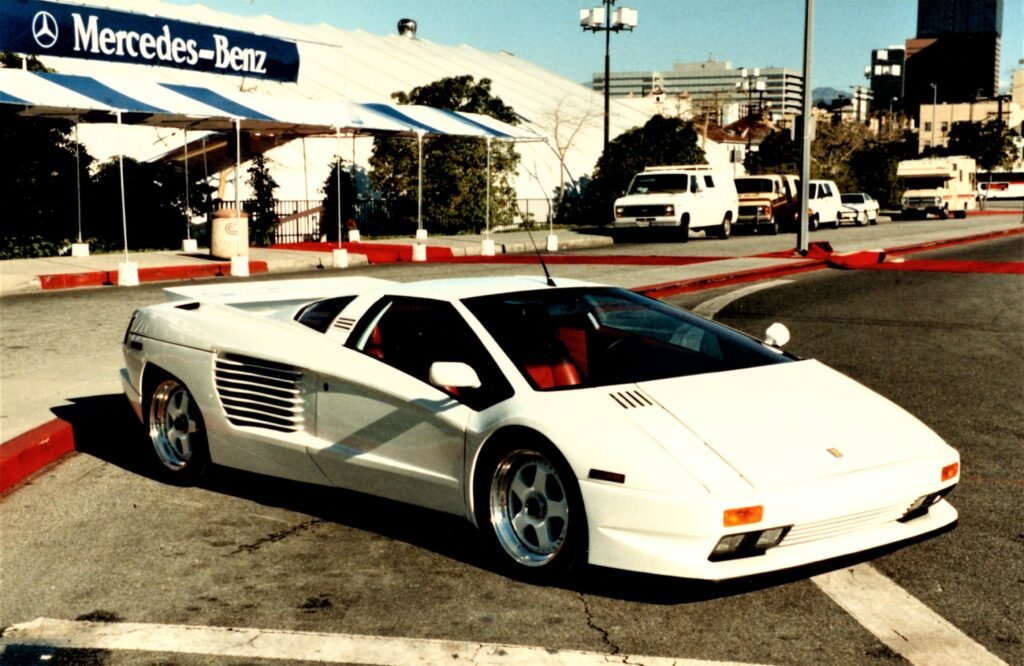
Chassis 001 was shown in Los Angeles in December 1988 and at Geneva in 1989. Then the partners fell out. Moroder couldn’t see why production was crawling and floated building the car with a fiberglass body and a BMW engine instead of the V16. One story, which we couldn't confirm, has him calling Uwe Gemballa in Germany behind Zampolli's back to sound out the idea. For Zampolli, that was like asking Gandini to style a minivan. Moroder walked, his name came off the car, and the customer cars were sold as plain Cizeta V16T at around $300,000 in 1991 money, about 40 percent more than a Diablo.
Final count: eleven cars including the prototype and one Spyder. Eight were built in Modena between 1991 and 1995; the last three were finished in Fountain Valley, California, between 1999 and 2003, after Zampolli moved what was left of the company to Orange County. Chassis 001, the only one with the Moroder badge, was restored by Canepa in 2018 and sold by RM Sotheby’s in Arizona in January 2022 for $1,363,500. Zampolli died on July 7, 2021, at 82, still insisting the car was available to order.
Gandini’s design had finally been built. In eleven copies, behind a closed garage door in California.
Wish three: Zagato makes it wilder
In the mid-’90s, Zagato and a Swiss businessman named Alain Wicki took a Diablo VT, with its all-wheel drive and 485-hp V12, and wrapped it in a new carbon-fiber body drawn by Norihiko Harada. It had no conventional doors. The whole middle of the car tilted forward like a fighter canopy. They threw out the ABS and traction control to save weight and fitted bigger brakes to make up for it.
The Raptor wasn’t a styling buck. It ran, it drove, it stopped, and when it was shown at Geneva in 1996 people left convinced it was ready for a short production run. Lamborghini, which had cooperated on the project, said no. No reason anyone has ever pinned down. Wicki kept the only car until 2000 and auctioned it at the Geneva show to a private collector.
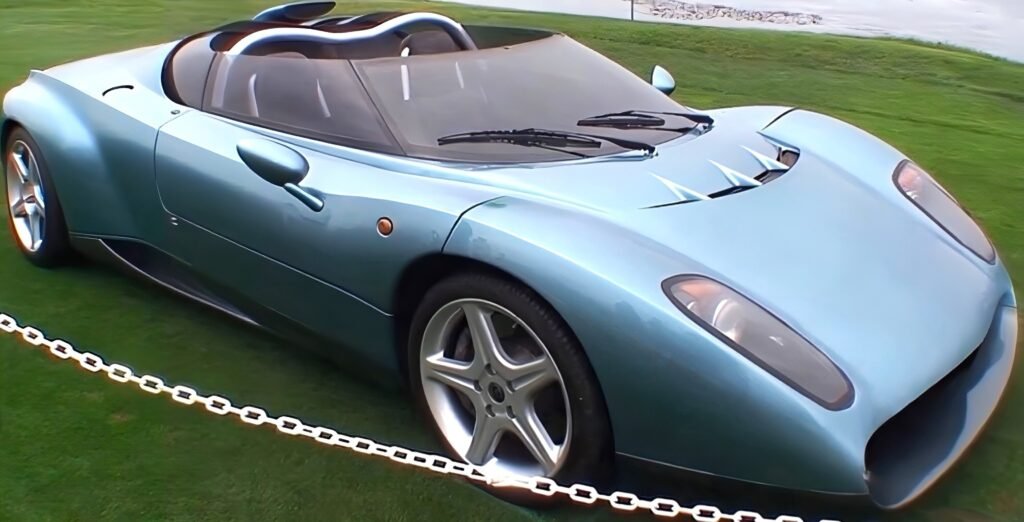
The wish was a wilder Diablo. The catch was that the one person who had to say yes didn’t care.
Wish four: a race car for the street
At the same time, in Toulon, on the French Riviera, a race-car shop called SAT (Signes Advanced Technology) built a Diablo for the GT1 class, where it would have faced the Porsche 911 GT1, the McLaren F1 GTR and the Mercedes CLK GTR. GT1 rules needed a road version to exist. Lamborghini supplied a V12 stroked to 6.0 liters, good for 646 hp at 7,500 rpm and 507 lb-ft. SAT built everything else: a tube-frame chassis, new suspension, an all-carbon body. Curb weight: 2,315 lbs. A regular Diablo VT weighed about 3,580. That’s 1,200-plus pounds gone and more than 160 hp added. Nobody has built a lighter Diablo since.
Two were made. The race car went to the Japanese team JLOC, which ran it in the All-Japan GT Championship from 1997 to 2000 without much to show, rebuilt it as the Diablo JGT-1, and retired it in 2004. The other, yellow and without the big rear wing, became the Stradale, plated and street-legal.
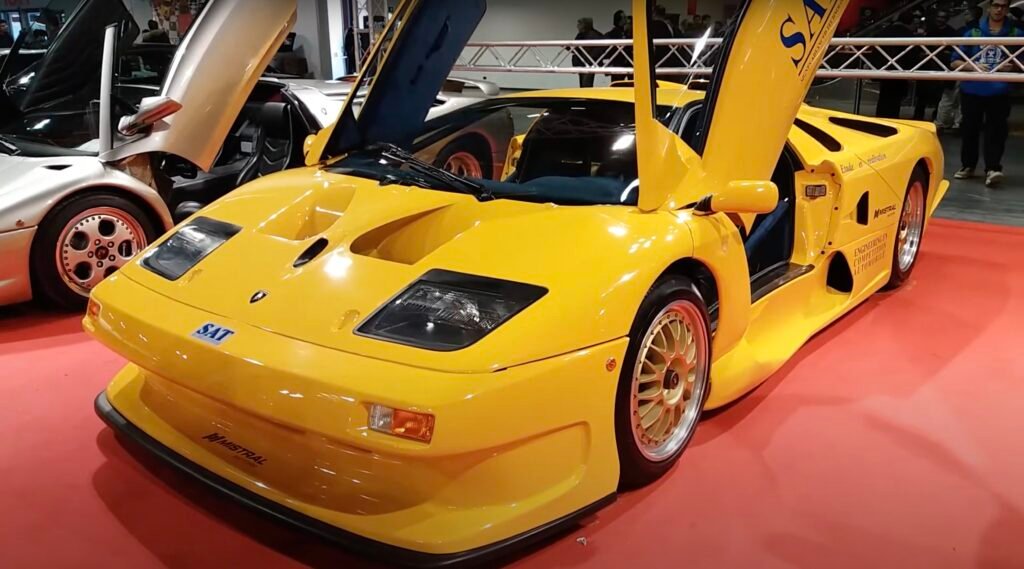
And then the catch. Chrysler had already sold Lamborghini in 1994, and the company was bleeding money under its new owners. Nobody had cash for a GT1 program. When Audi took over, it preferred to build its own Diablo GT and GTR racer, and the SAT car was forgotten. The Stradale stayed in France until Mistral Motors in Italy bought it.
Wish five: the French fighter jet with a Spanish name
In October 1998, French coachbuilder Heuliez rolled out the Pregunta at the Paris show. Under the carbon body was a Diablo, converted to rear-wheel drive, with the 5.7-liter V12 pushed to about 529 hp and a five-speed manual. The look was lifted from the Dassault Rafale fighter. Inside: a wraparound windshield, Magneti Marelli digital gauges, cameras instead of mirrors, navigation and fiber-optic interior lighting. In 1998 that was science fiction.
The designer was Marc Deschamps, a Belgian who had worked at Bertone under Gandini in the early ’70s and replaced him as Bertone’s head of design in 1979. His best-known Lamborghini was the Jalpa. So the man who took Gandini’s chair was now redrawing the car Gandini had lost, with a jet fighter for a muse.
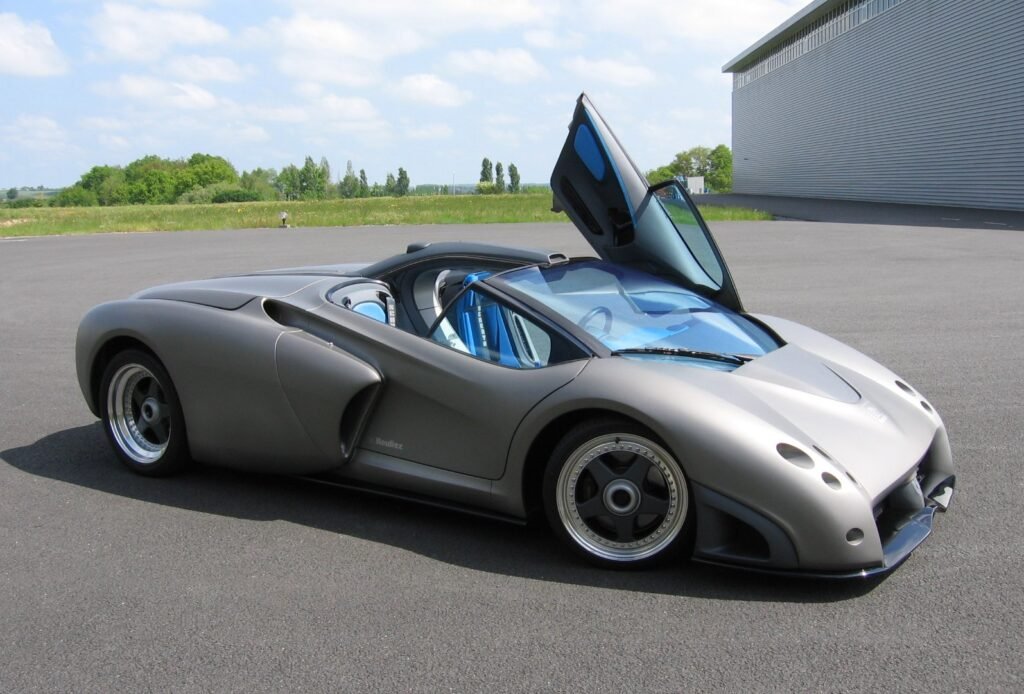
The name, by the way, isn’t Italian. Pregunta is Spanish for “question,” in line with Lamborghini’s habit of borrowing its names from Spanish bullfighting. And the question was obvious: what would the Diablo have become if nobody had reined it in?
The timing killed it. Audi had signed for Lamborghini that June, four months before Paris. The future the Pregunta was pitching already had a new owner with its own plans, which became the Murciélago and the Gallardo. Heuliez kept its one-off for nearly a decade before selling it. Lamborghini’s own heritage department, Polo Storico, certified it in 2014. In October 2025, Broad Arrow sold it at the Zoute Concours in Belgium for €2,143,750, below estimate. It had taken sixteen years for the family to acknowledge it.
Wish six: the Lamborghini built in Mexico
The strangest one comes from south of the border. In 1994 Chrysler sold Lamborghini to MegaTech, a Bermuda-registered outfit controlled by Tommy Suharto, son of Indonesia’s dictator, with a Malaysian partner, for a rumored $40 million that was never officially confirmed. The same Tommy Suharto who was later convicted of ordering the murder of a Supreme Court justice. That was who owned the bull now.
In that chaos, a Mexican businessman named Jorge Antonio Fernández García, who goes by Joan Ferci, says he signed a deal giving him the rights to build, assemble and restyle Lamborghinis for Mexico and Latin America. For 99 years. Lamborghini’s position, stated publicly in 2007, is that no such license for South America exists. The company, Automóviles Lamborghini Latinoamérica, was real enough. So were the cars.
Ferci took a Diablo, reskinned it with gill-like side intakes and stretched headlights, claimed 635 horsepower from the V12, and called it the Coatl, after Quetzalcóatl, the feathered serpent of Aztec myth. It took four years and appeared in 2000, with a claimed 239 mph nobody has ever verified. By Ferci’s count, three were built: one went to Belgium, one to Germany, one stayed in Argentina. Then came the Alar 777, another Diablo-based car with a 7.7-liter V12, and later announcements of Lamborghini-branded electric SUVs built in Mexico. As recently as July 2026 he was telling Paraguayan press that his agreement is genuine. Sant’Agata, now under Volkswagen, still recognizes none of it.
Put it next to the Zagato Raptor and it’s a mirror image. One redesign the factory killed by not caring; the other it killed by pretending not to see it.
Wish seven: the restomod
Which brings us back to that lawn in Monterey. Emanuel Colombini runs the Colombini Group, a furniture giant based in San Marino, and has been obsessed with the Diablo his whole life. Some accounts add that he fell for it on a Quattroruote cover and that he races in Lamborghini's Super Trofeo; we couldn't confirm either. He founded Eccentrica Cars and handed the design to BorromeodeSilva, the Milan studio of Michael Borromeo and Giorgia De Silva.
The first version, shown in July 2023, had headlights that flipped down instead of up. By the time the real car rolled onto the grass at The Quail in August 2024, that idea was gone and the pop-ups were back where they belong, over a front end with LED running lights. In July 2025 it ran up the hill at Goodwood for the first time.
The Eccentrica V12 starts with a first-series Diablo and keeps the 5.7-liter V12, with new cams, an electronic throttle, a new flywheel and a center-exit exhaust: 550 hp and 442 lb-ft. The gearbox is a six-speed manual with new ratios, driving the rear wheels through an open metal gate. Add active dampers, a nose lift, Brembo brakes, carbon body panels and 3D-printed titanium parts. The company claims 0-62 mph in 3.5 seconds and 208 mph; Top Gear puts the weight around 3,500 lbs. Against the original’s 4.5 seconds and 202 mph, that’s what thirty-odd years of progress buys you. Less than you’d think.

Nineteen cars, no two alike, with deliveries starting in summer 2025, at €1.2 million each, donor not included. Anyone tempted to drop a battery pack in their classic instead should first read what our sister site Not Enough Battery wrote about electric crate motors. Colombini, at least, had the decency to keep the V12.
And the catch? The silhouette Eccentrica honors so faithfully is the Diablo Chrysler signed off on, the sanded version. Not the 1985 drawing. A $1.3 million tribute to a design its own author disowned.
The wish nobody can make anymore
Line them up: Chrysler’s Diablo, Zampolli’s Cizeta, Zagato’s Raptor, SAT’s GT1, Heuliez’s Pregunta, Ferci’s Coatl and Colombini’s Eccentrica. Seven attempts. Not one is what Gandini drew in 1985. The closest was the Cizeta, and even there somebody else redrew the rear.
Gandini died on March 13, 2024, at 85. The man behind the Miura, the Countach, the Lancia Stratos and the Renault 5 Turbo never got to see his Diablo built the way he imagined it. There was no “P132 as I meant it” at any show, in any private garage, in any boutique restomod shop.
In Bedazzled, you ask to be rich and powerful and wake up a Colombian drug lord. You ask to be sensitive and end up weeping at sunsets. Ask the Devil for a wish and he will always find a way to screw you.
The greatest trick the Diablo ever pulled wasn’t convincing the world it didn’t exist. It was convincing the world it had already seen it.
Check you’re still alive.
Photos: Matti Blume (CC BY-SA 4.0), Fake Shemp (CC0), Alden Jewell (CC BY 2.0), Zhu2005125 (CC BY 4.0), pelican-actor (CC BY 2.0), Zonda (CC BY-SA 3.0), MrWalkr (CC BY-SA 4.0). Wikimedia Commons.