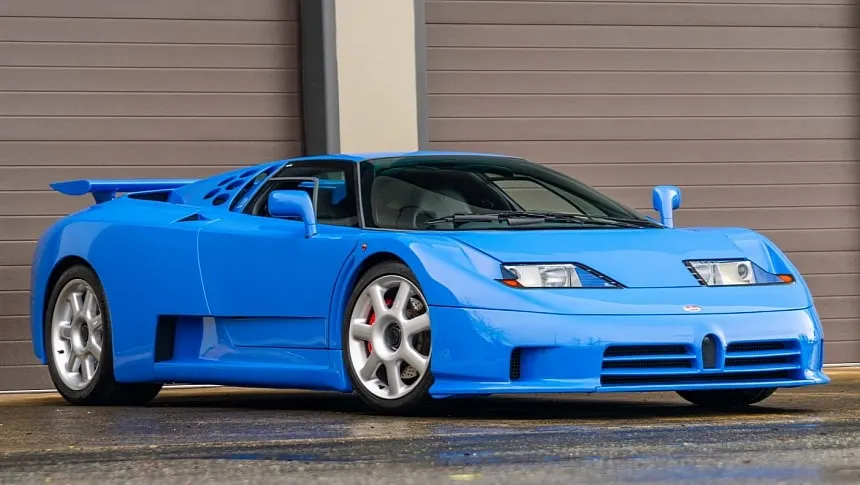
Bugatti EB110, the hypercar that put a twenty-first century spec sheet on the table in 1991
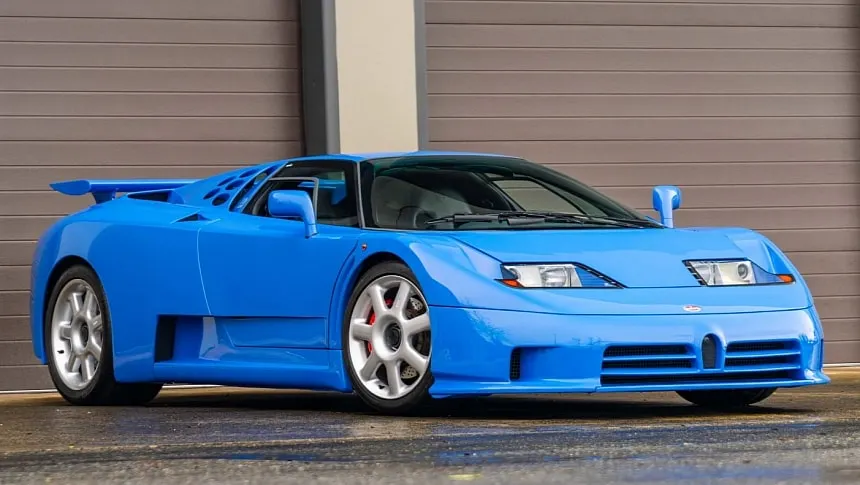
Cover the badge with your hand and read it like this.
Three-and-a-half-litre V12, mid-rear mounted. Sixty valves, five per cylinder, three intake and two exhaust. Twelve individual throttle bodies. Four small IHI turbochargers, two per bank, running between 1.05 and 1.2 bar and redlining at eight thousand two hundred and fifty rpm. Aluminium and magnesium block. Twin overhead cams per bank. Dry sump lubrication. Permanent all-wheel drive with a fixed 27:73 torque split and three differentials, limited-slip at the rear. Six-speed manual gearbox. Ventilated Brembo brakes. Carbon fibre monocoque built by Aérospatiale, the company that made Airbus airliners, weighing one hundred and twenty-five kilograms in total. Eighteen-inch magnesium wheels. Titanium bolts. Electronically operated rear wing. Air conditioning, power steering, electric Poltrona Frau leather seats, high-end audio and central locking, all standard.
Five hundred and sixty horsepower in the Gran Turismo. Six hundred and ten in the Super Sport. Zero to sixty-two in three point two six seconds. Two hundred and eighteen miles per hour recorded at Nardò in May 1993.
Show that sheet to anyone and tell them it’s an Italian car from 1991, launched the same month Ferrari released the 512 TR with a four hundred and twenty-eight horsepower naturally aspirated V12 and rear-wheel drive of the old school, and they’ll laugh in your face.
Well, it was an Italian car from 1991. It was called the Bugatti EB110. And it arrived on the market with a spec sheet that most of the hypercar industry wouldn’t catch up with until well into the new century.
The Italian who bought a dead brand and built it a blue factory
Romano Artioli bought the rights to the Bugatti name from the French government in 1987, after years of secret negotiation that neither the Italian nor the French nor the international press caught wind of until the deal was signed. He bought the brand to build the best possible sports car in the world with his own fortune on the table.
He built Campogalliano, near Modena. Seventy-five thousand square metres. Carrara marble floors. Naturally lit atriums. Circular showroom. A management wing kept separate from the production building. An in-house test track. The mainstream version has always sold Campogalliano as Italian megalomania. It can be read differently: it was the materialisation of a decision Artioli had made at sixteen, when he was chartering coaches from the Bolzano Students’ Circle to take his class round European car factories and discovered most of them were noisy, dark and windowless. That teenager decided that if he ever managed to build cars, the factory would be built for the workforce. Forty-two years later he built it.
Who designed the EB110: two versions on the table
Here the story splits in two. What thirty years of bibliography records, and what Romano Artioli claims actually happened inside.
The bibliographical version credits Paolo Stanzani, an engineer with a Lamborghini background, as the man who drove the project in its early phase. On that basis he was built a technical reputation lasting three decades.
According to Romano Artioli, in his book Bugatti & Lotus Thriller and in material he has shared with NEC, that reading is wrong. According to Artioli, Stanzani was a management engineer, had entered Lamborghini as a trainee, and the Sant’Agata cars credited to him were actually the work of the engineer Dallara. According to Artioli, Stanzani accepted the EB110 project on the express condition of working without interference, after being recommended by an adviser called Baraldini, and in turn surrounded himself with a Turin engineer named Trucco, of whom Artioli says literally that “he knew even less than Stanzani.”
According to Artioli, the technical heart of the EB110 was Oliviero Pedrazzi, chief technician at Tecnostile, a Modena-based company specialising in third-party sports car design that Artioli himself acquired when he bought Bugatti. In Artioli’s words, Pedrazzi was “a mechanical genius who had worked with the top specialists in the sector”, and without him “Bugatti would never have been reborn.”
Without access to engineering notebooks, patents, drawings and cross-checked testimonies from the development teams, it isn’t possible to settle who signed what within a project that employed dozens of people for five years. What can be stated is that the figure of Oliviero Pedrazzi has been systematically absent from the EB110 bibliography for three decades, and that the man who paid for the entire project out of his own pocket has decided, at ninety-three, to put on record that this silence doesn’t seem fair to him. Artioli’s correction doesn’t rewrite the car’s spec sheet. It opens a pending line of work for the specialist journalism that wants to cross-check testimonies with primary documentation.
Materazzi enters Campogalliano
When Stanzani left the project in 1991, Artioli called an engineer he had met during the Ferrari years. His name was Nicola Materazzi, born in Caselle in Pittari (Salerno) in 1939, and he arrived at Campogalliano with a résumé you can count on the fingers of one hand in Italian motoring.
He had started at Lancia in 1968 calculating chassis, suspension and steering systems, and from there moved into the forced induction engineering that would be the through-line of the rest of his career, with the Group 5 Lancia Stratos turbo as his first serious job. He passed through Abarth. He passed through Osella Corse designing Formula 2 and Formula 1 single-seaters. In 1979 he arrived in Maranello. And at Maranello he signed the 288 GTO, the Testarossa and the entire F40: engine, gearbox and mechanicals.
He left Ferrari at the end of 1987, with FIAT already at the helm after Enzo’s death, over disagreements with the new management. He went to Cagiva as technical and sporting director until 1991. At the end of that year, with Artioli’s call, he landed at Campogalliano.
Materazzi took over the EB110 with a reliability problem in the engine, a carbon chassis calling for more stiffness and an all-wheel drive system that wouldn’t fall into line. He resolved all three fronts before serious production began. He also signed off the whole 1992 SS development, one hundred and fifty kilograms lighter and raised to six hundred and ten horsepower. Nicola Materazzi died in August 2022, aged eighty-three.
Beside him, at Nardò, the test driver: Loris Bicocchi. A Bolognese from Sant’Agata, he had started at Lamborghini in 1974 as a warehouseman, promoted to mechanic the following year and to Countach test driver the year after that. Stanzani personally hired him for Bugatti in 1989. He stayed with the EB110 until 1995, until the end. He later signed off the Dauer 962, the Pagani Zonda, the Koenigsegg CCX, the Veyron and the Chiron. He is the test driver with the most hypercar miles in his legs on the planet. And of his EB110 chapter he says literally: “It’s the best period of my professional life. Even though I’d been a test driver for another brand since 1974, with Bugatti from 1989 I was able to learn a huge amount, and I grew alongside the car and my responsibilities.”
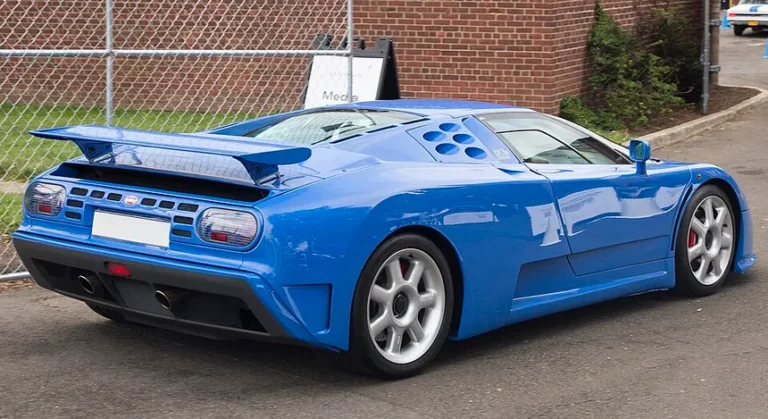
The square engine and the four turbochargers no one else would fit
Three thousand five hundred cubic centimetres in twelve small cylinders, eighty-one millimetre bore and fifty-six point six millimetre stroke. Almost a square engine. Built to rev. And rev it did: an eight thousand two hundred and fifty rpm redline, six hundred and ten SS horsepower at eight thousand two hundred and fifty, and peak torque of four hundred and seventy-nine pound-feet at four thousand two hundred.
Five valves per cylinder. Twin overhead cams per bank. Dry sump so the oil wouldn’t slosh in high-speed corners. Twelve individual throttle bodies, one per cylinder, each with its own butterfly. Aluminium and magnesium block.
On top, four small IHI turbos running between 1.05 and 1.2 bar. Restrained figures compared to what the mechanicals could have taken, following a clear philosophy: four small turbos instead of two large ones, moderate pressure instead of maximum, low-end response instead of a top-end punch. Four small turbos spool earlier, deliver torque at low revs, minimise turbo lag and spread thermal loads better. The trade-off is that they quadruple the critical moving parts, the ducting, the wastegates. Anyone who has stripped a turbo in the workshop knows what it costs to get one to work without leaks, without vibration and without heat problems. Four is four times the work.
The transmission is where the EB110 pulled clear of its segment competition. A six-speed manual when most European sports cars were on five. Permanent all-wheel drive with three differentials (centre, front and rear, with a limited-slip at the rear) and a fixed 27:73 split. With that combination, the EB110 was one of the first modern supercars to combine permanent AWD with extreme power and performance beyond two hundred and eighteen miles per hour. The Porsche 959 had already explored advanced all-wheel drive in the eighties with a different approach, more rally than pure road, and the Lamborghini Diablo VT would arrive with all-wheel drive in 1993, two years after the EB110 GT debuted. The real popularisation of permanent AWD in the modern hypercar wouldn’t arrive until the Veyron in 2005.
The chassis, a chapter of its own. Carbon fibre monocoque, weighing one hundred and twenty-five kilograms as a structure. Built by Aérospatiale, the French aerospace company that made Airbus airliners. When the EB110 arrived on the market, Gordon Murray’s McLaren F1 was still being tested and would arrive in late 1992 with its own carbon solution. The Ferrari F40 that Materazzi himself had signed at Maranello had a tubular steel chassis with carbon panels bonded on top. The EB110 was one of the first production road cars to use carbon as a primary structure at a time when tubular steel remained the dominant solution in the segment.
On top of the monocoque, aluminium and carbon panels. Eighteen-inch magnesium wheels. Structural titanium bolts. And all of it packaged in a car that also offered air conditioning, power steering, electric Poltrona Frau leather seats and high-end audio as standard. The GT even offered an option of noble wood trim. It wasn’t an untamed track-only. It was a complete hypercar, usable as a road car, with luxury grand tourer finishes.
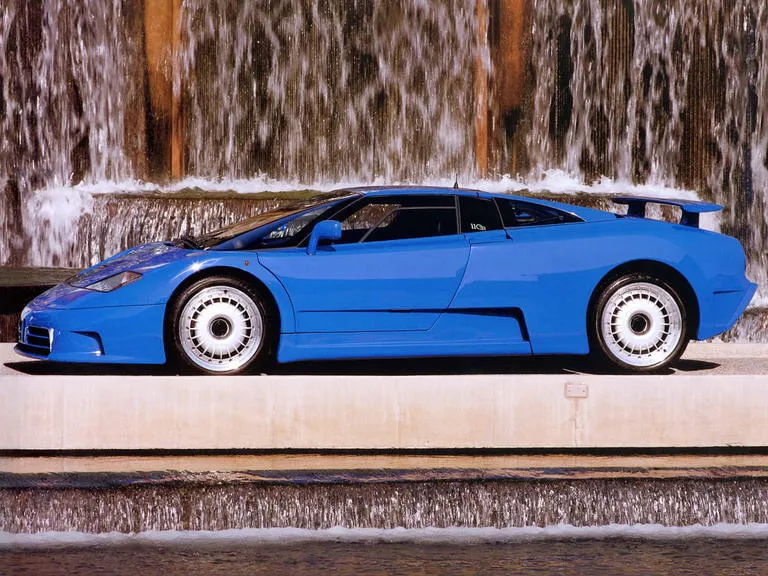
What the EB110 had that its rivals didn’t
Comparative 1991 spec against the three serious segment rivals.
The Ferrari F40, from 1987, with a 2.9-litre twin-turbo V8, delivered four hundred and seventy-eight horsepower, rear-wheel drive, no AWD, tubular steel chassis with carbon panels bonded on top, five-speed manual, no electronic aids, no air conditioning, one thousand three hundred and seventy kilograms, two hundred and one miles per hour. A brutal, iconoclastic, deliberately Spartan car.
The 1990 Lamborghini Diablo, with a 5.7-litre naturally aspirated V12, delivered four hundred and ninety-two horsepower, rear-wheel drive in the base version, tubular steel chassis, five-speed, one thousand six hundred and twenty-five kilograms, two hundred and two miles per hour. The VT variant with AWD would come in 1993.
The 1991 Ferrari 512 TR, with a 4.9-litre naturally aspirated flat-twelve, delivered four hundred and twenty-eight horsepower, rear-wheel drive, five-speed, tubular chassis, one thousand five hundred and seventy kilograms, one hundred and ninety-five miles per hour. A pure grand tourer derived from the Testarossa.
The 1992 EB110 SS, with a 3.5-litre quad-turbo V12, delivered six hundred and ten horsepower, permanent all-wheel drive, full carbon fibre monocoque, six speeds, three differentials, one thousand four hundred and eighteen kilograms, two hundred and eighteen miles per hour.
One hundred and eighteen horsepower more than the most powerful Italian rival in the segment. Sixteen miles per hour more top speed than the fastest. Two hundred and seven kilograms less than the heaviest. And the only one of the four with AWD, six speeds and carbon fibre as a primary structure.
The McLaren F1, arriving in late 1992, played in a different conceptual league: 6.1-litre naturally aspirated BMW V12, six hundred and twenty-seven horsepower, rear-wheel drive, carbon monocoque, three seats with central driving position, a radically different philosophy focused on minimum weight and purely mechanical response. Comparing the EB110 with the F1 requires a specific conversation that doesn’t fit in a comparative table: the two cars chose different paths to the same goal, and both are valid on their own terms.
The 1992 price of the Super Sport was five hundred and fifty million Italian lire, inclusive of servicing and wear parts for the first three years. In nominal terms, that figure equates to roughly two hundred and eighty-four thousand euros at the fixed lira/euro conversion rate of 1999. Adjusted for Italian inflation through to 2026 using ISTAT methodology, the approximate purchasing power lands around five hundred thousand euros today, a figure that should be read as an estimate and not as an exact equivalence. On the same approximate basis, the Ferrari F40 cost around four hundred million lire in 1990. The Lamborghini Diablo, between three hundred and eighty and four hundred and twenty million depending on configuration. The 512 TR, around two hundred and eighty million. The McLaren F1, when it reached the market in 1992, around eight hundred million. The EB110 sat between the existing Italian pack and Murray’s British car. More expensive than the Italian competition, much cheaper than the McLaren.
And it arrived in 1991, in the middle of a European recession. The high-end supercar market in Italy and Europe collapsed between 1991 and 1993 due to the yen crisis, lira devaluation, rising interest rates and the freeze in luxury consumption. Campogalliano’s commercial window closed before production reached cruising speed. Any niche manufacturer of those years dragged serious losses through the same two-year period.
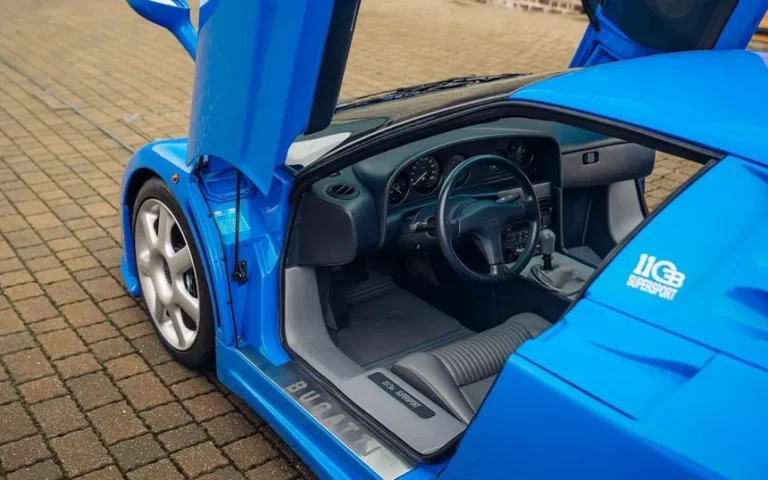
The Nardò figures
With that machine, Bugatti Automobili went to Nardò to mark its territory. On the southern Italian oval, between May and July 1993, with Bicocchi at the wheel in the decisive runs, the EB110 SS set a series of marks that Bugatti claimed as world records and which are today recorded in the current brand’s official documentation.
The first and most cited: two hundred and eighteen miles per hour top speed for a series-production road car. The car that achieved the figure was the S4 prototype, chassis 39004, the first EB110 built specifically as a Super Sport rather than starting from a modified GT. According to Bugatti’s official documentation, the printer on the measurement computer at Nardò produced a sheet showing “346 km/h” on the first setup and “351 km/h” on the definitive one. The Ferrari F40 had stopped at Nardò at one hundred and eighty-nine miles per hour.
The second: zero to sixty-two in three point two six seconds, with permanent all-wheel drive, one thousand four hundred and eighteen kilograms. Without a dual-clutch gearbox, without electronic traction control, without active differentials. Three pedals, six gears, a lever. Bugatti claimed it as the most powerful acceleration ever recorded on a production car of the period. Exact comparison with other contemporary cars would require reviewing the official measurements case by case.
The third: in September 1994, at Volkswagen’s Ehra-Lessien test track (a curious premonition of the future), an EB110 converted to methane reached two hundred and thirteen miles per hour. Bugatti claimed it as a mark for sports vehicles with natural gas engines.
The fourth: one hundred and eighty-four miles per hour on ice, claimed by Bugatti as a speed mark on frozen surface for a series-production car.
Four reference marks in two years. On a car built fewer than one hundred and forty times. The exact categories and the independent certification of each mark require direct consultation of period documentation, and this article limits itself to recording the figures and their official attribution by Bugatti itself.
The day of the debut
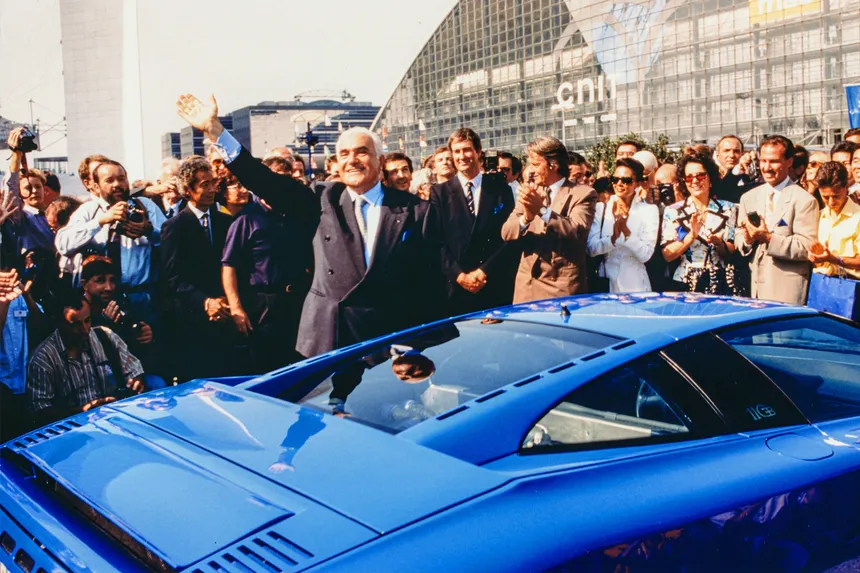
The EB110 was presented to the world on September 15th, 1991, at La Défense in Paris, on the one hundred and tenth anniversary of Ettore Bugatti‘s birth. Alain Delon unveiled the car alongside Renata Kettmeir, Artioli’s wife, who had organised the event. Test driver Loris Vittecoq paraded down the Champs-Élysées. Five thousand journalists covered the event. Gala dinner at the Château de Versailles.
According to Artioli’s account, on the eve of the event, letters of cancellation reached the organisation from every invited executive citing “unforeseen commitments”, and on the morning of the debut the president of ELF (the French oil company sponsoring the event) appeared because a journalist had told him the Artiolis were financed by the Mafia. According to Artioli, ELF immediately dismissed the slander with its own verifications and those of the French government, and he attributes to that smear campaign, whose source he places in a figure he calls “the Hidalgo” without further identification, the Sultan of Brunei’s withdrawal from the project. According to Artioli, the Sultan had shown willingness to enter with forty-nine per cent of Bugatti International’s capital.
All of this is Artioli’s version. It doesn’t stand contrasted with independent public judicial, financial or corporate documentation, and must be read with that in mind. The temporal correlation between the smear and the Sultan’s withdrawal doesn’t equate to demonstrated causality, and the events Artioli describes about internal sabotage, infiltrators and coordinated executive cancellations remain pending specific investigation with access to primary sources.
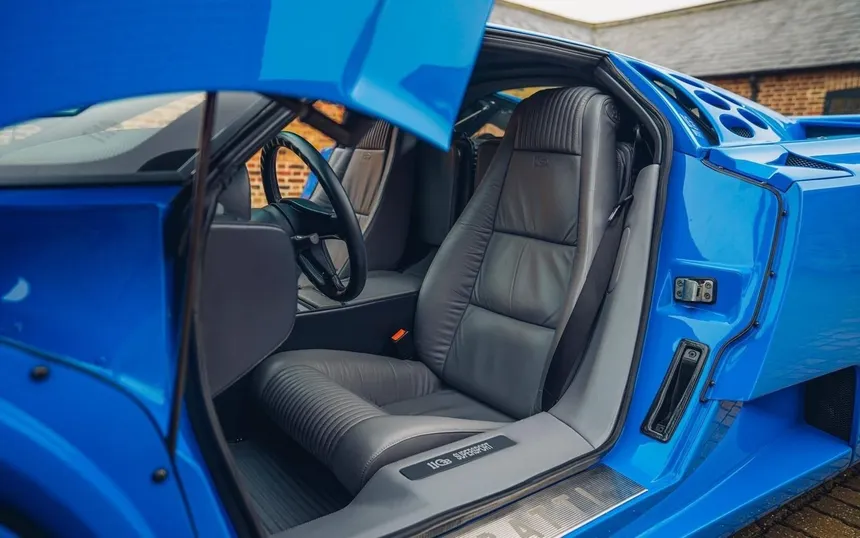
The EB110 in racing
Artioli wanted the car racing. In June 1994, at the 24 Hours of Le Mans, a blue EB110 LM number 34 entered with Alain Cudini, Éric Hélary and Jean-Christophe Boullion. Built on the SS base, two hundred kilograms lighter down to one thousand two hundred and eighty, special intake flanging and reduced turbo pressure to survive twenty-four hours. Six hundred horsepower between six thousand two hundred and seven thousand two hundred rpm. It didn’t finish.
In 1996, with Campogalliano already wobbling visibly, Gildo Pallanca-Pastor’s Synergie Motorsport took a silver EB110 SC to the 24 Hours of Daytona with Derek Hill (son of Phil Hill) among the drivers. They qualified twenty-first. They ran seventh overall before an electrical problem at seven hours.
Two official race cars, two retirements, zero victories. The EB110 wasn’t a finished race car: it was an advanced road car needing years of race-specific development that the factory was no longer going to be able to give it.
The Saturday of the bankruptcy
In September 1995 the bankruptcy of Bugatti Automobili SpA was declared. The factory closed with cars half-built on the line and tooling in place.
According to Artioli’s account, the bankruptcy proceedings were prepared from outside with accusations based on debts he considers non-existent, the hearing coincided with the heart attack and subsequent death of Bugatti’s lawyer, and BMW first and Porsche immediately after showed up offering to buy Bugatti Automobili by paying all the debts and keeping the entire workforce. According to Artioli, the Curator chose to immediately liquidate at fire-sale prices the Mandelli machining centres (which worked the EB110 engines to the thousandth of a millimetre) and the four-hundred-kilometre-per-hour Schenk test benches, built to measure for Bugatti.
This version, Artioli’s version, contrasts with the official reading of the Italian bankruptcy proceedings of the period and would deserve specific investigation with access to court documentation, cross-checked testimonies of the administrators and traceability of the purchase offers attributed to BMW and Porsche. This article records Artioli’s version as the protagonist’s testimony, not as a documented reconstruction of the facts.
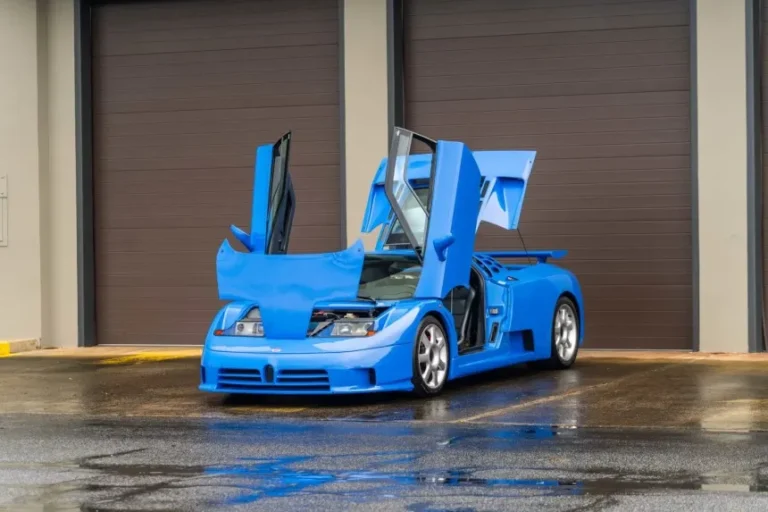
Ninety-six EB110 GT units, fewer than forty EB110 SS units and two official race cars were built. Total: under one hundred and forty.
The Edonis, Materazzi’s epilogue
In 1998, a year before the Volkswagen deal, Jean-Marc Borel (who had been in the management of Bugatti Automobili during the good years) bought part of the Campogalliano complex and founded B Engineering. He hired Nicola Materazzi as technical director. The project came out in 2001 with the name Edonis: carbon monocoque and mechanical architecture of the EB110 SS, but with twin-turbo instead of quad-turbo, without all-wheel drive, six hundred and eighty horsepower. Only twenty-one units. It’s Materazzi’s last work, and a proof that Campogalliano’s technical architecture had years left in it if the original project had had the finances behind it.
The ghost that reappeared in Monterey
In August 2024, at the RM Sotheby’s auction in Monterey, chassis 39004 went to auction. The S4. The car with which Bugatti had set the two hundred and eighteen miles per hour at Nardò in May 1993. One of the seven SS prototypes built, shown by Bugatti at the official Tokyo presentation on April 3rd, 1993 alongside three GTs and the EB112 concept, sold new to the Japanese driver Sokichi Shikiba. It crossed the block at two million one hundred and fifty thousand dollars. Grigio Chiaro Metallic over black.
What Volkswagen took away
In 1998, three years after the bankruptcy, Romano Artioli sold Volkswagen the rights to the Bugatti brand that he had personally bought from the French government in 1987 and that had never passed into the bankruptcy estate of Bugatti Automobili SpA. Volkswagen used them to build the Veyron.
Volkswagen didn’t copy the EB110. It didn’t need to. It bought the brand that had demonstrated fourteen years earlier that a conceptual architecture of an extreme-power hypercar with multiple turbos and permanent all-wheel drive was possible on a road car. When in 2005 the Veyron reached the market with a quad-turbo W16, one thousand and one horsepower and permanent AWD, it did so in a completely different technological context (electronics, materials, tyres and control systems developed for fifteen more years) and with the entire industrial apparatus of Volkswagen behind it. The honest comparison isn’t “one ahead and the other caught up”. It’s a shared conceptual architecture developed in two incomparable industrial contexts.
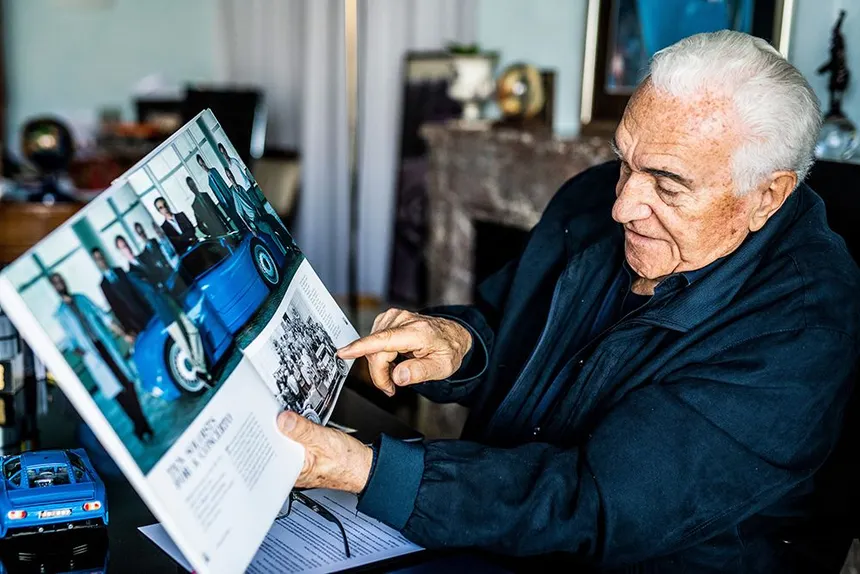
Bugatti acknowledged it officially in 2019 with the presentation of the Centodieci, a special car on the Chiron base, produced in ten units at eight million euros each, whose name refers to the one hundred and tenth anniversary of the EB110. For the Centodieci’s development, Bugatti brought Loris Bicocchi back to Nardò, with two original EB110s parked next to the Centodieci prototype in the pit lane. Bicocchi said it stepping out: “When they unloaded the two EB110s from the truck, I instantly felt thirty years younger.”
The market vindication
An EB110 SS changes hands today for between two and three million dollars at any serious auction on the calendar. In 2026 another SS came to auction that had been physically missing for twenty-four years, forgotten at a supplier when the factory closed in 1995 and not appearing in the bankruptcy inventory. Each unit that reappears is a pending chapter of a factory that closed too fast to properly account for what was inside.
One hundred and thirty-eight units plus two official race cars. Four reference marks claimed at Nardò and Ehra-Lessien between 1993 and 1994. Presence at Le Mans and Daytona. A spec sheet that in several key parameters (permanent AWD, carbon monocoque, four turbos, six speeds) anticipated what the modern hypercar would be a decade and a half later. Engineers like Nicola Materazzi working the chassis and the engine. A test driver like Loris Bicocchi closing the dynamic development at Nardò with the material of his life. And behind it all, an Italian industrialist who bought a dead brand and built it a blue factory in Carrara marble because at sixteen he had decided that if he ever built cars, the factory would be built for the workforce.
A quarter of a century after the bankruptcy, the market has started putting the EB110 in the place it belongs. It was much more important than popular history has decided to remember.
Check that you’re still alive.