
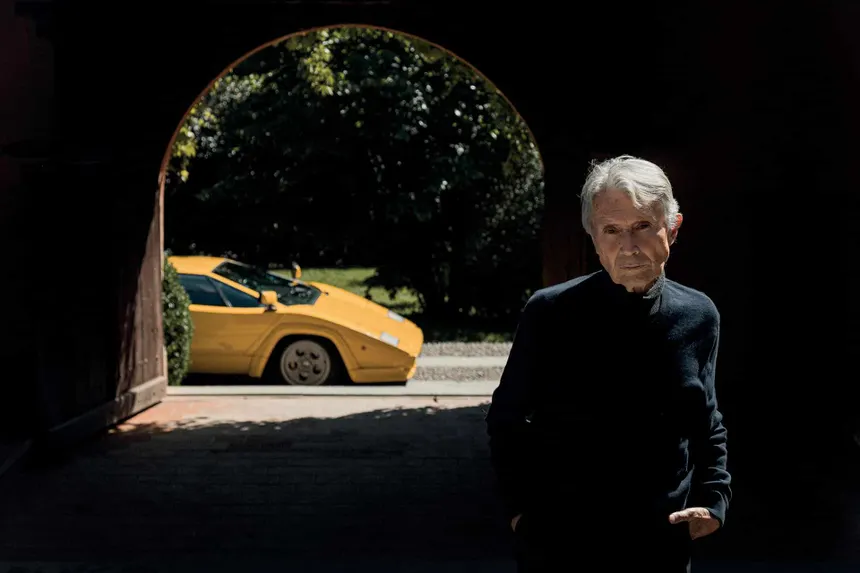
MARCELLO GANDINI: THE GENIUS BERTONE NEVER LET SIGN HIS OWN CARS
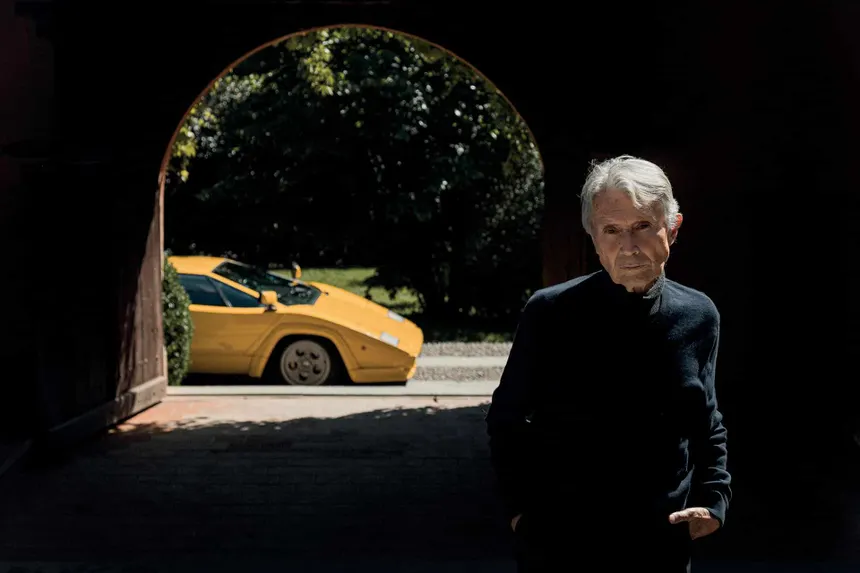
At sixteen, they gave him money to buy a Latin textbook. He bought a combustion engine manual written by Dante Giacosa instead. That act of rebellion defines everything that followed. Because Marcello Gandini wasn’t born to study what he was told. He was born to tear apart every rule of car design — and do it with a pencil, a drafting table, and a mind that worked unlike anyone else’s.
On March 13, 2024, he died in Rivoli, just outside Turin. He was 85. Headlines called him “the Lamborghini designer.” That’s like calling Goya “the ceiling painter.” Incomplete. Almost insulting. Gandini designed the Miura, the Countach, the Stratos, the Espada, the Montreal, the Khamsin, the X1/9, the first Volkswagen Polo, the first BMW 5 Series, the Citroën BX, and the Renault 5 Supercinq. And that’s only the list you remember.
But what nobody’s going to tell you is what happened behind the lines. Between them. That’s why we’re here.
Turin, 1938. Son of an orchestra conductor
Marcello Gandini was born on August 26, 1938, in Turin. His father, Marco, held two university degrees and conducted orchestras. His French grandmother had been a patron of Claude Debussy and had introduced the composer to Italian high society. The family wanted Marcello to study humanities, classical literature, piano. The natural path for an orchestra conductor’s son in 1950s Italy.
But Marcello spent hours with a Meccano set. And when the time came to choose between music and engines, he chose engines. He didn’t go to university. He didn’t study design. He walked away from the conservatory and started working with his hands. One of his first hacks was sawing off the rear of an Abarth 750 Zagato and welding chicken wire over the hole. He wanted to know if the lighter car would go faster. That’s who Gandini was. Before he could draw a car, he wanted to know how to break one.
He made a living as an interior designer. He did the interior of a nightclub in Turin. Years later, someone asked about that project. His answer was flawless: “Happily, it burned.”
1963. The door Giugiaro slammed shut
In 1963, at 25, Gandini gathered his nerve and showed his drawings to Nuccio Bertone, the man running the most important design house in Italy. Bertone looked with interest. But Giorgetto Giugiaro, the firm’s chief designer, blocked the hire. He didn’t want Gandini there. A curious detail: Gandini and Giugiaro were born the same year, 1938, just 19 days apart. Two titans of Italian design born practically the same month, destined to cross paths for decades. They exchanged unfriendly remarks about each other for years.
Gandini didn’t get into Bertone that day. But he didn’t quit. He went through Carrozzeria Marazzi, worked briefly, kept learning. Until 1965, when Giugiaro left Bertone for Ghia. And Nuccio Bertone called Gandini. On November 1, 1965, Marcello Gandini entered the company that would give him the chance to change automotive history.
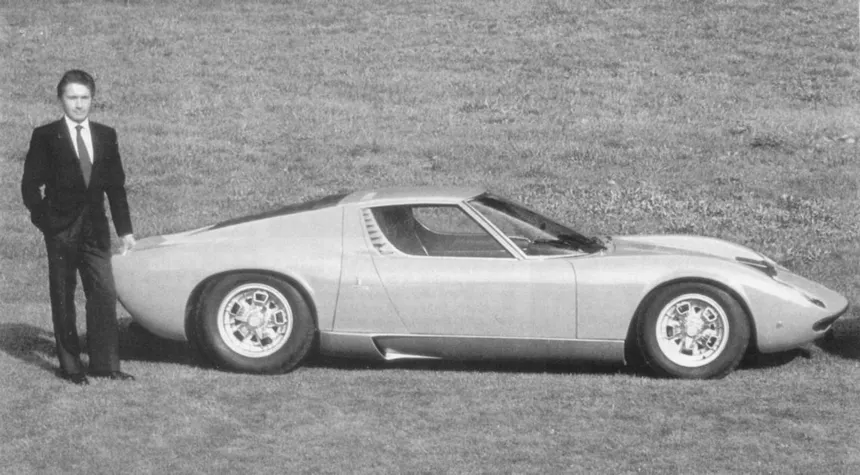
He was 27. And his first project was the Lamborghini Miura.
The impossible catalogue: Bertone, 1965–1979
If someone told you a single person designed all these cars, you’d think it was a lie. But it’s true.
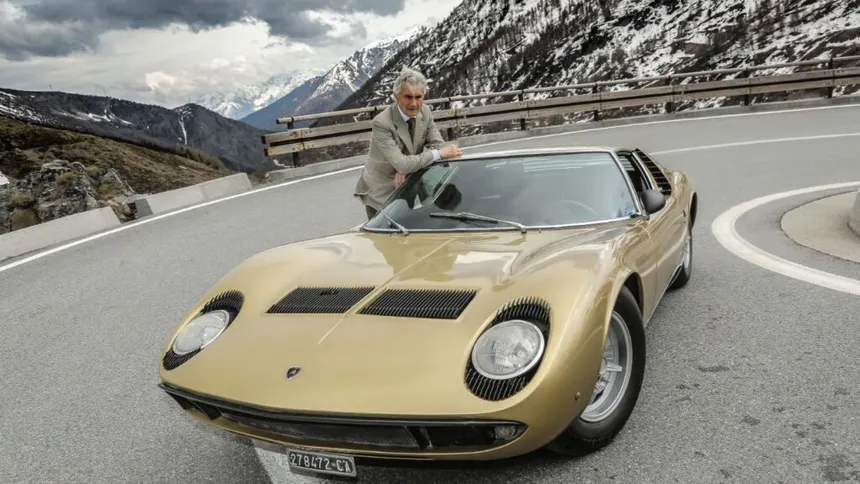
In 1966, months after joining Bertone, Gandini unveiled the Miura at the Geneva Motor Show. A car that defined the meaning of the word supercar. The concept drew partly from Ford’s GT40, the surface treatments echoed Giugiaro’s prior work at Bertone, but the synthesis was pure Gandini. He designed it in three months. At 27. With a pencil. No computer. No software. No one telling him what a car of that calibre should look like, because nothing like it existed.
In 1967 came the Marzal — a four-seat spaceship with gullwing doors that looked designed for another planet. In 1968, the Alfa Romeo Carabo: the first car in history with scissor doors, built on an Alfa Romeo 33 Stradale chassis. If you drive a Lamborghini with upward-opening doors, thank Gandini. He invented that.
And then the list doesn’t stop. The Alfa Romeo Montreal. The Lamborghini Espada. The Jarama. The Urraco. The Maserati Khamsin. The Fiat X1/9, an affordable mid-engine roadster that democratized driving pleasure. The Lancia Stratos Zero, a concept that looked like a UFO on wheels where the driver entered through the windshield. And its production version, the Stratos HF, which won three consecutive World Rally Championships.
But it wasn’t all supercars. Gandini designed the Audi 50, which became the first Volkswagen Polo. He designed the first-generation BMW 5 Series (E12). He designed the Innocenti Mini, which sold over 300,000 units across 19 years. And he designed the Ferrari Dino 308 GT4 — the only production Ferrari signed by Bertone instead of Pininfarina.
And then, in 1971, the Countach.
The LP500 at Geneva was a bomb. It didn’t evolve from the Miura — it negated it. Where the Miura was curves and sensuality, the Countach was wedges, edges, and raw aggression. The NACA ducts carved into the bodywork, the impossible proportions, the visual brutality. That car shouldn’t have worked as a design. But it worked so well it became the poster on every teenager’s wall for an entire generation.
Gandini did all of that in 14 years. From a drafting table outside Turin. With a pencil. On a salary.
The Bertone contradiction: genius on payroll
And here’s what stings. All that work — the Miura, the Countach, the Stratos, the Montreal, the X1/9, the Polo, the 5 Series — carried Bertone’s name. Not Gandini’s. Nuccio Bertone took the commercial credit, the manufacturer relationships, the public recognition. Gandini was an employee. Brilliant, but an employee.
He explained it himself with clarity that cuts to the bone. He said “the salary was seductive” and that’s what made him stay. But seductive doesn’t mean fair. Gandini didn’t earn royalties on the Miura. He didn’t earn royalties on the Countach. He didn’t earn royalties on any of the most iconic cars of the twentieth century. He picked up his paycheck, did his work, and went home.
What’s it worth to design the Countach? Marcello Gandini doesn’t know. Because he never got paid for it.
1979. The independence that arrived late
Gandini left Bertone in July 1979, founded his own studio called Clama with his wife Claudia, and went independent. He was 41. Everything we just reviewed — all of it — he created as a salaried employee. From now on, he’d be a freelance designer. But the world works strangely when you no longer have a major carrozzeria’s machinery behind you.
He worked exclusively for Renault for five years. That’s where the second-generation Renault 5 came from, the Supercinq — a car that sold millions — and the Renault AE Magnum truck. Designs that proved Gandini could do anything, from a city car to a long-haul truck.
But the deepest wounds came from Lamborghini and Bugatti.
Lamborghini commissioned him to design the Countach’s successor. Gandini drew the P132 prototype — a brutal machine with his trademark straight lines, angular wheel arches, pure wedge essence pushed to the limit. But in 1987, Chrysler bought Lamborghini. And the Detroit executives didn’t like Gandini’s design. They called it “too aggressive.” They put Tom Gale, Chrysler’s head of design, to smooth out the edges, round the corners, make it “more commercial.” The result was the Lamborghini Diablo — a car with a plaque on the flank reading “Disegno Marcello Gandini,” but which Gandini never truly recognized as his own. His original design ended up as something else entirely: the Cizeta-Moroder V16T.
With the Bugatti EB110, something similar happened. Romano Artioli hired him alongside Paolo Stanzani to revive the Bugatti brand in the late 1980s. Gandini designed the prototype, called the DMD80. But Artioli thought it looked “like another Lamborghini” and wanted something softer, rounder, more Bugatti. Gandini refused to alter his vision. Tensions escalated. Eventually, Gandini and Stanzani left the project, and the design was reworked by Giampaolo Benedini, the architect who had built Bugatti’s blue factory in Campogalliano. From Gandini’s original design, the scissor doors survived, the greenhouse structure, and little else.
Twice they took a car from his hands. Twice they said his vision was “too radical.” And both times, history proved Gandini right.
Through the 1990s, Gandini kept working. Maserati — then under De Tomaso’s control — commissioned the Shamal in 1990, the Ghibli II in 1992, and the Quattroporte IV in 1994. All three carried his angular DNA. All three sold poorly. Alejandro de Tomaso rejected the slanted rear wheel arches Gandini wanted on the Ghibli, just as Chrysler had rejected the sharp edges on the Diablo. The pattern was always the same: Gandini proposed something radical, and whoever was paying said it was too much. Then, in 2021, Lamborghini twisted the knife one last time. They announced the Countach LPI 800-4 — 112 units, sold out before being announced — and never told him it was going into production. They filmed an interview with him, showed him a scale model, and let him believe it was just a tribute. When Gandini found out the truth, he issued a public statement distancing himself from the project. His words were precise and devastating: “To repeat a model of the past represents, in my opinion, the negation of the founding principles of my DNA.” At 83, Gandini still had the spine to tell Lamborghini they were wrong. That takes something no design school can teach you.
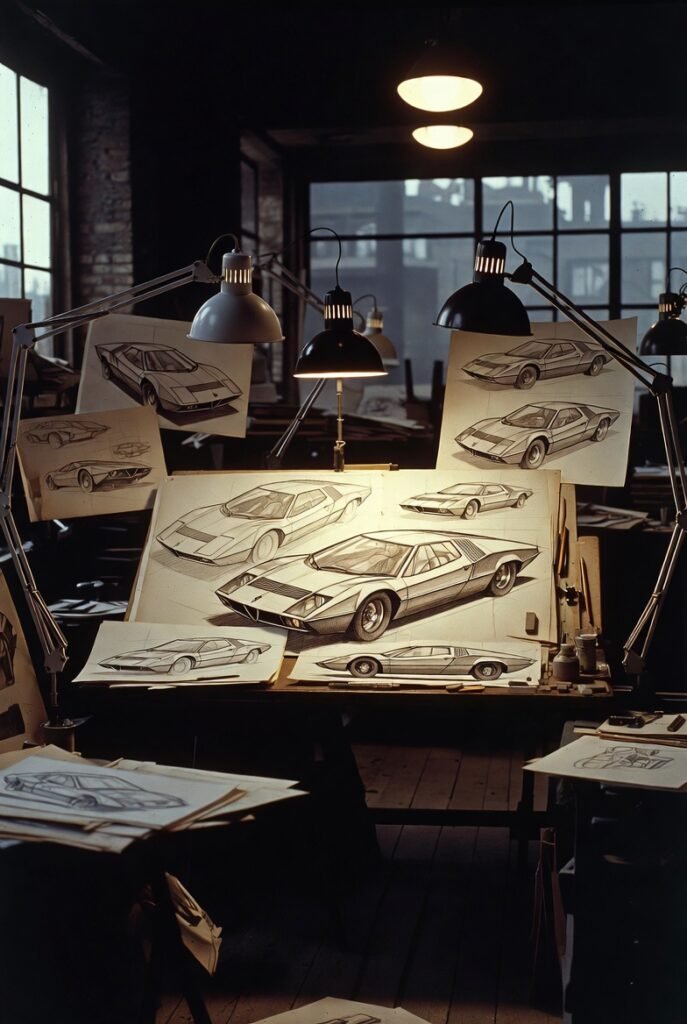
The designer who didn’t go to motor shows
Robert Cumberford, the Automobile Magazine journalist, visited him in 2009 at his restored 17th-century villa in Almese, outside Turin. He described Gandini as “self-effacing, modest, and quiet.” Gandini didn’t attend motor shows. He didn’t do public relations. He had no interest in fame. He preferred walking his four German Shepherds, riding horses, and working from his studio with Claudia.
He lived with the calm of someone who knows what they’ve done and doesn’t need anyone to remind them.
But Gandini himself said something that defines him better than any headline: what interested him about car design wasn’t the styling — it was the vehicle’s architecture, construction, assembly, and mechanisms. The man who drew the most beautiful cars in the world didn’t consider himself a stylist. He considered himself a frustrated engineer who could draw. One who also designed the Heli-Sport CH-7 helicopter and the 1968 Moto Guzzi V7 Sport motorcycle, because for Gandini a vehicle was a vehicle, whether it had two wheels, four, or rotor blades.
January 2024. The final rebellion
On January 12, 2024, the Polytechnic University of Turin awarded him an honorary doctorate in Mechanical Engineering. It was his last public appearance. He was 85. In the university courtyard, fifteen of the cars he’d designed for Bertone were exhibited. Gandini had known nothing about the initiative — the idea had been born from his family, and he was only informed once Italy’s Ministry of Universities had authorized the process.
In his speech, he told the story of the Latin textbook and the engine manual. And he told the students something worth more than any degree: “Extract from limitations and impositions a strong, stubborn, and constructive sense of rebellion.”
Two months later, on March 13, 2024, he died in Rivoli.
The question Gandini left unanswered
We’re not writing an obituary. NEC doesn’t do obituaries. We’re leaving a question.
If Gandini had opened his own studio at thirty. If Lamborghini had left the Diablo untouched. If Artioli hadn’t rejected the EB110. If no one had smoothed out the edges. What would he have designed?
Because what he designed under other people’s restrictions was already enough to change automotive history. Imagine what he’d have done without them.
Check you’re still alive.