
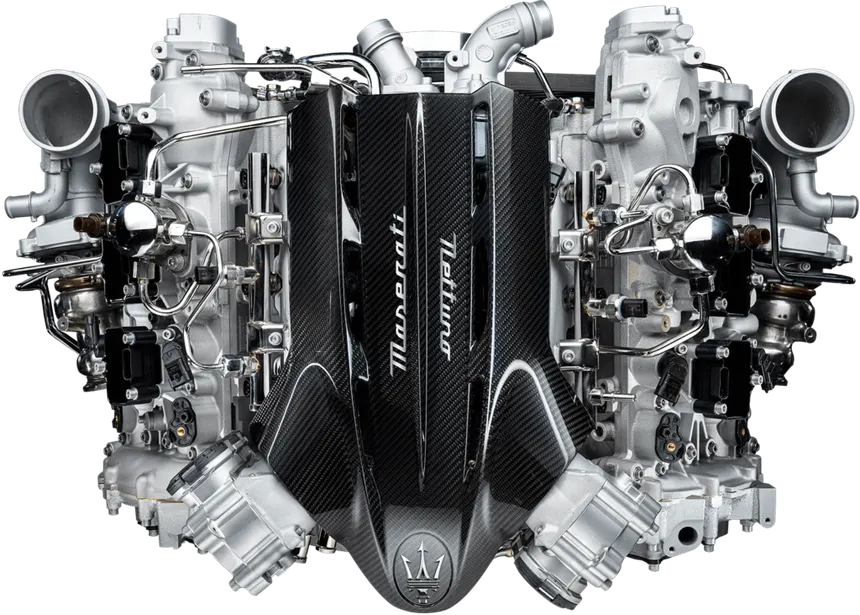
Maserati cooked its own engine, regulations took the heat out
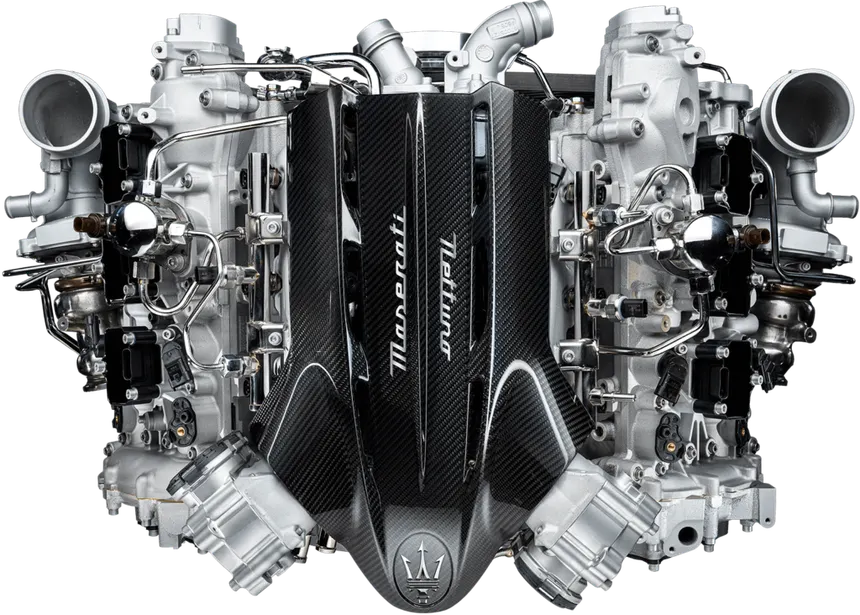
Some engines explain themselves. Others hit you.
The Nettuno does the first better than almost anything else alive. The second — no. And that’s exactly what you need to know before someone sells it to you as the future of Maserati.
Because the future is brilliant, cold, technically flawless. And when you’re standing in front of it, running, with those 630 horsepower ready to go, part of you waits for something that never arrives.
That’s not a manufacturing defect. That’s the truth of downsizing taken to its highest technical expression.
What the Nettuno IS on paper
First, the numbers, because the Nettuno earns them.
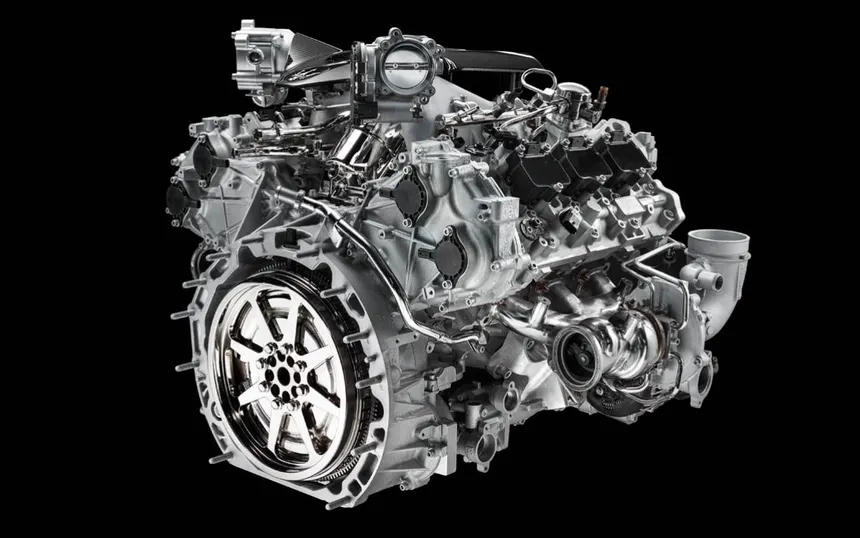
90-degree V6, 3.0 litres, twin-turbo, dry sump. 630 hp at 7,500 rpm, 730 Nm from 3,000 rpm, 8,000 rpm redline. Specific output of 210 hp per litre, weight under 220 kilograms.
And then comes what makes it unlike anything else: the pre-chamber combustion system.
This is Formula 1 technology, literally. Maserati brings it to road cars for the first time in history, protected by international patents. Here’s how it works: a secondary chamber, tiny, sits between the central electrode and the main combustion chamber. Inside the pre-chamber, a small amount of mixture is injected and burned. That initial combustion generates a turbulent jet through precisely engineered holes into the main chamber, igniting the mixture with a flame propagation speed far beyond anything conventional ignition can achieve.
What do you get from that? More ignition points in the main chamber, more homogeneous combustion, leaner mixtures possible at partial loads. Higher compression ratio — 11:1 — which on a twin-turbo engine of this output is a remarkable figure. And according to Maserati’s own patent, the system allows for 30% less fuel consumption or a 25% smaller engine with equivalent performance.
Twin spark plugs per cylinder. And here’s a detail that deserves slowing down on, because it’s the heart of the system. The pre-chamber plug kicks in when the engine is being asked for real: full load, turbo pushing, high revs. That’s when the turbulent jet leaving the pre-chamber carries enough energy to sweep the entire main chamber and ignite the mixture from multiple simultaneous fronts. The result is combustion almost detonating in speed, but controlled, no knock, no efficiency loss.
The lateral plug, the conventional one, takes over at partial loads. When you’re cruising at half throttle, with low demand, the pre-chamber doesn’t receive enough mixture to generate a usable jet. The engine then works as a conventional twin-turbo V6, ignition from the main plug, and consumption drops. That automatic alternation, managed by the ECU in real time, is what lets the Nettuno pass Euro 6 and deliver 630 hp at the same time when everything is asked of it.
Twin injection — direct and indirect — at 350 bar, alternating strategy based on load mapping. Indirect injection sweeps the intake port and cools the chamber, direct injection atomises inside the cylinder with millimetre precision. Firing order 1-6-3-4-2-5, identical to the Alfa Romeo 690T, not by coincidence since they share block architecture with the Ferrari F154 V8 of the SF90 era, minus two cylinders and with a cylinder head redesigned from scratch by Maserati.
The dry sump is the other decision that shapes the rest of the car. On a 220-kilogram mid-mounted engine, keeping the oil in a separate reservoir rather than a wet sump under the block lets you drop the engine two or three centimetres closer to the floor. That moves the MC20’s centre of gravity down, reduces mass transfer under braking and cornering, and gives the chassis engineers margins a conventional sump never allows. It’s not just another technical detail, it’s a decision that builds the entire car around the engine.
It’s the first entirely new engine Maserati has developed in twenty years, the successor to the F136 V8 Ferrari built in Maranello for the Trident since 2001. An engine that came out of the renovated Modena factory. The new heartbeat of a brand that had spent two decades depending on someone else’s engines.
On paper, it’s a piece of engineering that shouldn’t exist at this price point.
What the Nettuno communicates when it starts
This is where I need to be straight with you.
I was with the MC20, I had it in front of me, I heard it start. I felt the vibrations travel through the carbon chassis and rise through the floor. I analysed everything that engine communicates when it’s alive, in static, with the revs rising and falling under the open bonnet.
And it’s precise, and it’s sophisticated, and the numbers say what they have to say: 0 to 100 km/h in 2.9 seconds, 325 km/h top speed. Numbers that belong to a different class of machine.
But there’s something an engine tells you before you ever push it. It tells you at startup, it tells you at idle, it tells you when the revs rise in neutral and the air mass moves through the intake. A naturally aspirated V8 speaks to you from the first second, it warns you what’s coming. The frequencies it generates don’t just reach your ears, you feel them in your chest, in your teeth, in some place between your stomach and your throat that no datasheet can map.
The Nettuno doesn’t do that in static. And if it doesn’t do it standing still, it’s very hard for it to hand it to you at 7,500 rpm.
The Nettuno communicates something else. Cleaner, smarter, more controlled. It explains itself with the efficiency of something that has solved a complex engineering problem and solved it well, but it doesn’t pull you in from the first turn of the crankshaft, it doesn’t get inside you.
And that’s not the engine’s fault, it’s the fault of what the engine has to be.
When I can push it in motion, I’ll write again. But what an engine doesn’t give you in static, it rarely hands you in motion.
The price of intelligence
The F136 V8 the Nettuno replaced ran a cross-plane crankshaft against Ferrari’s flat-plane, which gave it a sound different from Maranello but unmistakably its own. That engine, built in the same factory where Ferrari made its Grand Prix powerplants, gave the GranTurismo one of the most celebrated exhaust notes of its era. It wasn’t Ferrari, it was something of its own, it was Maserati speaking with its deepest voice.
The Nettuno has to be something else. It has to pass Euro 6, it has to perform in city traffic, on motorways, on mixed cycles, it has to consume what it promises. It has to live in a world where naturally aspirated V8s, V10s and V12s are disappearing species, sacrificed on the altar of emissions.
And it does all of that. Brilliantly, with technology that deserves genuine respect.
But there’s a cost that appears on no specification sheet. The cost of that efficiency is precisely what Formula 1 engineers have spent a decade quietly mourning: the smartest engines in history are also the ones that move you least when you’re standing in front of them.
The Nettuno is the most advanced engine Maserati has ever built. And at the same time, it’s the clearest proof that the industry has won the technical battle while losing something that had no name but that everyone recognised the moment it was present.
It’s not the Nettuno that fails, it’s the era that makes it necessary.
What remains
If the Busso V6 was Italian poetry with a carburettor, and the F136 V8 was Maranello theatre with a cross-plane crank, the Nettuno is Swiss precision with F1 patents.
All three are great engines, all three define a Maserati era. Only one of the three moves something inside you before you’ve touched the wheel.
That doesn’t make the Nettuno a failure, it makes it a child of its time. An engine that knows everything it needs to know and feels everything it’s allowed to feel.
And sometimes, with the best engines, that’s not enough.
Check you’re still alive.