
GIANPAOLO DALLARA: THE ENGINEER WHO CHOSE A GARAGE IN PARMA OVER A DESK IN MARANELLO
The first note Enzo Ferrari left on his desk read “Più ordinato, per favore.” Tidier, please. Handwritten in the purple ink the Commendatore used for everything. It was December 1959. Gianpaolo Dallara had just left university and just walked into Ferrari’s Racing Department. He was 23. A desk. A boss who signed in purple. And a future any engineer on the planet would have killed for.
Ten years later, he left it all behind. He went to a garage behind his house in a village of 7,000 people in the province of Parma. He founded a company with a handful of employees. And from there he built the most important single-seater factory in the world.
This is not the story of a man who got lucky. It’s the story of a man who chose.
Varano de’ Melegari, 1936
Gianpaolo Dallara was born on November 16, 1936, in Varano de’ Melegari, a village between churches and football pitches in the province of Parma. Not in Modena. Not in Turin. Not in Milan. In a place where the car industry was something that happened elsewhere.
But Dallara wanted aeronautical engineering. He went to the Polytechnic of Milan, graduated in 1959 with a thesis on a supersonic statoreactor — a jet engine with no moving parts that operates at speeds above the speed of sound — and at 22 he already had a degree that prepared him to design aircraft. He chose to design cars.
Ferrari, Maserati, Lamborghini: three factories in six years
In December 1959, he entered Ferrari. Assistant to engineer Carlo Chiti, technical director of the Racing Department. His job was aerodynamics and wind tunnel calculations — a position that matched his aeronautical training but chained him to an office. Dallara summed it up years later with a phrase that says a lot about him: “They taught me everything there. I understood that when you’re wrong, you learn. Every time I was wrong they corrected me, and I went back.”
But Dallara was suffocating in office life. He wanted to go to the circuits, touch the cars, be on the track. At Ferrari, a junior engineer didn’t do that until he had experience. So he left. Enzo Ferrari even asked Dallara’s father to convince him to stay. It didn’t work. Within months of arriving at the most coveted company in motorsport, Dallara turned his back on it.
In 1961, he moved to Maserati. He worked two years under Giulio Alfieri, the technical genius behind many of the Trident’s masterpieces. This wasn’t just any position: Alfieri was the man who had designed the engine for the Maserati 250F that Juan Manuel Fangio used to win his fifth world title. Under his mentorship, Dallara contributed to the development of the Tipo 151 — a competition GT built for Le Mans — and the Tipo 64, a two-seat racer. At Maserati he touched what Ferrari had kept from him: the track, the mud, the real mechanics. He learned that you don’t design a car on a blackboard. You design it underneath one.
And in 1963, at 27, Ferruccio Lamborghini hired him as chief engineer. Lamborghini was a company that barely existed as a sports car brand. It had no history. No victories. Nothing except a successful tractor business and a man with money who wanted to prove he could build better cars than Ferrari. Dallara accepted. And what happened next is one of the most improbable episodes in automotive history.
The Miura: a clandestine project that changed everything
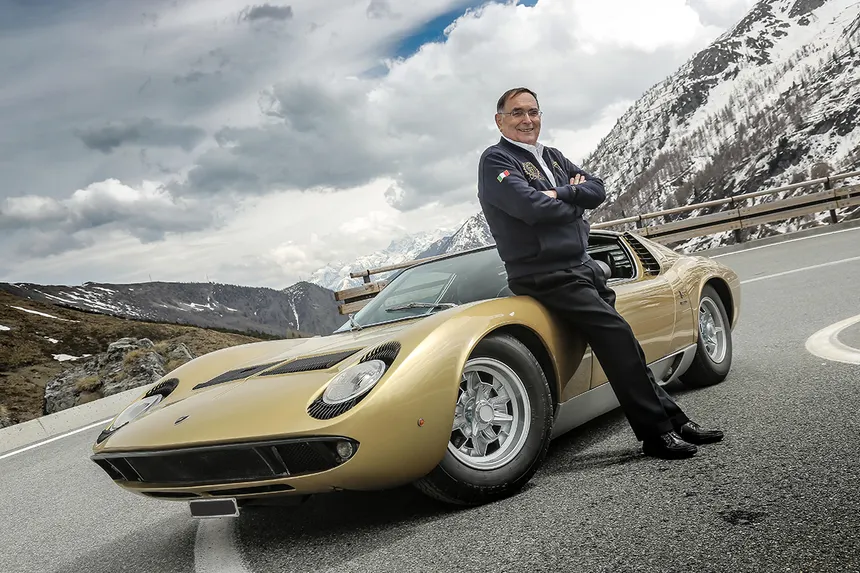
In the summer of 1964, when production of the Lamborghini 350 GT was underway and the work pace eased slightly, three young engineers — Dallara, Paolo Stanzani, and Bob Wallace, a New Zealander who served as Lamborghini’s test and development driver and would later build the legendary Miura Jota competition car — started working after hours on an idea Ferruccio Lamborghini hadn’t asked for. A mid-engine car. A race car with a license plate.
Ferruccio was skeptical. Mid-engine cars were for circuits, not roads. But Dallara led the chassis design — a platform structure in folded sheet metal with the 4-liter V12 mounted transversely behind the driver — and when the mechanicals were ready, he convinced Ferruccio to show them.
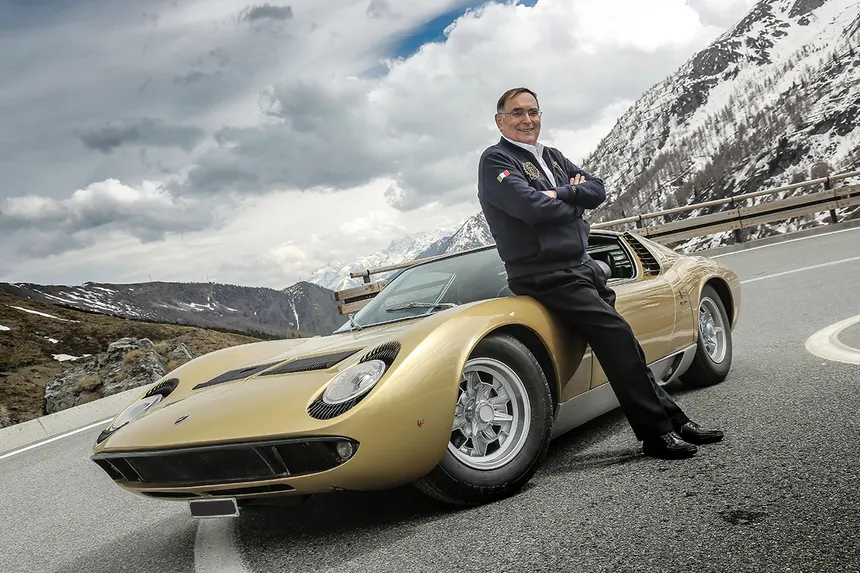
On November 3, 1965, at the Turin Motor Show, Lamborghini exhibited the bare chassis of Project L105. No bodywork. No paint. Just the mechanical structure, built by Marchesi of Modena. The bare chassis weighed 120 kg. People crowded around it as if it were a sculpture. Nuccio Bertone walked past the stand and told Ferruccio: “I will make the perfect shoe for this wonderful foot.” Over Christmas 1965, Marcello Gandini presented the first sketches to Ferruccio, Dallara, and Stanzani. In March 1966, at the Geneva Motor Show, the Turin chassis became the Lamborghini Miura.
Dallara was 29 when he designed the chassis of the car that British journalist L.J.K. Setright would christen the first “supercar” in Car magazine. He did it without being asked. After hours. At a company that made tractors. And though the debate over design credits has persisted for decades — Giugiaro suggested his influence remained in the Miura’s lines, which Gandini categorically denied — nobody has ever disputed who designed what lay beneath that bodywork. That was Dallara.
After the Miura came the Espada, a four-seat grand tourer with a front-mounted V12 that Dallara also engineered. But the relationship with Lamborghini wasn’t going to last forever.
De Tomaso: the Pantera, F2, and Frank Williams
In 1968, Alejandro de Tomaso convinced Dallara to join his company in Modena. De Tomaso was the opposite of Lamborghini — an Argentine-Italian with outsized ambitions, tight budgets, and an almost supernatural ability to attract talent. Dallara came in as chief engineer and went to work on two fronts.
On one hand, he designed the pressed-steel monocoque chassis of the De Tomaso Pantera — the car that put De Tomaso on the map when Ford decided to sell it through their Lincoln-Mercury dealerships in the United States. The Pantera ran a 5.8-liter Ford Cleveland V8 and could exceed 250 km/h. Over 7,000 units were built through 1993. It’s one of the most commercially successful Italian supercars in history, and Dallara designed the chassis.
On the other hand, he designed a Formula 2 single-seater with a tubular monocoque chassis in riveted aluminum sheet, inspired by aeronautical techniques. That car became the basis for the single-seater that Frank Williams — yes, that Frank Williams — raced in the Formula 1 World Championship in 1970.
But De Tomaso was acquired by Ford, and Dallara started feeling what he’d already felt at Ferrari and Lamborghini: that he couldn’t build what he wanted under someone else’s priorities.
1972. The garage, the church, and the football pitch
The decision of 1972 is what defines Dallara. At 36, having worked at Ferrari, Maserati, Lamborghini, and De Tomaso, capable of running the technical department of any manufacturer in the world, he went back to his village. To Varano de’ Melegari. To the garage behind his house, between the church and the football pitch.
He founded Dallara Automobili da Competizione. With a handful of trusted employees. No outside investors. No sponsors. With the conviction that he could build better racing cars than the ones he’d made for others.
The early years were tough. The garage had no glamour. Dallara started building chassis for sports cars and hillclimb races, small commissions that paid the bills while he learned to run a company without a major brand behind him. There was no safety net. If a client didn’t pay or a chassis failed, the company went under. But Dallara had something no investor can buy: technical credibility. Everyone in Motor Valley knew who the engineer was who had designed the Miura and the Pantera. And the commissions started coming.
That garage is now a company of over 700 employees that designs and builds single-seaters for IndyCar, Formula 2, Formula 3, Indy Lights, and a list of categories spanning more than 300 championships worldwide. In 1991, they inaugurated their first real plant: 3,500 square meters in the same Varano de’ Melegari. In 1998, a Dallara single-seater won the Indianapolis 500 for the first time. Since 2012, every car on the IndyCar grid is a Dallara. But in 1972, it was just a man with an aeronautical engineering degree, a spotless track record, and a decision that anyone else would have called insane.
Lancia and rallying: the other Dallara
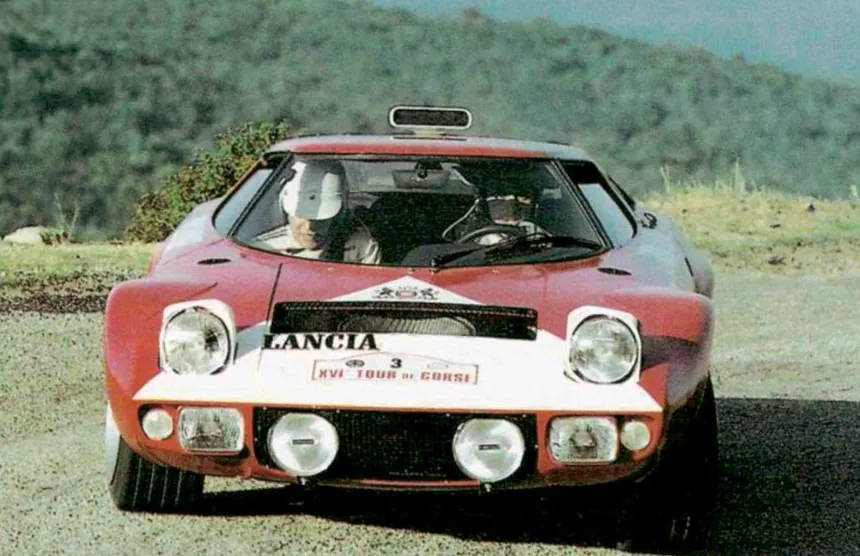
Most people associate Dallara with single-seaters. But his first major collaboration as an independent company was with Lancia. From 1972, Dallara worked as a consultant on the chassis and suspension development of the Lancia Stratos, the most radical rally car ever built. Alongside English engineer Mike Parkes, he modified the rear suspension — from double wishbones to MacPherson struts — to withstand the punishment of gravel stages. Dallara managed the technical team at the Stratos’s earliest competitions, including its debut at the 1972 Tour de Corse with Sandro Munari behind the wheel.
After the Stratos came the Lancia Beta Montecarlo Group 5, the LC1, and the LC2 — every competition car that took Lancia to the summit of the World Rally Championship and endurance racing passed through Dallara’s hands.
The philosophy: the engineer who refused to be anyone’s subordinate
There’s a question the Gandini article leaves open that Dallara answers with his life. What happens when a talent decides not to depend on someone else’s priorities?
Gandini stayed at Bertone for 14 years on a salary. Dallara left at 36. The two worked on the same car — the Miura — without anyone placing them together in the history books. Gandini drew the bodywork. Dallara designed everything underneath. One made it impossibly beautiful. The other made sure it didn’t fall apart.
But where Gandini remained an employee until he was 41, Dallara cut the cord sooner. Not because things were going badly. Because he wanted to build racing cars without anyone telling him what engine to use, what budget to respect, or what commercial priority to follow. And he succeeded.
There’s a phrase Dallara has repeated throughout his career that captures his philosophy perfectly: “If we work together, no one else has a chance.” He wasn’t talking about corporate synergies or business plans. He was talking about Varano de’ Melegari, about the Motor Valley, about the idea that a cluster of small companies in the Italian countryside, each obsessed with engineering excellence, could outperform any multinational. And looking at what Dallara has built — a company that supplies chassis to the most demanding racing categories in the world from a village that doesn’t even have a motorway exit — it’s hard to argue with him.
Today he’s 89 years old. He still lives in Varano de’ Melegari. He’s still president of the company he founded in a garage. His daughter Angelica, an aeronautical engineer like him, works alongside him as partner and collaborator. The Polytechnic of Milan gave him his degree. The University of Parma granted him the title of Professor Ad Honorem in 2014. The President of the Italian Republic named him Cavaliere del Lavoro in 2016.
But what defines Dallara isn’t a list of awards. It’s a decision. The one made by a man who, given the chance to stay in Maranello, chose a garage in Parma. And from that garage, built the future of racing.
Check you’re still alive.
4 thoughts on “GIANPAOLO DALLARA”