LANCIA STRATOS: THE CAR THAT ONLY KNEW HOW TO WIN
Here is the shortest version of the Lancia Stratos story: a small Italian company begged Ferrari for an engine, built the minimum number of cars required by the regulations, and won three consecutive World Rally Championships. Then its parent company killed it — not because it stopped winning, but because it won too well for a subsidiary brand.
That’s the headline. The real story is more absurd than any headline can hold.
A car that drove under a barrier
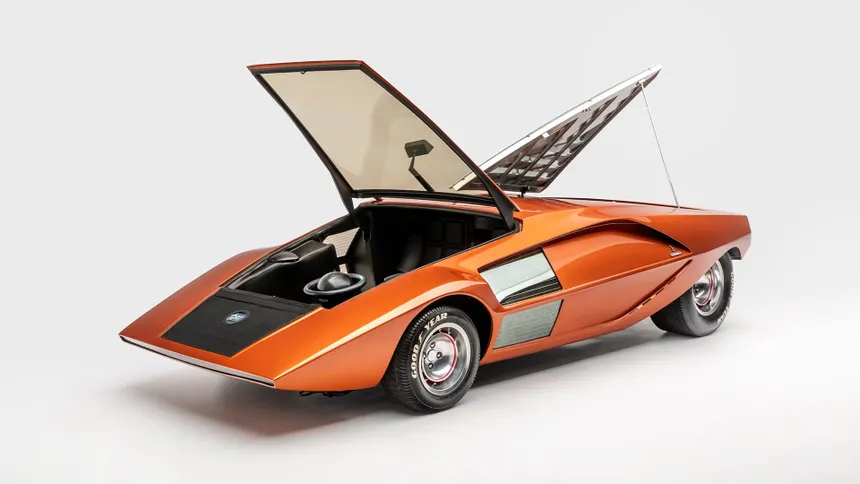
In November 1970, Nuccio Bertone arrived at the Lancia factory in a car so low it passed beneath the entry barrier. Workers on the factory floor applauded. The car — the Stratos Zero, designed by Marcello Gandini — was a concept where the driver climbed in through the windshield, rear visibility didn’t exist, and practical utility was not a consideration that had crossed anyone’s mind.
But Cesare Fiorio saw it differently. Lancia’s sporting director needed to replace the aging Fulvia in international rallying. Fiat, which had acquired Lancia in 1969, wasn’t interested in funding competition. Fiorio convinced managing director Pierlugo Gobbato that something radical was possible: not an adapted road car, but the first rally car in history designed from a blank sheet with no purpose other than winning.
The engine nobody wanted to give them
Gandini reworked the Zero concept into something less theatrical but no less extreme. An ultra-short 2.18-meter wheelbase — shorter than most modern city cars. A panoramic wraparound windshield offering total forward visibility and almost nothing rearward. Mid-mounted engine. Fiberglass clamshell bodywork that flipped open front and rear for instant mechanical access during service.
The engine Fiorio needed was the 2.4-liter V6 from the Ferrari Dino 246 GT. Enzo Ferrari said no. He considered the Stratos a rival to his own Dino and refused to supply the motor for months. Lancia explored backup plans — the Beta’s four-cylinder, a Maserati V6 or V8 — but nothing matched the Dino’s combination of power, compactness, and reliability.
The breakthrough came on February 2, 1972. Lancia’s Fulvia had just won the Monte Carlo Rally. Enzo called Gobbato to congratulate him — and in that call, agreed to supply 500 Dino engines. The Dino production line had already shut down. The engine competed with nothing Ferrari still made. The Commendatore gave in because it cost him nothing.
By December 1972, Fiat approved the deal. Five hundred V6 engines — triple Weber 40 IDF carburetors, 190 hp at 7,000 rpm, 7,800 rpm redline — dropped into a car weighing 980 kg. On the road: 0-100 km/h in 6.8 seconds, 230 km/h top speed. On a rally stage with the 24-valve Group 4 head: 280 hp. With the turbo Group 5 setup: 380 hp. Pushing less than a tonne.
The Dino V6 was the perfect engine for this application, and not just because of its output. It was compact enough to mount transversely in the Stratos’s tiny engine bay. It was mechanically robust — race teams pushed it to levels Ferrari never intended, and it held together. And it had a sound that no turbocharged four-cylinder rally engine would ever match: a hard-edged bark that climbed to a scream through the rev range, echoing off mountain walls on Corsican stages and Monaco tunnels alike. The engine made the Stratos fast. But it also made the Stratos theatrical — and in rallying, theater matters because spectators standing on stage corners need a reason to come back.
The Stradale was not a comfortable car to drive. It was deafeningly loud, roasting hot from the mid-mounted engine, impossibly cramped, with rearview mirrors that showed you nothing useful. The pedals were offset left. The suspension was race-spec direct. Nobody bought a Stratos because it was pleasant. They bought it because nothing else on any road felt remotely like it.
Engineering without compromise
Gianpaolo Dallara — who had designed the chassis of both the Miura and the Pantera — consulted on the Stratos’s chassis and suspension from 1972 alongside Mike Parkes, former F1 driver and Lancia’s competition technical director. The original rear double wishbones bent and deformed under gravel impacts and the V6’s torque, forcing two retirements in the car’s earliest rally outings. Dallara replaced them with MacPherson struts. Problem solved.
Giovanni Tonti coordinated the engineering between Lancia and Bertone. Claudio Maglioli, official test driver, used real rallies as the development program — the car entered events before it was homologated, running as a Group 5 prototype, treating every stage as a shakedown session that happened to count for points. The steel monocoque sat between a tubular front subframe and a box-section rear structure. Every body panel was fiberglass, every one opened for complete access.
The servicing philosophy is worth understanding, because it’s what made the Stratos different from every rally car that came before it. Traditional rally cars were modified road cars — when something broke, you worked around production-car packaging to reach it. The Stratos was designed the other way around: the mechanics came first, and the bodywork was shaped to give you access to them. Lift the rear clamshell and the entire engine, gearbox, and rear suspension were exposed. Lift the front and you had the radiator, steering, and front suspension. A competent mechanic could pull the engine faster than you can read this article. In a sport measured in seconds, that design choice won rallies.
Exactly 492 cars
Group 4 homologation demanded 500 units within 24 months. What the FIA actually required was enough components and chassis to build 500 — not 500 completed, road-ready vehicles. Fiorio’s homologation declaration claimed 515 units as of July 23, 1974. The number was disputed. Seventeen months later, the FIA reduced the minimum to 400, making the argument academic.
Best estimate: 492 completed Stratos, plus ten spare shells. Every one left-hand drive. Bodies from Bertone’s Grugliasco plant, final assembly at Lancia Chivasso or the team’s Via Caraglio workshop in Turin. Ten became official factory Group 4 cars. The rest went to dealers — who were contractually obligated to accept at least one — and to privateers who prepared them for competition.
The dealer obligation is worth dwelling on. Lancia effectively forced its own sales network to absorb a car that most customers couldn’t comfortably drive, couldn’t easily see out of, and couldn’t use for anything except going very fast in a straight line or winning a rally. Some dealers resented it. Some customers wrecked their cars within weeks, discovering that 190 hp in a sub-tonne mid-engine car with no electronic safety nets required more skill than enthusiasm. The Stratos didn’t care. It wasn’t built for their comfort. It was built for Fiorio’s trophy cabinet.
This was never a car for Sunday drives. It was a weapon with license plates, manufactured in the exact quantity the regulations demanded.
Three titles wearing Alitalia colors
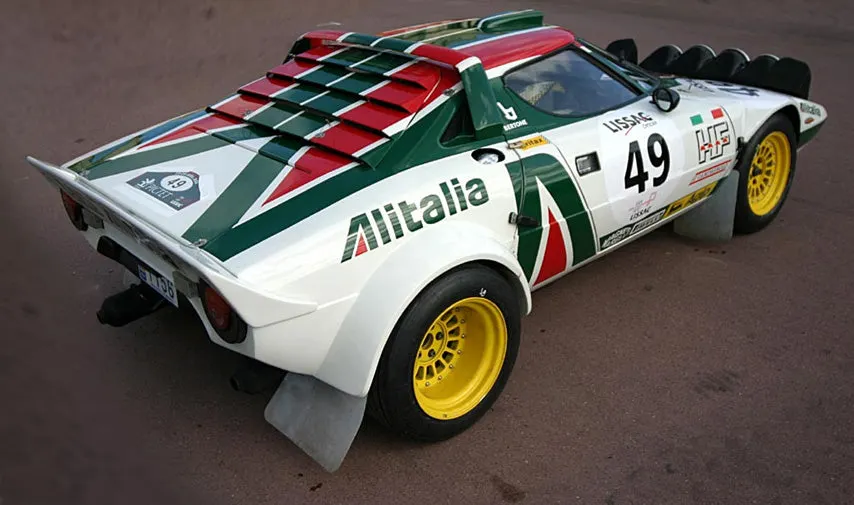
Competition debut: Tour de Corse, November 1972. Sandro Munari driving, Dallara running the technical crew. The car entered as a Group 5 prototype — not yet homologated — and retired with suspension failures that the MacPherson conversion would later fix.
First win: Firestone Rally, Spain, April 1973. Munari and Mario Mannucci. By October, Munari had won the Tour de France Auto. Group 4 homologation arrived on October 1, 1974.
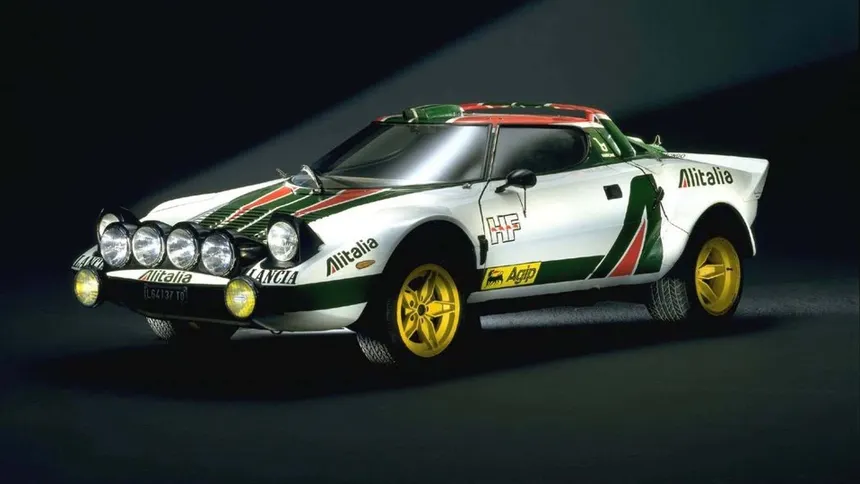
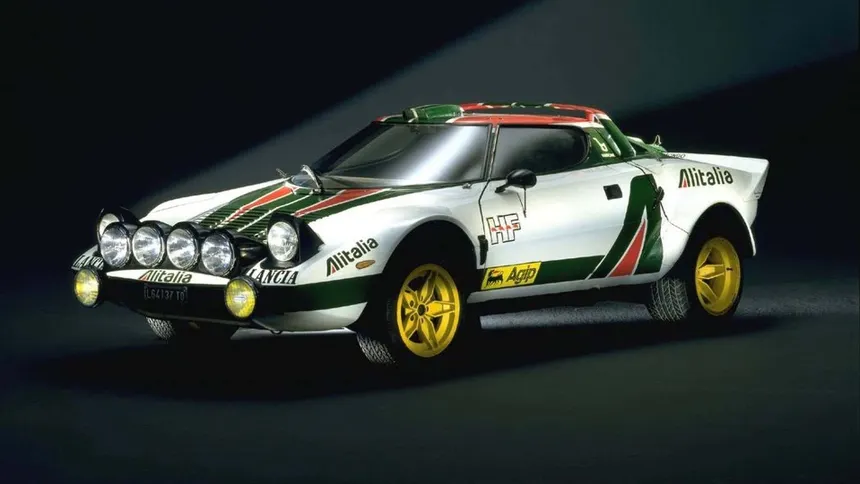
Then the Stratos wearing Alitalia’s white, red, and green livery — one of the most iconic images in motorsport history — swept everything aside. WRC 1974. WRC 1975. WRC 1976. Three straight. Munari was the spearhead, but Björn Waldegård and Bernard Darniche proved the car didn’t need one specific driver. It needed its engineering.
On tarmac, the Stratos had no equal. The Alpine A110 — 1973’s champion — was fading, its rear four-cylinder outgunned by the Ferrari V6. The Ford Escort RS1800 competed on gravel but couldn’t live with the Stratos on Mediterranean mountain roads. The Porsche 911 was heavier, longer, engine in the wrong place — reliable but fundamentally outmatched in agility by a mid-engine car with a wheelbase shorter than a go-kart’s.
What made it unbeatable wasn’t one thing. It was that every element served a single objective. Clamshell access meant minimal service time. The Ferrari V6 tolerated savage tuning without cracking. Fiberglass panels meant a crash destroyed the skin but left the mechanicals intact — swap the panel, keep racing. Every component existed to win rallies. Nothing else.
Death by corporate arithmetic
In 1977, Fiat redirected Lancia’s competition budget to the Fiat 131 Abarth. The official rationale was cost: the 131 was cheaper to build, cheaper to run, better suited to evolving regulations. The politics of a subsidiary outshining its parent company undoubtedly played a role, but the budget argument held up — the 131 went on to win the WRC in 1977, 1978, and 1980.
What Fiat’s accountants couldn’t quantify was what made the Stratos different from the 131 — or from every other rally car of its era. The 131 was a road car converted for competition, which was how rallying had always worked. You took something from the showroom floor, reinforced it, tuned it, and went racing. The Stratos inverted the logic. It started as a racing car and reluctantly accepted the minimum requirements for road registration. That inversion — competition first, road tolerance second — was the Stratos’s most radical innovation, more important than its engine or its bodywork or its wheelbase. It changed what manufacturers thought was possible.
The Stratos kept fighting with private teams. Darniche won Monte Carlo in 1979 for the Chardonnet squad. The Tour de Corse fell to a Stratos five times between 1974 and 1981. But without factory money, the car couldn’t evolve. The Lancia Rally 037 and then the Delta S4 picked up the brand’s rally legacy — the 037 supercharged, the S4 turbocharged and four-wheel drive. Both faster on paper. Neither possessed the Stratos’s absolute clarity of intent. And every one of them inherited its template: short wheelbase, mid engine, service-first bodywork. Every Group B homologation special that followed — the Peugeot 205 T16, the Audi Sport quattro, the Ford RS200 — carried Stratos DNA in its concept.
What 492 cars proved
Gandini drew it. Dallara gave it a chassis. Fiorio gave it direction. Enzo surrendered the engine because it no longer cost him anything. Fiat killed it when the accounting said so.
In between, 980 kg of steel and fiberglass with a borrowed Ferrari V6, built in the exact number required by a rulebook — not one unit more — won three consecutive world championships, redefined what a rally car could be, and established the blueprint that every purpose-built competition car would follow for the next decade.
The Stratos was built to do one thing. It did that one thing better than anything before or since. And the fact that it did it with an engine begged from a rival, a body drawn by a man who worked for someone else, and a chassis engineered by a consultant who’d already left for his own garage — that’s not a weakness. That’s the most Italian story ever told.
Check you’re still alive.