Audi sold just 763 original quattros through official channels in North America, between 1983 and 1986. That’s it. The car that rewrote rallying, the one every Audi ad still leans on four decades later, was practically a rumor over here. Then a TV show nearly finished Audi off in the US, and when Audi came back to American racing with all-wheel drive, it won so hard the rule makers threw it out.
That’s the quattro story worth telling. Not the brochure version.
Geneva, 1980: four-wheel drive was for farmers
When the quattro was shown at the Geneva Motor Show in March 1980, nobody serious built fast cars with all-wheel drive. It meant weight, complexity and something that belonged on a Jeep. The idea came out of winter testing of the VW Iltis, a military off-roader whose four-wheel drive embarrassed far more powerful cars on snow. Audi’s engineers asked what would happen if you put that in a coupe with a turbo.
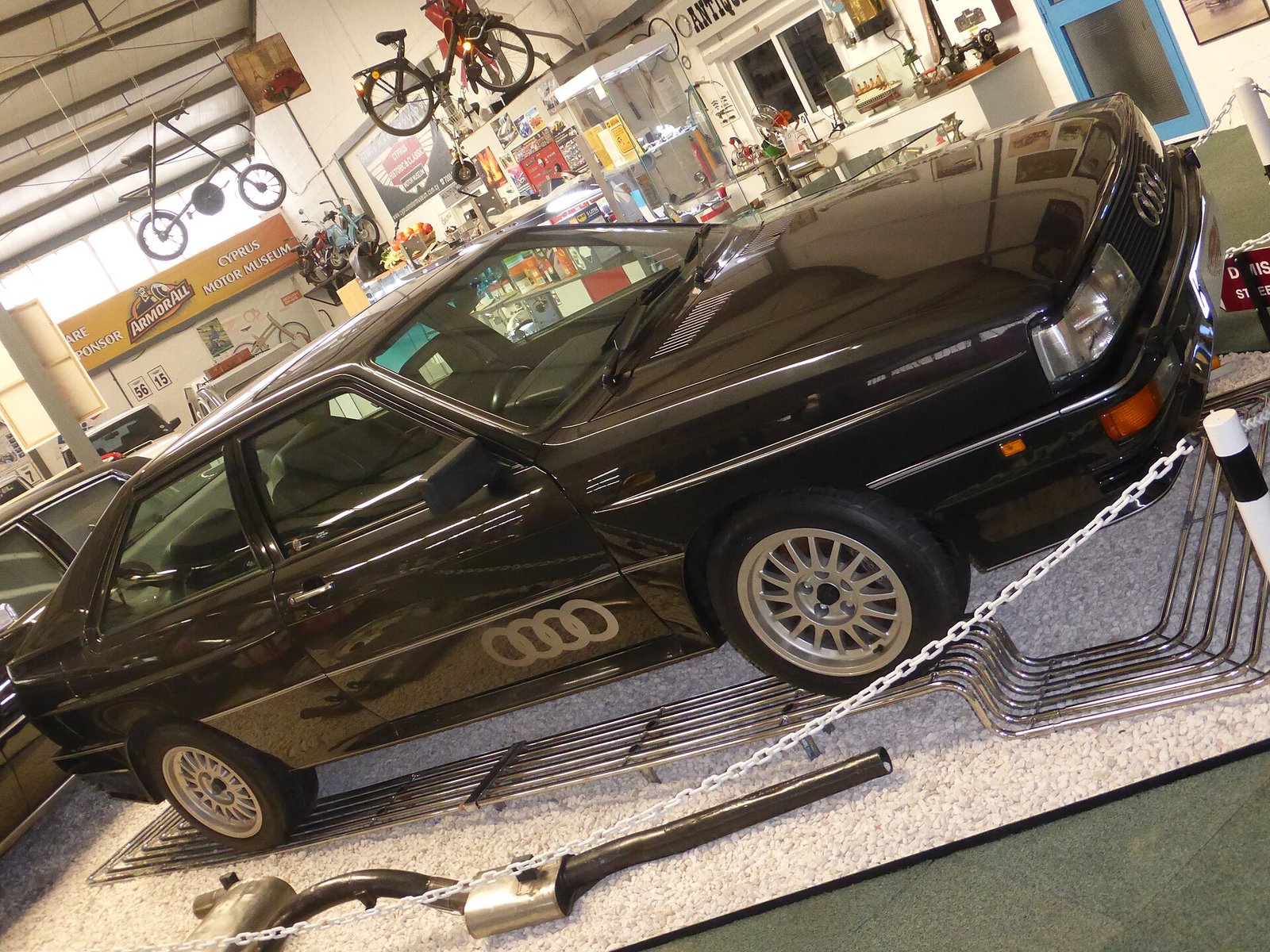
The answer was a car based on the Audi 80 coupe body with a 2.1-liter turbocharged five-cylinder making 200 hp. Not a huge number even then. The point was that all of it reached the ground, on gravel, on ice, in the rain. Later road cars went to 2.2 liters and, in 1989, to a 20-valve head with 220 hp. Audi built 11,452 of them by 1991. Only 763 came to North America through official channels, and just 240 of those arrived in 1983.
It’s worth understanding what "quattro" actually solved, because it wasn’t just bolting a driveshaft to the rear axle. When a car turns, all four wheels travel different distances, and the front axle covers more ground than the rear. Lock the front and rear together and the drivetrain fights itself in every corner, scrubbing tires and binding up. That’s fine for a Jeep in the mud, terrible for a road car. Audi’s trick was a center differential inside a compact, hollow-shaft gearbox, light enough to fit a normal car, which let the front and rear turn at different speeds and could be locked by the driver when traction got bad. From 1987 Audi moved to a Torsen center differential, a worm-gear design that shifts torque toward the axle with more grip on its own, without the driver touching anything. Every Audi with the badge since has been a variation on that idea, electronically managed in recent years.
What it did to rallying
The quattro’s first World Rally Championship win came at the 1981 Swedish Rally with Hannu Mikkola. Audi won the manufacturers’ title in 1982, Mikkola took the drivers’ title in 1983, and in 1984 Stig Blomqvist was champion and Audi took the manufacturers’ crown again. Michèle Mouton won rallies outright in a quattro, a first for a woman at that level, and finished second in the 1982 drivers’ standings.
It wasn’t a clean sweep, though, and that’s the part ads leave out. In 1983 Lancia won the manufacturers’ title with the mid-engined, rear-wheel-drive 037, the last two-wheel-drive car ever to win the championship. Raw traction didn’t beat a lighter, better-balanced car on every surface. Not yet.
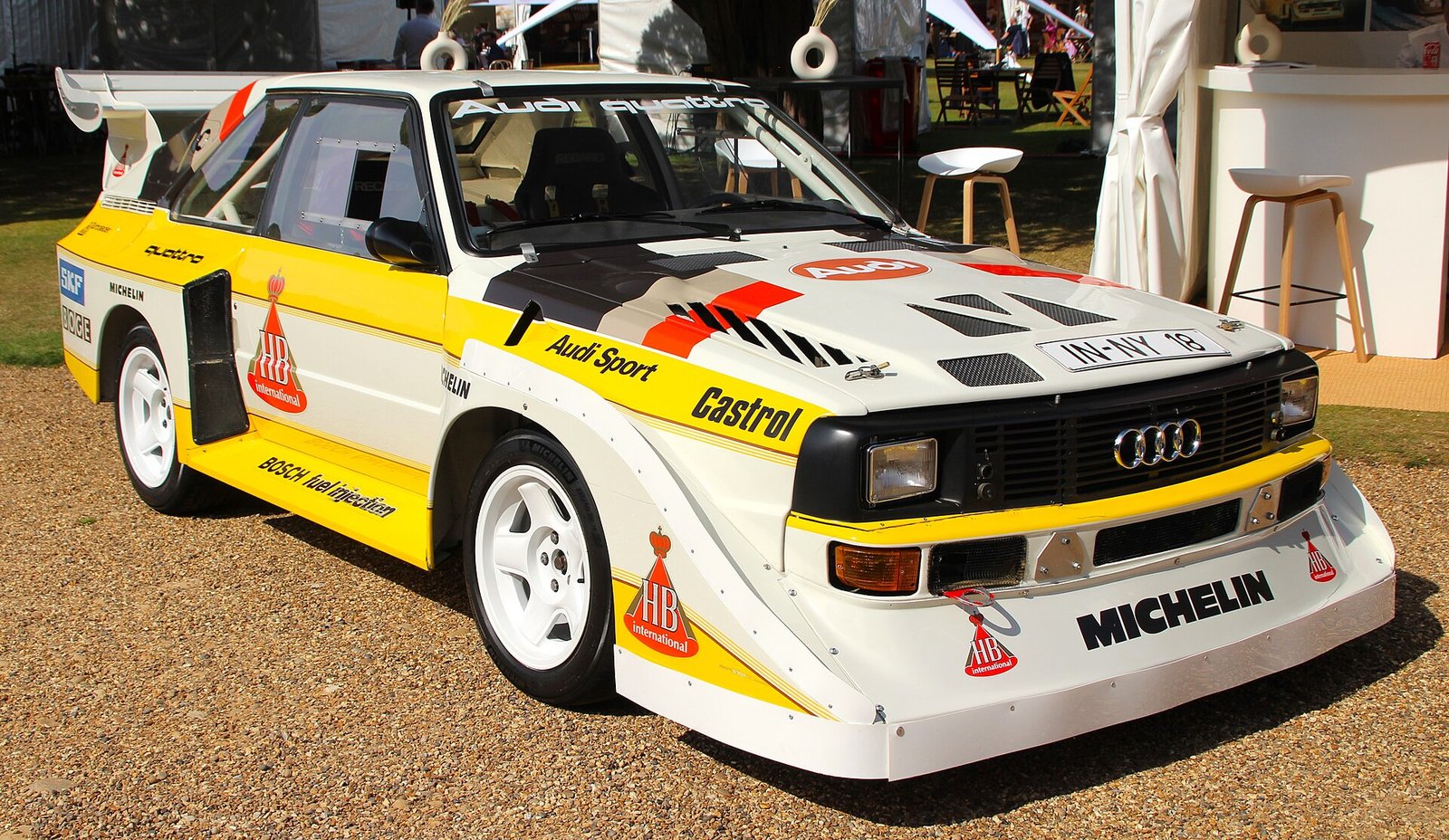
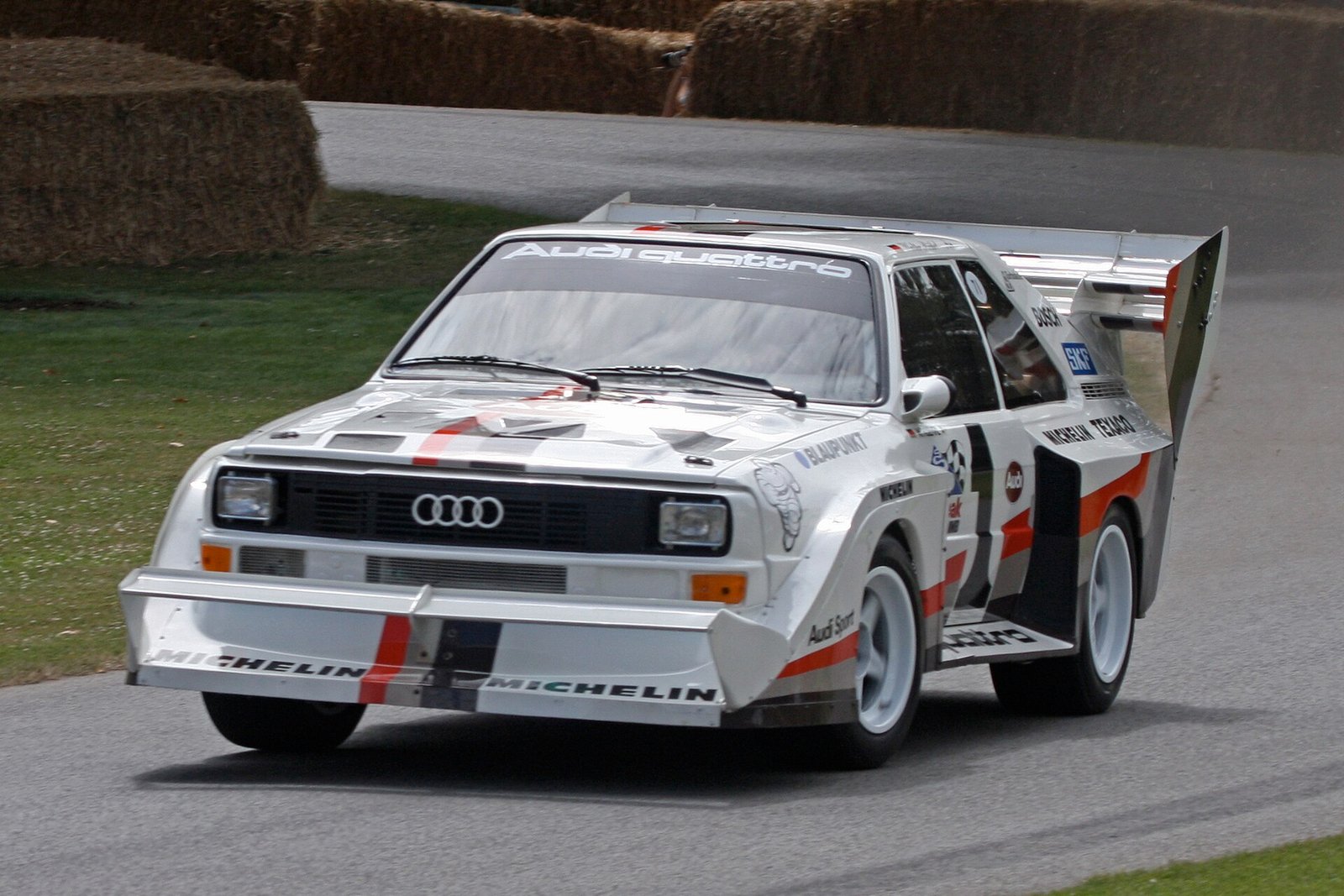
To keep up, Audi chopped the wheelbase. The Sport quattro of 1984 was 320 mm shorter, with a 2.1-liter four-valve engine making 306 hp in road trim. Audi built 214, 164 of them for the road, to homologate the rally car. Then came the Sport quattro S1 in 1985, with around 476 hp officially and enough wings to look like it had been built by a fighter-plane contractor. Walter Röhrl won the 1985 Sanremo Rally in it.
It did not win the world championship. Peugeot’s mid-engined 205 T16 took the titles in 1985 and 1986. Audi withdrew from Group B after a Ford RS200 crashed into spectators at the 1986 Rally Portugal, and after Henri Toivonen and Sergio Cresto were killed at the Tour de Corse in May 1986, the governing body banned Group B for 1987.
Pikes Peak, where it found its home
If you’re American and the quattro means something to you, it’s probably because of a mountain in Colorado. Michèle Mouton won the Pikes Peak International Hill Climb in 1985 in a Sport quattro, in 11 minutes 25.39 seconds, on what was still largely a gravel road. Bobby Unser, a three-time Indy 500 winner, won in 1986 in the S1 and set a record of 11:09.22. In 1987 Walter Röhrl brought the S1 back and ran 10:47.85, more than 21 seconds quicker than Unser’s record.
Three years, three wins, three records, three different drivers. That’s what all-wheel drive and a screaming turbocharged five-cylinder could do on loose dirt with a cliff on one side.
60 Minutes and the near-death of Audi in America
Then came November 23, 1986. CBS’s 60 Minutes aired a segment on the Audi 5000 and "sudden unintended acceleration," including footage of a car lurching forward with nobody touching the pedals. It was devastating. It was also staged: it later came out that the demonstration car had been rigged with a compressed-air canister and a hose feeding fluid into a hole drilled in the transmission. The National Highway Traffic Safety Administration concluded that most cases, including those that prompted the report, came down to drivers pressing the wrong pedal.
By then the damage was done. Audi’s US sales collapsed through the late 1980s, and it took the brand years to recover. If you want to know why the fast Audis of the 1990s mostly stayed in Europe, start here.
1988: the year Trans-Am got scared
Audi’s response was to go racing in America with the thing it did best. In the 1988 SCCA Trans-Am series, a championship built around big American V8s, Audi entered the 200 quattro with its turbocharged five-cylinder and all-wheel drive. Hurley Haywood, already a Le Mans winner and a fixture of American endurance racing, drove one car all season; Walter Röhrl and Hans Stuck shared the other. Picture it: a German sedan with a five-cylinder that sounded like nothing else on the grid, putting power down out of slow corners while Camaros and Mustangs spun their rear tires. They won 8 of 13 races and took both the drivers’ title, for Haywood, and the manufacturers’ title.
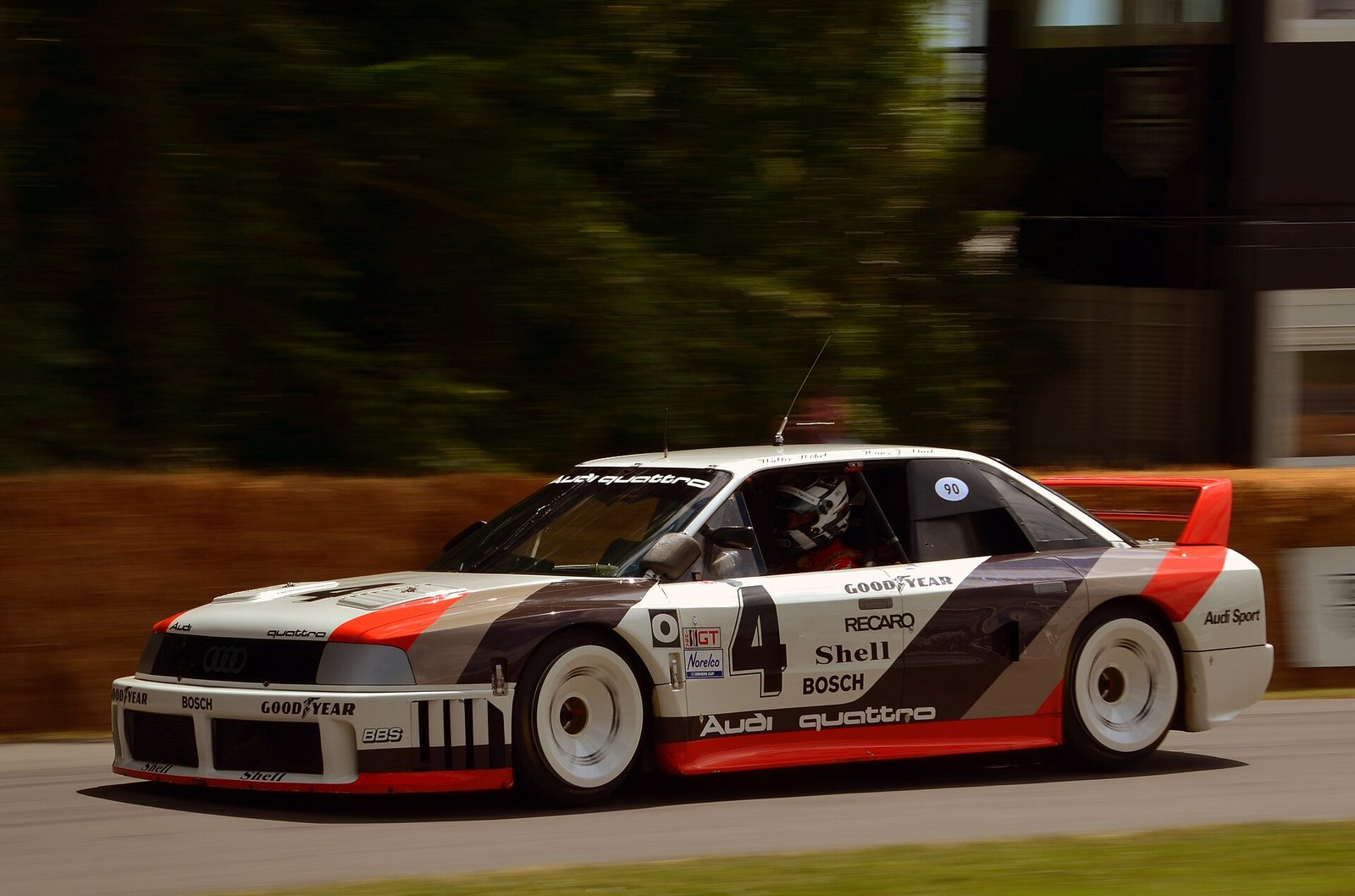
The SCCA’s answer was to change the rules for 1989: two-wheel drive only, and no non-American engines. Audi moved to IMSA GTO with the 90 quattro, a pure race car with a tube frame, carbon-fiber body and a 2.2-liter five-cylinder making around 720 hp. It won seven races that season. There was no road version, whatever you’ve read online.
The wagons America never got
Back in Europe, Audi spent the 1990s turning family wagons into weapons, and most of them never crossed the Atlantic.
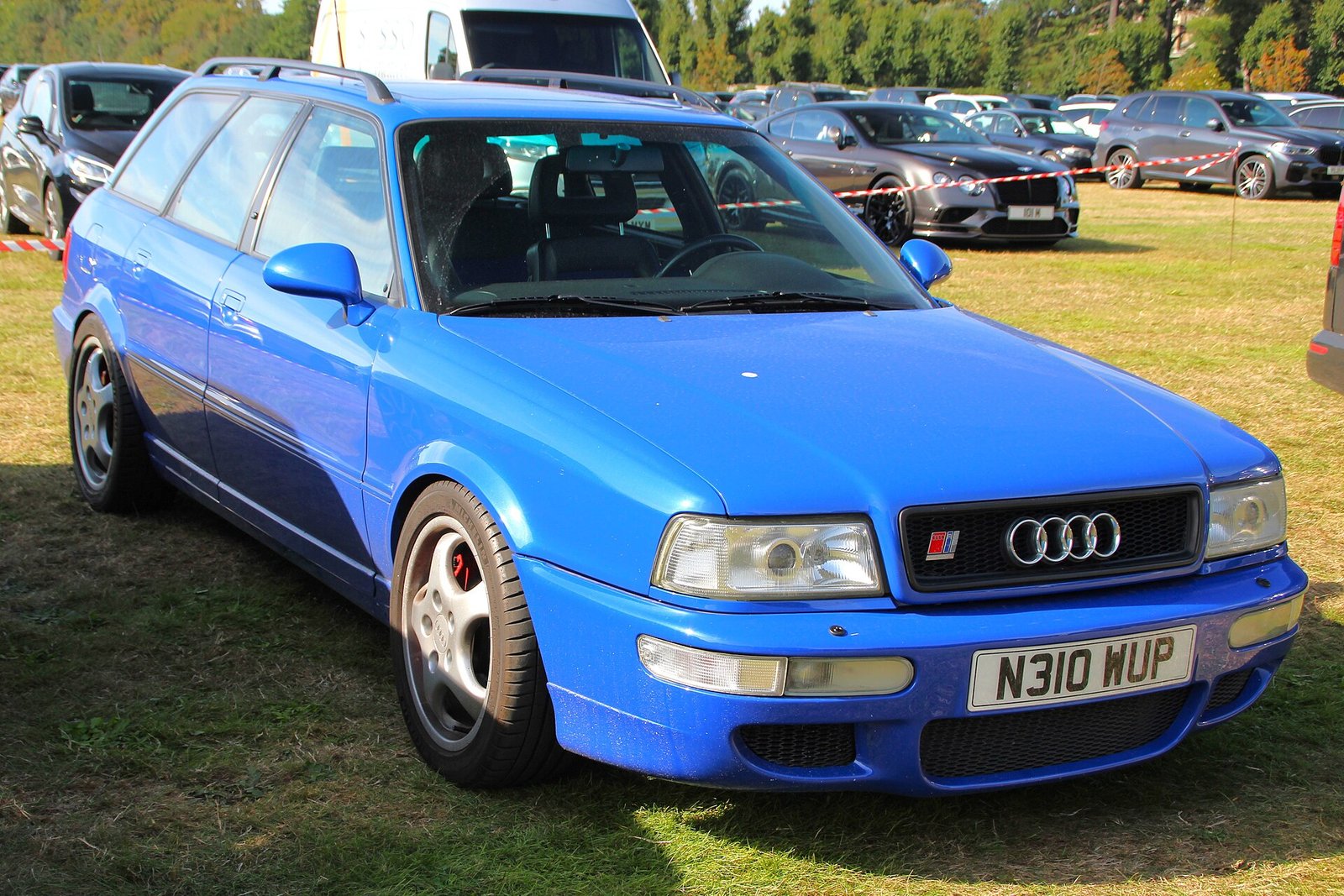
The RS2 Avant of 1994 was built with Porsche: a 2.2-liter turbo five with 315 hp, 0 to 100 km/h in 4.8 seconds and a top speed of 262 km/h, about 163 mph, in an 80-series station wagon. Porsche-badged wheels, brakes and mirrors. 2,891 were made. None were sold in the US.
The RS4 Avant B5 followed in 1999 with a 2.7-liter twin-turbo V6 developed with Cosworth in Britain, 380 hp, 0 to 100 in 4.9 seconds. Audi planned 3,000 and ended up building 6,030. It was never sold in the US either, which is why American enthusiasts now import them as soon as they turn 25 and become legal.
The first RS for America, and what followed
The first full RS model sold in North America was the RS6 of the C5 generation, from 2003. It had a 4.2-liter twin-turbo V8, again with Cosworth’s hand in it, making 450 hp. Audi expected to sell 860 in North America and ended up shipping an estimated 1,200. Worldwide, just over 8,000 were built from 2002 to 2004.
The next RS6, the C6 of 2008, got the famous one: a 5.0-liter twin-turbo V10 with 580 hp. The RS4 B7 of 2006 is the one American enthusiasts talk about most. It came to the US as a sedan and cabriolet, never as a wagon, with a 4.2-liter naturally aspirated V8 making 420 hp, revving past 8,000 rpm, and a six-speed manual as the only transmission. For all the talk of Audi going soft, the B7 might be the most driver-focused RS ever sold here.
After that the direction is clear. The RS4 B8 of 2012 kept a 450 hp high-revving V8 but came only with a seven-speed S tronic dual-clutch, and it was never sold in the US at all. The RS4 B9 of 2018 swapped to a 2.9-liter twin-turbo V6, 450 hp, an eight-speed automatic and 0 to 100 in 4.1 seconds. The RS6 C8, which finally brought the RS6 Avant to America for the 2021 model year, has a 4.0-liter twin-turbo V8 with 600 hp and a 48-volt mild-hybrid system, and does 0 to 100 in 3.6 seconds. It weighs over two tons.
The electric one
The RS e-tron GT arrived for 2021 with 646 hp on overboost. The 2024 update went further: the RS e-tron GT performance makes up to 925 hp on overboost, hits 100 km/h in 2.5 seconds and weighs 2,320 kg, a bit over 5,100 lb, by the German DIN measure. It’s the most powerful production Audi ever built. It’s also the furthest thing imaginable from a 200 hp coupe sliding through Swedish snow.
The Spanish connection
There’s a Spanish chapter most Audi histories skip. Between 2011 and July 2018, around 800,000 Audi Q3 and RS Q3 models were built at SEAT’s plant in Martorell, near Barcelona, many of them with quattro all-wheel drive. The word Audi built its legend on spent seven years coming off a Spanish assembly line.
What to take from it
The quattro idea was simple and brutal: put the power on all four wheels and let physics do the rest. It won titles, it conquered Pikes Peak three years running, and it scared an American racing series into rewriting its rulebook. What Audi built on that name afterwards got heavier, faster and more complicated with every generation, and America saw only a slice of it. The new ones are better at almost everything, except making the driver sweat for the result the way that first coupe did.
If you want the purest expression of the idea you can actually buy in the US, it’s a 1983 to 1986 quattro, if you can find one of the 763. If you want the best RS that was sold here new, a B7 RS4 with its manual and its high-revving V8 makes a strong case. The wagons that made the legend in Europe, the RS2 and the B5 RS4, you’ll have to import.
Photos: Brian Snelson (CC BY 2.0); Andrew Bone (CC BY 2.0); MrWalkr (CC BY-SA 4.0); Nic Redhead (CC BY-SA 2.0); MrWalkr (CC BY-SA 4.0). Via Wikimedia Commons.
Check you’re still alive.
20 thoughts on “Audi Quattro: The Rally Car America Barely Bought, the Race Series That Banned It and the Wagons It Left Behind”