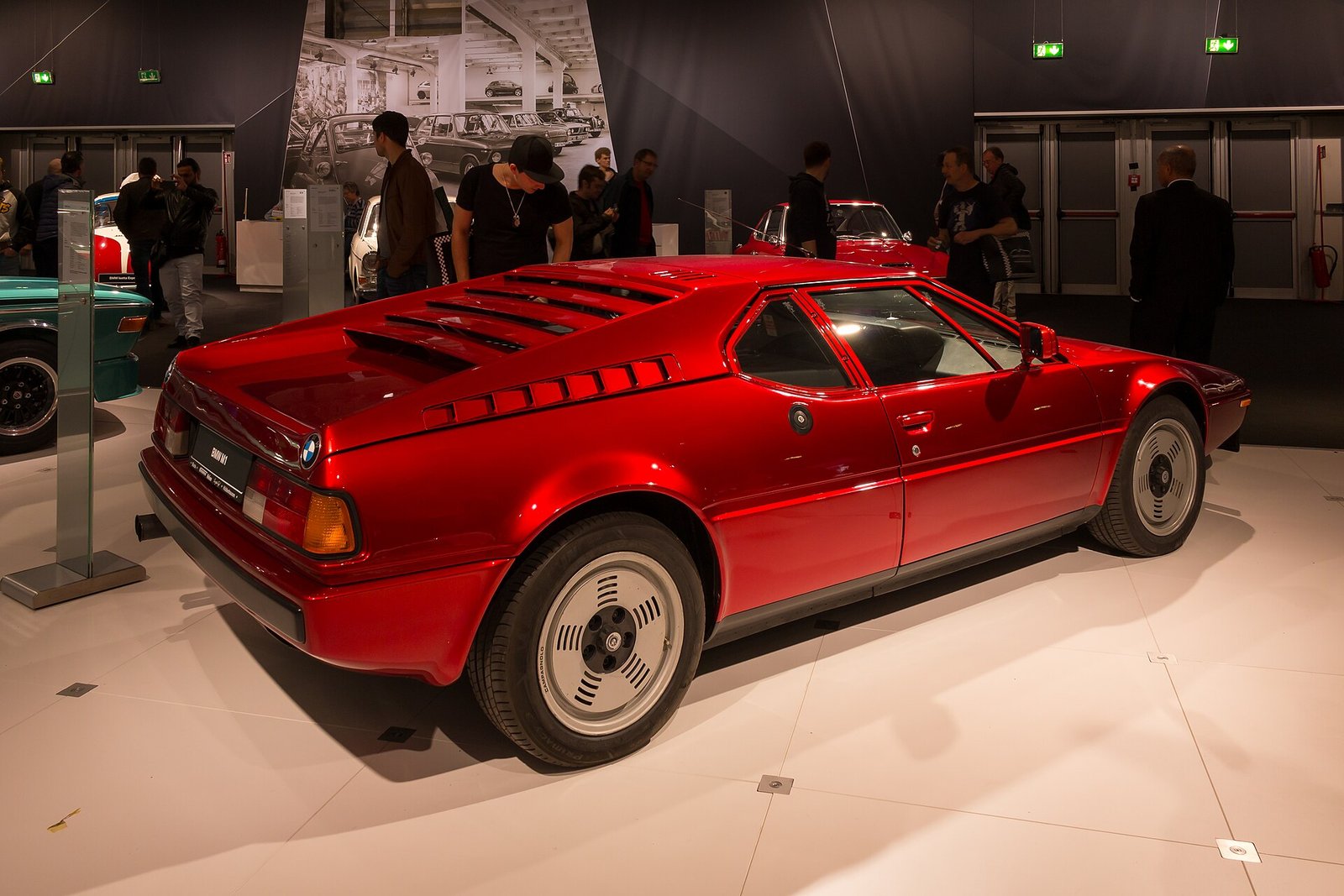
BMW never imported the M1 into the United States. Not one, officially. And in 1981 an M1 still won 12 of the 16 races in the IMSA GTO championship, with Dave Cowart behind the wheel. That’s the M1 in a nutshell: a car that kept showing up where it wasn’t supposed to be, and winning.
It’s also the only true mid-engine supercar BMW has ever built. Forty-odd years later, Munich still hasn’t made another one. Here’s how it happened, why it nearly didn’t, and why BMW has never dared to try again.
Munich calls Sant’Agata
In the mid-1970s BMW wanted a mid-engine car to go racing in Group 4 and to prove it could build something besides fast sedans. There was one problem: it had never built anything like that.
So it called Lamborghini. Sant’Agata would develop the chassis and build the cars, Giorgetto Giugiaro‘s Italdesign would design the body, and BMW would supply the engine.
Lamborghini was broke; in 1978 it ended up in receivership. Prototypes ran late, parts didn’t show up, budgets blew up. BMW engineers went to Italy and came back with horror stories. Eventually BMW pulled the plug on the deal and found itself holding a half-developed car, no factory, and a racing homologation that required 400 units.
What came next was a production line spread across half of Europe. Marchesi in Modena built the tube-frame chassis. TIR, also in Modena, made the fiberglass body. Italdesign put body and interior together. Coachbuilder Baur in Stuttgart did final assembly by hand. In total, 453 M1s were built between 1978 and 1981: 399 road cars and the rest for racing. By the time there were enough cars to homologate it, the rules were already moving on toward Group B.
It helps to understand what homologation meant. Group 4 was for production-based GT cars, and to race one you had to prove you’d built hundreds of road versions. Group 5, the "silhouette" class, let teams keep little more than the car’s outline and rebuild everything underneath. That’s why racing programs of that era started with a road car most buyers never asked for: the street M1 was, first and foremost, an entry ticket.
The construction tells the same story. Instead of a steel monocoque like a regular BMW, the M1 used a welded tube-frame chassis, the way race cars were built, wrapped in a fiberglass body that was light, easy to repair and cheap to make in small numbers. Great for a race shop. Terrible for a car company used to stamping steel by the million.
Giugiaro’s wedge
If Marcello Gandini’s Countach was the poster on every bedroom wall, Giugiaro’s M1 was the one the grown-ups liked. It wasn’t born from nothing. The starting point was the BMW Turbo concept of 1972, a gull-winged mid-engine show car penned by Paul Bracq and built around a turbocharged version of the four-cylinder that would soon power the 2002 Turbo. Giugiaro took its spirit and made it cleaner: a low nose with pop-up headlights, slatted vents behind the side windows feeding the engine, a cut-off tail with two BMW roundels on the back.
At 4,360 mm long and only 1,140 mm tall, about 45 inches, it looks pinned to the road. Next to today’s supercars, all creases, vents and active wings, it looks almost severe. It has also aged far better than most of them.
The M88
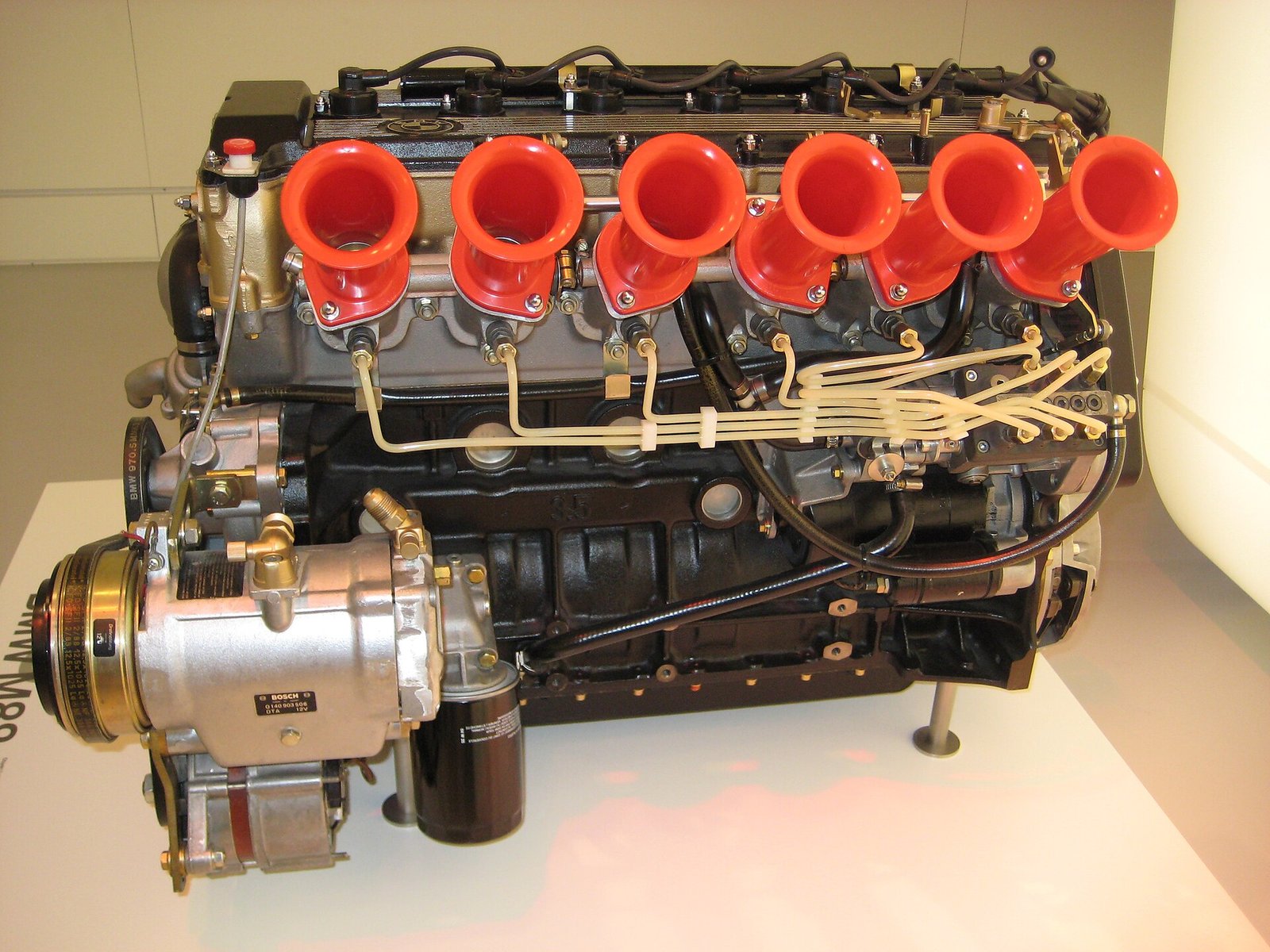
The engine was where BMW knew exactly what it was doing. The M88 was a 3.5-liter inline six with twin overhead cams, four valves per cylinder and Kugelfischer mechanical fuel injection. Mechanical injection meant no computer at all: a pump driven by the engine metered fuel through a three-dimensional cam that read engine speed and throttle position, a precise piece of clockwork that racing engineers loved and road mechanics feared. In road trim it made 277 hp at 6,500 rpm and 330 Nm, good for 0 to 100 km/h in about 5.6 seconds and a top speed past 260 km/h, around 162 mph.
Why a straight six, when the Italians were using V8s and V12s? Because BMW built straight sixes better than anyone, and because an inline six is naturally balanced: its primary and secondary forces cancel out, so it can rev high and smooth without fancy counterweights. Mounted in the middle of the car, ahead of the rear axle, it put the mass where a race car wants it.
The road car sold for 100,000 Deutsche marks, about $55,000 at the time. That was serious money in 1979, but it was a hand-built car whose parts came from three different specialists in two countries.
Procar: Formula 1 drivers in road-going supercars
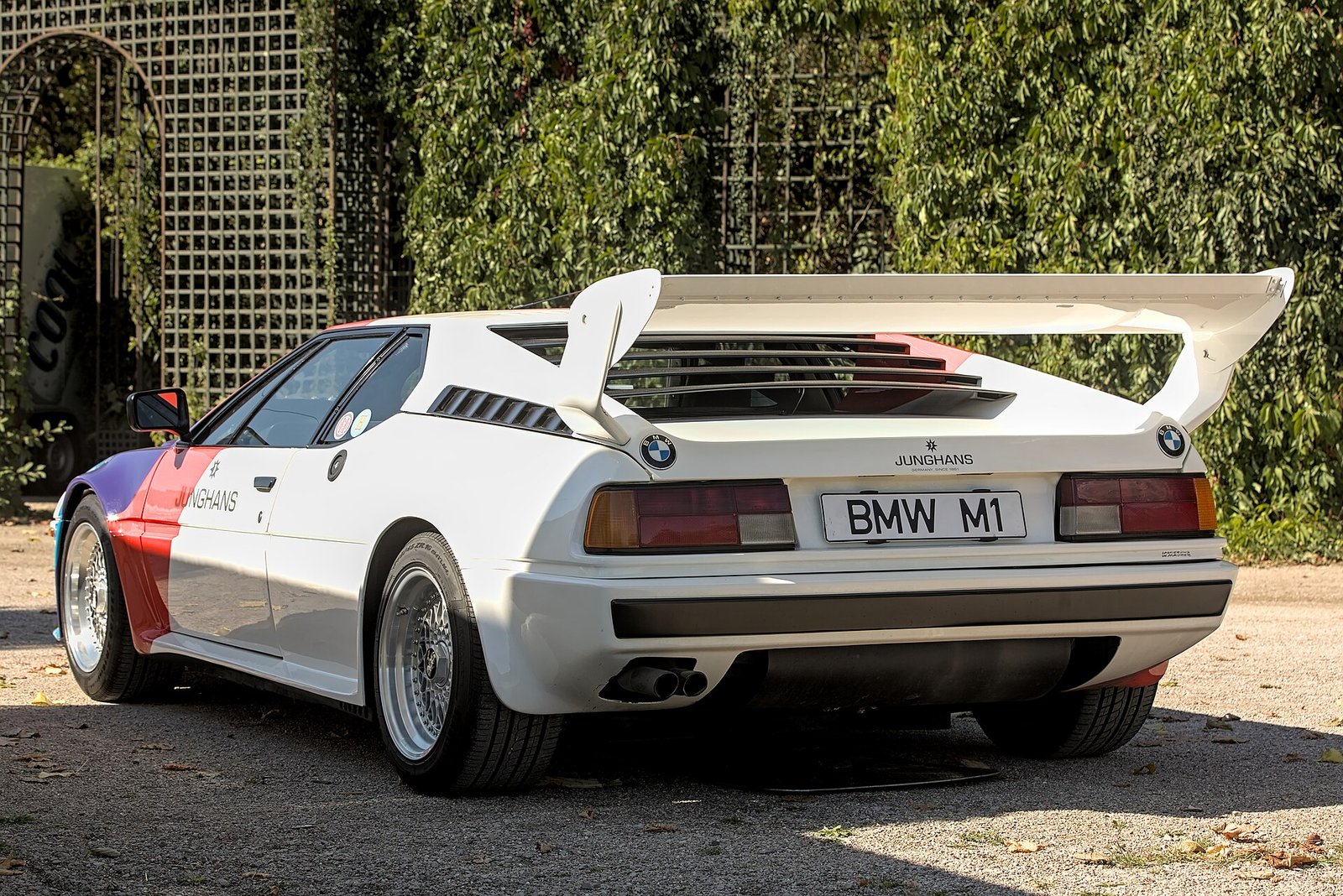
BMW couldn’t get the M1 into Group 4 fast enough, so Jochen Neerpasch, the head of BMW Motorsport, invented a championship for it. Procar was a one-make series with identically prepared M1s, run in 1979 as a support race at eight European Formula 1 Grands Prix. The fastest F1 drivers from Friday practice got guaranteed seats, and they lined up against sports car and touring car regulars.
The Procar cars were prepared by racing specialists; Britain’s BS Fabrications alone built five cars for the BMW factory team. They ran a heavily modified, still naturally aspirated M88 making 470 hp at 9,000 rpm, good for more than 310 km/h, about 193 mph, depending on gearing.
American fans had a reason to watch: Mario Andretti, the reigning Formula 1 world champion, started the very first Procar race at Zolder in 1979. Niki Lauda won that first season with Ron Dennis’s Project Four team, three wins and a second place at Monza. In 1980 the title went to Nelson Piquet, who won the last three races of the year. Then the series ended. Two seasons, and the image of F1 champions banging doors in BMW supercars has outlived most of the races it supported.

Le Mans, and a painted car
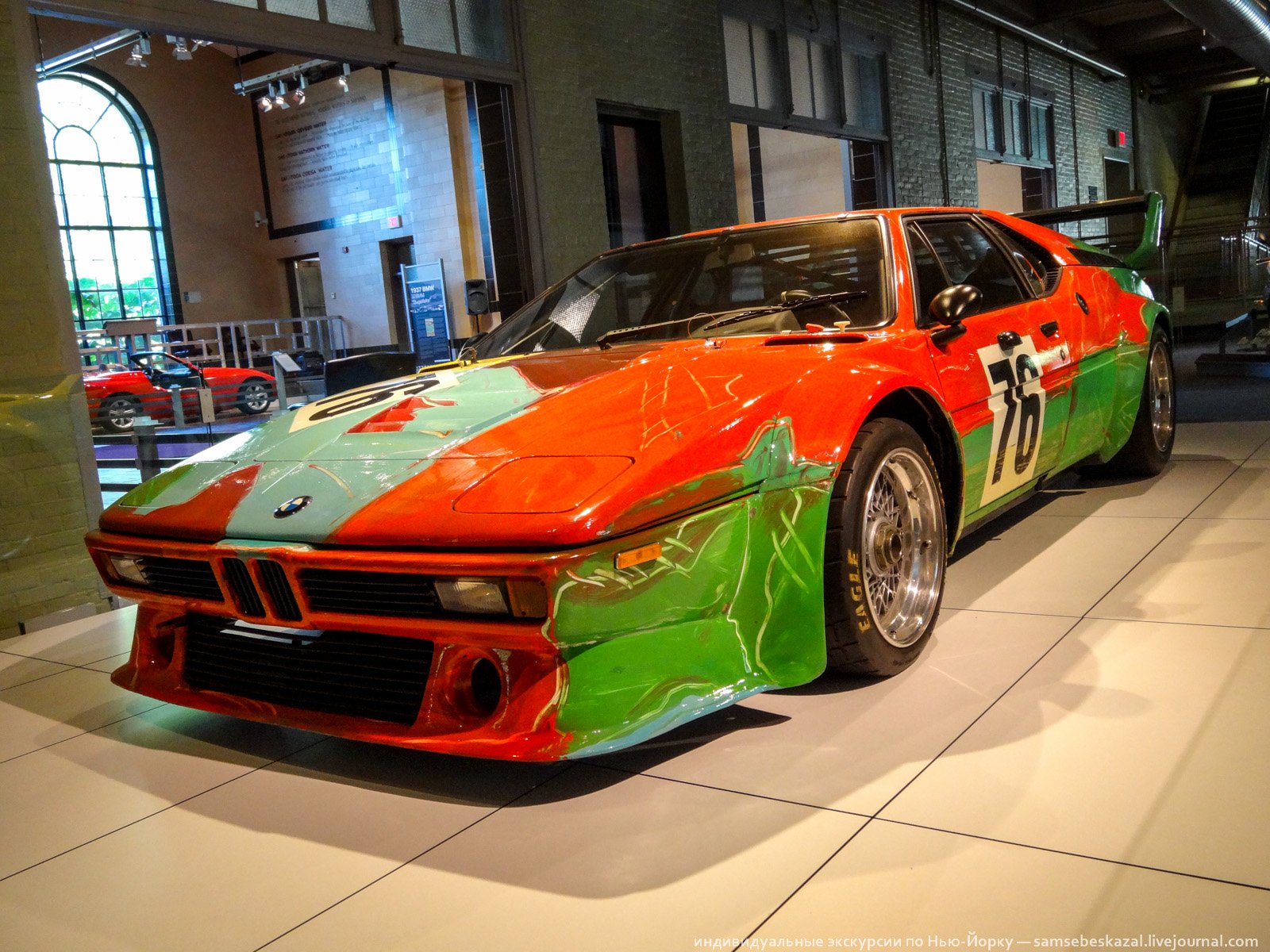
In 1979 Andy Warhol painted a racing M1 by hand for BMW’s Art Car collection. He took 28 minutes and used almost six kilos of paint, about 13 pounds. The car didn’t go to a museum. It ran the 24 Hours of Le Mans that June with Hervé Poulain, Marcel Mignot and Manfred Winkelhock, and finished sixth overall. A piece of American pop art, top ten at the world’s hardest endurance race.
BMW’s Art Car program had started in 1975, when Alexander Calder painted a 3.0 CSL that also raced at Le Mans. Warhol’s M1 was the fourth. Unlike the artists before him, who had worked from scale models, Warhol painted the real car himself, which is why it has drips and brush marks that make it look more like a canvas than a livery.
IMSA: the M1 comes to America anyway
Since BMW didn’t sell the M1 in the US, the American story is written on race tracks. IMSA’s GTO class was the American equivalent of production-based GT racing, home to Porsche 911s, Corvettes and Mazda RX-7s, and the place where privateers could actually win. Several Group 4 M1s went over to race in IMSA, and in 1981 they took the top two places in the GTO championship. Dave Cowart’s car won 12 of the 16 races. On the street, the few M1s in the country came in privately, sometimes bought new in Europe and federalized by hand.
The Group 5 monsters
The wildest M1s were the Group 5 silhouette cars. BMW only built two for that category, and the German tuner Schnitzer pushed the idea furthest with a twin-turbocharged 3.2-liter six. Depending on which source you believe and how much boost it was running, that engine made somewhere between 800 and 1,000 hp. Turbo lag was savage: floor it, wait, and then everything arrives at once.
The birth of the M division
The M88 is where the modern M story starts. Its version with electronic injection, the M88/3, went into the M635CSi and the E28 M5, both with 286 hp in Europe. The head of the four-cylinder S14 in the first BMW M3 was closely related to the M1’s six. Without the M1, there’s no M3 as we know it, and probably no M badge on half the BMWs on American roads today.
The rivals
Against its contemporaries, the M1 held its own:
- BMW M1 (1978): 3.5-liter inline six, 277 hp, more than 160 mph. 399 road cars.
- Ferrari 308 GTB (1975): 3.0-liter V8, 255 hp.
- Lamborghini Countach LP400 (1974): 3.9-liter V12, 375 hp.
- Porsche 911 Turbo (1975): 3.0-liter turbocharged flat six, 260 hp.
It wasn’t the most powerful, but it was the one built to race from the beginning, and that showed. The Countach was the bedroom poster; the M1 was the car that actually turned up on a starting grid on Sunday.
Why BMW never did it again
BMW had a mid-engine supercar with a Giugiaro body, a legendary engine and real race wins. Today a road M1 sells for seven figures when one comes up. And BMW walked away from the idea.
Yes, there was the i8 from 2014 to 2020, a plug-in hybrid with a 1.5-liter turbo three-cylinder making 231 hp and an electric motor adding 131 hp, 362 hp combined. A clever, futuristic car. Not the same thing.
BMW even teased everyone in 2008 with the M1 Hommage, a concept shown at the Concorso d’Eleganza at Villa d’Este on Lake Como that redrew the M1’s wedge for the 21st century. Enthusiasts took it as a promise. It turned out to be a tribute, and nothing more came of it. For a company that has built V12 engines for a McLaren F1 and won Le Mans outright, the excuse that it doesn’t know how to build a mid-engine car doesn’t hold up. It’s a choice.
The official reason is always some version of "it doesn’t fit the brand." The real reason is that the M1 was a crazy project that cost money, arrived late and never made a profit, and today’s BMW runs on spreadsheets. It took someone like Neerpasch to push it through, and there’s nobody like him in Munich anymore.
The car BMW should remember
The M1 proved BMW could build something extraordinary when it wanted to, and that you didn’t need twelve cylinders to stand next to Ferrari and Lamborghini. Every time BMW unveils another giant grille on another heavy electric SUV, someone in that boardroom should be made to stand in front of an M1 for five minutes. It wasn’t a commercial success. It’s still the only BMW you can call a supercar without anyone arguing, and the only one that won in America without ever being sold here.
Photos: Matti Blume (CC BY-SA 4.0); Buschtrommler (CC BY-SA 3.0); Alexander Migl (CC BY-SA 4.0); Lothar Spurzem (CC BY-SA 2.0 de); Dennis Fraevich (CC BY-SA 2.0). Via Wikimedia Commons.
Check you’re still alive.
5 thoughts on “BMW M1: The Mid-Engine BMW America Never Officially Got, and Won With Anyway”