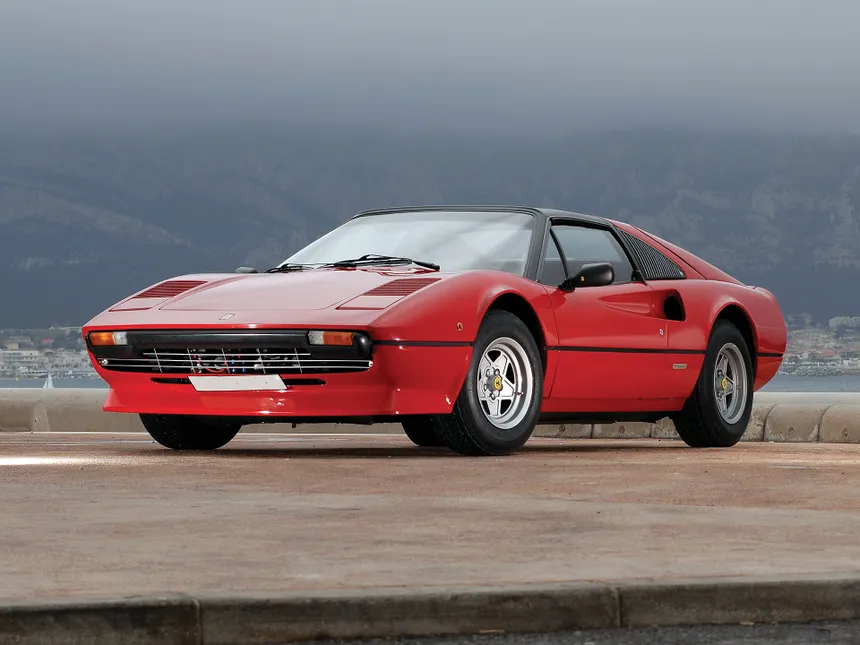
Ferrari 308: The First Turbo Ferrari Was a Tax Dodge
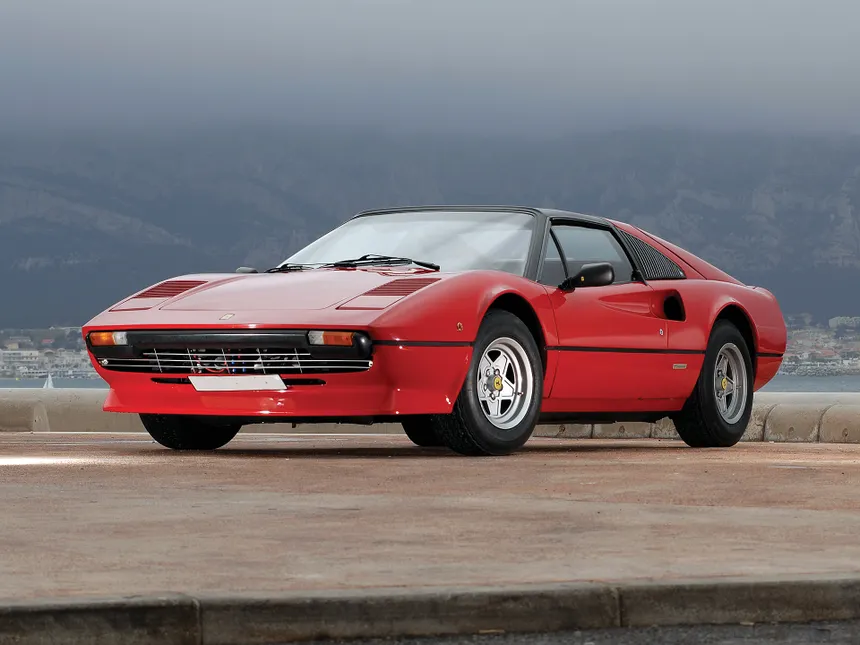
Ask any enthusiast which was the first turbocharged Ferrari road car and you will get the 288 GTO of 1984. They will say it with confidence, because it is what gets repeated everywhere.
It is wrong. The first one arrived two years earlier, displaced two liters, and existed for a reason that has nothing to do with performance: dodging an Italian tax.
That car is a 308. And it is not the strangest thing this family did.
Magnum made it the most-seen Ferrari in history
Start with the part Americans already know, because it is bigger than it looks.
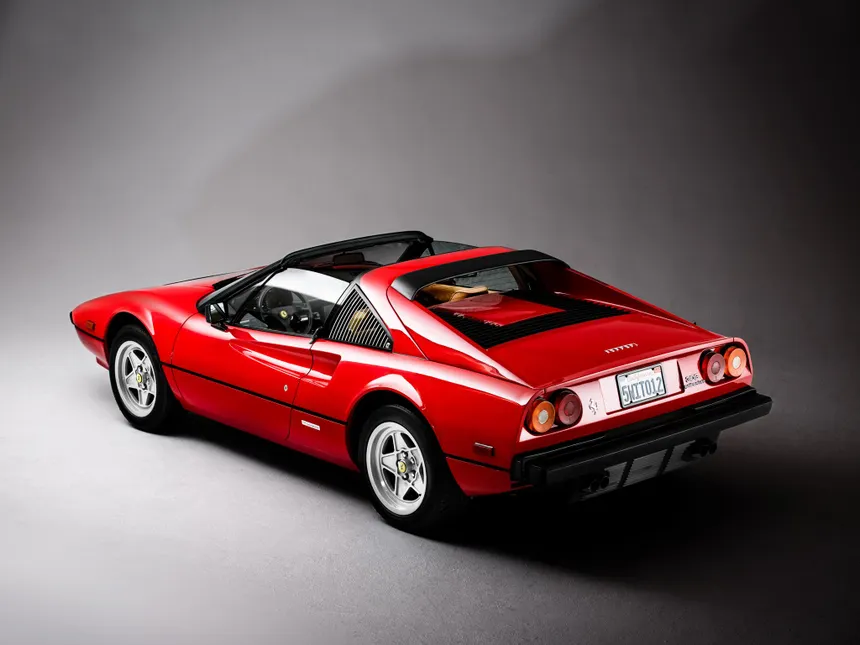
The 308 GTS spent eight seasons on television in a red targa driven by Tom Selleck, and it did more for Ferrari in the United States than any advertising campaign the company ever paid for. One of the cars used in the first season, a 1979 GTS, went to auction with documentation supporting its appearance in the pilot episode.
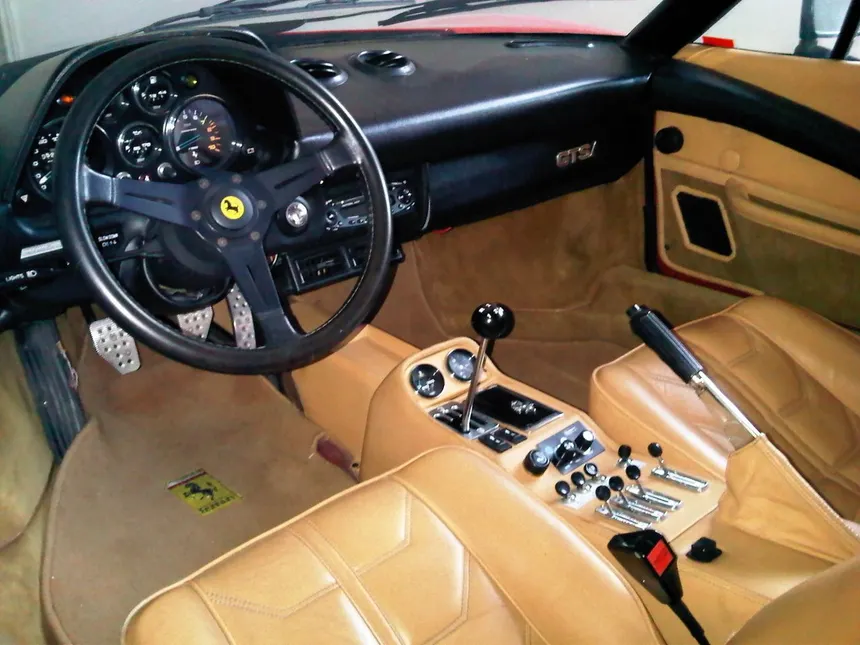
It carries the show’s most repeated anecdote, which is true and documented in the auction listing: the seat had to be modified because Selleck was too tall to fit in a standard car.
An actor too tall for the cabin, wedged into an Italian two-seater, was for eight seasons the best advertisement Ferrari has ever had. And it cost Maranello nothing.
A two-liter Ferrari
In Italy at the time, engines over two liters carried an additional levy that inflated the purchase price. For an expensive sports car the difference was brutal: according to Ferrari itself, staying under the threshold cut the purchase tax by more than half.
Maranello did what any company with Italian customers who wanted a Ferrari and did not want to pay that would do. It took the 308’s three-liter V8, fitted cylinder liners to bring displacement down to 1,991 cc, and sold it as the 208 GTB and 208 GTS.
The result was a commercial success and a disaster of character: 155 hp at 6,800 rpm. Fine for a normal car in the early 1980s, ridiculous for something wearing the badge.
Italian customers loved the saving and disliked the car. Ferrari had a problem it had manufactured itself.
The fix came from Formula 1
Meanwhile, on track, Ferrari was deep in the turbo era. The 126 C2 ran a 1.5-liter V6 with two KKK turbos that reached around 650 hp in qualifying trim, and it gave Ferrari the 1982 constructors’ title. Gilles Villeneuve and Didier Pironi were its lead drivers at the start of that season, and neither finished it: Villeneuve was killed at Zolder in May and Pironi was severely injured at Hockenheim in August.
The transfer was direct. At the Turin Motor Show in 1982 the 208 GTB Turbo appeared: the same two liters, now with a KKK K26 turbocharger and compression dropped to 7:1. Power jumped from 155 to 220 hp at 7,000 rpm, with 18 percent more torque.
Ferrari says it plainly in its own archive: the intention was to close the power gap between the two- and three-liter engines without increasing the customer’s tax burden. With the turbo, the 208 sat just 20 hp below the 308 GTB Quattrovalvole.
Ferrari built 437 GTBs between 1982 and 1985, every one for the Italian market, plus 250 targa-roofed 208 GTS Turbos between 1983 and 1985. Six hundred and eighty-seven cars in total. Externally it was given away by a deeper front spoiler with five horizontal cooling slots below the grille.
The man who built it then built the F40
Here is the detail that turns this into more than a tax anecdote.
Development of the 208 GTB Turbo began in 1981 with engineer Nicola Materazzi as the decisive technical figure, arguing for forced induction as the way to recover the performance lost to the reduced displacement. Materazzi also led engine development on its successor, the GTB Turbo of 1986, which with an IHI turbocharger and a Behr intercooler rose to 254 hp at 6,500 rpm.
And Materazzi is the same man who then signed off the 288 GTO and the F40.
Which means the technical genealogy of the F40, the most mythologized Ferrari of them all, begins in a two-liter built so that some gentlemen in Milan would pay less tax. That does not turn up in any documentary.
Where the 308 came from
Back up, because the base car deserves its place.
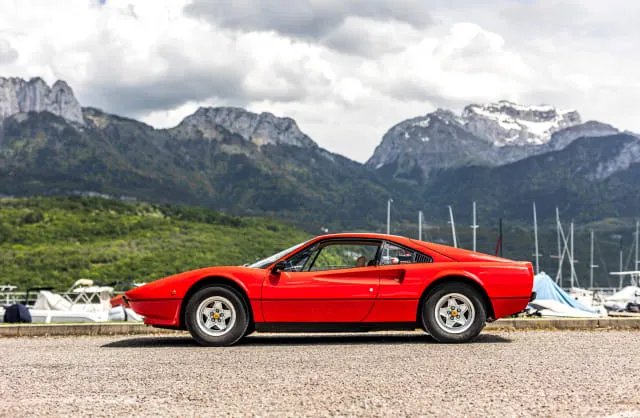
The 308 GTB was shown at the Paris Salon in October 1975 as the replacement for the Dino 246 GT. Leonardo Fioravanti signed the design at Pininfarina, the same man behind the Daytona, the Dino itself and the 365 GT4 BB, as we have covered in those articles.
The references are visible: the scalloped sides, the round taillights and the concave rear window between flying buttresses come from the Dino, while the wedge nose, pop-up headlights and horizontal swage line look to the Berlinetta Boxer.
One technical detail that rarely gets mentioned: the 308 was the first road-going Ferrari developed with the help of Pininfarina’s wind tunnel.
And one that matters for understanding the company in those years: the previous GT4 had been bodied by Bertone and sold as a Dino. The 308 GTB goes back to Pininfarina and wears the Ferrari badge from day one.
The fiberglass customers refused
The first cars left Carrozzeria Scaglietti with bodywork made almost entirely of fiberglass, the aluminum hood being the only exception. In Italian, vetroresina.
It is the first production Ferrari with a fiberglass body, and the company never used that material on a series model again. It lasted two years.
The reason for the change was not technical, it was perception. Part of the clientele decided fiberglass was too cheap a material for a Ferrari, with added paint finish problems, and Ferrari came away so burned that it has never used it on a production car again. From 1977 the 308 switched to steel.
On how many fiberglass cars were built, sources disagree and it is worth stating: some say 712 and others 808. On how much weight the switch to steel added there is agreement on the order of magnitude, around 150 kg, with the caveat that the exact figure varies by version and by whether the weight is measured dry or as delivered.
The scene is worth holding onto. Ferrari put a lighter Ferrari on the market and the clientele rejected it as cheap. Forty years later those cars are the most sought-after and most expensive in the family.
The GTS, the targa and market-by-market output
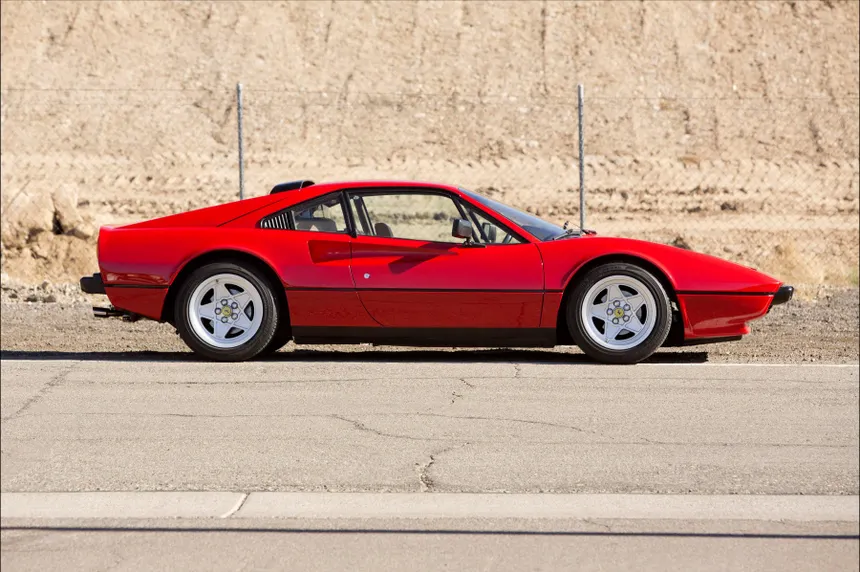
The 308 GTS arrived in 1977, with a removable roof panel stowing behind the seats, a 155-liter rear luggage area and the spare wheel under the front lid.
The three-liter V8 made 255 hp in European specification. Versions for markets with tougher emissions rules lost output noticeably, to the point where a late-1970s American 308 sits well below that figure. It is the same phenomenon we covered in the Testarossa article with catalyzed engines, and the same one American buyers of this generation live with.
The range evolved through fuel injection and then the four-valve-per-cylinder Quattrovalvole. Between 1975 and 1985 more than 12,000 308s were sold across all variants, and the 328 that replaced it added 7,412 more through 1988.
That made the 308 the most-produced and best-selling Ferrari in the company’s history to that point. This is the car paying the bills while Maranello spent the money on Formula 1.
Michelotto, rallying and a Spanish driver
This chapter gets told least and has the most in it.
Ferrari did work on a rally version of the 308, which competed in Group 4 from 1978. It never got past prototype stage, because the demands of the Formula 1 team inside the company absorbed the resources, and Maranello preferred to let private preparers handle the development.
Which is where Giuliano Michelotto comes in, a young engineer from Padua who from 1977 set about turning the 308 GTB into a dirt car, and who had previously prepared several Lancia Stratos.
With the Commendatore’s blessing, Michelotto built eleven Group 4 cars, developed from bare chassis under the supervision of Ferrari’s Assistenza Clienti. The first started from a production car numbered 20951. That is where the Ferrari-Michelotto relationship begins, the same one that twenty years later produced the competition 348s that put Ferrari back across the finish line at Le Mans in 1994, as we covered in that article.
And when Group B arrived in 1983, requiring only 200 homologation cars instead of Group 4’s 400, Michelotto wanted to exploit it. He did so at the request of one specific driver.
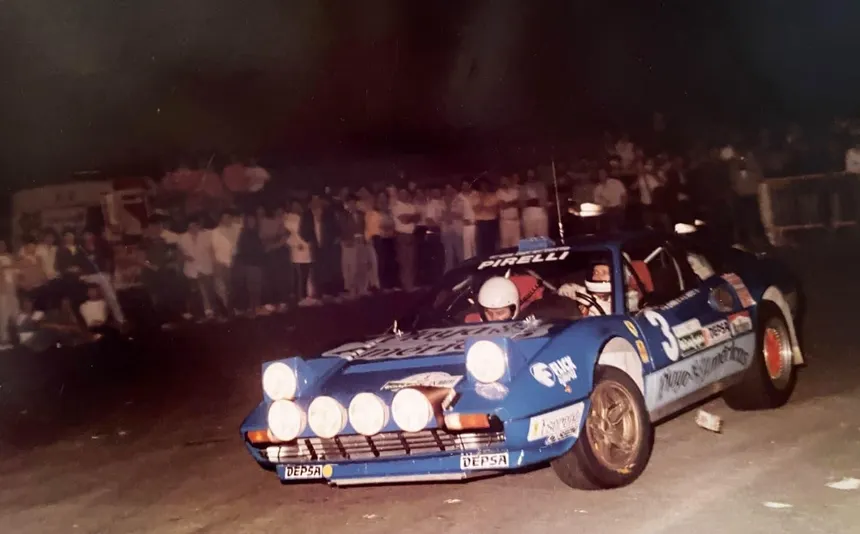
That driver was Spanish. Antonio Zanini, a multiple Spanish rally champion, saw the 308’s potential for the new category and went to Michelotto. From that request comes chassis 18869, with modified suspension, Brembo brakes, Canonica wheels, Pirelli tires, Bosch K-Jetronic injection, a quick-change competition gearbox, lightened wishbones, reinforced anti-roll bars, quick-ratio steering and adjustable dampers. Power rose from 252 to 288 hp.
Four Group B cars were built. That one is the only two-valve example; the other three, with four valves, made 310 hp.
Zanini ran it in 1985 at the Rally El Corte Inglés in Gran Canaria with Josep Autet co-driving, and for that event the car was repainted blue for a sponsorship deal. That specific chapter of the car’s history is confirmed by Cristiano Michelotto, with traces of blue paint still visible on the roof vent cover.
A rally Ferrari exists because a Spaniard asked for one.
One note on precision: sources disagree on Zanini’s exact record, some citing seven national titles and others ten plus a European crown. The point that matters here, that he triggered the Group B car, is consistent across all of them.
What the American market got, and what it cost
Worth spelling out for buyers here, because the 308 is the first car in this series that arrived in the United States in real volume through official channels.
Unlike the Berlinetta Boxer and the 400 family, which Ferrari never certified for this market and which came in one car at a time through private importers, the 308 was federalized and sold new through the dealer network. That is a large part of why so many survive here and why the parts and specialist support are better than for almost any other classic Ferrari.
The price was paid in output. Emissions equipment took a meaningful bite out of the European 255 hp figure, and the earliest fiberglass cars barely reached this market at all: reporting around one auction car suggests only about a hundred fiberglass 308s were shipped to the United States.
So the American 308 story is the opposite of the Boxer’s. There the scarcity is in the cars themselves. Here the scarcity is in the early, light, powerful ones, and the abundance is in the later steel cars that Magnum made famous.
What to check before buying one
It is the most affordable way into a classic mid-engined Ferrari, with a wide price range depending on version and condition.
Three variables move the value. The first is the bodywork: a fiberglass car from 1975 to 1977 plays in a different league from anything else. The second is the state of mechanical evolution, with carbureted cars ahead of the early injected ones in market preference. The third is the usual one: the folder of invoices.
Because this is a 1970s Ferrari with a timing belt, carburetors on the early cars and forty years behind it. Buying the car cheaply does not reduce the workshop bill, and we have repeated that in every article in this series because it keeps being true.
The verdict
The 308 is the Ferrari that did everything Enzo was not interested in, and that is why it carried the decade.
It was bodied in fiberglass because it was lighter and cheaper, and the clientele rejected it as unworthy. It was built in a two-liter version to dodge a tax. It got a turbo because that tax version was gutless, and that made it the first turbocharged road-going Ferrari, two years before the 288 GTO everyone gives the medal to. It went rallying, which Enzo did not care about, because an engineer from Padua insisted and a Spanish driver came asking. And it ended up on American television doing more for the brand than any paid campaign.
None of that was in the plan. All of it worked.
What grates is the rewrite. When Ferrari celebrates forty years of turbocharging, the story starts in Formula 1 and jumps to the 288 GTO. Materazzi’s two-liter turns up in passing, as a local-market curiosity, when it is literally the first link in the chain and the same engineer signed it.
Maranello has spent half a century building its mythology by cutting out the parts where you can see it working.
How many legendary cars started out as a solution to an accounting problem?
Check you’re still alive.