Ferrari 400: The V12 With a General Motors Gearbox
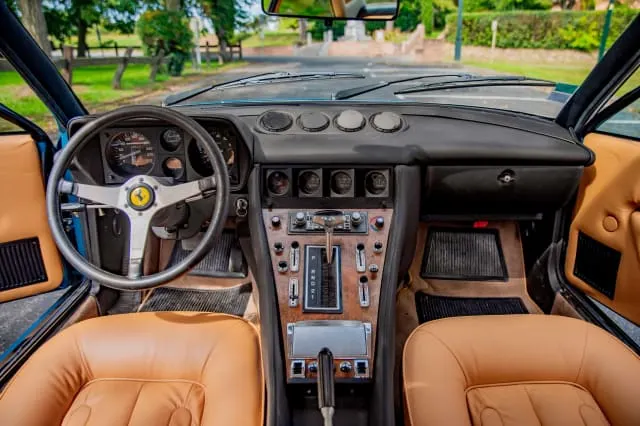
In 1976, with Enzo Ferrari alive and in charge, Maranello launched a twelve-cylinder fitted with an automatic gearbox bought in Detroit. The same unit Cadillacs and Buicks used.
Ferrari fitted it to win the American market. It then never sold a single car here.
The gearbox came from Cadillac
The transmission is General Motors’ THM400, three speeds plus reverse, a unit the American industry had used since 1964 under the Turbo Hydra-Matic name at Cadillac and Super Turbine at Buick. Ferrari sourced it through the global supplier BorgWarner.
The decision was about time and money. Developing an automatic in-house made no sense for a manufacturer of Maranello’s volume, so it bought an existing one. And not just any one: the THM400 can absorb very high input torque and an enormous number of shift cycles, and it is still considered one of the toughest automatics ever built.
Heavy, made of aluminum and iron, and reliable as an anvil. The precise opposite of what the brand’s mythology was selling in those years.
The purists lost badly
The reaction was predictable. Ferrari had spent decades arguing that a car without three pedals could not be a pleasure to drive, and the specialist press received the automatic as a betrayal.
Buyers disagreed. From the moment it became available until the end of 400 production, roughly two thirds of cars sold were automatics. In Britain the proportion was higher still, with most customers choosing it. In numbers, between 1976 and 1985 Ferrari sold 1,238 automatics against 569 manuals.
The car that was supposed to scandalize enthusiasts turned out to be the one real customers wanted.
And it never reached the United States
Here is the contradiction that holds the whole story together.
Ferrari acknowledges in its own model archive that the automatic was offered to meet demand from the American market. And no version of this family, not the 400, not the 400i, not the 412, was ever officially imported into the United States. The cars here arrived through the gray market, imported and federalized one at a time by third parties.
The reason is exactly the one we covered in our 512 BB piece. Enzo Ferrari concluded that between escalating emissions and safety rules and the 55 mph national speed limit, the company’s eight-cylinder cars would suffice for this market. Certifying a twelve here was not worth the cost.
It fits the eleven-year exile documented in our Daytona article, when the last twelve-cylinder Ferrari sold new in the United States through official channels was that car, until the Testarossa arrived in 1984. The 400 is the second model filling that gap, and it is not here either.
So Ferrari bought an American gearbox, for an American taste, and did not sell the car in America. All at once.
Where this car came from
The 400 is not a new model. It is an update of the 365 GT4 2+2 that Leonardo Fioravanti designed at Pininfarina and that had been on sale since 1972.
The chassis is tubular steel derived from the 365 GTC/4, with the wheelbase stretched 200 mm to 2,700. That is what makes four real seats possible. Bodies are steel with a fiberglass floor, and there is an industrial detail here that rarely gets told: Pininfarina built them at its Turin plant and shipped them fully finished to Modena, where Ferrari assembled the cars.
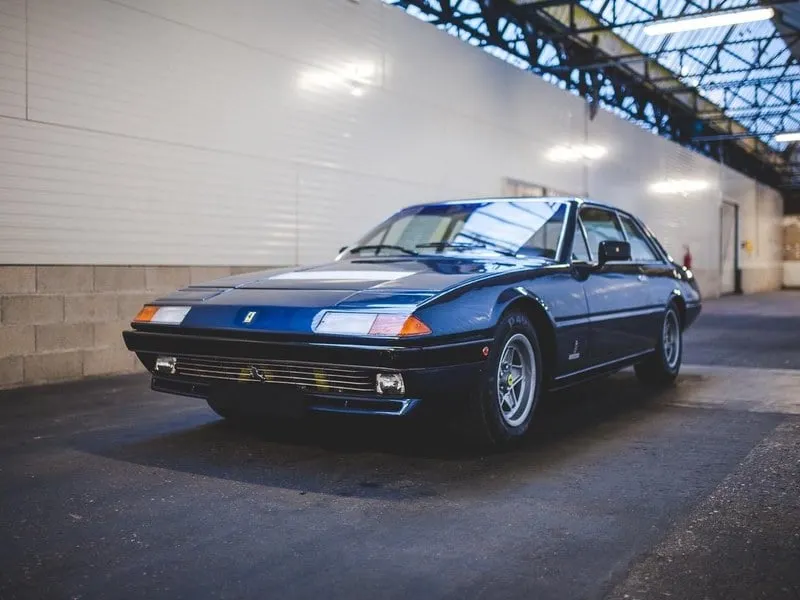
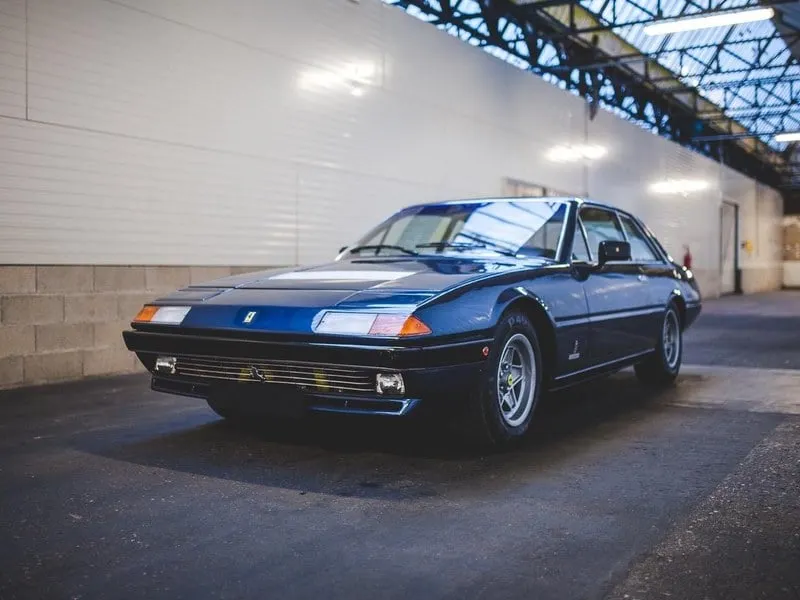
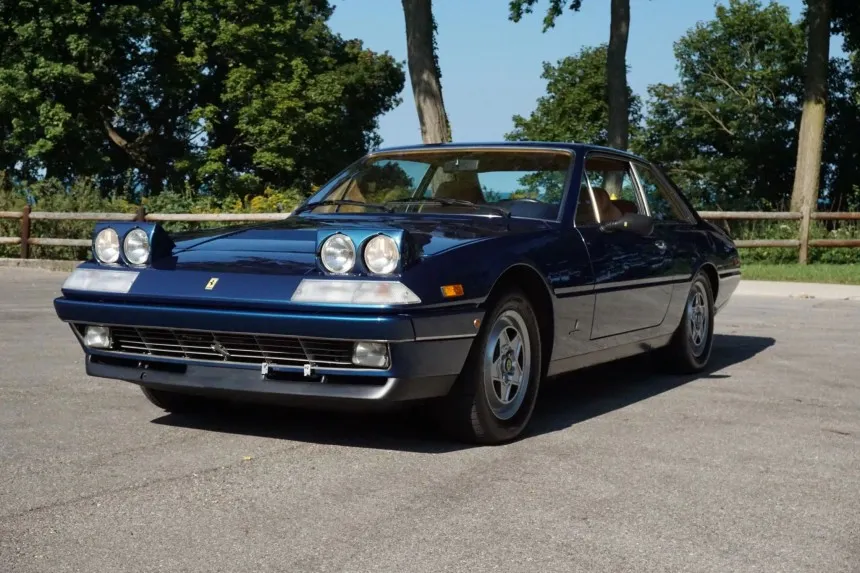
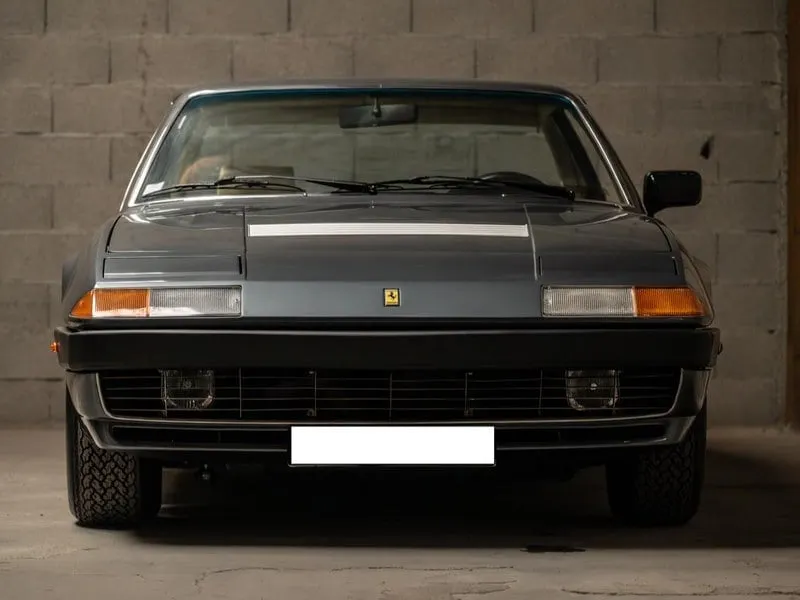
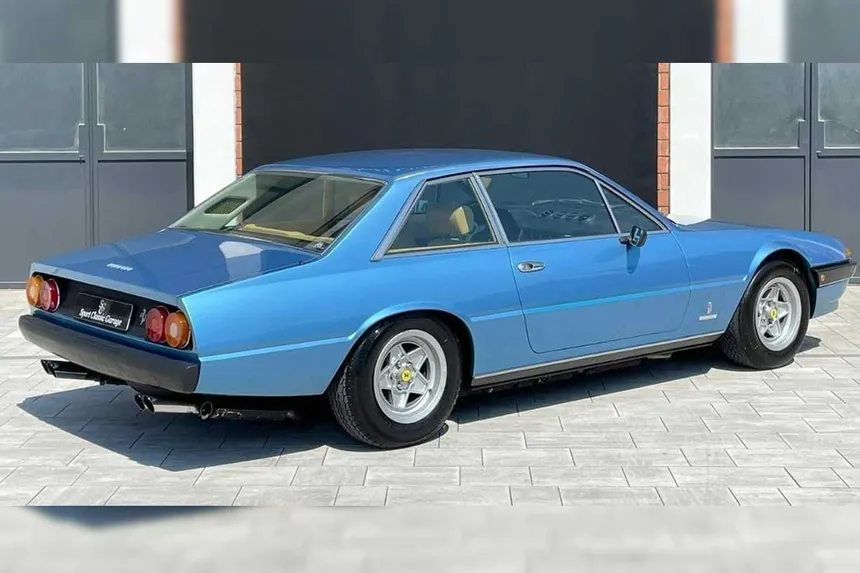
Visually the 400 differs from the 365 by a small body-colored spoiler low on the nose, five-stud wheels in place of the three-eared knock-off hub, twin circular taillights instead of three, and the disappearance of the prancing horse from the grille.
The name reverts to the Daytona system
After several articles tracking how Maranello names its cars, here we get a step backward rather than a new system.
The 400 is named for the displacement of a single cylinder, the same criterion as the Daytona 365 GTB/4. The engine keeps the 81 mm bore of the earlier 365 GT4 2+2 but lengthens the stroke to 78, raising total displacement to 4,823 cc. When the 412 arrives in 1985, the figure comes from the enlarged 4,943 cc engine.
It is the same criterion Ferrari abandoned with the 512 BB, recovered here, and abandoned again afterward with the F355, the 360 and the 599.
400, 400i and 412: what changed
The original 400, from 1976, feeds its V12 through two banks of three twin-choke Weber carburetors and claims 340 hp, with 0 to 60 mph in around 7.1 seconds. It came in two forms: the 400 Automatic with the General Motors gearbox and the 400 GT with a five-speed synchromesh manual.
The 400i arrived in 1979. Out went the six carburetors, in came Bosch K-Jetronic injection. Power dropped to roughly 310 hp, rising to 315 from 1982, but emissions improved appreciably. It is the same move Ferrari would later make on the 512 BBi and for the same regulatory reasons.
The 412 appeared in 1985. The engine grew to 4,943 cc and around 335 hp. Chrome trim disappeared from the greenhouse, bumpers became body-colored and the turn signals turned white.
Ferrari built 576 examples of the 412, of which 270 were GTs with the manual gearbox and the rest automatics. Production ended in 1989.
The longest production run in Ferrari’s history
Counting from the 365 GT4 2+2 of 1972 to the last 412 of 1989, this family stayed in production for seventeen years. It is the longest-running series Ferrari has ever had.
And it ended with no successor. From 1989 until the 456 arrived in 1994, Ferrari had no four-seat twelve-cylinder in the catalog at all. A five-year hole.
Seventeen years building the same car and then five without replacing it. That is not a product decision. That is a company unsure what to do with the segment.
The Ferrari that made it into a book about terrible cars
This one sticks with you. The BBC published a book titled Crap Cars, and the Ferrari 400 appears at number 18.
Between a Daihatsu Applause and an Austin Ambassador.
A twelve-cylinder grand tourer bodied by Pininfarina, on a list of the worst cars ever built, surrounded by British and Japanese economy cars of the 1980s. I cannot name another manufacturer at this level with a model treated that way in popular culture.
The coachbuilt oddities
An entire conversion industry grew up around this family, rivaling the Testarossa’s for strangeness.
Carrozzeria Pavesi in Milan built convertible conversions of the 400, with one documented car described as one of roughly fifteen cabriolets to leave its workshop. It is the third time Pavesi has appeared in this series, after the Testarossa spiders. Richard Straman, from California, did the same on this side of the Atlantic, as he would with the Daytona and the Testarossa.
Switzerland’s Felber showed a shooting brake on 400 GT underpinnings at the 1981 Geneva Salon, called the Felber Croisette. A Banham convertible and a stretched limousine also exist.
On the 412 there is the Pavesi Ventorosso, a one-off that turned the 2+2 coupe into a four-seat convertible, replaced the pop-up headlights with fixed horizontal units and added a grille running the full width of the nose. The standard V12 was left alone.
The Meera S: a Ferrari with a backup camera in 1982
Of all the oddities, this is the one to sit down for.
In March 1982 a Ferrari 400i went into Carrozzeria Michelotti’s workshop in Turin on a customer commission. It was stripped completely. The Pininfarina bodywork disappeared and an entirely new steel structure took its place, with radical lines, a wedge profile and a tail that struck more than one observer as damaged.
What went inside is the interesting part. A digital instrument panel designed and built by Michelotti’s technical studios. Dual automatic air conditioning. Wipers articulating in all four directions. Brake cooling ducts at all four corners. Ventilation extractor units with fans built into the doors. Built-in radar. Dual alternators. Alloy nose, door and tail sections.
And a closed-circuit television system replacing the rear-view mirror. A backup camera with a monitor, in a 1982 car, decades before that became standard equipment on an economy hatchback.
It is unique, the mechanicals were left untouched and the car has barely been driven. And it still turns up on lists of the ugliest Ferraris ever built.
What the gray market left behind
One consequence worth naming for American buyers, because it shapes every car on this market.
Since Ferrari never federalized the 400 series, every example here passed through a private importer who had to make it comply, one car at a time. That work varied enormously in quality. Some conversions were done properly by specialists who understood the car; others were done to pass an inspection and nothing more, with sealed beam headlights, added side markers, reworked bumpers and emissions plumbing improvised to satisfy whichever rules applied that year.
Which means the due diligence on an American 400 or 412 is different from the due diligence on a European one. On a European car you are checking service history. On a gray-market car you are also establishing what somebody did to it in 1981 and whether it was reversed properly afterward. Cars retaining original European specification, or whose federalization was done and documented by a known specialist, are worth materially more than cars with an undocumented history.
It is the same situation we described with the Berlinetta Boxer, and for exactly the same reason: two twelve-cylinder Ferraris that Enzo decided were not worth certifying for this country.
Why it is cheap and what to check
The 400 and 412 remain among the most affordable twelve-cylinder Ferraris in existence, for the same three reasons as the 612 Scaglietti: a body customers found too restrained, four seats in a brand where prestige comes with two, and the shadow of a bought-in automatic gearbox.
What has not fallen with the price is maintenance. This is a Maranello twelve with all the complexity that implies, and buying the capital cheaply does not reduce the workshop bill. Cars with the THM400 do carry one counterintuitive advantage: that gearbox is among the toughest and best-documented automatics in automotive history, and its parts have been manufactured in the United States for fifty years. It is probably the easiest component on the entire car to maintain.
The version the market pays for, as with the 599 and the 612, is the manual. With one important difference: here the manuals are not thirty cars, they are hundreds, so the premium exists without reaching the extremes of the later models.
The verdict
The 400 proves that a brand’s mythology is assembled after the fact, with scissors.
This car was in production for seventeen years, longer than any other Ferrari model. It sold most of its units with an American automatic gearbox. And it barely exists in Maranello’s official story, which would rather talk about the 288 GTO, the F40 and the mid-engined twelves.
I understand the choice and I think it is a mistake. Because the 400’s history is a company doing what it takes to survive: accepting that some customers want a Ferrari to drive daily in a city, buying in the part you cannot build yourself, and keeping a model on sale for nearly two decades because it works. Exactly the logic that later produced the Alcoa chassis in the 360 Modena and the Delphi suspension in the 599.
What is revealing is the ending. Seventeen years selling this car and then five years without replacing it, until the 456. Ferrari did not close the series because it had something better. It closed it and stood looking at the hole.
How many cars we dismiss today for not being pure were the ones actually paying the bills?
Check you’re still alive.