
Ferrari 612 Scaglietti: Cheap Because of a 1954 Gift
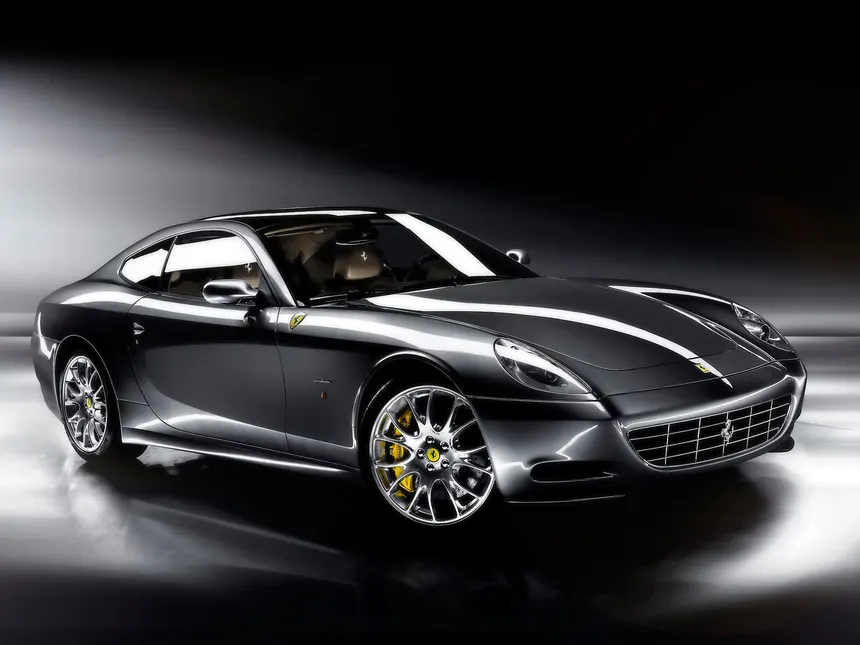
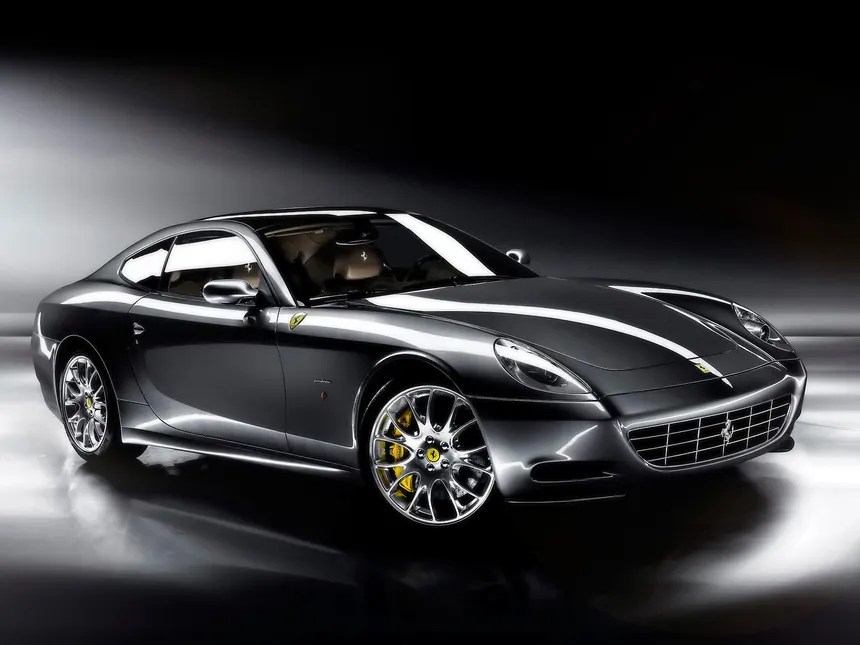
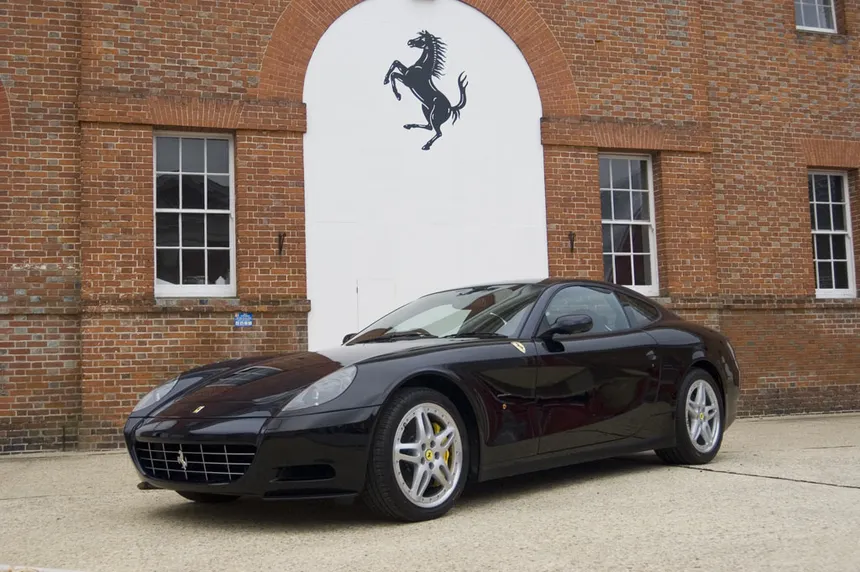
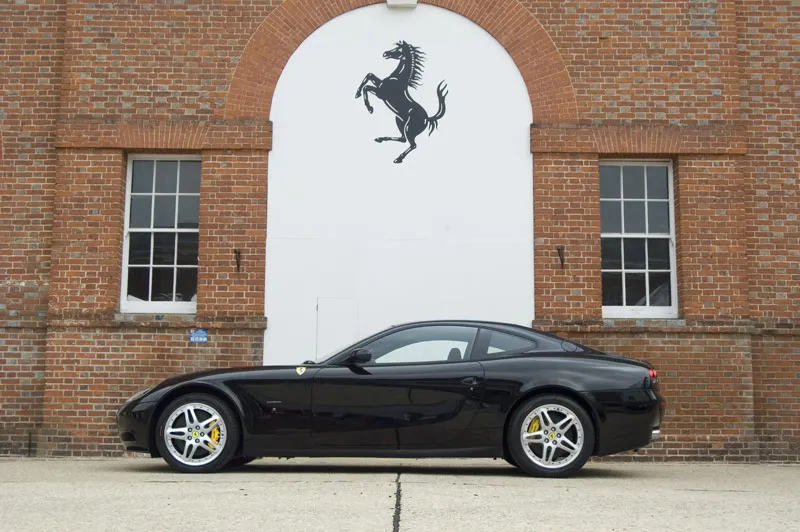
It is the most affordable twelve-cylinder you can buy wearing the Maranello badge, and it is affordable because of its shape. The side scallops that wrecked its value are a quotation of a one-off a film director commissioned as a gift for his wife.
The wife was Ingrid Bergman.
Ferrari built this one for America first
Start with a strategic detail that rarely gets mentioned. The 612 did not make its public debut at a European show. It was unveiled at the North American International Auto Show in Detroit in 2004, an explicit acknowledgment of how much the North American market meant to Maranello’s accounts.
A four-seat grand tourer built to cross continents, launched on the continent with the most highway to cross. That decision makes more sense than most of Ferrari’s marketing.
The car behind the scallops
In 1954, Roberto Rossellini commissioned a custom-bodied Ferrari 375 MM as a gift for Bergman, to whom he was married. The car appeared at the Paris Salon that year as chassis 0456 AM, bodied by Sergio Scaglietti.
That berlinetta introduced a set of styling decisions that went on to define a genre: hollowed flanks, a curved windscreen, small lights set high on the fenders, and twin fins running back from the rear window. Half a century later it won Pebble Beach.
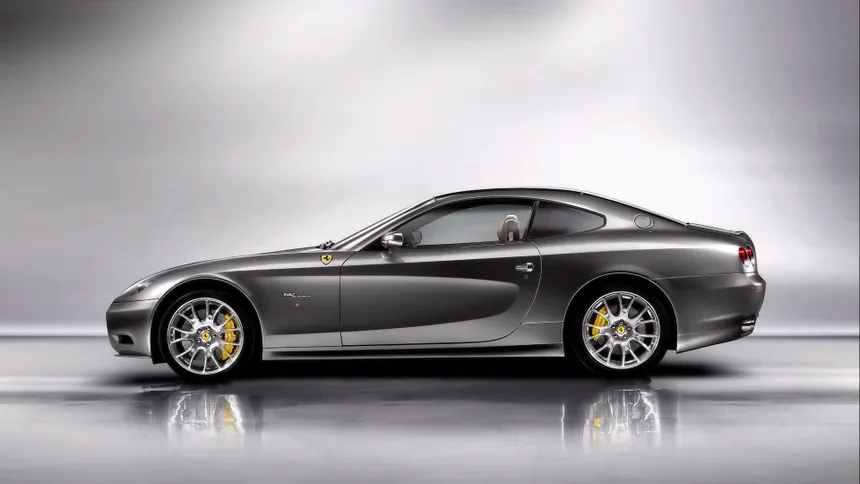
When Ferrari set about replacing the 456 M, Pininfarina went straight back to that car. The 612’s side scallops and headlights are the direct quotation.
And that is where the commercial trouble starts. Those hollowed flanks are what buyers and much of the press refused to accept in 2004, and they are the main reason this car now trades for premium-sedan money with a naturally aspirated V12 up front. The bodywork that destroyed its value is a tribute to a 1950s love story.
The first Ferrari named after a coachbuilder
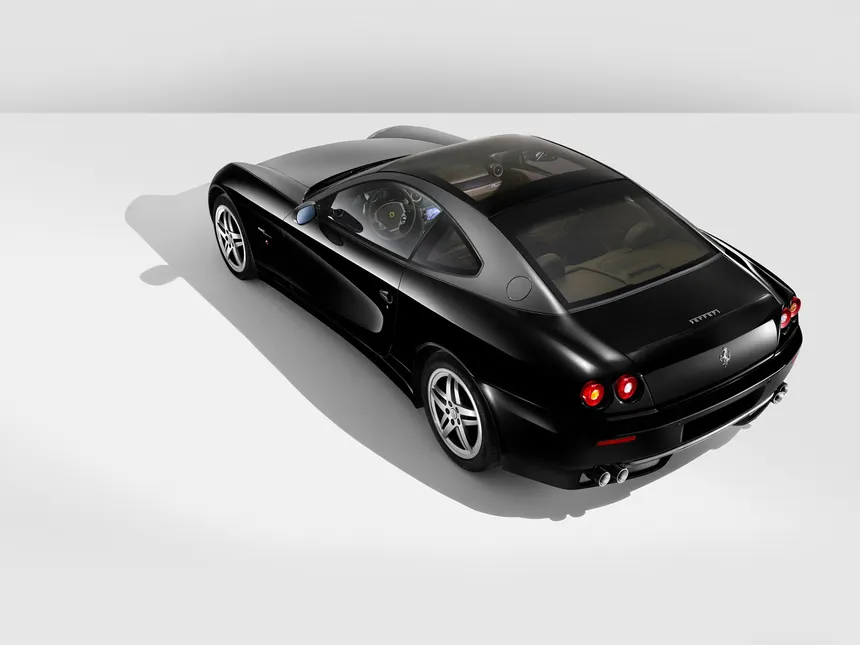
Very few Ferraris officially carry the name of a carrozziere. The 612 carries Sergio Scaglietti’s, the Modena craftsman who shaped some of the most celebrated Ferrari competition cars of the 1950s and 1960s.
Which closes the circle: Scaglietti bodied Bergman’s 375 MM. So the car honors the craftsman in its name and his specific work for the actress in its sheet metal.
The number does not quite add up either. A 612 should mean six liters and twelve cylinders, but the engine displaces 5,748 cc. Generous rounding.
That is the sixth naming system in this series of articles. The Daytona used single-cylinder displacement. The 512 BB used liters plus cylinder count. The F355 mixed liters and valves. The 360 used total capacity plus a city. The 599 used capacity divided by ten plus a racetrack. The 612 uses capacity rounded up plus a coachbuilder’s surname.
Aluminum, with an American accent again
The 612 was Ferrari’s second all-aluminum car after the 360 Modena, and the first Ferrari twelve-cylinder with both chassis and body entirely in that material.
The frame is a space frame built from extrusions and castings with the alloy body welded on, manufactured in collaboration with Alcoa, the same Aluminum Company of America that had signed off the 360’s chassis. The second time a Ferrari skeleton carried a Pittsburgh surname.
The results justify the effort. Aluminum cut weight by 40 percent and raised torsional stiffness by 60 percent. The engine sits front-mid, behind the axle line, giving a 46 percent front and 54 percent rear weight distribution. On a car 193 inches long with a 116-inch wheelbase and rear seats adults can genuinely use, that number is why it drives far better than it looks like it should.
The engine belongs to a much more expensive car
Under the hood sits the naturally aspirated Tipo F133 V12, 5,748 cc, 11:1 compression, making 540 PS at 7,250 rpm and 589 Nm at 5,250. It is the same engine as the 575 Superamerica.
That works out to 4.2 seconds to 60 mph and a top speed just under 200 mph, with a curb weight between 1,850 and 1,865 kg.
There is a buying argument in that sentence which rarely gets made out loud: at current 612 money you are buying the Superamerica’s engine, from a car playing in a completely different market bracket.
One hundred ninety-nine gated cars
Of the 3,025 built between 2004 and 2011, only 199 left with the six-speed gated manual. The rest have the six-speed F1 automated gearbox.
Read that figure alongside our 599 piece. There, on comparable production, only 30 manuals were built. Here there are 199. In practice the 612 is the last realistic chance to buy a Maranello twelve-cylinder with three pedals without entering seven-figure territory.
And there is a wrinkle few people exploit: through the One to One personalization program, a customer could swap the F1 gearbox for the gated manual as part of a bespoke order. The lever was not just on the option list, it stayed available as a configuration choice until the end.
The packages that fix what reviewers complained about
The 612 drew criticism from the beginning for a muted exhaust note and suspension tuned too far toward comfort. Ferrari answered with packages, and knowing which one a car has changes what you are buying.
From 2006 came HGTS and HGTC. The first adds a sports exhaust, 19-inch wheels front and rear, colored calipers and specific mapping for the adaptive damping and the gearbox. The second adds carbon ceramic brakes on top.
HGT2 followed, with 20-inch wheels, its own grille, and specific exhaust and suspension.
A 612 with HGT2 and one without are different cars to drive, and the used market does not always price that difference properly. There is room there for anyone who knows what to look for.
Sessanta, sixty cars for sixty years
Ferrari marked its sixtieth anniversary in 2007 with a limited run of 60 cars called the 612 Sessanta.
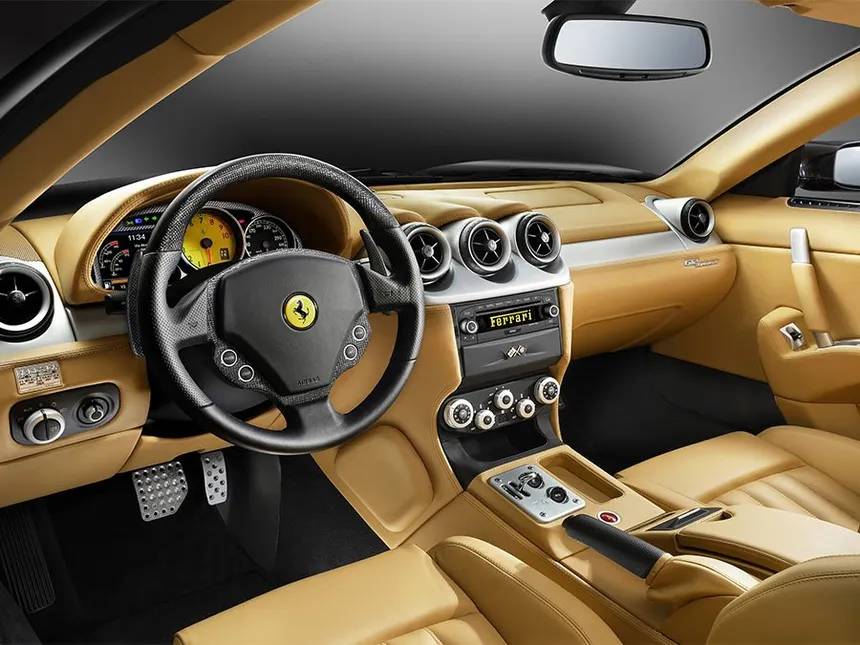
It came with the F1 gearbox only, in a two-tone combination of dark grey and ruby, with a three-setting electrochromic panoramic roof, 19-inch wheels, Bose audio, a television tuner, a parking camera and a new front grille. It is the 612 the market chases hardest.
A note on spelling: sources render the name both as Sessanta, the correct Italian for sixty, and as Sessenta. I am using the former.
Fifteen thousand red miles
Here is the chapter that turns this car into something more than a discounted grand tourer.
On August 29, 2005, two 612 Scagliettis set off to cross China. The operation was called 15,000 Red Miles and it was the first time a car manufacturer had organized a complete traverse of the country.
The cars were driven by teams of Chinese and international journalists, 43 in total, who had to obtain Chinese driving licenses before setting off because local regulations required it. The route ran north and toward Manchuria, then southwest to Beijing, followed the Great Wall to Lanzhou, and from there covered more than 3,000 km above 4,000 meters of altitude to Lhasa in Tibet. It then turned west across the Gobi Desert to Kashi, the silk market city Marco Polo described, before dropping through the tropical south to Guangzhou and back to Shanghai.
Forty-five days. Thirty-seven major cities. The Tanggula Shan pass at 5,231 meters above sea level, an altitude no car of this class had reached before.
And the detail that finishes it: the cars were not prepared. The only additions were headlight and underbody protection, which made sense because roughly 2,000 of the more than 24,000 km were unpaved.
A production twelve-cylinder grand tourer with an aluminum body welded in Maranello, crossing the Gobi and Tibet with nothing but guards bolted on. That is the exact opposite of this car’s reputation.
A precision note: the distance figures vary between sources. The official branding says 15,000 miles, roughly 24,000 km, and some publications cite 45,000 km, which fits neither the name nor the other data. I am using the former.
What it replaced and what replaced it
Placing the 612 properly needs both ends of the line.
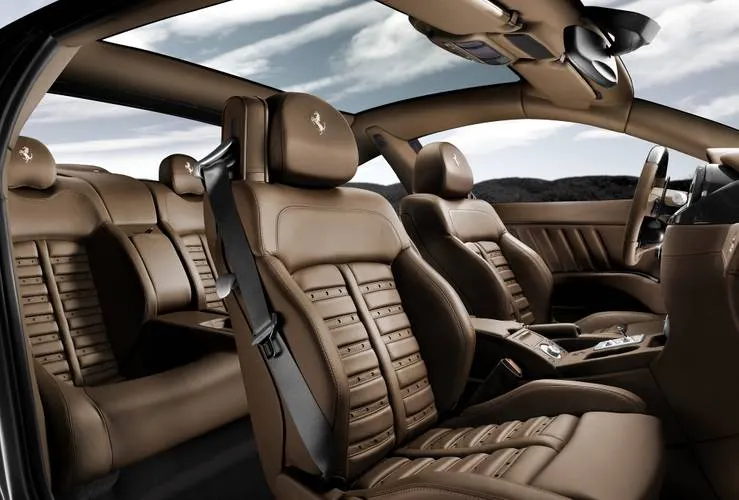
It replaced the 456 M, a car with a conventional, widely admired shape that sold on its looks. The 612 was larger in every dimension, and that growth was deliberate: Ferrari wanted rear seats adults could actually occupy rather than a nominal 2+2. Buyers got the space they had asked for and rejected the proportions that made it possible. The wheelbase that carries four people is exactly what makes the car look long in photographs.
It was replaced in 2011 by the FF, which went further still with a shooting brake body and all-wheel drive, and which took an even harder beating from the traditionalists on launch. Ferrari has spent two decades being punished for its four-seaters and has kept building them anyway, because the customer who wants a Ferrari and has a family is a customer who otherwise walks into a different showroom.
Seen from that angle, the 612 is not a failed sports car. It is a successful family car that Ferrari never dared market as one.
Why it is cheap and what it costs to keep
The 612 is the least expensive way into a modern Ferrari twelve-cylinder, for three reasons: a body that divided opinion from day one, four seats in a catalog where prestige comes with two, and a run of 3,025 cars that creates no scarcity.
What has not fallen with the purchase price is the cost of ownership. This is a twelve-cylinder Ferrari with a timing belt on a scheduled replacement interval, and buying the capital cheaply does not reduce the workshop bill by a dollar. The 612’s arithmetic is an entry-level car with expensive-car invoices.
Translated: anyone buying it as a shortcut to the badge is in for a shock at the first major service. Anyone buying it knowing what is coming gets the best mile-per-dollar in Maranello’s entire catalog.
The verdict
The 612 is the best argument I know against majority taste.
This car was dismissed for its shape. The hollowed flanks now cited as the reason for its low price are a literal quotation of the berlinetta Scaglietti built for Rossellini’s wife, a car that won Pebble Beach half a century later. The 2004 customer rejected as strange precisely what concours judges reward as exceptional.
And my opinion, since we are here: the problem was not the design, it was the color. The 612 was photographed and sold in red, which is where those scallops work worst, because the light reads them as dents. In dark grey, deep blue or black, the same surfaces read as what they are, a play of volumes inherited from the fifties. Ferrari picked the wrong palette, not the wrong line.
Then there is Tibet, which to me is the best part of the whole story. While the press argued about whether the car was ugly, two production examples were climbing to 5,231 meters and crossing the Gobi with headlight guards. No other manufacturer at this level has been willing to put its product in that position, because the risk of breaking down in public is enormous.
A car with plenty of character and no decent color chart.
How many cars you think are ugly today are just waiting for somebody to paint them properly?
Check you’re still alive.