
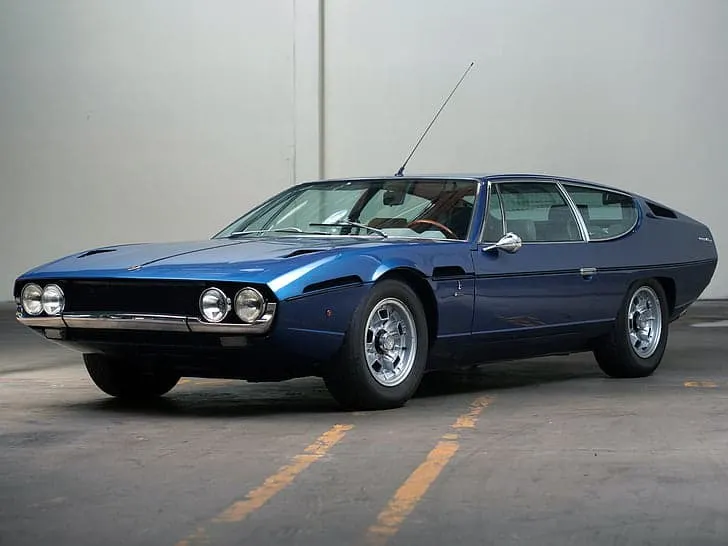
Lamborghini Espada: The Four-Seat V12 That Started as a Jaguar
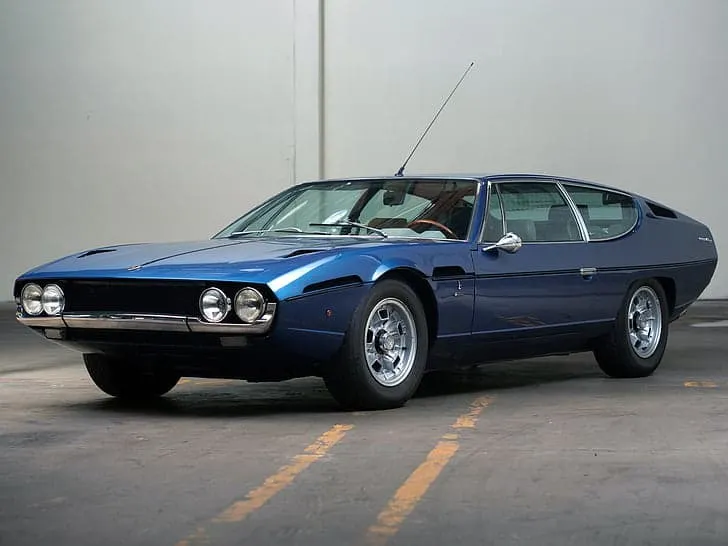
Lamborghini’s family car was not drawn in Sant’Agata. It was drawn in London, over Jaguar mechanicals, on commission from a British newspaper. The wooden body buck built for that Jaguar was then reused to put together the first Espada prototype.
None of that appears in the factory’s official telling. It is in the car’s documentation, and it is the origin of the best-selling Lamborghini of the company’s entire first era.
A newspaper ordered a car
At the London Motor Show at Earls Court in 1967, Bertone displayed the Pirana. The Daily Telegraph had commissioned it as an example of the “ideal car” — a piece of chequebook journalism no newspaper would attempt today. Underneath sat the chassis and 4.2-liter XK straight-six of a Jaguar E-type. Body by Bertone, design by Marcello Gandini. One car only, registered TGF 1F. After London it traveled to the New York show and then to Montreal.
That car fed directly into the Espada. And the wooden buck built to shape the Pirana’s body was reused to construct an early Espada prototype.
The Espada’s other parent is the Marzal, also by Gandini, shown at the Geneva show in 1967. Four seats, fully glazed gullwing doors, a hexagonal obsession running through every interior detail, and a 2.0-liter inline-six that was literally half of the 4.0-liter V12, engineered by Gian Paolo Dallara, making 175 horsepower at 6,800 rpm and mounted transversely behind the rear axle with the Miura’s transaxle. Prince Rainier III drove the Marzal on the parade lap before the 1967 Monaco Grand Prix with Grace Kelly beside him. That car sold at RM Sotheby’s Villa d’Este auction on 21 May 2011 for €1,512,000.
A show car doing a royal lap of Monte Carlo, and a one-off paid for by a London newspaper. Those are the two parents of Lamborghini’s four-seat grand tourer.
The prototype that rotted behind the factory
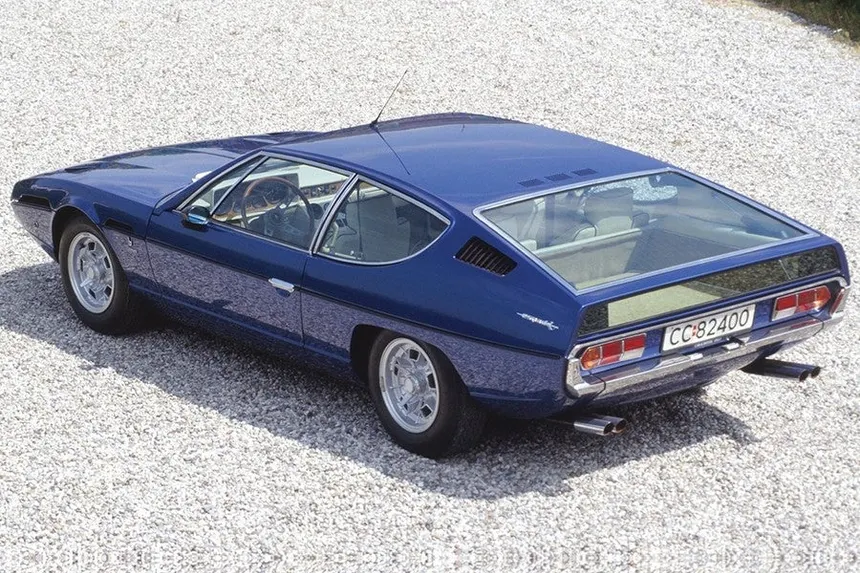
Before the production car there was an Espada prototype. It had gullwing doors inherited from the Marzal and glass panels in the lower sections of the doors. Ferruccio disliked the glass and told his people to base the road car on the Pirana’s lines instead.
The prototype was fully finished and driven by the factory test drivers. Then it sat abandoned at the plant for years, picked clean: no interior, no engine, no wheels. It is on display today at the Museo Ferruccio Lamborghini.
Worth pausing there. The company now selling six-figure commemorative editions left its own founding four-seater prototype outdoors as scrap.
Geneva 1968: four adults and 350 horsepower
The production Espada was unveiled at the Geneva motor show in March 1968. Body and body assembly by Bertone, chassis by Marchesi of Modena, final assembly at Lamborghini.
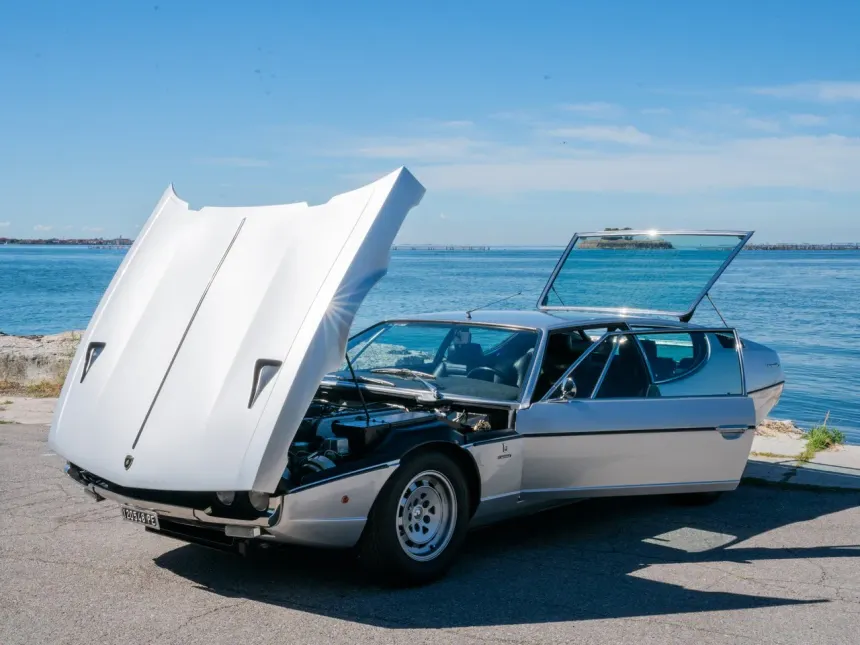
The structure is a pressed-steel semi-monocoque with tubular elements and an aluminum hood. Wheelbase 104.3 inches, length 186.2 inches, width 73.2 inches, height 46.7 inches. Curb weight 3,594 lb. Two fuel tanks totaling 93 liters, with the filler caps hidden in the rear pillars.
The engine is the 3,929 cc — 240 cubic inch — V12 with twin overhead cams per bank and six Weber 40 DCOE carburetors. Series 1 made 325 horsepower on 9.5:1 compression; from Series 2 it made 350 horsepower at 7,500 rpm on 10.7:1. The engine alone weighs 511 lb, and 646 lb with the gearbox attached. It holds fourteen liters of oil. Fully independent suspension at all four corners with unequal-length arms, coil springs and anti-roll bars. Girling discs all round, solid on Series 1 and ventilated from Series 2. ZF worm-and-sector steering, power assistance optional early and standard on Series 3. Pirelli Cinturato tires.
No single number there is the point. The combination is: four adults, genuinely, not as a courtesy, traveling at 150 mph.
Set that against the direct rival. The Ferrari 365 GT 2+2, which replaced the 330 GT 2+2 in 1967, used a 4,390 cc V12 with 320 horsepower, independent rear suspension, power steering and optional air conditioning. Around 800 were built in four years. A fine car. And a 2+2, with occasional rear seats.
The Espada was not a 2+2. American buyers in 1968 had exactly one domestic frame of reference for a fast, expensive, four-seat two-door — the personal luxury coupe — and none of those had twelve cylinders, four camshafts and six Webers. Detroit sold cubic inches and a bench. Sant’Agata sold a V12 and a back seat you could use.
Two cars on the same stand
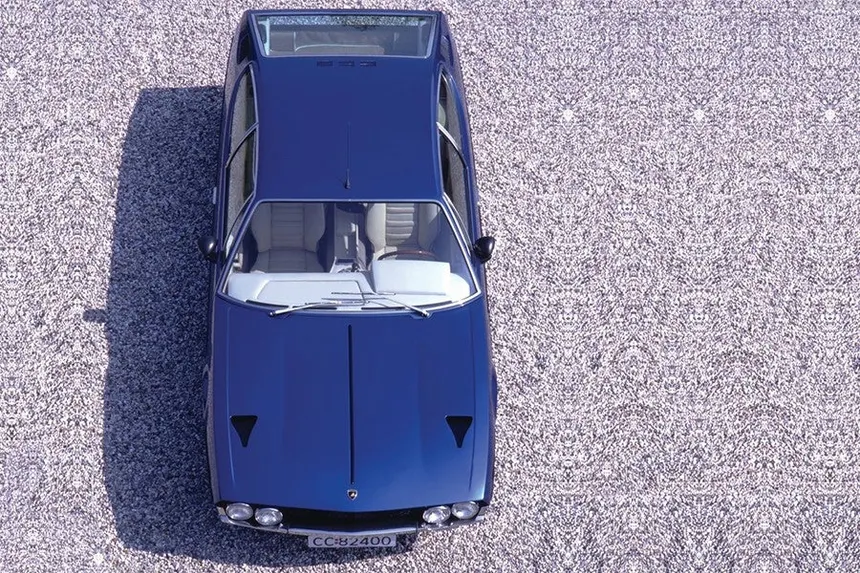
One detail of that 1968 Geneva show almost never gets told alongside the Espada: Lamborghini launched two models there at once. The Espada and the Islero.
The Islero was the opposite proposition. It replaced the 400 GT and was offered as the visually conservative alternative to the radical Espada, keeping the traditional lines of the earlier car. Same 3,929 cc V12 with 325 horsepower, rising to 350 in the 1969 Islero S after work on the valves and compression.
Its body was not built by Bertone but by Carrozzeria Marazzi, and the reason ties straight back to the beginning of the marque. Marazzi was staffed by former Touring workers — the Milanese house that had bodied the 350 GT and had wound up its operations in 1966. Founder Carlo Marazzi was himself an ex-Touring employee, working alongside his sons and part of that same workforce. When Touring died, the same hands kept building Lamborghinis under a different letterhead.
Ferruccio drove an Islero in those years, as did his brother Edmondo. The boss took the discreet one.
Islero production ran to 125 cars plus 100 of the Islero S: 225 in total. The Espada passed twelve hundred. Given the choice between the sober suit and the loud one, Lamborghini’s customers took the loud one by a margin that was never close.
Three series, and numbers that never line up
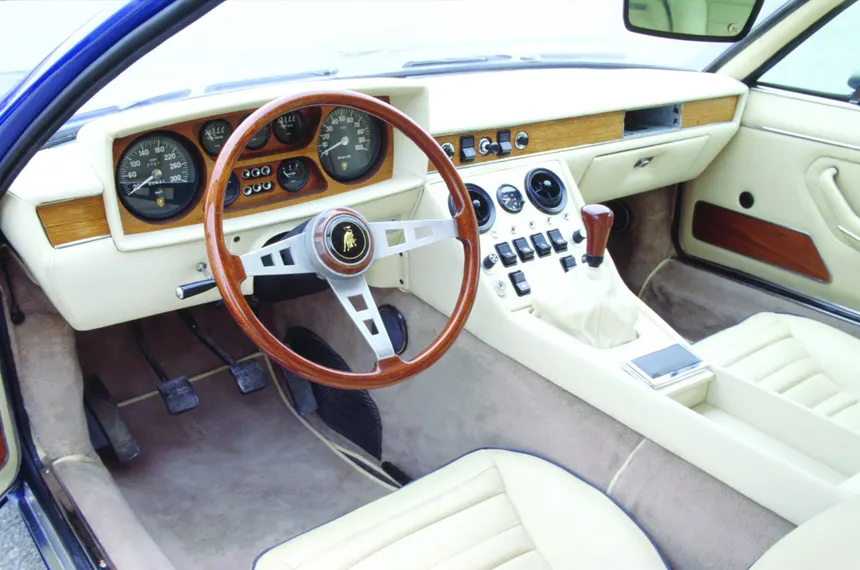
Series 1, from 1968 to 1970, carried the octagonal dashboard inherited from the Marzal and Campagnolo wheels with Miura-style centers. Series 2, from 1970 to 1972, switched to a rectangular dash, deleted the front grille and raised output to 350 horsepower. Series 3, from 1972 to 1978, brought five-bolt wheels, a new grille, standard power steering and an optional sunroof.
Production figures, as always with Lamborghinis of this period, depend on who is publishing. English-language Wikipedia lists 186 Series 1 cars, 575 Series 2 and roughly 466 Series 3, for a total of 1,217 — while its own summary box says 1,227. LamboCars splits it 168, 575 and 456. Nobody agrees with anybody.
What is clear is the comparison that matters. Miura production ran to 275 P400s, 338 P400 S and 150 P400 SV. That is 763 cars.
The Espada — the sensible one, the one with the back seat — outsold the Miura comfortably. It was Lamborghini’s best-selling model of its entire first era. It is also the one the factory mentions least.
And for anyone who thinks automatics are a modern concession at Sant’Agata: from 1974 the Espada could be ordered with a Chrysler TorqueFlite three-speed automatic. Fifty-five were built. Acceleration and top speed both suffered, as you would expect.
What the press actually said, in 1972
This is where the myth gets its hair mussed. In its March 1972 issue, Motor Sport ran a road test of the Espada by Denis Jenkinson. The period price: £10,950 all in, before insurance and road tax.
The driving verdict was strong. Jenkinson noted it was pleasant to drive slowly as well as quickly, comfortable on motorways and on back roads, and flexible enough to be threaded through the narrow streets of London’s East End without drama. At 6,000 rpm in each gear it ran 40, 60, 85, 100 and 125 mph. That means crossing a continent at 125 mph with the engine loafing.
Then came the hit. The quality of the paint finish left a lot to be desired, and the all-steel body was already showing unpleasant pitting corrosion. On a nearly eleven-thousand-pound new car. He also criticized the seat base for being too rounded fore and aft, with insufficient support under the thigh.
That is not a hobbyist website grumbling fifty years later. That is one of the great motoring writers of the century, reporting on a freshly delivered press car.
Somebody else’s parts bin
The Espada is also a lesson in how cars were built in Emilia in the sixties. The Series 1 tail lights come from the first-series Fiat 124 Sport Coupé. The Series 3 units come from the Alfa Romeo 1750 Berlina.
There was also an experiment almost nobody remembers: a hydropneumatic self-leveling rear suspension called Lancomatic, developed with the German firm Ehrenreich/Langen and shown at the Turin show in 1968. It never reached production. The seals failed and the ride hardened, according to notes from test driver Bob Wallace.
And there was an offshoot that deserves its own article: the Lamborghini Faena, a one-off four-door built by Pietro Frua on a Series 2 Espada, chassis 8224 renumbered 18224. Eight months of work, wheelbase stretched by seven inches, roughly 4,400 lb, and Citroën SM tail lights. It appeared at the Turin show in 1978 and at Geneva in 1980. Its name is the Spanish term for the final act of a bullfight.
Four decades of failing to replace it
The Espada left the catalog in 1978 and Lamborghini never managed to put anything in its place. Rumours of a new four-seater circulated in 1999 and never got past drawings. Edmunds reported in 2006 that the factory intended to field one by 2009. At the Paris show in 2008 came the Estoque, a four-seat concept whose name is yet another piece of bullfighting hardware — the sword again. It was never produced either.
That is thirty years of a company saying it wants to build the car it had already built, and not building it. When a four-seat Lamborghini finally reached customers again, it was an SUV with a turbocharged V8, which is a different animal from a 350-horsepower V12 coupé however the marketing department files it.
The name is the sharpest part
In bullfighting vocabulary, the espada is the sword the matador uses to finish the bull. In Spanish, “el espada” also means the matador himself.
Ferruccio put a charging bull on the nose of every car he built and then named his family grand tourer after the blade that kills the bull. The animal on the badge, the sword on the trunk lid. Nobody at Sant’Agata seems ever to have stopped to think about it.
The case
Lamborghini has spent years selling the Urus as the moment the brand opened up to the real world, to daily use, to customers with families. That story is false. The Espada did that job first and did it better: twelve cylinders up front, four usable seats, 1,217 cars and ten years in the catalog — built by recycling the silhouette of a show Jaguar commissioned by a newspaper and a wooden buck that already existed.
The Miura took all the posters because it photographs better. The Espada paid the bills. The factory barely names it when it tells its own story.
One thing stays on the record: the Espada had factory defects and they were serious. A new car at almost eleven thousand pounds arriving at the British press with pitting corrosion in 1972 is not something nostalgia fixes. Sant’Agata was building first-rate engineering and third-rate bodywork, and that half of the story deserves a place in the anniversary photo too.
Check you’re still alive.