
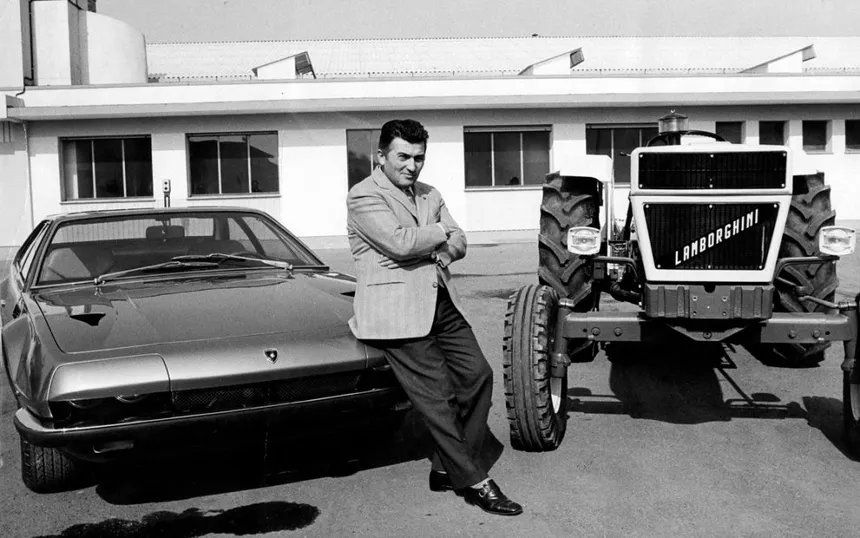
Ferruccio Lamborghini: the farmer who insulted Enzo Ferrari and built an empire
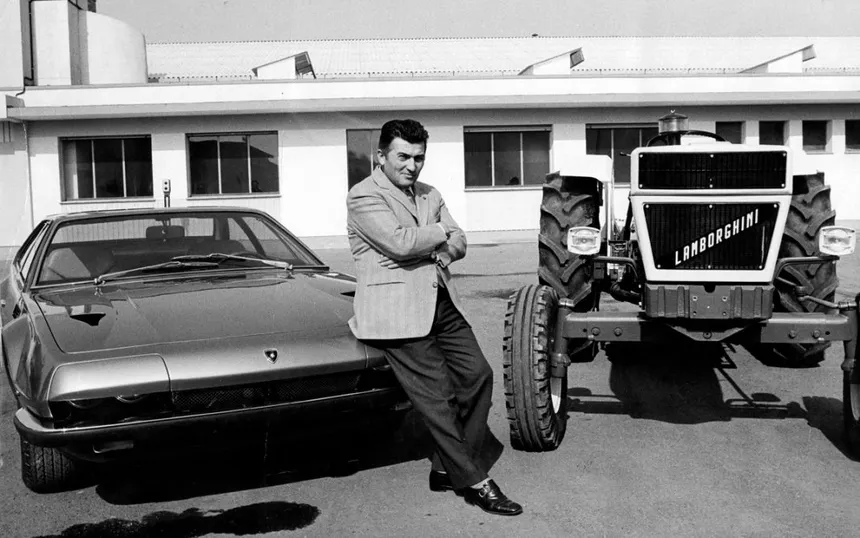
The man who answered an insult with a V12
A 47-year-old tractor manufacturer walks into Enzo Ferrari’s office in Maranello and tells him his cars are rubbish. Ferrari tells him to go back to his tractors. Four months later, the tractor manufacturer has a new factory, a fresh V12, and a team of the best engineers Italy can offer.
This is not a story made up after the fact. It is documented. Ferruccio Lamborghini said it himself in 1991, six years before he died, in an interview that became the official version of the most famous insult in automotive history. And the funny thing is that the insult was, in a way, a favour. Without it, the supercar industry of the 20th century would have looked very different. Maybe Lamborghini would never have existed. Or maybe Ferruccio would have built it anyway, just slower.
The point is he didn’t build it slowly. He built it in four months. And to understand how a man does that, you have to go back to a small village in Emilia-Romagna in 1916.
Renazzo: where engines beat fields
Ferruccio Elio Arturo Lamborghini was born on April 28, 1916, in Renazzo, part of the municipality of Cento, in the heart of Emilia-Romagna. Same region as Ferrari, Maserati, Ducati, Pagani. Same red soil. But his family had nothing to do with engines. They were grape farmers. His father, Antonio, expected him to work the land. Ferruccio expected something else.
He was the kid who watched the threshing machine and forgot about the harvest. He liked things that moved by themselves. He opened a small workshop with a friend, Marino Filippini, when he was eighteen, fixing motorcycles. Then he went to study mechanical engineering at the Fratelli Taddia Technical Institute near Bologna. And in 1940, when Italy went to war, he was drafted into the Regia Aeronautica and sent to Rhodes, in Greece, with the 50th Repair Section.
He spent the war repairing trucks and military vehicles. By the time the British took the island, he had been promoted to head of the workshop. When the war ended, he scavenged everything he could from the abandoned military equipment. Engines. Differentials. Spare parts. He shipped what he could back to Italy. He arrived home with his hands full and an idea forming in his head.
1947: the tractor that built an industrialist
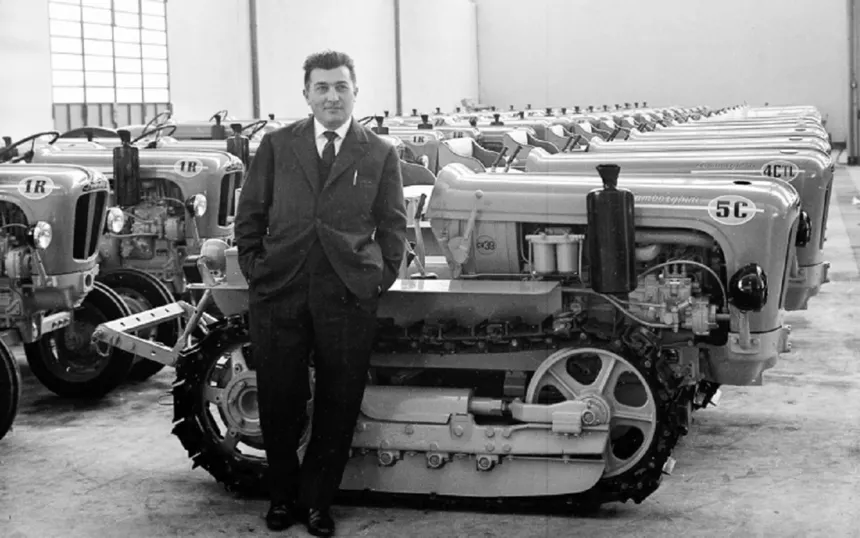
Postwar Italy was a wreck. The countryside was worse than the cities. Farmers needed tractors and could not afford them. Ferruccio saw the opportunity that nobody else was working on quickly enough.
He built his first tractor using a six-cylinder Morris engine he had brought back from the war and a differential from a military vehicle. He called it the “Carioca”. It had one trick of his own design: a fuel atomiser that allowed the tractor to start on petrol and then switch to diesel, which was much cheaper than petrol in postwar Italy. That kind of detail tells you everything about Ferruccio. The kind of mind that solves problems other people had not even noticed.
In 1948, during the patron saint’s festival in Cento, he showed his tractor in the village square. He sold eleven on the day. He used his father’s farm as collateral to buy a thousand Morris engines. Lamborghini Trattori was born. Within fifteen years, it was one of the largest tractor manufacturers in Italy.
In 1960 he founded a second company: Lamborghini Bruciatori, building burners and air conditioning systems. The Lamborghini burners were quieter, more efficient and more reliable than what the competition offered. Within a few years they were heating houses across Italy. The profits from tractors and heating systems made Ferruccio one of the wealthiest men in the country. And he started doing what wealthy men in Italy did at the time: he bought sports cars.
Lancia Aurelia. Mercedes 300 SL. Maserati 3500 GT. And two Ferrari 250 GTs. He was a customer. A serious customer. Someone who understood how machines were built and what they were supposed to do. And the Ferraris, in his view, were not doing what they were supposed to do.
The clutch that started everything
The clutches in his Ferrari 250 GTs kept failing. Repeatedly. Every time one broke, he would drive the car to Maranello, leave it in the workshop for several hours, pay a substantial bill, and then have it break again a few weeks later. After a few rounds of this, Ferruccio decided to do something that most Ferrari owners would not do: he took one of his 250 GTs to his own tractor factory in Cento and pulled the clutch apart on his workbench.
What he found stopped him cold.
The clutch was a Borg & Beck. Same part number as the one he was fitting to his high-end tractors. Same supplier. Same year. Different price tag by a factor of roughly a hundred. Same failure.
Stop here for a second, because this is what the rest of the story hinges on. Anyone who has had a clutch on a workbench knows what this means. A clutch is not just a friction disc. It’s an assembly — friction plate, pressure plate, diaphragm spring, flywheel, release bearing — and every single piece has to be specified for the power, the torque, the rev range and the use case. Take a clutch designed for a tractor, where the engine pulls hard at 2,000 rpm in a flat, low torque band, and bolt it behind a V12 that revs to 7,000 rpm and gets shifted aggressively by an owner who paid for the privilege of doing exactly that. You will have failures. Not because the part is bad. The part is fine. The part is wrong for the job.
That’s not a part failure. It’s a project failure.
Ferrari had not upgraded the spring. Hadn’t reworked the friction material. Hadn’t redesigned the pressure plate for those revs. They had taken an industrial-catalogue clutch, mounted it behind a high-revving V12, and charged race-car money for it. Any mechanic who has ever pulled one apart sees it instantly. Oversizing the clutch is the first thing you learn. If you don’t know exactly how the part will be used, you oversize. If you do know — and Ferrari did — you build in margin. Not borderline. Margin.
Ferruccio saw it. And he got angry. Not the way a wealthy customer gets angry at a service bill. He got angry the way a mechanic gets angry when he realises he’s been sold a bodge job dressed up as artisan work. A mechanic’s ego, when he sees a botched assembly, is a different animal from a rich man’s ego when something doesn’t work. The mechanic doesn’t want a refund. He wants to walk into the workshop of the person who did it and tell them they did it wrong.
Ferruccio got in the car and drove to Maranello.
The insult, in his own words
The exact date is still debated. Some sources say 1962. Others say 1963. Ferruccio himself, in a 1991 interview with Thoroughbred & Classic Cars magazine, did not give a specific year, but his telling places the meeting in the months immediately before he founded Automobili Lamborghini in May 1963. The version he gave on record reads as follows:
“I decided to talk to Enzo Ferrari. I had to wait for him a very long time. ‘Ferrari, your cars are rubbish!’ I complained. Il Commendatore was furious. ‘Lamborghini, you may be able to drive a tractor but you will never be able to handle a Ferrari properly.’ This was the point when I finally decided to make a perfect car.”
That is the official version, told by the man himself, six years before his death. It is the only first-person account that exists.
There are other versions. Valentino Balboni — the legendary Lamborghini test driver who tested every car that left Sant’Agata for forty years — has shared a slightly different account. According to Balboni, Ferruccio said to Enzo: “you build your beautiful cars with my tractor parts.” And Enzo replied that he was a farmer and should go back to his tractors. Balboni has also said he is not entirely sure the meeting took place in Ferrari’s office at all — it might have been at a motor show. Memory is unreliable. The exact words are slightly different in every retelling.
What is not in dispute is what happened next.
Four months that built a factory
Ferruccio drove back to Cento in a fury. But it was not the fury of a tantrum. It was the fury of an executive with the resources to act. He picked up the phone and started hiring.
To understand what he was about to assemble in four weeks, you have to understand what had happened in Maranello two years earlier. In October 1961, five senior figures walked out of Ferrari simultaneously: chief engineer Carlo Chiti, engine designer Giotto Bizzarrini, racing manager Romolo Tavoni, administration head Ermanno Della Casa, and purchasing manager Federico Giberti. The Italian press called it the Great Walkout. The official cause was the interference of Enzo’s wife, Laura Ferrari, in factory operations. The real cause was that Enzo could not tolerate being contradicted.
By 1963, those men and their direct disciples were the open market of Italian competition engineering. And Ferruccio had tractor money, burner money, a freshly built factory, and an itch that wouldn’t go away. He started making calls.
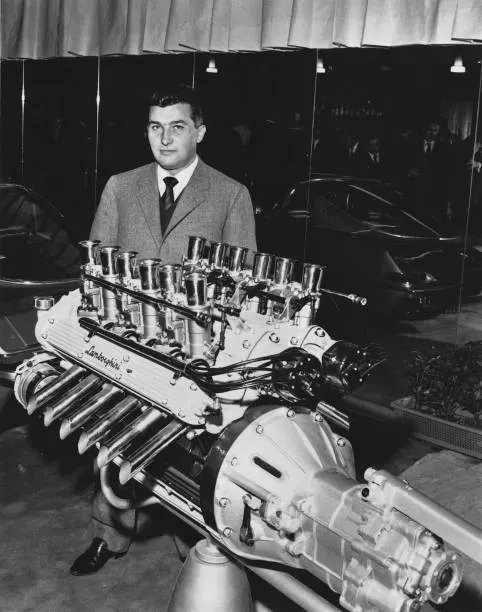
Giotto Bizzarrini. Former chief engineer at Ferrari. Designer of the Ferrari 250 GTO engine. By the time Ferruccio called him, he had been out of Maranello for two years, picking up consulting jobs. Ferruccio commissioned him to build a new V12. More modern. More powerful. And — above all — more reliable than the engine that had embarrassed him. The car Bizzarrini had not been allowed to build under Enzo.
Gian Paolo Dallara. Twenty-three years old. Just out of Ferrari and Maserati. Hired to design the chassis. He would later design the chassis of the Miura.
Paolo Stanzani. Engineer. Would eventually be the man behind the Countach.
Bob Wallace. A New Zealander. Brilliant test driver.
Franco Scaglione. Designed the body of the first prototype, the 350 GTV.
Five hires in four weeks, paid for with tractor money, fuelled by the rage of a mechanic who’d been sold a bodge job. Three of them came directly from Maranello or its orbit. That wasn’t a hiring spree. That was assembling a technical commando squad to flank Ferrari from behind.
To this team Ferruccio gave one instruction: build a car without flaws. Not a race car dressed up as a road car. A road car. Powerful but quiet. Fast but comfortable. Reliable. Beautiful. The opposite of what he had suffered with his Ferraris.
In May 1963 he established Automobili Ferruccio Lamborghini in Sant’Agata Bolognese. He bought the land. He built the factory from scratch — a large, well-lit shed connected to a small office building so management could see the production line at all times. By November 1963, just six months after the founding, the prototype 350 GTV was ready for the Turin Motor Show. The engine was not finished in time, so they covered it. Nobody noticed.
The badge was a bull. Ferruccio’s zodiac sign was Taurus. The animal also happened to be the natural opponent of the prancing horse from Maranello. A useful coincidence.
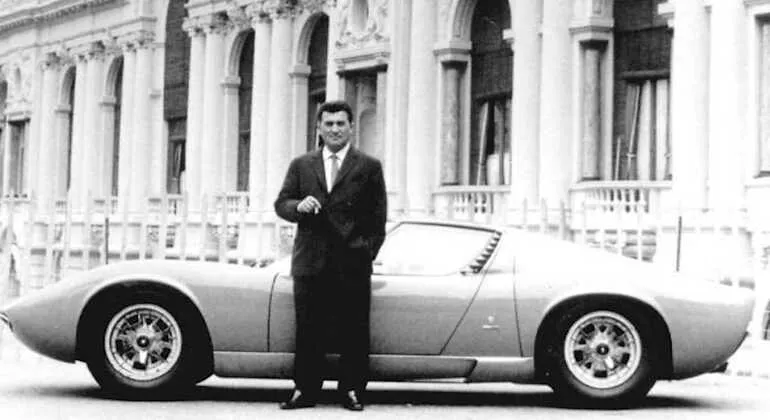
Miura, Espada, Countach
The 350 GT — the production version of the GTV, with Bizzarrini’s V12 finally working — entered production in 1964. Thirteen customers bought it immediately. Within two years, 120 units had been sold. It was not a car for everyone. It was exactly what Ferruccio wanted: a top-tier grand tourer without the flaws he had personally suffered in Maranello.
But the car that changed history came in 1966.
The Miura was not Ferruccio’s idea. It was the idea of his engineers — Dallara, Stanzani, Wallace — who in their spare time, after hours, designed a revolutionary chassis with the V12 mounted transversely behind the driver. When they showed it to Ferruccio, he approved it. The Miura’s bare chassis was displayed at the 1965 Turin Motor Show. The bodywork, designed by Marcello Gandini at Bertone, arrived a year later. It became the world’s first mid-engined production supercar.
Then came the Espada — the four-seater Ferruccio actually used as his personal car —, the Jarama, the Urraco, and the early development of what would become the Countach. By the start of the 1970s, Lamborghini was one of the most respected brands in the automotive world. And then everything fell apart.
Bolivia, South Africa, and the end
In 1971, Lamborghini Trattori’s South African importer cancelled every single order. It was a huge slice of tractor revenue. And tractors were, quietly, what bankrolled the rest of the Lamborghini group. The South African hit alone would have hurt. It was survivable.
Then 1972 happened.
The new Bolivian military government, freshly installed by the Hugo Banzer coup, cancelled an order of 5,000 tractors. Five thousand units. The largest single contract Lamborghini Trattori had ever signed. The tractors were already crated and waiting at the port of Genoa. An order of that scale doesn’t get cancelled and rebuilt the next month — there is no other buyer for that volume on short notice. The workforce was unionised. Layoffs were not legally available. Payroll kept running. The company ran out of cash with five thousand finished tractors sitting on a dock.
Ferruccio sold Lamborghini Trattori to its rival SAME in 1972. Then he started looking for a buyer for Automobili Lamborghini. In 1973, he sold 51% of the car company to Georges-Henri Rossetti, a Swiss businessman and personal friend, for 600,000 USD. The following year, he sold the remaining 49% to René Leimer. He walked away from the company that carried his name. He was 58.
By 1978, Automobili Lamborghini was in receivership. The brand passed through the hands of the Mimran brothers (1981), Chrysler (1987), an Indonesian consortium (1994), and finally Volkswagen Group through Audi (1998). Four owners in less than twenty years. Each one misunderstood the brand differently. And yet the brand survived.
La Fiorita: the man who walked away
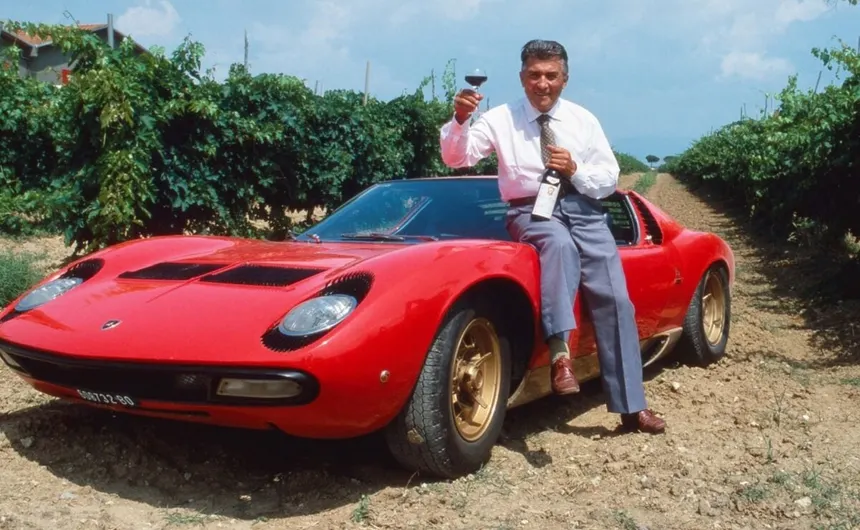
Ferruccio bought a vineyard in Umbria, La Fiorita, near Lake Trasimeno. He spent his last twenty years making wine and olive oil.
He never bought another Lamborghini.
He rarely spoke about the brand that carried his name. There were occasional interviews — the most cited being the 1991 Thoroughbred & Classic Cars piece where he put his version of the Maranello incident on the record. He visited the Sant’Agata factory under the Mimran brothers, who treated him with a respect Rossetti and Leimer never had. But it wasn’t his anymore. It was a courtesy visit to a company that wore his surname. When asked, his answers were short. He died on February 20, 1993 in Perugia. He was 76. The company he had founded was thirty years old at that point. Lamborghini was six years deep into the Chrysler era.
Visit La Fiorita today and they still make wine. The label has a bull on it.
What this story is actually about
Ferruccio Lamborghini was not a genius. He was a man with mechanical instincts, an ego, deep pockets and a long memory. A grape farmer with an engineering qualification who became one of the wealthiest men in Italy by building tractors and burners. A man who got angry when he realised he was being taken for a ride. And who had the resources, the team and the will to answer with a V12 of his own.
The official version says that Lamborghini was born from an insult. That is only partially true. Lamborghini was born because a man who was already tired of things not working properly received the right insult at the right time. The insult only accelerated a decision he was likely going to make anyway. But what a decision. And what a company.
Sant’Agata Bolognese is still there. Still making cars. Still wearing the bull. And somewhere in 1963, a tractor manufacturer with two broken Ferraris knocked on the worst possible door to complain, and walked away with the most expensive sentence Enzo Ferrari ever spoke.
Check you’re still alive.
6 thoughts on “FERRUCCIO LAMBORGHINI”