
Ken Block: the man who invented a genre and gave it away
January 2, 2023. Mill Hollow, Wasatch County, Utah. A snowmobile flips backward on a steep slope and lands on top of the man riding it. He’s alone at that moment. By the time search and rescue reach him, there’s nothing to be done. He’s pronounced dead at the scene. He’s 55. His name was Kenneth Paul Block.
Mill Hollow doesn’t ring a bell. It shouldn’t. But a mile and a half away, in Woodland, there was a ranch where a man lived who had done more for car culture in fifteen years than most people manage in thirty. Without a single World Championship to his name. Without a Le Mans podium. Without ever sitting in a single-seater in his life.
And still. Without him, a huge piece of what you understand by “petrolhead” today simply doesn’t exist.
Start at the end, because that’s where the beginning is
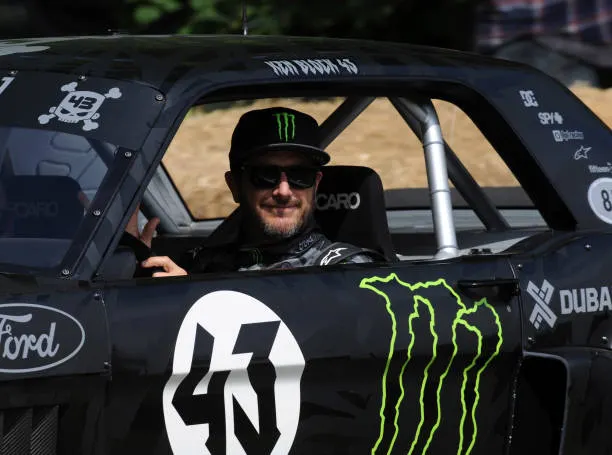
Ken Block wasn’t a racing driver in the way you understand racing drivers. He didn’t get signed at fourteen. He didn’t climb the junior categories. There’s no résumé like that.
He started competing in rally at 37. Thirty-seven. The age at which most circuit drivers are starting to think about retiring, he was sitting in a competition car for the first time. And what came next wasn’t a championship. It was something else. Something that didn’t have a name back then and is now called Gymkhana, even though the name falls short.
Block didn’t take on the best and beat them. Block did something rarer: he took a competition car, stuck it in an abandoned airfield, hit record on a camera, and founded a genre. Before him, motorsport on the internet was circuit onboards and crash compilations. After him, there are millions of people who walked into the world of cars through a door he kicked open.
That’s the story. And it starts long before the first Subaru.
Long Beach, California, November 21, 1967
Kenneth Paul Block is born in Long Beach. Raised in Southern California. Skateboarding, snowboarding, motocross. Eighties Californian culture in pure form. He’s not a born petrolhead. He’s a kid with a deck and a long fringe. What interests him is clothes, sneakers, design, music. Cars come later.
In the late eighties he starts screen-printing T-shirts in his garage and selling them to local skate shops. At Palomar College he meets Damon Way. Damon Way cares about skateboarding more than food — his brother Danny is one of the biggest riders in skateboarding history. Block and Way launch businesses almost nobody remembers: Eightball Clothing, Blunt Magazine, Type A Snowboards. Some sink. Others almost.
In 1994 they found DC Shoes. Damon Way, Ken Block, and Clayton Blehm. DC stands for Droors Clothing, a brand they’d run before. The idea is simple: shoes built for actual skaters, designed with skater logic. No condescension, no generic athletic-shoe marketing. The first order came out of the $20,000 the partners put in between them.
In ten years they turned that into a company with four hundred employees and $100 million in revenue. On March 8, 2004, Quiksilver bought DC Shoes for $87 million. Fifty-six in cash, 1.6 million restricted shares, and ten million more in assumed debt. Block was 36. He’d just sold the company he’d built from nothing.
And then he did what almost nobody does when that check lands: he got bored. And decided to learn how to drive.
The improbable choice
When you sell a company for nearly $100 million at 36, the logical move is the predictable one. Big house, boat, foundation, golf, board seats. What Block did was climb into a Subaru WRX STi prepped by Vermont SportsCar and debut in Rally America at 37, in 2005.
He had no real competition experience. But he had instinct, money to train, and — more importantly — patience to look like an idiot for a couple of years until he stopped looking like one. In his debut he finished seventh overall at Sno*Drift, across 200 kilometers of ice. For someone who’d never raced, that was a statement.
That year he closed five top-fives and walked away with Rookie of the Year in Rally America. In 2006 he signed with his old friend Travis Pastrana on the Subaru Rally Team USA and finished runner-up in the national championship. In 2008 he repeated the runner-up spot. He won the Rally in the 100 Acre Wood five years in a row, breaking John Buffum’s all-time record. Pastrana usually beat him to the title. Block accepted it. He was learning, and he knew it.
But that part of the story — the serious American rally career — isn’t why Block is Block. By that part alone he’d be a regional driver with respectable results. End of file. What changed everything was an idea he had in 2008, while trying to learn to slide a car on tarmac in a country where there was no tarmac rally.
An empty runway, a camera, an idea
- Block has been chewing on something specific: he wants to learn to control the car on asphalt the way the WRC guys do in Catalunya or Corsica. Rally America doesn’t have that discipline. Solution? Invent the practice himself. Find ground. And he knows a place: the decommissioned El Toro Marine Corps Air Station in Orange County. Cracked runways, empty hangars, weeds growing through concrete. Sketchy, his friends tell him. Properly sketchy.
He calls Matt Martelli and Mad Media, two brothers who shoot skate films. The aesthetic Block has in his head comes from there: cameras pinned to the ground, raw audio, no filters. The philosophy isn’t to show the driver doing pretty things. It’s to put the viewer inside the car. Subaru Impreza WRX STi 2006, engine built by Quirt Crawford, 530 horsepower at the wheels. No roll cage. The engine runs for fifteen minutes before overheating. Martelli’s later description of the gig is direct and unfiltered: “We didn’t know if the car was going to blow up or if Ken was going to crash.”
The video was called “Gymkhana Practice.” Four and a half minutes. They posted it online with no expectation beyond having a good time. It worked. Fifty-one million views. In 2008 those weren’t today’s numbers. In 2008, that was an earthquake.
What happened after is the story you know even if you don’t know it. Fourteen episodes between 2008 and 2022. More than a billion accumulated views on the Hoonigan channel. Gymkhana 5 shot in San Francisco with the city locked down — drifts up the inclined streets, the Bay Bridge, Vermont Street. Gymkhana 7 in Los Angeles with the Hoonicorn. Gymkhana 9 in Dubai. And a finale in 2022, in Las Vegas, with the all-electric Audi S1 Hoonitron. That was the last one.
The jump to WRC
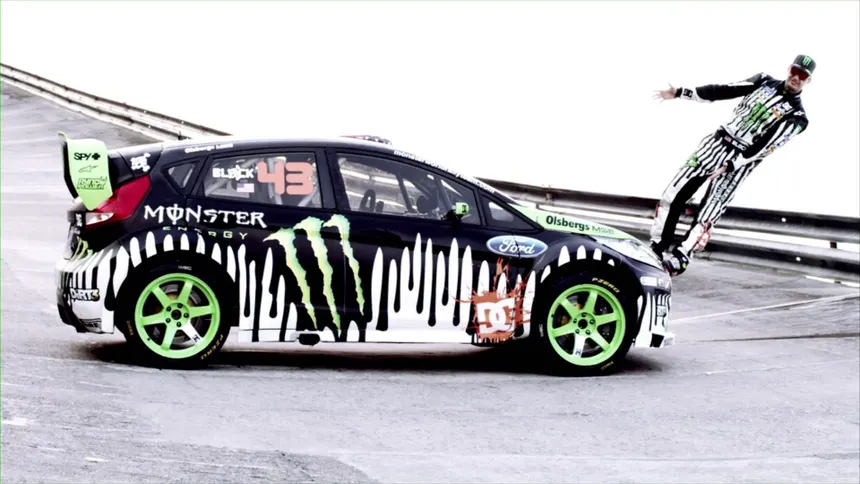
In 2010 Block left Subaru and signed with Ford. He founded Monster World Rally Team — later rebranded as Hoonigan Racing Division — and climbed into a Ford Focus RS WRC 08 prepped by M-Sport. His co-driver: Alex Gelsomino, who’d been with him for years. He became the first American to contest a season of the World Rally Championship in a factory-built car.
It wasn’t a heroic championship campaign. It was never going to be. Block said it without flinching: he was a Rally America driver learning to survive among Loeb, Solberg, and Hirvonen. In 2010 he ran seven rounds. He scored two points. His best result was ninth at Catalunya, in October. By that point, that was a conquest. He was the first American to do it.
In 2013 he improved: seventh overall at Rally Mexico. His best WRC result. He became the fourth American in history to score points in the World Rally Championship. Twenty-five total starts between 2007 and 2018. The last was a farewell run at Catalunya 2018 that he didn’t finish.
In parallel, he won six Global Rallycross rounds and finished runner-up in 2014. He got to World Rallycross. He got to X Games with five medals. He got to Pikes Peak with Climbkhana. He got everywhere.
But when somebody talks about Block fifty years from now, they won’t remember seventh at Mexico. They’ll remember the Subaru sliding on the broken concrete of El Toro.
Hoonigan: the brand he invented
In 2010, parallel to his arrival in WRC, he registered the word Hoonigan as a trademark. The word is a cross between “hooligan” and “hoon” — Australian slang for a reckless driver. Block named himself Head Hoonigan In Charge. The philosophy fit in four words: just make cars fun.
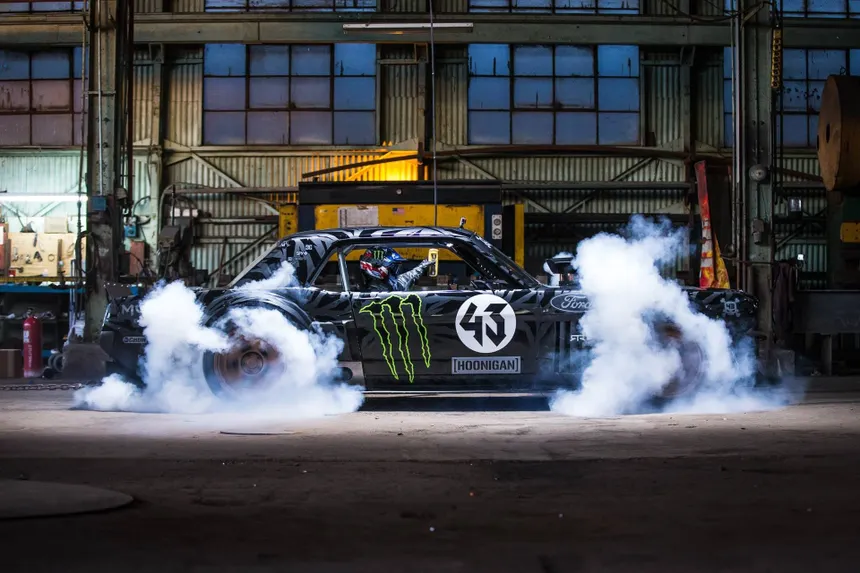
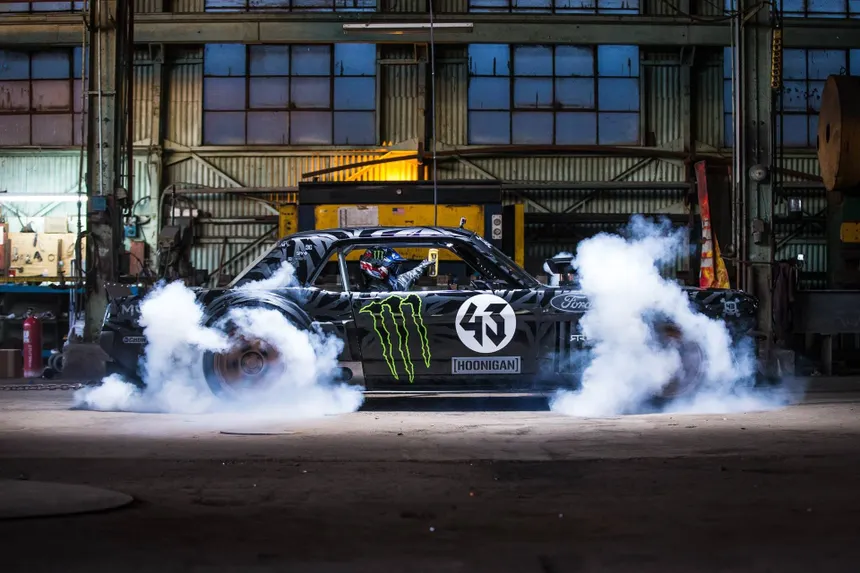
Over the next decade, Hoonigan became the most-watched motorsport channel on the internet. Over a billion views accumulated. He built impossible cars: the Hoonicorn, a 1965 Mustang with all-wheel drive and 1,400 horsepower running on methanol. The Cossie V2, an Escort Cosworth designed first as CGI and then built down to the millimeter. The Hoonitruck, a 1977 Ford F-150 pickup with an EcoBoost twin-turbo V6 and AWD. The all-electric Audi S1 Hoonitron for Electrikhana. Cars that didn’t fit in any rulebook because there was no rulebook.
Ford backed him until 2020. Audi after that. Monster Energy from the start. Those contracts were possible because the Gymkhanas weren’t videos anymore. They were million-dollar campaigns dressed up as entertainment. And they worked.
What happened to Hoonigan after Block’s death is another story that deserves its own piece. Here it’s enough to say this: Block built the brand. Others inherited it. That’s always a problem.
The TV that got it
September 2009. Block was invited onto Top Gear UK. James May went to Inyokern, another Californian airfield, and rode shotgun in a live Gymkhana. May, a man past 50 with nerves of ice, got out of the car with a face that’s the closest a British presenter has ever come to begging for mercy. That appearance was Block’s introduction to Europe. What had been quietly happening on YouTube for two years was confirmed on the BBC that day.
He came back to Top Gear in 2010 — the Reliant Robin lap, ending in a roll he didn’t quite complete. In 2016 he returned with the Hoonicorn, drifting the empty streets of London with Matt LeBlanc riding shotgun. In 2018 he played a police officer chasing LeBlanc, Chris Harris, and Rory Reid. Four appearances. Each one funneling more people in.
And the video games. Codemasters put him in Colin McRae: Dirt 2 in 2009 and Dirt 3 in 2011, where he showed up as a Gymkhana instructor — an entire game mode dedicated to his discipline. Forza Horizon copied the format from version 3 onward. Need for Speed absorbed it. Half the kids who today spend afternoons doing virtual donuts on a controller don’t know that game mechanic exists because a man from Long Beach took a Subaru and started spinning it on an empty runway.
The family
Lucy. Lia, Kira, and Mika. Wife and three children. Block guarded them obsessively. The family appeared when he decided they should appear, no more.
Lia, the eldest, started in karts at 11. At 14 she was driving the 1,400-horsepower Hoonicorn. At 16, three months before her father’s death, she presented her first car: a 1985 Audi Quattro she’d found in a barn in New Jersey and restored herself. The last post Block put up before he died was promoting episode four — the finale — where Lia would drive the restored Audi. It went up the night before January 2.
Lia was 16 when her father died. In 2023 she won the ARA Open Two-Wheel Drive championship — the youngest driver ever to win a title in the series. In 2024 she debuted in F1 Academy with ART, backed by Williams. In 2026 she returned to rally with a Hyundai i20 N Rally2.
She isn’t “the daughter of.” She’s Lia Block. But that’s another story too.
What he left
The FIA retired the number 43 from the World Rally Championship for the entire 2023 season. It didn’t appear on a single grid all year. That’s a gesture motorsport makes very rarely. And when it does, it does it seriously.
Cyberpunk 2077 added a car called “Hoon” with the number 43 in an update. CSR Racing 2 released a playable Hoonicorn. Real Racing 3, in November 2025, added the electric Hoonitron to the game. The video game industry — which owes Block more kids in the hobby than anyone else — is paying him back piece by piece.
But the real inheritance isn’t the numbers. The real inheritance is that right now, somewhere in the world, there’s a kid doing donuts in a parking lot with a car that barely holds together. And that kid walked into the world of cars because of a YouTube video of a 37-year-old American in a Subaru. What he does with that doesn’t depend on Block anymore. But the door he walked through was opened by a man named Kenneth Paul Block who never won a single World Championship.
The tension nobody has resolved
Here’s the unanswered question that defines Block: what was he, exactly?
If you measure by trophies, he isn’t a legend. Ten years in WRC, best result seventh. Runner-up in some secondary series. No Le Mans, no Mundial, no Dakar.
If you measure by influence, he’s the most important driver of the past two decades. Not the best. The most important. That distinction is brutal and worth not confusing. Block wasn’t Loeb. Loeb is Loeb. But Loeb didn’t invent anything — he won. Block invented something that didn’t exist and then competed while inventing it.
What Block did is the rarest thing in sport: he brought new people in. He took motorsport to millions of people who would never have watched a rally stage. He did it without asking permission, without a marketing department, without a press agency. With a camera, a Subaru, and an abandoned parking lot. And then he built an empire on top of it.
The other matter, the one nobody wants to address but has to be addressed, is the hybrid nature of what he was doing. The Gymkhanas weren’t competition. They were choreographed spectacle, with a million-dollar budget, fake takes, cuts, doubles. But the driving was real. The car control was real. The technical skill required to do that, repeat it, and not crash was at a level very few drivers in the world possess. Block was making cinema. But he was the one driving the cinema.
That’s why, when purists say “he wasn’t a real driver,” they don’t understand what they had in front of them. He was a real driver doing something that didn’t fit any category. Something he invented. Something that, for lack of a better word, we now call Gymkhana — but the word is smaller than the thing.
The last frame
January 2, 2023. Block went out riding snowmobiles with a group. At some point he separated from them. He was climbing a steep pitch when the machine flipped backward and landed on top of him. By the time emergency services arrived there was nothing left to do.
The last post he’d put up on Twitter, hours before, was an invitation to watch the final episode of Lia’s Audi project, going live at 8 a.m. Pacific the following day. “Will her Audi finally do a donut? Or will it break in the attempt? Tune in to find out!” he wrote. That’s the last public thing Ken Block said in his life. An invitation to watch his daughter drive.
Within minutes of the death announcement, tributes appeared on LinkedIn, on Twitter, on Instagram. Drivers from every discipline, engineers, journalists, people from the world of cars who probably never met him in person. Jenson Button, 2009 F1 World Champion: “In shock at the passing of Ken Block. Such a talent that did so much for our sport.”
That sentence sums up what happened on January 2 better than any other. A champion didn’t die. The man who’d made the sport bigger for everyone else did.
Forty-three. That was his number. The FIA retired it that same year. Lia carries it now when they let her, sewn into her overalls. KB43VER, she wrote on Instagram a couple of days later. Ken Block forever.
And that’s roughly how real inheritance works. Not with a bronze plaque or an official speech. With a 16-year-old who climbs into an Audi Quattro restored in a barn, turns the key, and starts doing donuts in the parking lot. Because that’s what her father would’ve done.
Check you’re still alive.