
LAMBORGHINI COUNTACH: WHY THE MOST FAMOUS SUPERCAR IN HISTORY WAS ALSO THE WORST
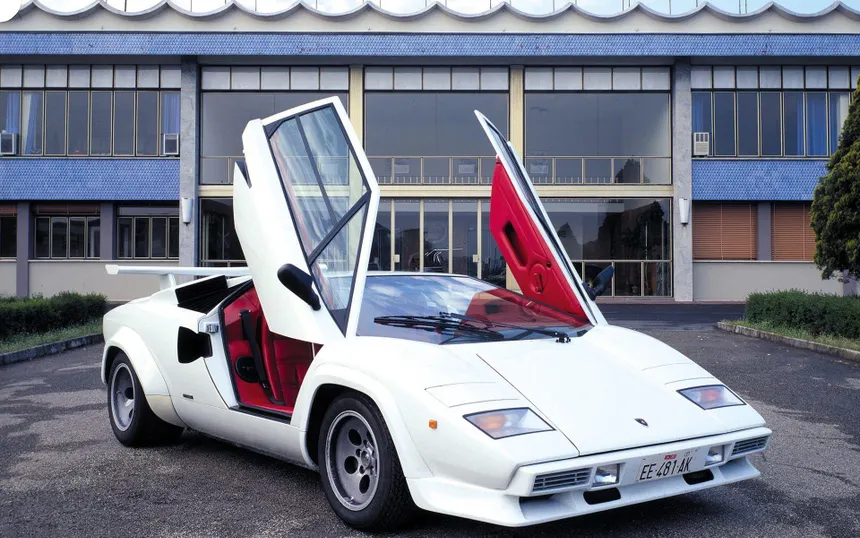
Let’s start with what the Countach actually was. Not what it looked like — what it was.
It was a car with no rear visibility. Literally none. The V12 and its intake scoops occupied the space where a rear window should have been. To reverse, you opened the scissor door, sat on the sill, twisted around, and prayed. The steering had no power assistance — at parking speeds, turning the wheel was a workout. The clutch required leg strength most drivers didn’t have. The pedals were offset to the left because the wheel arch intruded into the footwell. The engine behind your head produced enough heat to blister skin through the leather seats in summer. The windows barely opened because of the scissor door geometry. The air conditioning was decorative.
The electrical system failed regularly. The cooling was marginal — the engine overheated in traffic. The gearbox was noisy across all five versions. Suspension bushings wore out quickly. And the hydraulic clutch ate its own disc if you didn’t treat it with surgical precision.
It was slower than the Ferrari 512 BB on a circuit. Less reliable than the Testarossa. Harder to drive than both. In every measurable sense, the Countach was the worst supercar of its era. Every problem listed above was present in the LP400 of 1974 and still present in the 25th Anniversary of 1990. Sixteen years. Five versions. None of them fixed the fundamentals.
And it is the most famous car of the twentieth century.
That is not a contradiction. That is the point. The Countach wasn’t selling transportation. It was selling meaning. And meaning was immune to defects.
The geometry of fame
On March 11, 1971, the LP500 prototype appeared on Bertone’s stand at the Geneva Motor Show. Yellow. Scissor doors. A 5.0-liter V12 producing 440 bhp. A digital dashboard — in 1971. Across the hall, Lamborghini’s own stand was showing the Miura SV. Two cars from the same company. One was the past. The other was something nobody had a word for until a Piedmontese farmer, discovering the prototype hidden in an agricultural shed near Grugliasco during a labor strike, yelled “Countach!” — a dialect exclamation of astonishment. Gandini, himself Piedmontese, heard the story and chose it over any bull’s name.
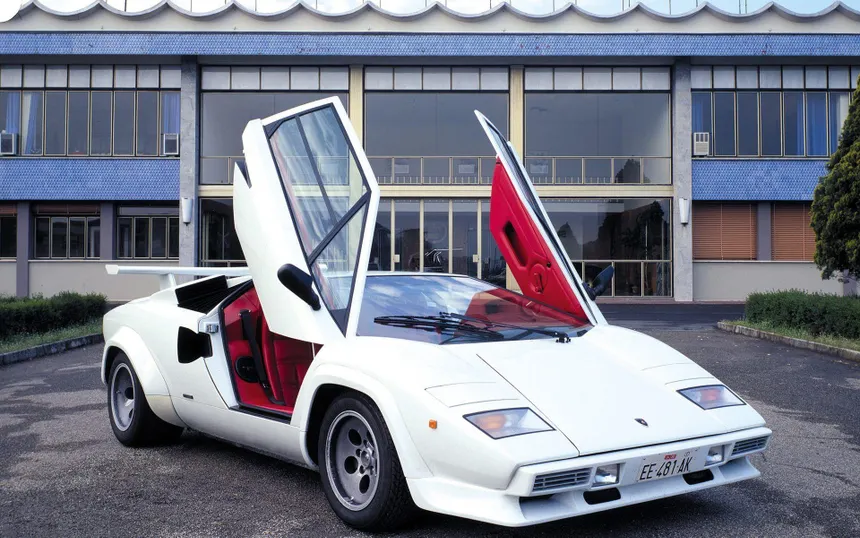
What Gandini designed wasn’t a beautiful car. It was something more dangerous: a car that communicated speed without moving. The Miura needed to be seen in profile, in motion, light rolling across its curves, to transmit its purpose. The Countach transmitted it in a still photograph. From any angle. At rest.
The method was geometric reduction. Gandini stripped out everything organic: the curves, the soft transitions, the reflections that shift with light. What remained were flat planes, hard edges, and pure wedge shapes. Every surface angular. Every line a cut. Every proportion deliberately exaggerated — too low, too wide, too aggressive. The result was a car that looked like a science fiction illustration even when standing in front of you in three dimensions.
This is what Ferrari’s rivals lacked. The 365 GT4 Berlinetta Boxer was elegant. The 512 BB was beautiful. The Testarossa was striking. All three were superior cars — faster, more reliable, easier to drive. But none of them worked as a static image. Ferraris needed movement to come alive. The Countach was alive in a photograph. And in the 1980s, when image consumed reality, that was everything.
Here is the deeper point. A car with curves loses information when it goes from three dimensions to two. Reflections vanish. Depth flattens. Surface subtleties disappear. A photographed Miura never has the presence of a real Miura. But a photographed Countach has exactly the same presence as a real Countach — because Gandini’s design was already flat. Already graphic. Already two-dimensional in its geometry. He designed, consciously or not, a car optimized for reproduction. A car that gained visual power by losing a dimension. A car that was more itself in a poster than in a parking lot. That single insight — whether it was intentional or accidental — explains why the Countach became the defining image of an entire decade while objectively better cars were forgotten.
What held the image up
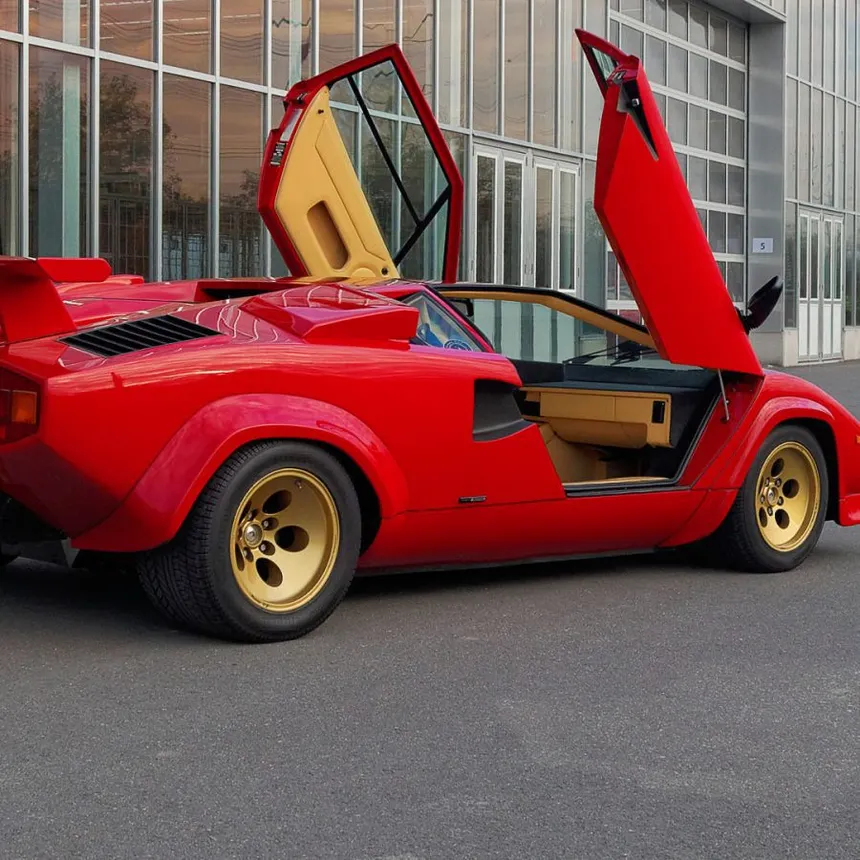
Beneath Gandini’s bodywork sat a longitudinal V12 with the gearbox mounted ahead of the engine, between the seats — a layout devised by technician Oliviero Pedrazzi under chief engineer Paolo Stanzani’s direction. The tubular spaceframe chassis, built by Marchesi, weighed just 90 kg. The scissor doors weren’t aesthetic — they were engineering: a car this wide and this low couldn’t open conventional doors in any normal parking space.
The production LP400 arrived in 1974 with a 3.9-liter, 375 bhp V12 after the prototype’s 5.0-liter proved unreliable. Bob Wallace — the New Zealand test driver who built the Miura Jota — had spent 1971 road-testing the LP500 before it was destroyed in a crash test at England’s MIRA facility on March 21, 1974. The car that redefined automotive design died against a wall for a homologation certificate.
Here’s where the fraud thesis becomes concrete. Every flaw listed above — the visibility, the clutch, the heat, the electrics — was present in the LP400 of 1974 and still present in the Anniversary of 1990. Sixteen years. Five versions. Not one of them fixed the fundamental problems. Because fixing them would have meant redesigning the car, and redesigning the car would have meant losing the silhouette, and losing the silhouette would have meant losing the only thing the Countach actually sold.
Nobody returned one. That’s the proof that the Countach wasn’t selling transportation. It was selling meaning. And meaning was immune to defects.
What followed was an evolution driven by money, ego, and accident. Walter Wolf — Canadian oil magnate, F1 team owner — bought an LP400 in 1975, judged it inadequate, and called Gianpaolo Dallara, the engineer who had designed the Miura’s chassis and was now running his own company in Varano de’ Melegari. Dallara redesigned the suspension, fitted wider Pirelli P7 tires on Campagnolo wheels, added fiberglass wheel arch extensions, a rear wing, and the original 5.0-liter engine producing 447 bhp at 7,900 rpm. Every Wolf modification ended up in the production car. The LP400 S of 1978 — the poster car — was actually slower than the original LP400 because the wider rubber added drag and weight. Nobody cared. The LP400 S sold on how it looked, not how it went. Exhibit A.
Displacement grew to 4.8 liters in 1982, then 5.2 liters with four-valve heads and 455 bhp in 1985. Each version was heavier, more complex, and arguably further from the brutal simplicity of the original LP400 — but closer to the poster image that was actually selling the cars. In 1988, Horacio Pagani — yes, the founder of Pagani Automobili, then running Lamborghini’s composites department — restyled the exterior for the 25th Anniversary Edition. Pagani had already built the Countach Evoluzione, a carbon fiber prototype that was lighter, faster, and more advanced than any production Countach ever made. It pointed to the future. The Anniversary pointed to the past — and sold 657 units, more than any other version, proving once again that what the market wanted from the Countach wasn’t progress but permanence. Sandro Munari — the driver who won three World Rally Championships in the Lancia Stratos — tuned the suspension. The Anniversary was the most refined Countach, the most livable, and the heaviest at 1,590 kg. The last one left Sant’Agata Bolognese in July 1990.
Total production: 1,983 cars across 16 years. Fewer than 125 per year. Every one hand-assembled in Sant’Agata Bolognese. Every one sold to someone who bought it for what it meant, not what it did. That is not an accident. That is the entire argument.
The poster that kept a company breathing
Here is the argument nobody makes in full: the Countach saved Lamborghini not because it was a great car but because it was a great image. During its 16-year production run, Lamborghini went through three financial crises, two ownership changes, and a period under Italian government administration. The company should have ceased to exist. It didn’t, because every child in the Western world knew the word “Countach” and the silhouette that accompanied it.
Engineering didn’t achieve that. Gandini’s geometry did. The purity of those lines made the car function as a symbol without anyone needing to drive it, touch it, or see it in person. No marketing department orchestrated this. No advertising agency manufactured it. A single design, drawn by a salaried employee who never received a royalty, kept a company’s name in the global consciousness for two decades through visual force alone.
Consider the absurdity. A factory in Sant’Agata Bolognese producing 125 cars per year — fewer than a decent restaurant serves dinners in a month — achieved a level of brand recognition that companies spending millions on advertising couldn’t match. Ferrari had Formula 1, a racing heritage stretching back decades, and a production volume ten times larger. Porsche had the 911 selling by the tens of thousands. Neither achieved the cultural penetration the Countach had in the 1980s. And Lamborghini did it with a product that was, by every objective measure, worse than what its competitors were offering. The Countach wasn’t selling performance. It was selling the idea of performance — and the idea turned out to be more powerful than the real thing.
The Countach proved that a car can be more powerful as an image than as a machine. That a design can transcend its function to the point of keeping alive a company that, on industrial merit alone, had no right to survive. Is that a fraud? Yes. The most glorious fraud in automotive history. Because the Countach didn’t lie about what it was. It lied about what mattered. And in doing so, it proved that form — when it’s pure enough, radical enough, impossible enough — becomes content. And content survives everything: financial crises, ownership changes, mechanical obsolescence, the passage of decades.
The Countach wasn’t a great car. It was something harder to be: a great object. An object that worked better as an idea than as a machine. That is the most accurate description of what Gandini achieved with a pencil, a drafting table, and a geometry that didn’t need to move to exist.
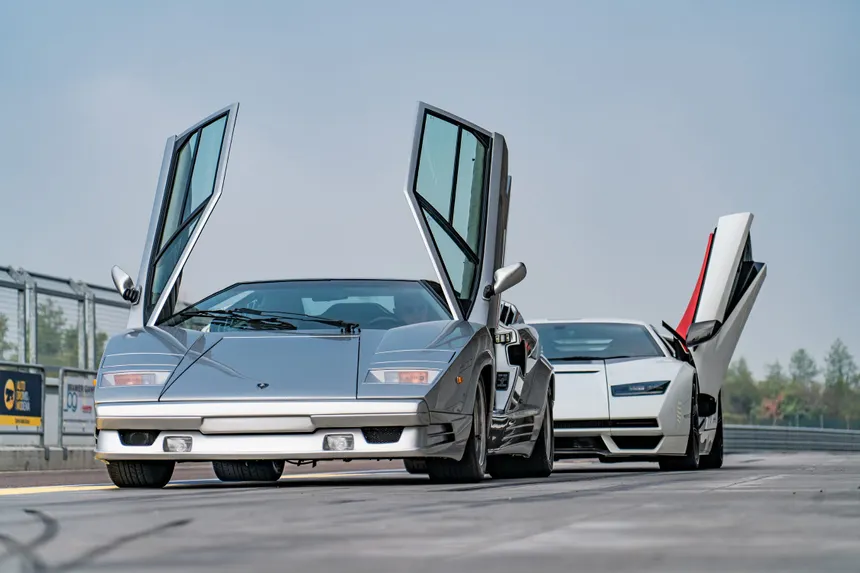
In 2021, Lamborghini resurrected the name. The Countach LPI 800-4 — 112 units, sold out before public announcement — used the Aventador’s platform and a hybrid V12. Gandini, at 83, issued a public statement distancing himself from the project: “To repeat a model of the past represents the negation of the founding principles of my DNA.” The creator rejected the resurrection. The market bought every unit. Final exhibit. The fraud still works half a century later. And it will keep working as long as someone remembers the silhouette. Which, given what Gandini drew, will be forever.
Check you’re still alive.