
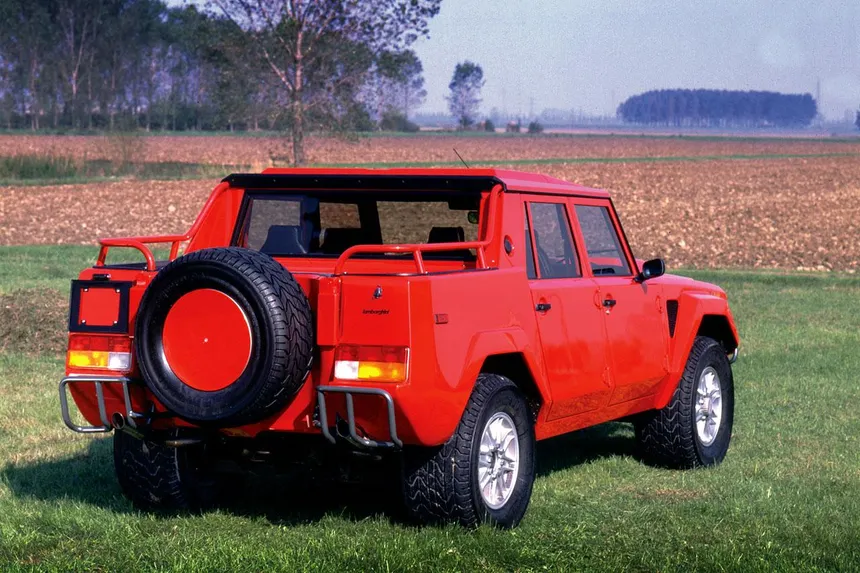
LAMBORGHINI LM002: The engine doesn’t match the car
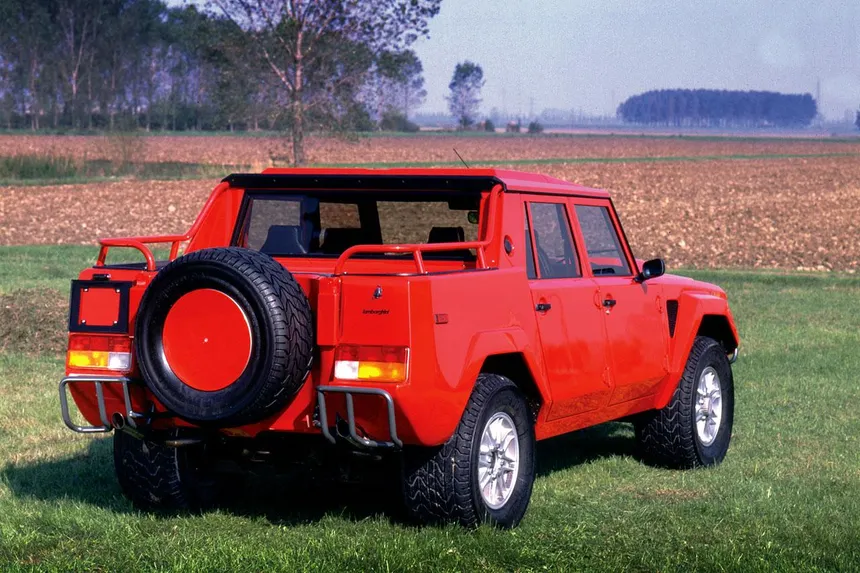
Pop the asymmetric bonnet of a Lamborghini LM002 and look down. What you’re seeing is a Tipo L510 V12. 5,167 cc. Double overhead cams per bank. Four valves per cylinder. Six twin-choke Weber carburettors feeding twelve cylinders. 444 hp at 6,800 rpm.
That engine has no business being in an off-roader. It belongs in the Countach Quattrovalvole. Same displacement, same block, same Sant’Agata production line, same assembly hands. Lamborghini didn’t build a similar engine for the LM002. They took the Countach motor and dropped it in.
Which tells you everything about this car before you’ve even turned the key.
The LM002 isn’t a heavy-duty SUV with a big engine. It’s a hand-built Italian supercar wearing tank bodywork. An engineering contradiction that should never have reached production, survived anyway, ended up in the garages of the world’s worst people, and today trades hands at auction for more than the Countach it shares a heart with.
Buckle up. This runs long.
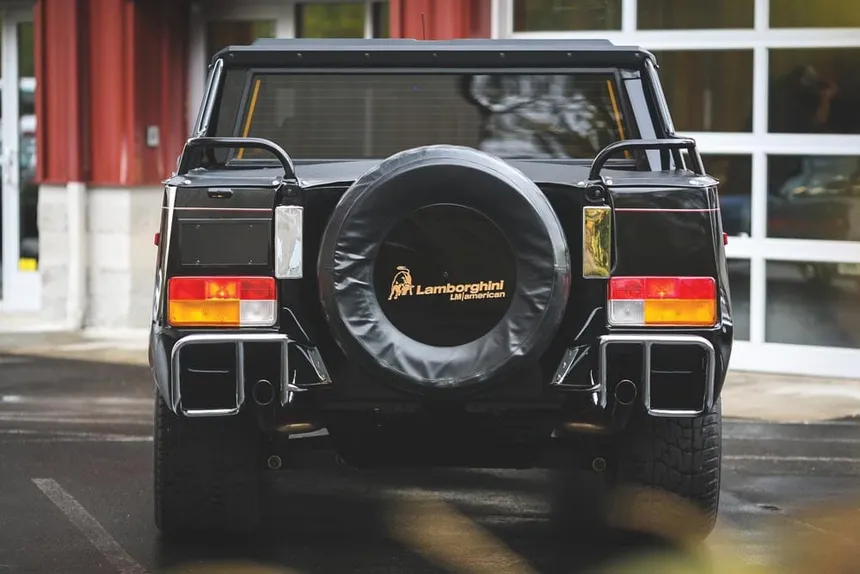
A commission that made no sense
Sant’Agata Bolognese, 1977. A factory hand-building Countachs, hovering on the edge of bankruptcy, accepts a project it had no business accepting: designing a replacement for the M151 Jeep for the US Army.
The prototype was called Cheetah. It was designed by an American, Rodney Pharis, with a rear-mounted Chrysler V8. One unit was built. The US military never actually tested it, only watched demonstration runs. It eventually got sold to Teledyne Continental Motors and vanished.
But Lamborghini didn’t quit. In 1981, engineer Giulio Alfieri dug the project up and showed the LM001 at Geneva. AMC V8 this time, same structural flaw: engine still at the back. An off-roader with rear-mounted weight handles like a drunk cow. No chassis tweak, no suspension upgrade, fixes that.
Alfieri figured out fast what had to happen. New chassis, engine up front. And if he was rewriting everything, he might as well use the Countach V12.
The LMA002 (the A stands for anteriore) appeared at Geneva in 1982. Four more years of development, and the production version was unveiled at Brussels in January 1986. By then the Pentagon had already spent six years with the Humvee contract awarded to AM General. The LM002 was born orphaned. No military customer, no commercial justification, no argument for its own existence beyond the fact of its own existence.
Hard pivot at Sant’Agata: if the military won’t have it, the millionaires will.
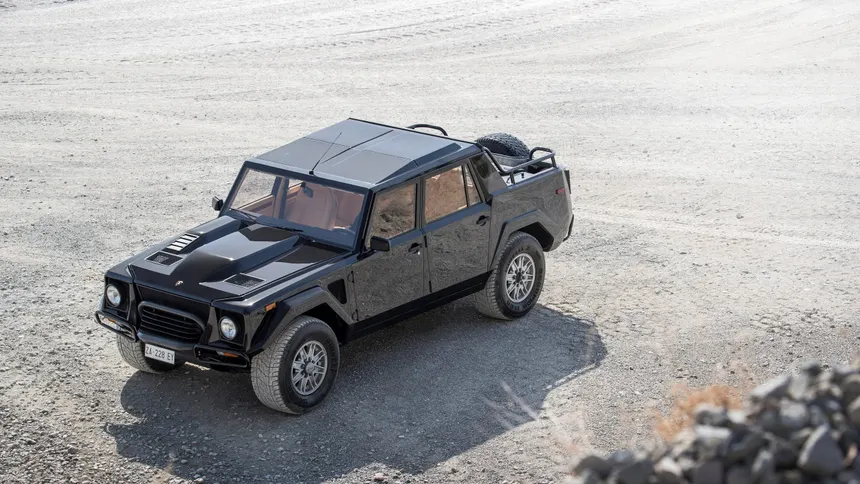
What it had (and why that matters)
Back to the engine, because this is where the story lives. That L510 V12 ran downdraught carburettors rather than the sidedraughts on the older 4.8-litre unit, with pentagonal combustion chambers and 36mm intake valves. Compression was dropped slightly from the Countach spec to swallow 94 RON fuel, because the commercial target sat in markets where petrol didn’t always come out of a European refinery.
Output: 444 hp at 6,800 rpm. Torque: 500 Nm at 4,500 rpm. Gearbox: ZF five-speed manual with a dogleg first (down and to the left). In an off-roader. Drivetrain: full-time four-wheel drive with three limited-slip differentials and a low-range transfer case. Multi-tubular steel chassis. Aluminium and fibreglass bodywork. 290-litre fuel tank. Kerb weight around 2,700 kg. Pirelli Scorpion Zero 345/60 VR17 tyres developed specifically for this vehicle, with semi run-flat capability and two different tread patterns depending on terrain.
0-100 km/h in roughly 7.7 to 8 seconds. Top speed around 210 km/h. Climbs a 120% gradient.
Now, context. A 1986 Range Rover Classic made 165 hp from a 3.5-litre V8 and weighed 1,950 kg. The contemporary Mercedes 300 GE made 170 hp. The Toyota Land Cruiser J80 VX didn’t exist yet (it arrived in 1990). The LM002, in 1986, made more horsepower than a Ferrari Testarossa (390 hp) and more torque than a Porsche 959 (500 Nm).
And if that wasn’t enough, the options list included the L804 marine V12 from Lamborghini’s Class 1 offshore race boats. The full story is in our piece on Lamborghini marine engines.
This wasn’t an off-roader with a strong engine. This was a supercar wearing military bodywork. Literally. Same engine, same serial number, same Sant’Agata production line. And that’s why, when the Pentagon said no, Gaddafi said yes.
The clientele that fell for the monster
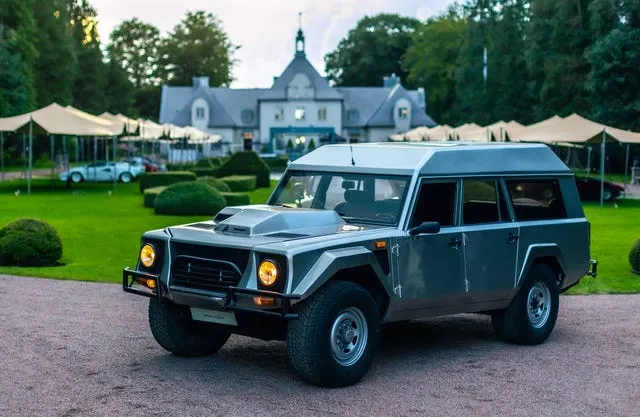
When you put a luxury off-roader with a Countach engine and armoured-vehicle aesthetics on the market, university lecturers don’t buy it. Other people do.
Gaddafi ordered one hundred units. One man. The Sultan of Brunei, a compulsive collector whose garages eventually held around 7,000 exotic cars, had a covered station-wagon version built by a Turin coachbuilder (the standard LM002 had an open rear deck). Pablo Escobar kept one at his private zoo at Hacienda Nápoles, driving it among the giraffes. Then the Western celebrity roster: Sylvester Stallone, Mike Tyson, Tina Turner, Eddie Van Halen, Keke Rosberg.
Of the 328 units built between 1986 and 1993 (some records list 301; Lamborghini officially cites 328), only one left the factory right-hand drive. It still lives at Sant’Agata.
This isn’t a list of celebrity owners. It’s a pattern. Look at the names. Dictators, drug lords, petroleum dynasties, boxers and rock stars. Nobody on that list was buying a car to drive to work. They were buying the LM002 because it said something no other vehicle was saying in the eighties: I don’t owe anyone an explanation.
And that DNA, the car that exists because it can rather than because it should, is exactly what connects the Pentagon’s 1977 rejection to the Monterey auction in 2024. We’ll get to that.
The rally adventure that almost was
At some point in 1986 somebody at Sant’Agata looked at the LM002 and thought: if this thing can climb a 120% gradient and eat sand, why not send it to the Paris-Dakar?
Here the story splits into two parallel campaigns that often get conflated. Worth separating them.
The factory effort. Lamborghini prepped chassis HLA12047, pushing the V12 to over 600 hp, stripping weight, installing a full roll cage, Plexiglas windows, a 600-litre fuel tank and GPS equipment. The contracted driver was Sandro Munari, Stratos legend, 1977 World Rally Champion. The debut was meant to be the Rally of the Pharaohs in Egypt, October 1987. The car never started the race: the main sponsor died in an offshore powerboat accident days before the event. The project dragged into 1988, when Mario Mannucci took the wheel with Munari as co-driver in a rally in Greece. They led a section, dropped to third, and a technical failure put them out just miles from the finish. Shortly afterward, Chrysler acquired Lamborghini and shelved the programme. The factory LM002 never ran a Paris-Dakar.
The privateer effort. That same 1988, Swiss team World LM Racing (funded by P.A. Burnier) entered an orange LM002 with start number 519 in the Paris-Dakar Marathon category, driven by Concet and Kurzen. Sources disagree: some say they had to retire, others that they finished tenth. It was the only LM002 that actually ran the Dakar in the eighties.
Almost a decade later, in 1996, Italo-Swiss racer Andrea Barenghi tried again with another LM002 (800-litre fuel tank, over 600 hp), having acquired one of the cars previously owned by the Mimran family. He didn’t win. No LM002 that ever made it to a Dakar start line finished in a meaningful position. But the attempts existed. Three of them.
The Uday chapter, told whole
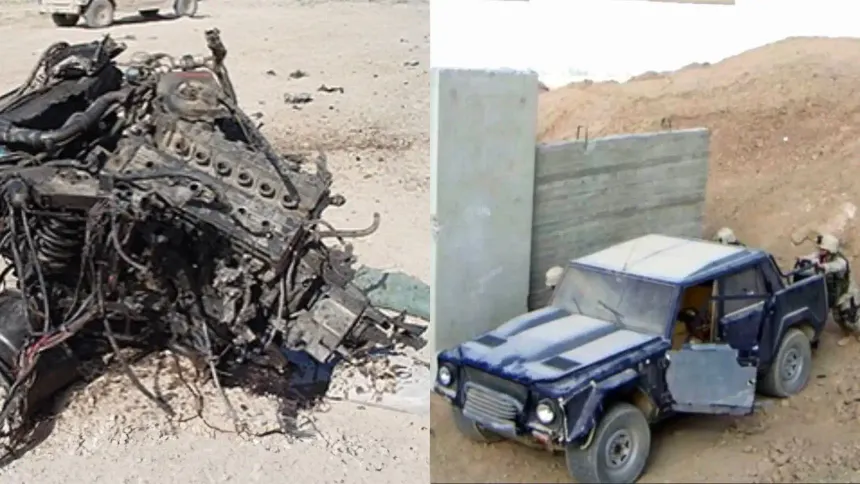
On July 18, 2004, at a US military base near Baqubah, northeast of Baghdad, a group of American soldiers took a navy-blue LM002, packed it with explosives, parked it next to a concrete barrier similar to the ones protecting the base perimeter, and detonated it.
The exercise was meant to simulate the effect of a V.B.I.E.D. (Vehicle Borne Improvised Explosive Device, a car bomb) against a structural barrier. Basic operational data. The soldiers were doing their job.
The problem is that this particular LM002 had belonged to Uday Hussein, Saddam’s eldest son, killed alongside his brother Qusay by the 101st Airborne Division in July 2003 during a shootout in Mosul. And it was one of roughly 327 LM002s still on the planet.
The soldiers had no way of knowing what they were holding. There was no military intranet to check the collector value of an eighties Italian off-roader. There was no chassis registry accessible from a tactical base in a combat zone. There was a heavy thing with four wheels, perfect for measuring car-bomb effects against reinforced concrete. That’s what they had.
Most of the vehicle was vaporised. What remained was unrecognisable. And with that unwitting act, Uday’s LM002 went from one more entry in the dictator’s son’s private collection to a historical footnote. Twenty-seven years earlier, Lamborghini had tried to sell this exact design to the Pentagon. The Pentagon had said no. Twenty-seven years later, the Pentagon destroyed it without knowing.
The loop closed. The official count of surviving units dropped by one.
This detail, seemingly anecdotal, matters. Because every time an LM002 disappears from the world (Uday’s, the three or four burnt in Kuwait during the Gulf War, the ones that simply rotted in sheikh garages without maintenance), the residual value of the survivors rises. That isn’t speculation. It’s arithmetic.
Why it trades for what it trades for
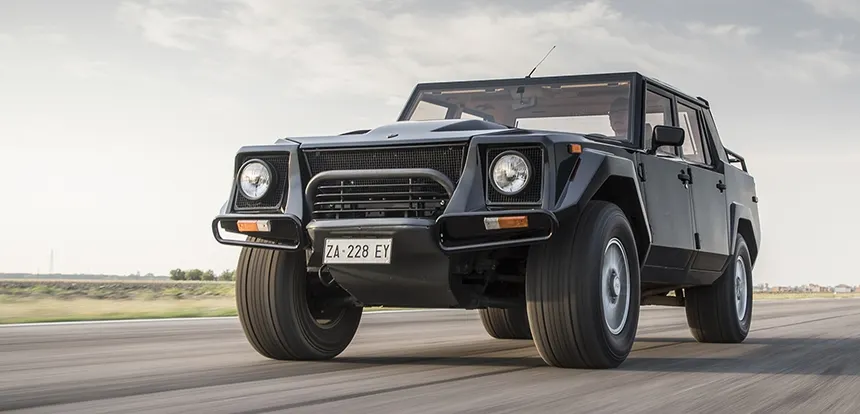
Lamborghini ended LM002 production in 1993. For the following decade, these cars were a problem. Impossible fuel consumption (around 33 litres per 100 km in normal use, dropping to 3 km per litre with a trailer), six Webers requiring monthly synchronisation by an Italian mechanic with infinite patience, specific parts either extortionately expensive or non-existent. They sold cheap in the 2000s. The lowest documented auction price is $62,000.
Then three things happened at once.
First: genuine scarcity. Of the 328 units originally built, probably fewer than 300 survive today. Uday’s vaporised. Several more lost in Middle East conflicts. Some in the Sultan of Brunei’s garages deteriorating without maintenance. Effective supply in the collector market at any given moment doesn’t exceed five or six units worldwide. That’s rarer than a Ferrari F50 (349 units) or a Porsche 959 Sport (two dozen).
Second: late recognition of the lineage. The classic market took a while to understand that the LM002 wasn’t an off-roader with a big engine. It was a Countach with tank bodywork. Same V12, same serial number, same assembly hall, same workers. When a Countach 5000 QV today trades between €500,000 and €700,000 and the LM002 was selling for €200,000 a decade ago, the asymmetry wasn’t sustainable.
Third: total absence of a successor. No current car fills the LM002 role. The Urus shares its engine with the Porsche Cayenne and the Audi Q8. The G63 AMG is a branded accessory. The Rolls Cullinan is a drawing room on wheels. The Defender V8 is a nostalgic wink. The LM002 has no successor because Lamborghini never again built an off-roader with its own clean-sheet engine. The experience it offers can’t be bought new. Not for two million.
The numbers setting today’s market: May 2022, €308,750 in Monaco (RM Sotheby’s). June 2024, £342,500 at Cliveden House. February 2024, €345,000 in Paris (Bonhams). And the documented peak: August 2024, $703,500 for a 1989 example at Monterey. A 1987 unit sold on Bring a Trailer in October 2025 closed at $400,000.
It isn’t a bubble. A bubble requires irrational expectations about future appreciation. What we have here is different: a unique product, with shrinking supply, verifiable lineage, structural demand from collectors looking for exactly this, and zero possibility of replicating the experience with anything new. The fundamentals hold the price up. If tomorrow another car appears offering the same thing, the valuation takes a hit. It isn’t going to appear.
What it actually is
Climbing into an LM002 is an exercise in calibrated physical discomfort. The steering wheel is small and angled badly. The power steering demands real effort every time you turn. The controls weigh more than dry cement. The V12’s roar at revs is a Countach with a fever. Fuel consumption forces you to stop at petrol stations every two hours. The 290-litre tank costs more than $450 to fill at current European prices.
And yet none of that matters. Because the LM002 doesn’t promise comfort, or efficiency, or reasonableness. It promises something else.
It promises the physical experience of driving an impossible contradiction. A car that shouldn’t exist and does. A commercial military failure that reconverted into a sheikh’s toy and ended up a museum object. A car whose first buyer wanted to kill you with it (Gaddafi, Uday) and whose last buyer keeps it in a climate-controlled garage with quarterly battery rotation.
The LM002 is physical proof that Sant’Agata, in the eighties, with a handful of engineers on the edge of bankruptcy, was capable of inventing a segment, failing commercially, reinventing itself, selling 328 units to the worst possible clientele, and ending up creating a legend still alive forty years later. No other car in the world can tell that story. None ever will.
There’s no manual for understanding the LM002. You just have to hear one start.
Check you’re still alive.