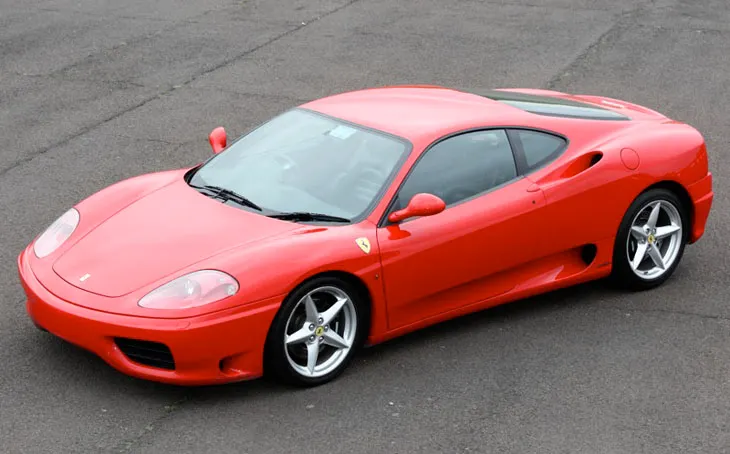
Ferrari 360 Modena: The Italian Ferrari With an American Spine
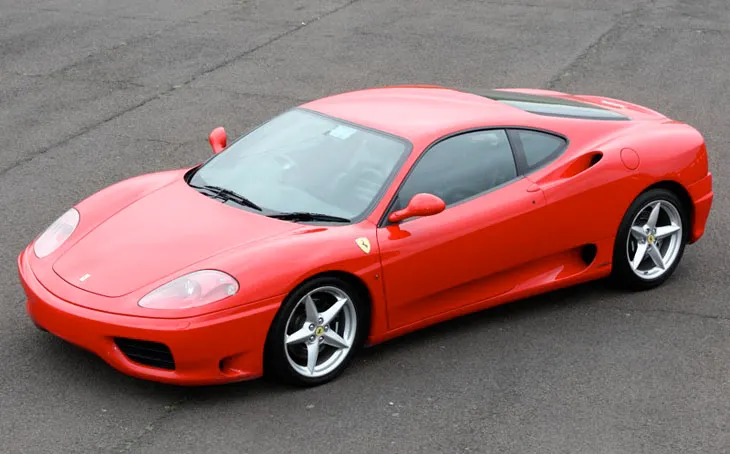
Ferrari named this car after the town where Enzo was born. It gave that name to the car that ended the way that town used to work.
The F355 it replaced was the last Ferrari with hand-built coachwork produced in Modena. The 360 arrived with an aluminum chassis co-developed with a company from Pittsburgh. The tribute to the roots is stamped on the car that cut them.
Alcoa built the part that matters
Unveiled at the Geneva Motor Show on March 9, 1999, the 360 was the first production Ferrari built entirely from aluminum. Chassis, body panels and suspension wishbones, all the same material.
The structure is made of variable-section aluminum extrusions, thicker where strength was critical and thinner where it was not, welded together through twelve aluminum nodes. That is the whole trick: rigidity where it is needed, controlled flex where it helps, and weight removed from everywhere else.
The numbers hold up. The 360’s chassis is 40 percent stiffer in torsion than the F355’s steel monocoque and 28 percent lighter, and the car is 10 percent larger. Gaining stiffness while losing weight are goals that normally fight each other.
Ferrari did not solve it alone. The chassis was developed in partnership with Alcoa, the Aluminum Company of America. The structural technology defining the first Ferrari of the new century carries a Pittsburgh surname.
That extra size shows in the wheelbase, which grew to 2,600 mm: 150 mm longer than the F355 and 100 mm longer than the front-engined 550 Maranello sold alongside it. The entry-level car had a longer wheelbase than the company’s twelve-cylinder GT.
The name changes systems again
The 360 refers to the engine’s full 3,600 cc. Ferrari abandoned single-cylinder displacement naming once more and switched to total capacity. Modena is Enzo Ferrari’s birthplace.
That is the fourth different system in this series of articles. The Daytona was a 365 GTB/4 for the displacement of one cylinder. The 512 BB used liters plus cylinder count. The F355 mixed liters and valves. The 360 goes back to total capacity and adds a city.
Four consecutive cars from the same company, four mutually incompatible naming logics.
The grille had been fake for fifteen years
The styling change that caused the most noise was the disappearance of the central egg-crate grille, a Ferrari signature going back what felt like forever. A good share of the press lost its composure.
Here is the detail that deflates the outrage: that grille had been decorative for three model generations. On the Testarossa, on the 348 and on the F355 itself, it was not a functional cooling intake. Fifteen years of fake grille before anyone dared remove it.
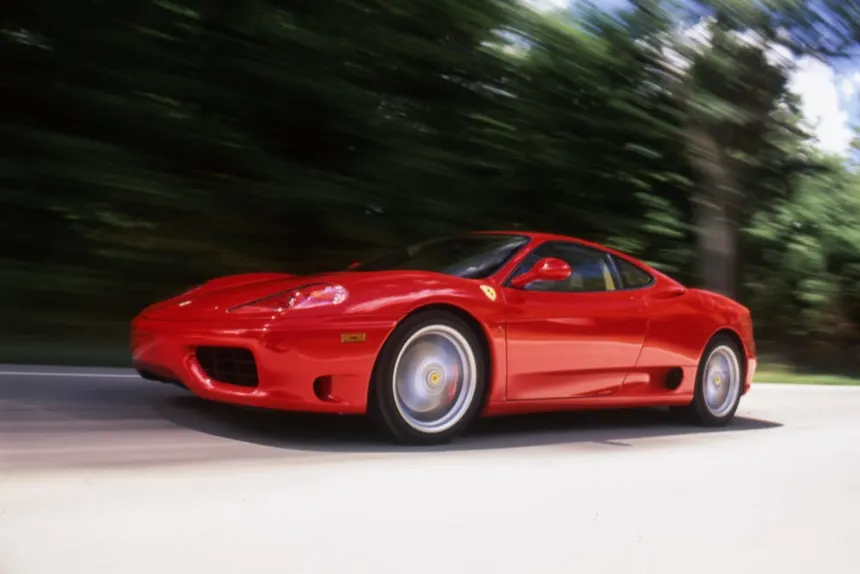
What replaced it does work. Two large intakes at the outer ends of the front bumper channel air to the radiators and, more importantly, underneath the car. Air passes below a raised central section, runs the length of the flat floor and feeds a twin-section rear diffuser that generates downforce increasing with speed.
No wings. No appendages. The car is pressed to the road by what is beneath it rather than what is bolted on top. It is the direct continuation of the flat floor the F355 introduced, applied this time to the entire design rather than one area.
Five thousand hours in the wind tunnel
Montezemolo introduced the 360 in the company’s own catalog, and among the figures he put on the table there is one worth holding onto: the car was the result of five thousand hours of aerodynamic study.
Alongside that came the list of Formula 1 transfers: variable-geometry intake, drive-by-wire throttle and the F1 gearbox. He put the aluminum weight saving on the structure at 34 percent.
Keep the five thousand hours in mind, because the closing argument comes back to it.
Pininfarina breaks with the wedge
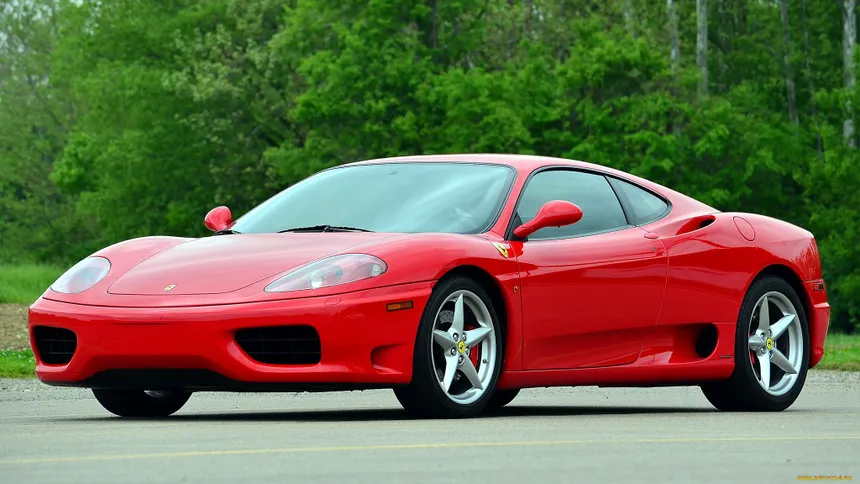
The 360 was the 163rd design Pininfarina produced for Ferrari, and it broke formally with everything before it. Out went the wedge proportions that had governed for two decades, in came curved surfaces and organic intakes.
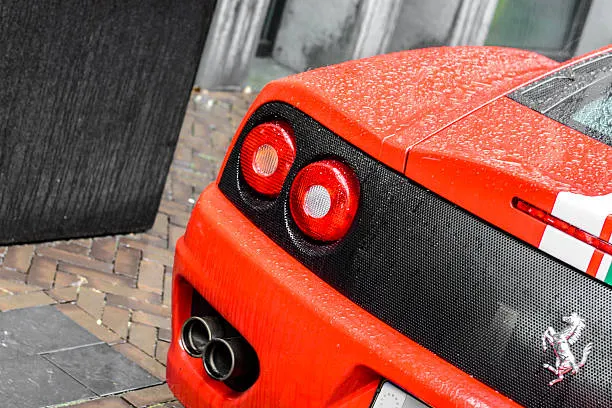
Inside that clean sheet there are deliberate backward glances. The engine bay intakes set into the rear haunches echo those of the 250 LM and the Dino, and the taillights keep the company’s traditional paired treatment. It is a car looking forward with two historical quotations stitched into its flanks.
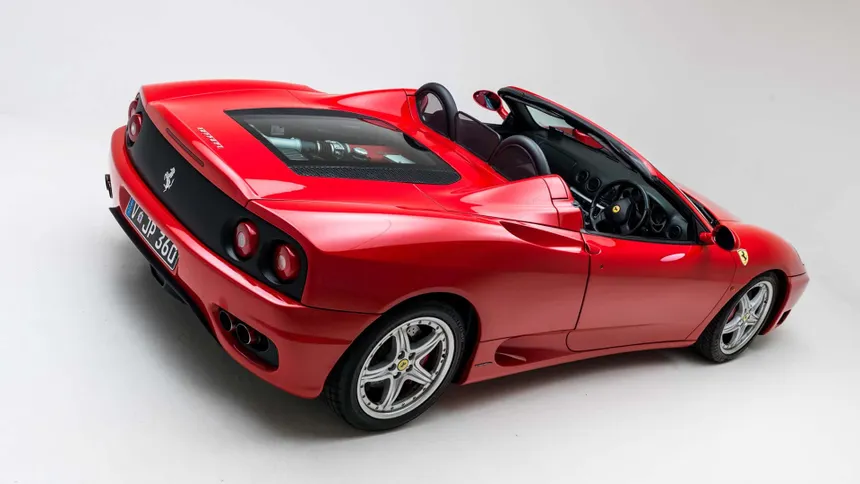
The piece that took the headlines was the glass rear screen. Magazines of the period nicknamed it the thunderdome, because it let you see the entire V8 from outside. It was not only transparency: what was on display had been prepared for display, with intake plenums finished in red crackle paint carrying the raised Ferrari script, plus a cast alloy bridge bearing the prancing horse.
Ferrari turned the engine bay into a showroom. Everything the company has done since follows that script.
Five and a half years of production
Manufacturing began in April 1999 and ended in October 2004. The replacement arrived in 2005 as the F430, which inherited the aluminum architecture and refined it rather than replacing it.
That is what places the 360 properly in Maranello’s history. It was not just another entry in the mid-engined V8 succession. It set the structural template the following cars were built on, and it marked the aerodynamic direction the rest of the industry ended up copying.
Engine and numbers
The naturally aspirated 3.6-liter V8 sits longitudinally amidships and delivers 400 hp at 8,500 rpm. It is an evolution of the F355’s 3.5, with displacement increased, and it keeps the high-revving character that defines this engine family.
The car runs to 60 mph in about 4.5 seconds with a top speed of 183 mph. Weight distribution sits at 42 percent front, 58 percent rear.
The gearbox became longitudinal, six speeds, offered as a manual with the traditional gate or as the F1 electrohydraulic unit with paddles behind the wheel, right to upshift and left to downshift, inherited from the 355 F1. Damping is electronic, by Boge Sachs, and traction control comes from Bosch with a solution related to the 550’s.
Then there is the glass cover over the engine, which lets you see the whole V8 from outside. Before this, that privilege had belonged only to the F40 and F50. Putting it on the entry-level car was a brilliant commercial decision: it turned the engine into a permanent shop window.
What it was up against
The 360 did not compete alone, and its rivals’ numbers show where it sat.
The Porsche 911 GT3 in 996 form, as updated in 2003, made 381 hp from its 3.6-liter flat six, weighed 1,380 kg and reached 190 mph with 4.4 seconds to 62. The 360 had more power and less weight, though the Porsche was the track benchmark of those years.
The Lamborghini Gallardo arrived in 2003 with a five-liter V10, 500 hp, all-wheel drive, 192 mph and 4.2 seconds to 62. A hundred horsepower above the Ferrari, but also considerably heavier and built on a different premise: where the 360 chased lightness, Sant’Agata added drive to all four wheels.
And then there is Honda again, which is the part worth reading slowly.
The NSX-R appeared in 2002, a stripped version of the car that had already embarrassed the 348 and forced the F355 into existence, as covered in that piece. Honda declared unchanged output of roughly 290 hp and a weight cut to about 2,800 pounds after deleting the audio system, sound insulation, air conditioning and power steering.
That car lapped the Nordschleife in 7 minutes 56 seconds. The same time as the Ferrari 360 Challenge Stradale.
A Japanese car with 130 fewer horsepower matched the sharpest Ferrari in the range. The lesson Maranello half-learned with the F355 still had not fully landed.
A Ferrari with room for golf clubs
This section sounds trivial and it is the one that explains the sales volume.
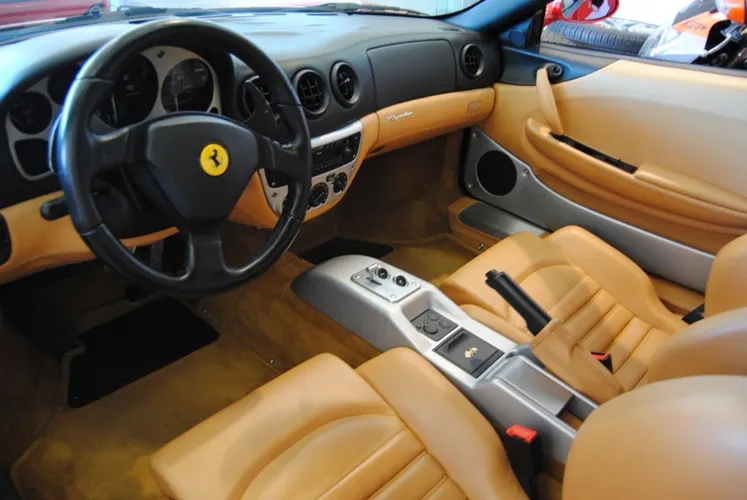
At launch, Ferrari made a point of the interior having space for luggage, golf clubs included. The cabin was cleared of switchgear, with far less clutter than the F355, and a pair of soft weekend bags fit under the front lid if you pack sensibly.
Read alongside what we covered in our F355 piece, this is the second half of the lesson Honda handed Maranello with the NSX. The F355 copied the technical ambition. The 360 finally copied the boring part: making the car usable.
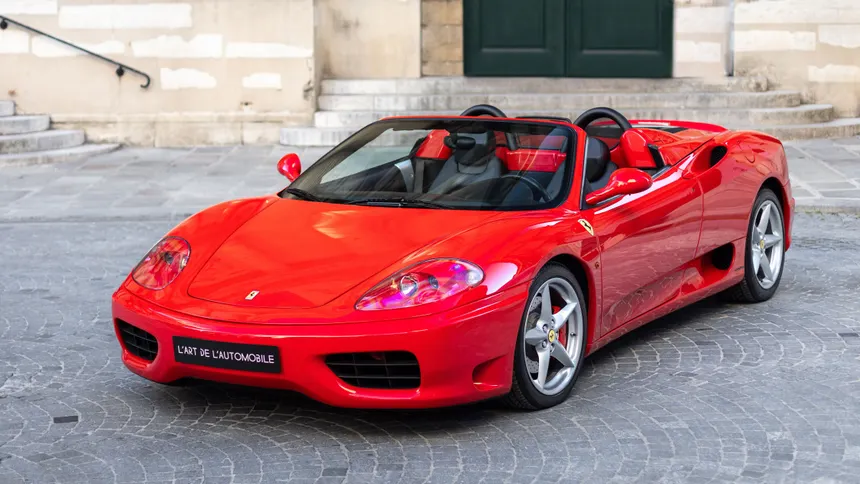
It worked. Around 8,800 Modena coupes were built between 1999 and 2004, and at its peak the 360 accounted for two thirds of Ferrari’s entire output. The Spider followed in 2000, with a fabric roof that folds itself in roughly twenty seconds, and it was the twentieth road-going convertible in the company’s history. Later came the Challenge Stradale, with output raised to around 420 hp and weight cut, plus the GT, GT-C and Challenge racing versions.
The Spider nearly outsold the coupe
The convertible deserves more than a line, because it is where you see what the new chassis was really for.
The F355 was not designed with an open version in mind. The 360 was, from the start, and that changes the outcome. Cutting the roof off a coupe wrecks torsional rigidity, so Ferrari strengthened the sills, stiffened the front of the floorpan, redesigned the windscreen frame and reinforced the rear bulkhead, the last also to cut engine noise in the cabin. Dynamic rigidity comes from additional side reinforcements and a cross brace ahead of the engine. Two roll bars sit behind the seats, integrated into the fairings.
The result is a convertible weighing only about 60 kg more than the coupe. On a car of this architecture, that figure is proof the aluminum was being used properly.
The fabric roof folds itself into the engine compartment in roughly twenty seconds using seven electrohydraulic actuators. What does pay a penalty is aerodynamics: drag rises from 0.33 on the coupe to 0.36 on the Spider.
And the commercial figure that reframes the whole model: Ferrari built 8,800 Modenas and 7,565 Spiders. The convertible came close to matching the coupe. In the United States it beat it outright, with 2,389 Spiders against 1,810 Modenas out of the 4,199 cars sold here.
That is the 360 people actually bought. Not the poster coupe, the convertible.
Challenge, GT and GTC are not the same car
Listing them without explaining them is filler, so here is the difference.
The 360 Challenge, from 2000, is the car for Ferrari’s own one-make series. It runs the racing car’s 18-inch BBS wheels, a front splitter for downforce, smaller mirrors, lightweight door trim, two bucket seats with harnesses and a sliding window in the driver’s door, like a circuit GT.
The 360 GT, from 2002, exists because of results. JMB Competition, with factory backing, had beaten Porsche to the FIA N-GT world team and drivers’ titles in 2001 running the Challenge car. Ferrari then built a specific model derived from it for privateers in N-GT and in Automobile Club de l’Ouest championships. JMB took the N-GT title again in 2002.
The 360 GTC was shown to the press at the Bologna Motor Show on December 4, 2003, and it exists because the Porsche 996 GT3 RSR had moved the goalposts. Corse Clienti in Maranello developed it with Michelotto Automobili. Wind tunnel work led to a repositioned rear wing with a significant downforce gain, and composite bodywork brought weight down to 1,100 kg, the regulatory minimum.
The detail that says most about the era is in the transmission. The GTC used a new six-speed sequential gearbox because the road car’s paddle shift was too slow for professional racing. The same technology Ferrari was selling as cutting edge in the showroom was not good enough on track, and it had to be replaced.
On power the sources disagree, placing the GTC between 445 and 472 hp at 8,750 rpm against the earlier GT’s 430 hp at 8,500. There is no factory figure that settles it.
What to check before buying one
The 360 is considered substantially more reliable than the F355, which says more about the F355 than about the 360. It is still a Ferrari and it still demands rigorous maintenance.
The specific item to verify on early cars is the cam variator recall. Any serious candidate should be able to document that it was completed.
The rest is what the family conditions you to expect: the timing belt service as a recurring major line item, and on F1-equipped cars the system hydraulics as a separate chapter, exactly as on the 355 F1. And here is the ownership improvement the 360 introduced that barely gets mentioned, despite being the most relevant thing to anyone who will be paying the bills.
The F355 requires the engine to come out of the car for its belt service, at the cost we covered in that article. The 360 added a removable panel between the engine bay and the cabin, allowing access to the timing gear without dropping the engine.
That panel, which appears in no brochure and no period road test, is the difference between a job measured in days and one measured in hours. Buying a 360 instead of an F355 is not only buying more rigidity and more power. It is buying your way out of the expense that has dragged down the previous car’s reputation.
The other known complaint is the so-called sticky buttons, the interior plastic parts that turn tacky with age and need specific restoration treatment. It is cosmetic, but it appears in every buying guide and it affects price.
What has changed since the previous car is which version the market chases. When the 360 was new, the F1 gearbox was the cutting-edge option and buyers paid extra for it. Today the manual with the aluminum gate is the one commanding money, for rarity and for feel. The same reversal we already saw with the F355. One note that connects to the rest of this series. Within the US market, of those 4,199 cars only 469 Modenas and 670 Spiders left with the gated manual rather than the F1. Compare that with the 612’s 199 manuals out of 3,025 cars, or the 599’s 30. The collapse of the lever was already under way here, with one difference: on the 360 it was still an option people ordered without thinking twice.
What it replaced, and what that cost
Worth stating plainly for anyone shopping across the two generations. The F355 is the more emotional car and the 360 is the better one, and both statements survive scrutiny.
The F355 wins on shape, on the noise of a flat-plane V8 at 8,500 rpm through a lighter body, and on the analogue feel of a steel car with hydraulic everything. It loses on the invoice, as covered in our F355 piece, where exhaust manifolds crack by design and the belt service requires removing the engine.
The 360 keeps the high-revving character and the manual gate, adds 20 hp, and puts all of it on a structure 40 percent stiffer. It also gives you a car you can drive across a state without planning the route around a specialist’s phone number.
Which one is right depends entirely on how many miles you intend to cover. That is a question the buyers of these two cars answer very differently, and it is the reason a good manual 360 and a good manual F355 sit closer in price than their spec sheets suggest.
The gray-market question, resolved
One advantage worth naming for American buyers. Unlike the Berlinetta Boxer covered earlier in this series, which Ferrari never certified for the United States and which arrived here one car at a time through private importers, the 360 was a fully federalized official-channel car from launch.
That matters because it changes what due diligence means. On a Boxer, working out what an importer modified in 1979 is part of the purchase. On a 360, the paperwork you need is service history and that recall confirmation, not compliance archaeology.
The verdict
Enzo Ferrari‘s position on the subject does not need a famous quotation. It is in what he did for twenty years.
Lamborghini launched the Miura with the engine behind the driver in 1966 and the whole industry turned. Ferrari answered in 1968 with the Daytona, engine up front. The first twelve-cylinder road car with the engine behind the cabin, the Berlinetta Boxer, did not arrive until 1973. Seven years of resistance to a solution that had already won the argument, and both cars are documented with sources elsewhere on this site. The engine ahead of everything and the rest as a secondary matter is not a quote, it is a track record.
Eleven years after his death, Ferrari released a car built out of five thousand hours of wind tunnel work, with its downforce generated by the floor, without a single wing, on a chassis developed with an American aluminum company, and named it after the town where Enzo was born.
That is not a betrayal. It is the opposite. It is proof the company had finally understood that survival requires contradicting the founder. The 360 is a better car than the F355 in every measurable respect, and it is better precisely in the areas Enzo treated as secondary.
What grates is the name. Calling it Modena, when this is the car that industrialized the process and moved the structural technology out of Modena, is a marketing operation run by the same hand that put Testarossa on a reworked Boxer and today puts 849 Testarossa on a revised SF90. Maranello has spent forty years using nostalgia as wrapping paper for the decisions that break with it.
How many tributes in this industry are really receipts for what has just been abandoned?
Check you’re still alive.