Ecolomafia: your lungs have a price
America fired the shot.
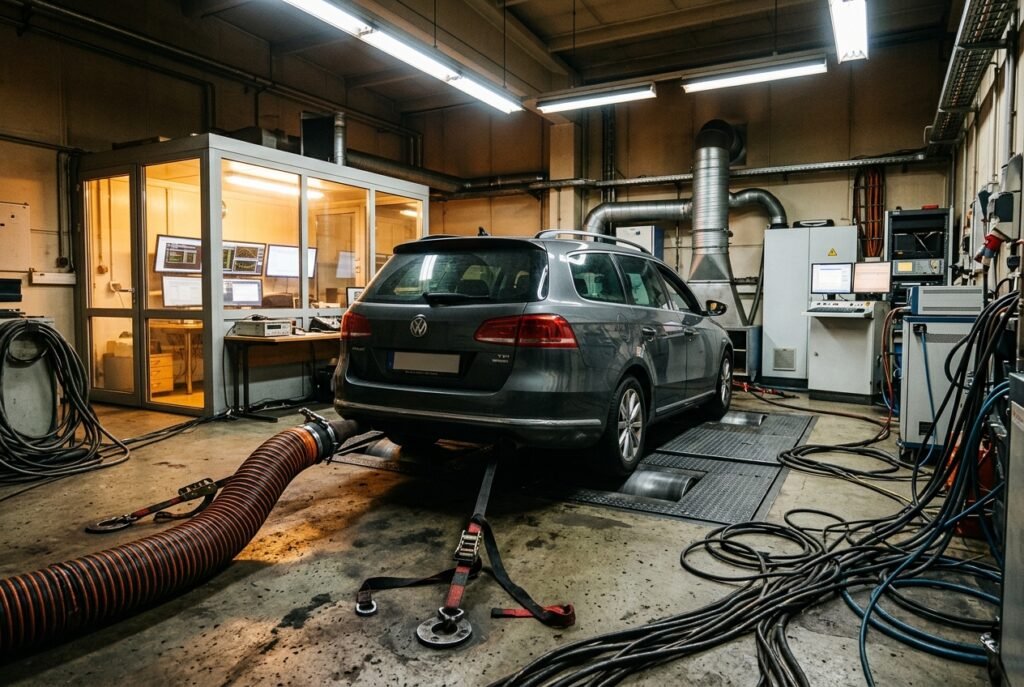
Not a European regulator. Not a Brussels commissioner with a mandate and a press office. A federal agency in Washington, working from test data, put a notice of violation on the desk of the largest carmaker on the planet in September 2015 and blew open a fraud that an entire continent had been living next door to for fifteen years.
That is the part Europeans skip when they tell this story. And it is the part that tells you who was actually running the room.
The olive oil business
Every respectable family needs a company that files tax returns, and a back room where the money is really made.
European diesel was exactly that. Out front, the import business: torque, low consumption, presentable CO2 figures, and an industry that genuinely believed it had built the most efficient engine on earth. Out back, the software that recognized the certification cycle and behaved like a saint for as long as the test lasted.
For fifteen years Europe sold olive oil. And the whole neighborhood knew.
That is not a figure of speech. The European Parliament’s own inquiry committee into emissions measurement put it in writing: the Commission, the competent authorities of the member states and many other parties were aware of the discrepancies between laboratory and road at least since 2004-2005, while Regulation 715/2007 was being drafted. Those discrepancies were confirmed by a large number of studies from the Commission’s own Joint Research Centre from 2010-2011 onward.
Read that again. The reports were inside the house. Signed by the Commission’s own scientists. Five years before the thing detonated.
An American audience should feel something familiar here, because Detroit has run this play before. The regulator that never quite gets around to enforcing is not a bug in the European system. It is the system working.
The man with the new product
There is a scene everyone remembers wrong.
The outsider walks into the old man’s office with a new product, margins no traditional family can match, and an argument that is hard to answer: this is happening with you or without you, and you have the judges and the politicians in your pocket, so let’s do it together. The old man listens politely. Then he says no. He would rather stick with the oil.
That “no” gets him shot five times in the street.
The European industry had that meeting. Not with a Sicilian trafficker, but with chemistry. Lithium cells, the supply chain, vertical integration from raw ore to finished pack. It was available, it was cheap to start, and it was staggeringly boring to build: fifteen years of industrial grind with no beautiful magazine covers in it. Europe said no and went back to refining the oil. Injection, turbos, AdBlue, a little more torque, a few fewer grams.
And be clear about what is being criticized here, because it is not what it looks like. The mistake was not refusing to electrify. Nobody was obliged to, least of all the person buying the car. The mistake was giving away the one part of the business that was going to matter, and keeping in exchange the obligation to buy it back fully assembled from somebody else. The factory was surrendered and the mandate was kept. That is the worst possible split: you lose the industrial sovereignty and then get handed the product you can no longer build as a civic duty.
The Chinese carmakers arriving today are not the offer. They are the invoice for keeping the second thing after selling the first.
The long table
After the war, the bosses sit down and agree how far the business goes. They do not ban it. They control it. Keep it orderly, keep it quiet, and nobody gets clever and breaks the balance for everyone else.
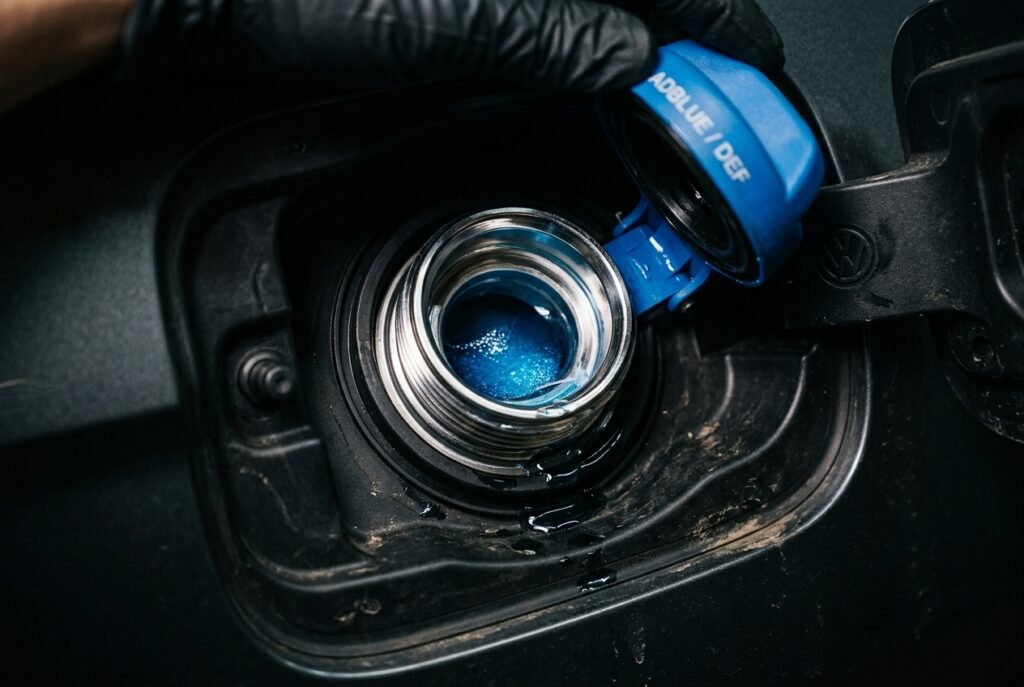
In July 2021 the European Commission fined that exact scene €875,189,000. Daimler, BMW and the Volkswagen group, with Audi and Porsche inside it, held regular technical meetings between 2009 and 2014 to discuss selective catalytic reduction systems. They agreed on the size and range of AdBlue tanks. And they agreed not to compete on cleaning nitrogen oxide better than the law required, while having the technology to do it.
It was the first cartel decision in the Commission’s history based purely on a restriction of technical development, with no price fixing and no market sharing.
Sit with what that means. They did not carve up customers. They carved up progress. They sat down and decided how much clean air a continent would breathe, and the answer was the legal minimum and not one milligram more.
Volkswagen paid €502,362,000. BMW paid €372,827,000.
The price of talking
One of the five paid nothing.
Daimler would have been hit for roughly €727 million and kept every cent of it, because it was the company that told the Commission the cartel existed.
That is Tessio, and he does it without malice and without drama. It is only business. The European Union’s leniency program is that scene turned into an administrative procedure: the first one through the door with the whole story walks out with no fine at all.
It works so well that it repeats.
In the trucks cartel the first through the door was MAN, which in January 2011 admitted to the Commission that it had been part of an arrangement running since 1997. They traded price lists, agreed on amounts, and coordinated the timetable for rolling out the technologies needed to meet emissions rules, passing the cost of those technologies on to buyers. The decision landed in July 2016 with fines totaling €2.93 billion. MAN avoided around €1.2 billion. Daimler, which also cooperated, took the largest single fine at €1,008,766,000 after a 40% reduction. Scania refused to settle, kept fighting, and was fined €880 million in September 2017; the General Court threw out its appeal in February 2022.
Note the pattern, because it is the load-bearing fact of this whole story. Twice, in two separate cases, European manufacturers were caught agreeing to slow down emissions technology. Not evading it. Slowing it. Together.
The Spanish informant
Here is the piece almost nobody outside Spain has heard, and it is the best one.
Spain had its own cartel. The national competition authority resolved it on 23 July 2015 with €171 million spread across twenty-one companies in the sector plus two consultancies, for a systematic exchange of confidential, forward-looking and strategic information across business management, aftersales and marketing.
Who turned them in? SEAT. It filed for leniency on 25 June 2013. For informing, SEAT walked free alongside Volkswagen Audi España and Porsche Ibérica. The fine the group avoided: €39,443,118.
Now line the dates up.
On 23 July 2015, Spain’s regulator forgives €39.4 million to the Volkswagen group for cooperating. On 18 September 2015, fifty-seven days later, the EPA notifies the Volkswagen group that its engines carry a device built to cheat emissions testing.
Same group. Same summer. Model informant in Madrid, epicenter of the largest industrial fraud in automotive history in Washington. Those Spanish fines were later upheld by the National Court and the Supreme Court, with Mazda the exception.
That is not hypocrisy. It is accounting. In a well-run family, informing and defrauding are not opposing moral acts. They are two tools in the same drawer, and you reach for whichever one the day calls for.

Vegas
There comes a point where the family realizes the money is no longer in its own neighborhood.
The new place is run by a loudmouth who thinks he owns the hotel and has not yet understood that the ground under his feet has already been bought.
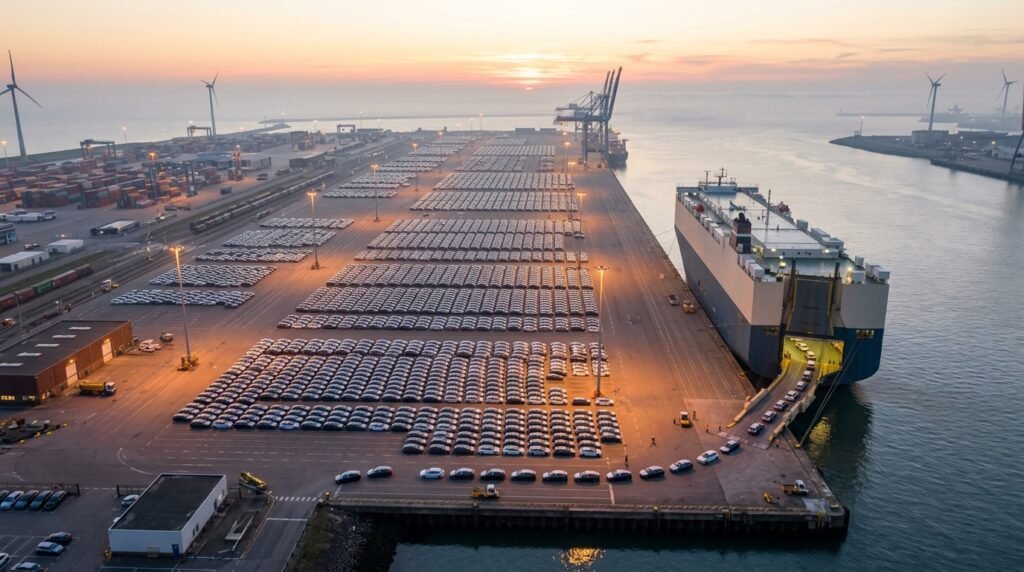
The numbers in Europe this year: Chinese brands have registered 755,124 units across the EU, the UK, Iceland, Norway and Switzerland, up 111.4% on the same period last year. Three groups account for more than 80% of that. SAIC leads with 208,009 units, BYD follows with 205,486, and Chery’s conglomerate, which includes Omoda, Jaecoo and Jetour, adds 201,544.
They are not visiting. BYD is building its plant in Szeged, Hungary, with an investment close to €4 billion and a target capacity of 300,000 vehicles a year. Chery builds Ebro models with EV Motors in Barcelona’s Zona Franca. SAIC has announced its Ferrol plant will be operational in 2028.
The sharpest line came from BYD executive vice president Stella Li at the Financial Times Future of the Car conference in London in May this year: the company is negotiating with Stellantis and other European groups to take over underused plants, not as a minority partner, but to directly control the industrial operations.
They do not want into the family. They want the house.
For American readers, note what is missing from that list. BYD does not sell passenger cars in the United States. Its footprint there is buses and commercial vehicles, with the Lancaster plant having built a few hundred buses. Europe is the open market. Whatever you conclude about the trade politics, the experiment is running over there first, in real time, with real registration numbers.
The baptism
Which brings us to the big scene.
While the renunciation of evil is being solemnly recited in the church, every outstanding account is being settled in parallel. You renounce, and you keep everything. That montage is the heart of the film, and it is point for point what happened in Strasbourg on 16 December 2025.
The Commission presented its amendment to the CO2 regulation for cars and vans. The 2035 target drops from a 100% reduction against 2021 levels to 90%, with the remaining 10% offsettable through credits for sustainable fuels and low-carbon steel made in the EU. In practice that is a fleet average of roughly 11 grams per kilometer instead of zero. Plug-in hybrids and range-extended electrics keep selling after 2035. The 2030 target for vans drops from 50% to 40%. And the Commission’s own estimate is that between 27% and 29% of new registrations after 2035 will still have a combustion engine.
Ursula von der Leyen welcomed the acceptance of the proposals after what were described as intensive dialogues with the sector, shareholders and unions.
Translation: the families came, asked for the favor, and got it. ACEA, Stellantis, Mercedes, Volkswagen and BMW pushing, with the German and Italian governments behind them, and Manfred Weber putting the number on the table before the Commission had opened its mouth.
A godfather whose arm gets twisted by the families is not a godfather. He is an employee with a large office.
And something needs saying plainly here, because the public debate has it exactly backwards. Diesel was not killed by environmentalists. It was killed by the people who built it. A cartel agreeing not to clean nitrogen oxide better than the law required while holding the technology to do it, plus certification fraud on an industrial scale, leaves no argument standing. Without that, diesel reaches 2020 with its head up and data on the table. It was the manufacturers who handed Brussels the political capital to impose the mandate. And it was the manufacturers who, ten years later, asked for the favor that got them out of the mandate their own fraud had made possible.
The buyer has been sent both invoices. The one for the fraud, and the one for the fix.
And it is worth being precise about where this stands today, because the easy headline has been repeated wrong across half the internet. It is not law. It remains a proposal in progress, still to be negotiated between the European Parliament and the Council. Environment ministers held an orientation debate on it on 17 March this year. ACEA, now chaired by Ola Källenius, is still pushing to make sure the flexibility survives the process. It could be tightened. It could stand. Nothing is signed.
The muscle and the arrangement
With the newcomers there was muscle first. Since 2024 the EU has applied additional duties ranging from 7.8% to 35.3% depending on the manufacturer, on top of the standard 10% import duty.
Then, as in all these stories, came the arrangement. In January this year the Commission published guidelines for replacing those duties with a minimum price mechanism: a Chinese manufacturer avoids the countervailing duty by committing not to sell below an agreed price, model by model and configuration by configuration.
Look closely at that, because almost nobody underlines it. A tariff is money that goes to the public purse. A minimum price is money that stays in the seller’s margin. Swapping one for the other makes not a single car cheaper. It raises the floor of the market and protects the balance sheets of everyone already seated at the table.
One point of precision. The Commission’s trade spokesperson made clear this was guidance, and that publishing it did not mean a deal to remove the duties was coming; those duties remained in force at the time.

The door
The film does not end with a shootout.
It ends with a woman standing in a hallway, watching a man receive the deference of his people inside an office. Someone walks over without hurrying. And closes the door in her face, with exquisite politeness, without raising his voice, without explaining anything.
That is you.
You are not a bystander caught in crossfire between Brussels and the manufacturers. That version flatters you, because it puts you in the middle of the action. The real one is smaller and more humbling: you are the person who does not get told. You paid for clean diesel that did not clean. You paid the markup set by men who sat down and decided how much you would breathe. You are still paying, through claims and judgments still working through the courts, for trucks whose prices were fixed for fourteen years. You were told combustion ended in 2035, you arranged your buying decisions around that date, and when the industry asked for the favor the date moved without anyone asking you. Now a minimum price is being prepared so the cheap Chinese car stops being quite so cheap, and it will be sold to you as protecting your industry.
I don’t want a better godfather. I want a room with the door left open.
And I’ll put my bet in writing so it can be held against me: the 90% figure for 2035 will not be the last concession. There will be another. It will arrive dressed as industrial realism, jobs and competitiveness, it will be signed by the same people who spent two decades agreeing to slow technology down, and it will be celebrated again as a victory for common sense. The only question is whether it lands before or after the first Chinese plant running at full capacity on European soil makes the entire argument academic.
So whose customer are you: the industry’s, Brussels’, or your own?
Check you’re still alive.