
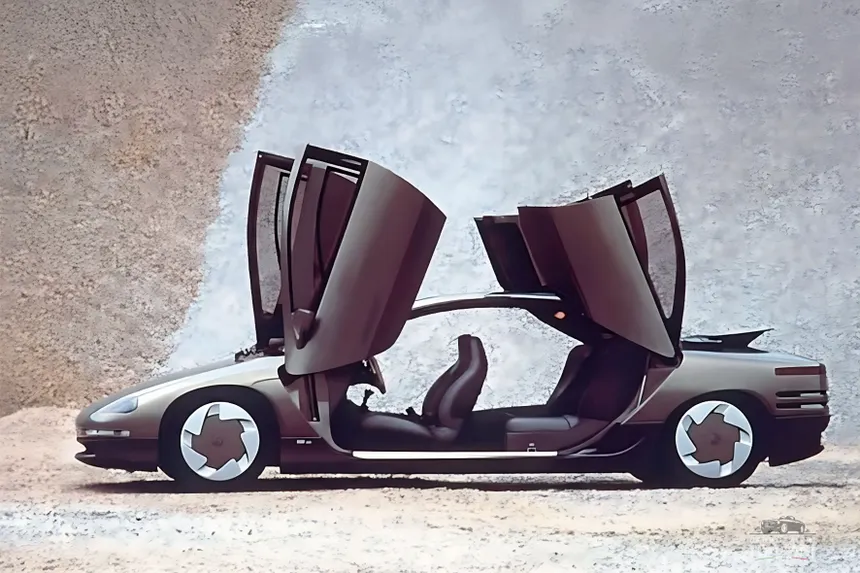
Lamborghini Portofino: Four Scissor Doors, Frankfurt 1987
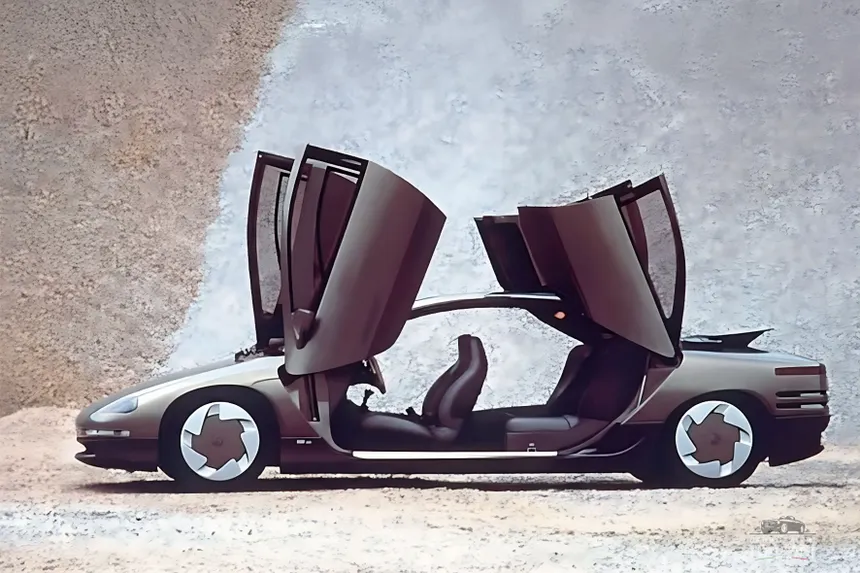
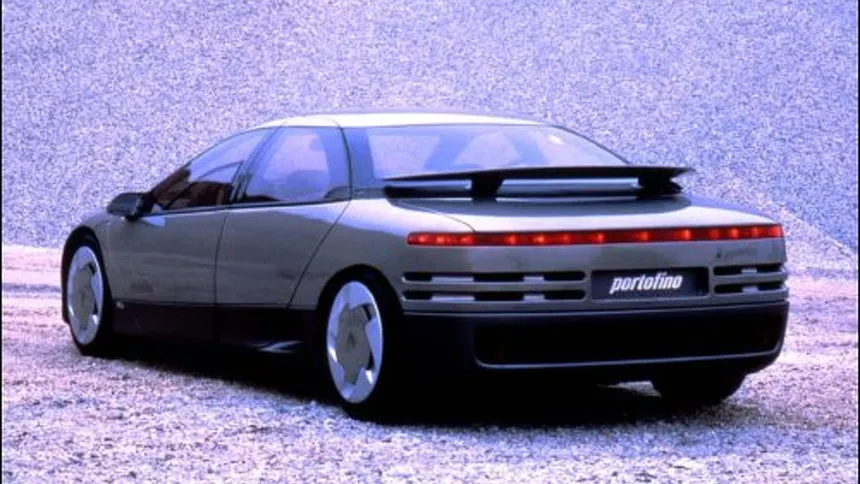
If you drove a first-generation Dodge Intrepid, you drove the face of a Lamborghini. Chrysler built 645,281 of them between 1993 and 1997, and the nose on all of them traces back to a four-door Lamborghini prototype that was shown exactly once.
The car is the Portofino, unveiled at the Frankfurt show in 1987. It is the most influential Lamborghini nobody remembers.
Twenty-five million dollars and a marque in hand
The deal closed on 23 April 1987: Chrysler bought Automobili Lamborghini for twenty-five million dollars. It held the company until 1994, when it sold to Megatech.
Seven years of American ownership. What gets told about that period, when it gets told at all, is the Diablo. What does not get told is what traveled the other way, from Turin to Michigan.
The car that was never Italian
The Portofino did not begin life as a Lamborghini. It did not begin life as Italian either.
Kevin Verduyn, one of Chrysler’s lead designers, had drawn a concept called Navajo in 1986. It never got past the mock-up stage. When Chrysler bought Lamborghini the following year, somebody pulled that design back out, made minor tweaks and put a bull on the nose.
A four-door Lamborghini conceived by an American, for an American concept that had already been rejected. Italian hands did build it: the body came from Coggiola, in Turin.
Sant’Agata did not like the design. According to Car Design News, people inside the factory called the car the “Big Potato.” That is the nickname the people who had to build it gave to a drawing that arrived finished from Detroit, with the bull added afterwards.
What Coggiola put underneath
The base is a Jalpa chassis lengthened by 26 inches — 66 centimeters.
That figure deserves a pause. The Jalpa was a mid-engined two-seater, the last evolution of Sant’Agata’s V8 line, built in 410 units between 1981 and 1988. Stretching a mid-engined platform by 26 inches is not stretching a sedan: it means fitting a four-seat cabin ahead of an engine that still sits behind the driver. Every inch of space the car gains comes out of the front overhang and the wheelbase, not out of where the mechanicals live.
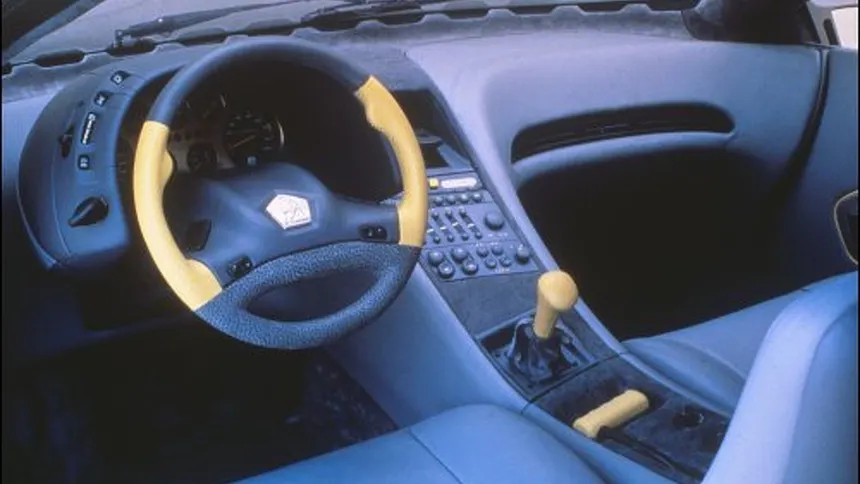
The engine is the Jalpa’s water-cooled 3.5-liter V8 with 255 horsepower, a five-speed manual, 7,000 rpm and a claimed top speed of 149 mph. Chassis number LC0001. One car built.
Outside, the signature is four scissor doors: the fronts pivot forward and up, Countach-style, and the rears open up and back. No B-pillars. Four seats and a passenger compartment with nothing in the middle.
Four scissor doors in 1987, with the Countach still in production. Nobody else tried that for a long time afterwards.
What “cab forward” means, and why this car could have it
The concept needs explaining, because it is the reason a mid-engined prototype ended up shaping the design of front-engined, front-wheel-drive sedans.
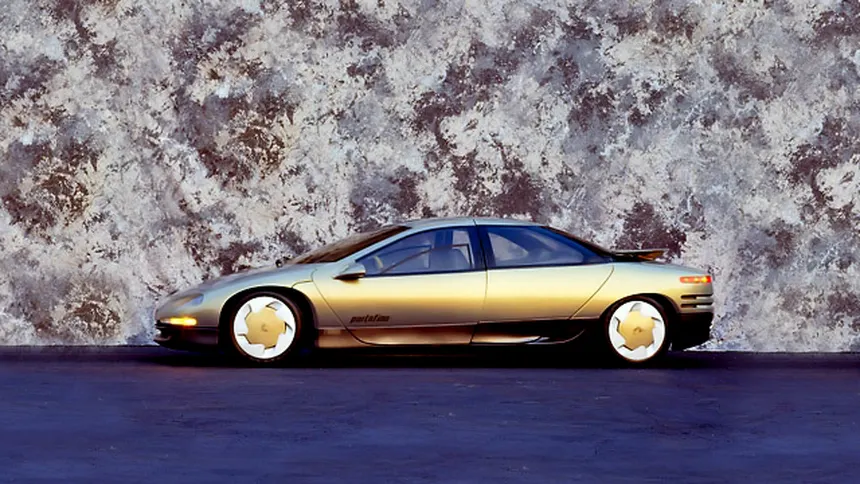
Cab forward means pushing all four wheels out to the corners, shortening the overhangs, lowering and raking the hood, and stretching the windshield forward until it starts almost over the front axle. The result is a bigger cabin inside the same exterior length. Chrysler later sold that as its advantage over rival sedans: more room inside, same footprint outside.
On the Portofino those proportions were not a styling exercise, they were a consequence of the layout. With the V8 behind the driver, the nose has nothing to house — no engine, no gearbox, no radiator for a big block up front. It can be dropped, raked and shortened as far as the designer likes, and the cabin can move forward with nothing in the way.
That is the catch in this story. Chrysler copied the proportions of a car that could have them by architecture, and applied them to cars with a transverse front engine, which could not. It solved that with packaging and a new platform, and it worked for two generations.
The four-door line Lamborghini never built
The Portofino is not an isolated accident. It is the third attempt by the company to sell a Lamborghini with room for a family, and every attempt died.
The Espada, from 1968, did reach production with four genuine seats and 1,217 cars, and it was the brand’s best-selling model of its entire first era. On a second-series Espada, Pietro Frua built the one-off four-door Faena in 1978, with the wheelbase stretched by seven inches. Then came this Portofino in 1987. And at the Paris show in 2008, the Estoque, another four-door that was never built either.
Forty years of trying. Zero production four-doors, until the company solved the problem a different way by raising an SUV off the ground.
What did get built: the nose
The Portofino introduced what Chrysler branded cab-forward design, and the LH platform launched in 1993 took that language straight from it.
The cars that came out of it: Chrysler Concorde, Dodge Intrepid, Eagle Vision, Chrysler New Yorker and Chrysler LHS in the first generation, from 1993 to 1997. Then in the second, from 1998 to 2004, Concorde and Intrepid again, plus the LHS and the 300M.
And one figure puts the volume in perspective. The first-generation Intrepid alone accounted for 645,281 cars in five years — one model in that family built more cars than every Lamborghini in history combined well into this century.
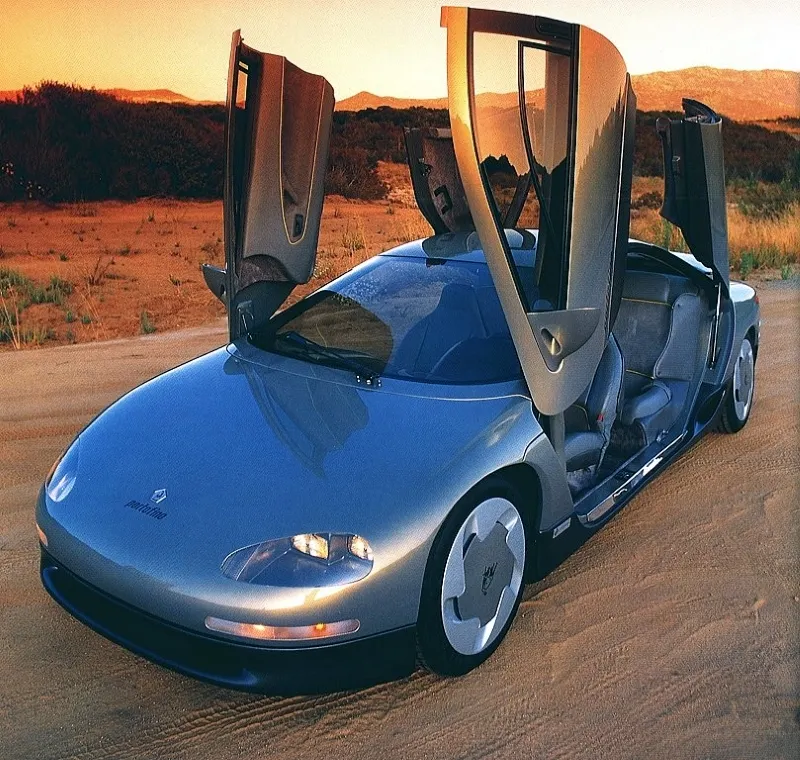
The Intrepid is also the closest visual match, with its triangular headlights and rear lamps. Eleven years of high-volume American sedans wearing the nose of a Lamborghini prototype that was displayed a single time.
Seven years, one new model
Line up what the Chrysler era actually delivered at Sant’Agata and the Portofino stops looking like a footnote.
The Jalpa was killed in 1988. The Diablo arrived in 1990 and ran to 2,903 cars through 2001. The company was sold to Megatech in 1994. That is the whole ledger: one new model launched, one model cancelled, one sale.
So when Chrysler’s people looked at a four-door prototype built on the chassis of the car they were about to discontinue, they were looking at the only expansion idea the company had. They chose to keep the design and drop the car.
Two faces in one showroom
Look at what Lamborghini was in 1987, the year this prototype appeared.
The flagship was the Countach, a design first shown as a prototype in 1971 and by then sixteen years old, still in production and still selling on a shape from another decade. Its LP400 S version had introduced the wide arches and the Pirelli P7s in 1978, and only 237 of those were built across three series.
Against that, the Portofino: four doors, four seats, no B-pillar, a mid-mounted V8 and a nose that would define American sedans for eleven years. One of the two cars was the past being milked. The other was a future nobody funded.
Detroit redrew the master too
Design traffic between Turin and Michigan ran both ways, and the other direction only ever gets half told.
While the Portofino was becoming the face of the LH cars, Sant’Agata was preparing the Countach’s replacement. Marcello Gandini drew the Diablo, and Chrysler’s management did not like it. It handed its Detroit design team a third extensive redesign to soften the sharp angles of the original work.
Gandini did not swallow it quietly. He realized his original design in another car: the Cizeta-Moroder V16T.
The Diablo that reached the market on 21 January 1990 carried a 5.7-liter V12 with 492 horsepower and ran to 2,903 cars through 2001. It was a success and it carried the decade. But the shape it wears is the one Detroit approved, not the one Gandini signed.
Put the two halves together. The Americans took an Italian prototype’s design to sell sedans, and at the same time rewrote the Italian supercar’s design from Michigan.
And then they killed the car it came from
There is a postscript almost no Portofino spec sheet mentions.
The Jalpa — the model whose chassis was stretched 26 inches to build this four-door — died in 1988. Production closed with sales falling and the company already under Chrysler control, after 410 cars since 1981.
One year after using its platform for the Frankfurt prototype, the new owners killed off the company’s entry-level model. And with it, the only V8 range Lamborghini had managed to put on the road in eighteen years of trying.
The 1991 crash
The Portofino came to a violent stop, literally. It was badly damaged in 1991, in a crash during transport.
Chrysler did not let it die. The car went to Metalcrafters, in Costa Mesa, California, and roughly $300,000 went into restoring it.
Read that figure next to the car it came from: three hundred thousand dollars of repair work on a prototype whose mechanical base was a Jalpa, Lamborghini’s entry model. Rebuilding the prototype cost considerably more than buying the production car it started from.
That an American company in the middle of a restructuring spent that on a four-year-old Italian concept says more about what Chrysler thought of the design than any press release.
Where it is today
The car is still in the United States. It is kept at Chrysler’s headquarters in Auburn Hills, Michigan, and it formed part of a Detroit Institute of Arts exhibition between 15 November 2020 and 9 January 2022.
A Detroit fine-arts museum showing a four-door Lamborghini designed by an American and bodied in Turin. The whole story fits in that sentence.
The traffic ran both ways
The Chrysler era usually gets told as an occupation: the Americans come in, take over, impose and leave. The technical exchange went in both directions.
While the Portofino’s design traveled to Michigan to become the face of the LH cars, Sant’Agata was working on the 8.0-liter aluminum V10 for the Dodge Viper. That engine was central to the Viper’s success, and Lamborghini’s Chrysler years funded and developed it.
Seven years of American ownership left two marks nobody associates with Lamborghini: a ten-cylinder engine in an American sports car, and the nose of hundreds of thousands of family sedans.
What Sant’Agata let walk out the door
The Portofino has a pedigree problem the factory would rather not look at straight on.
Lamborghini did not think of it. No Italian drew it. It is not named after a bull but after a town in Liguria, which is another way of saying that nobody in Sant’Agata was deciding the vocabulary any more. And its best idea ended up in Detroit, selling fleet sedans.
What bothers me is not that. It is that the car was superb. Four scissor doors, no B-pillar, four usable seats and a mid-mounted V8 behind your head, in 1987. Had they built it, Lamborghini would own thirty years of four-door history — instead of the line about an SUV being the brand’s opening to the real world.
Sant’Agata had the answer sitting on a stand in Frankfurt and let somebody take it to Michigan to draw Intrepids with.
Check you’re still alive.