
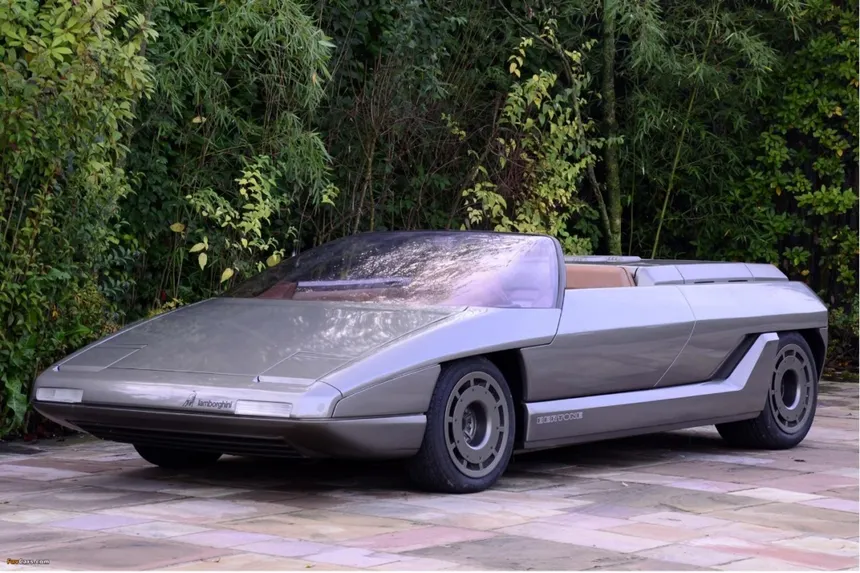
Lamborghini Athon: 260 HP, No Roof, Turin 1980
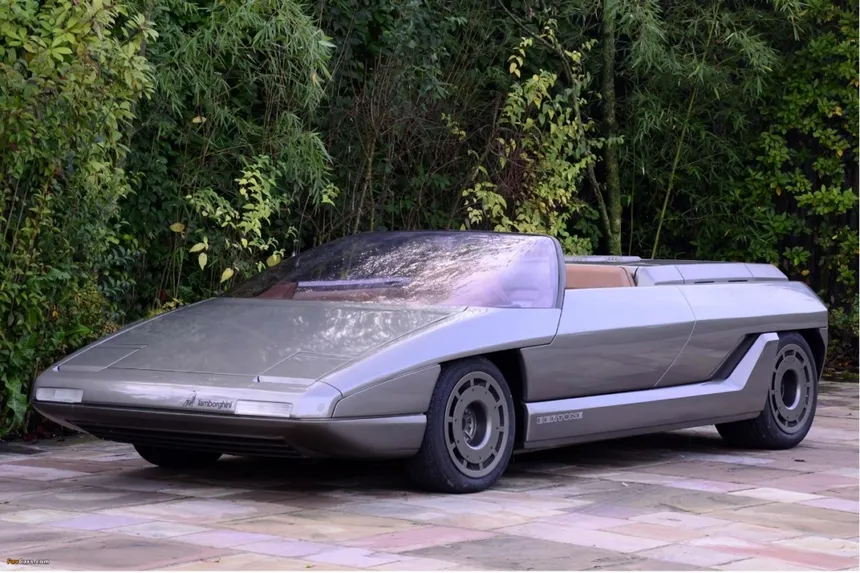
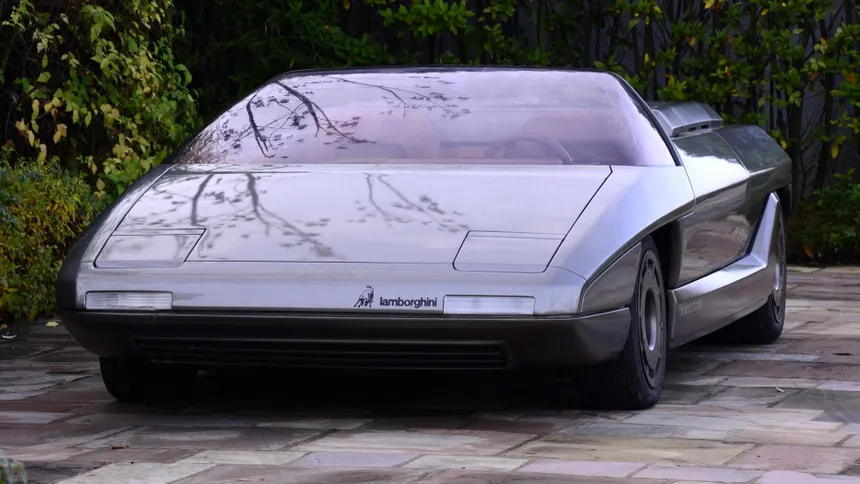
Bertone brought a brand-new Lamborghini to the Turin motor show in April 1980. An open two-seater, futuristic, with a fully digital instrument panel and a single-spoke steering wheel.
Lamborghini had been bankrupt for two years.
A coachbuilder publicly unveiled a car for a client that was in the hands of the Italian courts, and said so in writing in its own press release. Nobody does that.
What being Lamborghini meant in 1980
The dates first, before the car.
The company entered bankruptcy in 1978 and the Italian courts took control. In 1980 the Swiss brothers Jean-Claude and Patrick Mimran were appointed to administer it through the receivership. They would end up buying it for US$3 million and renaming it Nuova Automobili Lamborghini SpA.
At the moment Bertone put the Athon on its stand at the 58th Turin motor show, the manufacturer whose badge that prototype wore was not a going concern. It was an insolvency proceeding with a factory inside it.
And in that situation, a supplier who could have walked away did the opposite. Bertone’s press release made the intent explicit: to support the Emilian manufacturer through the crisis, and to present the car as a new impulse for the brand.
The cost of a gesture like that can be worked out. A functioning prototype — chassis, installed running gear, new bodywork, bespoke interior and electronics developed with a supplier — does not come out of petty cash. Somebody pays. And the Athon stayed in Bertone’s collection, not Lamborghini’s, until it went to auction thirty-one years later.
Marc Deschamps’s first big Lamborghini
The Athon was signed by Marc Deschamps, the French designer who had taken over the studio from Marcello Gandini in late 1979.
That handover is worth weighing. Gandini had signed, for Bertone, the Miura, the Marzal, the Espada, the Jarama, the Urraco, the Countach, the Silhouette and the Bravo. The entire visual language of Lamborghini since 1966 came off his pencil.
And the first major commission for the man replacing him was a car for a client in bankruptcy.
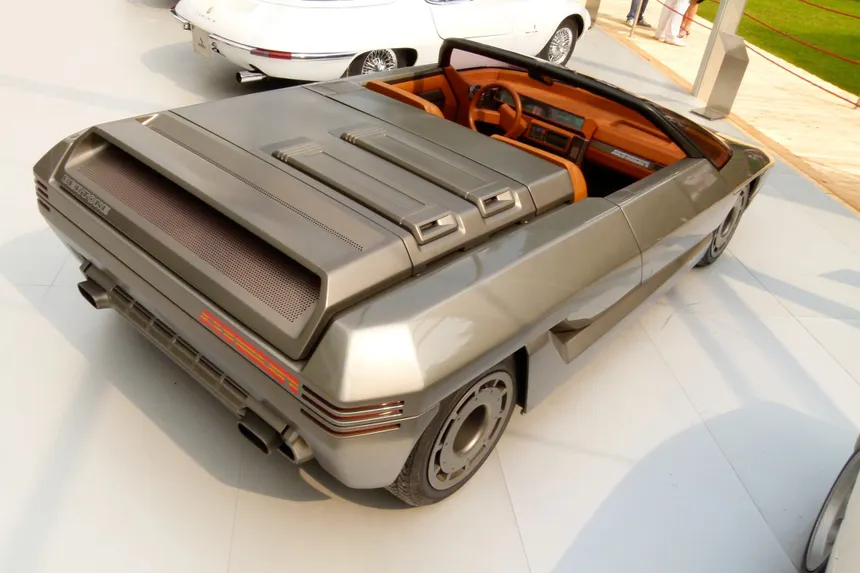
Deschamps answered with taut surfaces, heavily sculpted volumes and hard edges. Oversized lower side skirts, a steeply raked windshield, a very high beltline, pop-up headlights and an angular tail with the spoiler set into a recess.
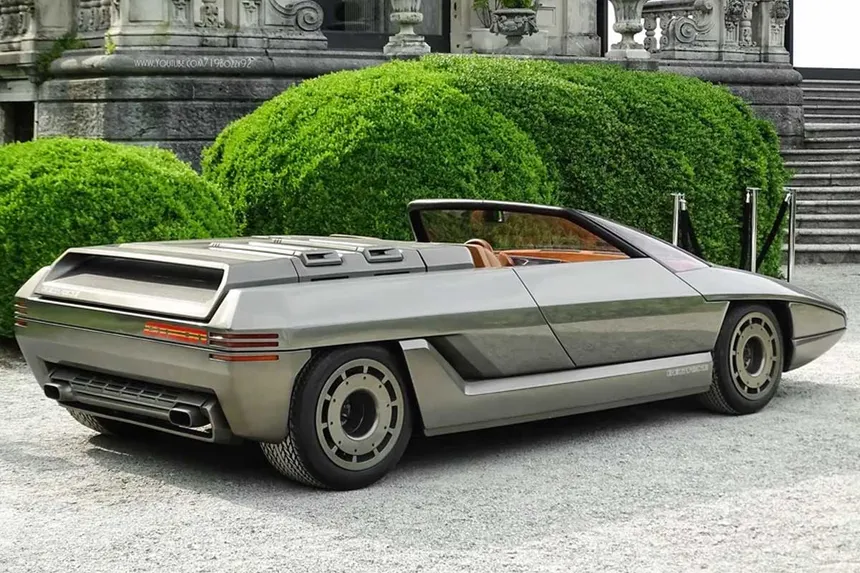
A convertible with no roof
The mechanicals come from the Silhouette. That choice says plenty on its own: Bertone picked as its base the model that had sold 54 cars according to Wikipedia, or around 52 by other counts: the company’s biggest commercial failure.
A 2,996 cc V8 mounted transversely amidships, 260 horsepower at 7,500 rpm and 321 Nm. Five-speed manual. Chassis number S155/01.
The dimensions belong to a genuinely small car: 3,739 mm long — under four meters — 1,882 wide, 1,041 tall, on a 2,455 mm wheelbase. On the scales, around 2,390 lb.
And a decision nobody makes on a car intended for production: it is a spider with no top. Not a folding roof, not a stowed one. There is none. If it rains, you get wet. The cabin also sits further forward than convention.
What matters is that it worked. RM Sotheby’s describes it as fully functional and notes that it retained the Silhouette’s road-holding and handling. This was not a fiberglass mock-up pushed onto a stand.
They cannot even agree about the roof
As with everything surrounding this marque in these years, sources disagree about the most visible part of the car.
English-language Wikipedia describes a spider with no top of any kind. LamboCars instead describes a targa-style removable roof panel, again with no conventional soft top.
Those are two different cars in practice. One is permanently open with no option but to get wet. The other takes a panel over your head. And this is a single, unique car, photographed a thousand times, displayed in a museum for decades.
Performance is the same story. The figures in circulation — roughly six seconds to 60 mph and close to 160 mph — are published as estimates, not measurements. Nobody ran a stopwatch.
What no source disputes is that the car ran and was driven.
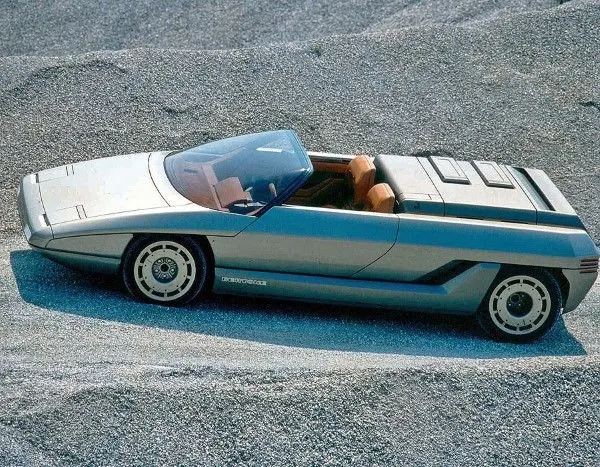
Half a meter shorter than its own donor
One comparison places what Deschamps did. The Silhouette it comes from is 4,320 mm long. The Athon is 3,739. That is 581 mm less — nearly two feet — on the same mechanicals, with a wheelbase that barely changes, from 2,450 to 2,455 mm.
Everything removed came out of the overhangs. That is why the car looks the way it does: a short, wide wedge with nothing spare at either end.
And it did not stay in the photographs. The motoring press drove it on the road, with good reviews. A prototype from a bankrupt manufacturer, handed to journalists, in 1980.
The dashboard that got there first
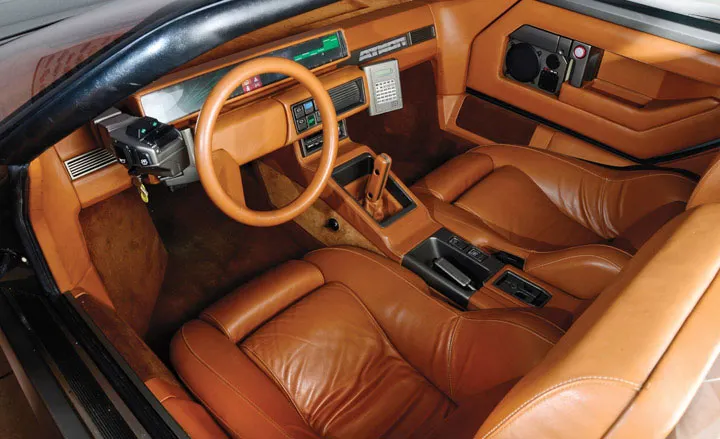
The Athon carried fully digital instrumentation developed with Veglia, laid out horizontally in front of the driver’s eyes. The secondary controls, wipers and indicators included, sat in a side pod away from the column, following the philosophy Citroën was applying with its satellite controls. The steering wheel was a floating single-spoke design. Beige and brown leather throughout.
That, in 1980, was science fiction in a car you could actually drive.
The context explains why nobody else dared. Aston Martin had shown the Lagonda at the London motor show in 1976 with an LCD digital dashboard and touch controls. Developing that electronics package cost four times the entire budget of the car, the system proved fragile, and in 1980 Aston Martin abandoned those displays. The Series 3 moved to cathode ray tubes, which turned out to be even less reliable.
In the same year the manufacturer that had bet on digital instrumentation gave up on it, an Italian coachbuilder fitted it to a prototype for a bankrupt brand.
Four dream cars in thirteen years
Put the Bertone-Lamborghini prototypes in a row and the Athon’s position becomes clear.
The Marzal came first, at Geneva in 1967, a four-seat study with glazed gullwing doors that led directly to the Espada. The Countach prototype followed at Geneva in 1971 and went into production almost unchanged in silhouette. The Bravo arrived at Turin in 1974 as the intended Urraco replacement, was driven for tens of thousands of miles, and never got built. Then the Athon, at Turin in 1980.
Four cars in thirteen years, from one coachbuilder for one client. The first two turned into production models. The third was killed by the oil crisis. And the fourth was built for a customer that legally could not order anything, could not pay for it, and did not own it when it was finished.
Three of the four have since been sold at auction. The Athon fetched the least of them.
What the Silhouette gave it, and what it cost
One comparison sets up everything the Athon is. Its donor, the Silhouette, was a 2,997 cc mid-engined V8 that made 265 horsepower and sold 54 cars because Lamborghini never got it certified for the United States. The Athon takes that same engine, drops to 260 horsepower, and adds no roof at all.
For an American reader the implication is blunt. The mechanical package under this show car was one that could not legally be sold in the largest market on earth. Bertone built its statement of support on the only platform Lamborghini had going spare, and the reason it was spare is that nobody could buy it.
That is what makes the gesture bigger, not smaller. A coachbuilder chose a commercial failure as the base for a car meant to signal that the brand had a future.
A car with no bull
One detail gets skipped, and it says a lot about the moment.
The name Athon refers to the Egyptian sun cult — a hymn to the sun — which suits a car built with no roof. No bull. No ranch. No ring.
Since the Miura of 1966 the company’s vocabulary had come from Spanish bullfighting: Islero, Espada, Jarama, Urraco, Jalpa. Breeds, ranches and terms from the corrida, chosen one by one.
The Athon and the Silhouette are the two exceptions of that era. And the Athon pushes the break furthest, because it does not merely avoid being a bull: it crosses to another continent and another religion to find its name.
What the factory managed afterwards
Bertone’s gesture was not wasted, though it took time to pay off.
With the Mimrans inside, first as court-appointed administrators and then as owners after buying the company for three million dollars, Sant’Agata built cars again. The Jalpa — the restyled Silhouette — appeared at the Geneva show in 1981, signed by the same Marc Deschamps. The Countach LP 500 S followed in 1982. In 1984 came the Countach LP 5000 Quattrovalvole, with Patrick Mimran as chief executive running a restructuring plan and injecting capital.
The man who drew an impossible roofless car for a bankrupt company ended up signing the only entry-level Lamborghini that ever sold in decent numbers with eight cylinders — 410 Jalpas between 1981 and 1988.
The Athon was not only a gesture. It was the calling card of the designer who would carry the range through the whole decade.
From gift to auction lot
The Athon stayed in the Bertone S.p.A. collection. For decades it remained little known even among enthusiasts of the marque.
It went to auction with the rest of that collection. At Villa d’Este, in May 2011, it sold for €347,200.
To place that number: at the same sale the 1967 Marzal reached €1,512,000 and the 1974 Bravo €588,000. The Athon, the most modern of the three and the only one built as a gesture toward a ruined client, was worth the least.
And the reason those cars were on the block closes the story in the worst possible way.
Bertone was in the middle of a financial reorganization. It was the liquidators of the Bertone Museum who offered six of the collection’s most original vehicles for sale. The company had been struggling since Nuccio Bertone’s death in 1997.
In November 2011 the Italian government designated the rest of the collection national heritage, protecting it from further sales.
The coachbuilder that in 1980 built a car with its own money to hold up the image of a bankrupt manufacturer ended up, thirty-one years later, with its own prototypes under an auctioneer’s hammer and the Italian state stepping in to stop the rest being sold.
The industry does not do gifts
The car industry does not do free gestures. It does contracts, clauses and invoices. Behind the Athon there is no business model: there is a coachbuilder telling the whole of Turin that Lamborghini still existed, with the signature of a newly arrived designer staking his reputation on the debut.
The brand that today sells anniversary editions at the price of an apartment shows the Athon in its prototype retrospectives as an aesthetic curiosity, without mentioning that the car was built when it was worth nothing itself and that somebody else paid for it. Its digital dashboard, the genuine technical leap in this prototype, appears on no list of the company’s innovations either.
Plenty of brands trade on heritage and have forgotten who held them up when they could not make payroll. This is one of them, and Bertone signed the receipt.
Check you’re still alive.