
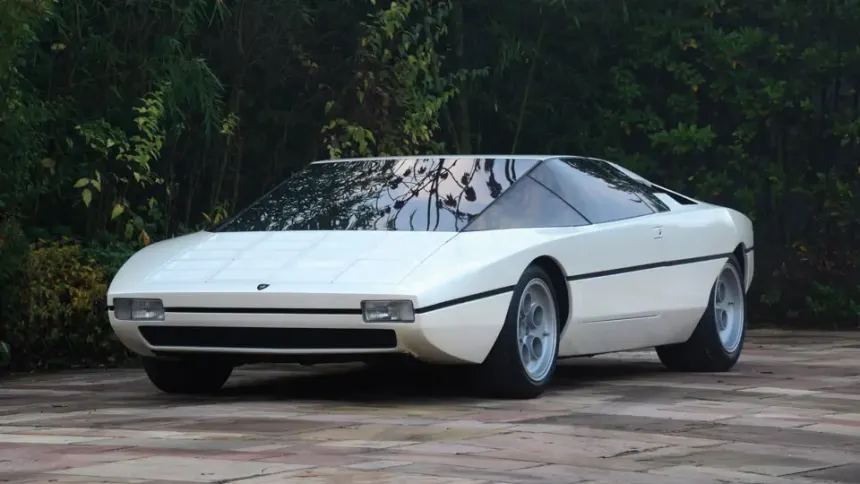
Lamborghini Bravo: 300 HP and 2,390 lb in 1974
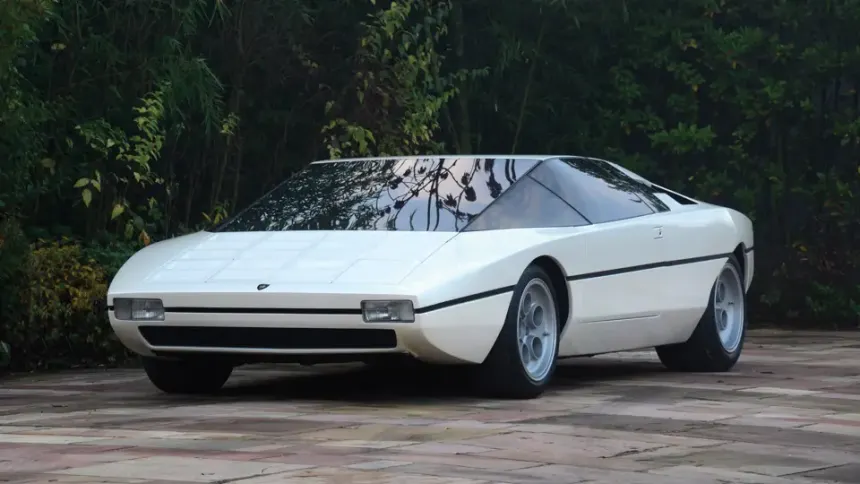
A show car does not get driven. It is pushed onto the stand, lit, photographed and put away.
The Lamborghini Bravo covered tens of thousands of test kilometers. American journalists drove it and published a verdict. And in April 1978, three and a half years after its debut, the factory was still saying a production version was three or four years away.
It never came. What stayed in the window was not a pretty concept car. It was a finished product that a bankrupt company could not build.
Turin, October 1974
The Bravo appeared at the Turin motor show in October 1974, designed by Marcello Gandini and bodied by Bertone.
For Bertone it was the third dream car built on Lamborghini mechanicals, after the Marzal of 1967 and the Countach prototype of 1971. With that lineage it was never decoration: it was the third instalment of a partnership that had already produced two cars that changed the company.
Internally it was known as Studio 114.
Those two predecessors are worth knowing, because they set the standard the Bravo was measured against. The Marzal, shown at Geneva in 1967, was a four-seater with fully glazed gullwing doors and a 2.0-liter straight-six that was literally half of the 4.0 V12, engineered by Gian Paolo Dallara for 175 horsepower at 6,800 rpm, mounted transversely behind the rear axle. Prince Rainier III drove it on the parade lap of the 1967 Monaco Grand Prix with Grace Kelly beside him. The Countach prototype followed at Geneva in 1971 and became the most recognizable supercar silhouette ever drawn.
So when Bertone rolled the Bravo onto the Turin stand, nobody in that hall treated it as a styling doodle. Bertone’s previous two Lamborghini dream cars had produced a royal photo opportunity and the production car that would define the company for the rest of its independent life.
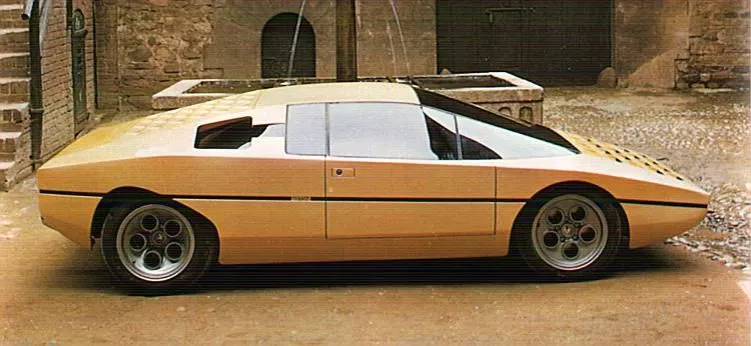
An Urraco with everything surplus removed
The mechanical base is the Urraco, and the work consisted mostly of cutting.
Bertone shortened the chassis by deleting the rear seats. The figures for that cut vary: English-language Wikipedia says 175 mm off the wheelbase, RM Sotheby’s says 7.8 inches — about 198 mm — and Car Design News says 200 mm. The final wheelbase came out at 2,275 mm.
The result is 3,775 mm long, 1,900 wide and 1,050 tall. Weight: 1,085 kg, around 2,390 lb.
Those numbers deserve a pause. An Urraco weighed 1,250 to 1,300 kg and measured 4,250 mm. The Bravo is nearly half a meter shorter and more than 150 kg lighter, with the same three-liter V8 mounted transversely amidships, here making 300 horsepower — fifty more than the road-going P300.
Five-speed manual with a synchronized reverse. Independent suspension with MacPherson struts at the front and Chapman struts at the rear.
The suspension choice is worth explaining, because it is not decorative. The Chapman strut is essentially the MacPherson principle applied to the rear axle, the solution Colin Chapman made famous at Lotus: compact, light and cheap to build. In other words, the Bravo kept the Urraco’s engineering philosophy of being cheap to produce. This was not a motor-show fantasy. It was designed to be manufactured.
The proof it was serious: it was driven
One thing separates the Bravo from every other concept of the period.
How far, nobody can say. English-language Wikipedia records close to 40,000 miles of testing. The documentation RM Sotheby’s cites, from Jean-François Marchet, puts it at around 70,000 kilometers. Other sources go as far as nearly 168,000 miles, more than 270,000 km. Between the lowest and the highest figure there is a factor of more than four, on a single car, perfectly identified, which belonged to its own coachbuilder’s collection until 2011. That is the state of Lamborghini’s seventies paperwork.
What none of the sources dispute is the essential point: this car was used, hard, for years.
And not only at Sant’Agata. Road & Track tested it and praised its power delivery, its steering and its handling.
A show prototype that racks up tens of thousands of miles and gets a published road test from an American magazine is not a styling exercise. It is a pre-production car waiting for a manufacturing order that never arrived.
The design: a Countach you could live with
Gandini drew a purer wedge here than the Countach itself.
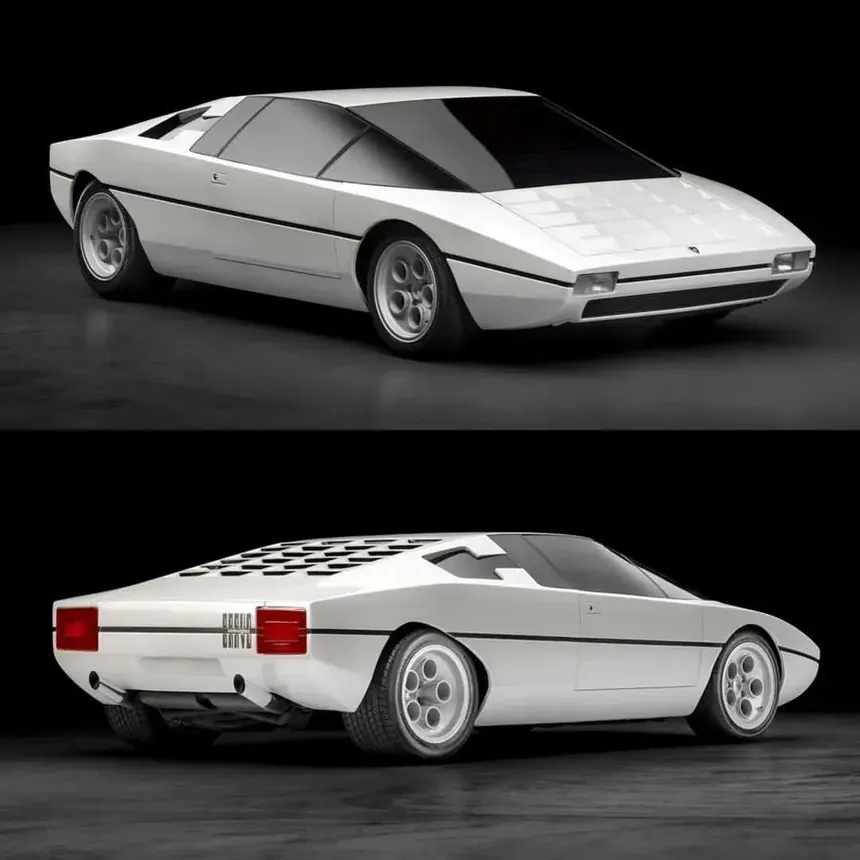
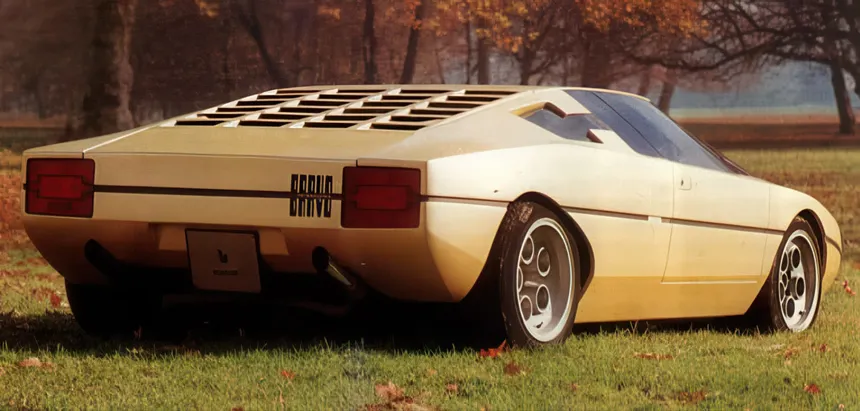
The key is the windshield, raked at virtually the same angle as the hood, flanked by triangular side glass, with extremely thin A-pillars hidden behind glass bonded over them. Louvered panels vented the engine front and rear. A small luggage compartment sat behind the engine.
Bertone widened both tracks to fit the Pirelli P7 tires then reaching the market, adding around 110 mm of overall width. The same tires that would go into production on the Silhouette.
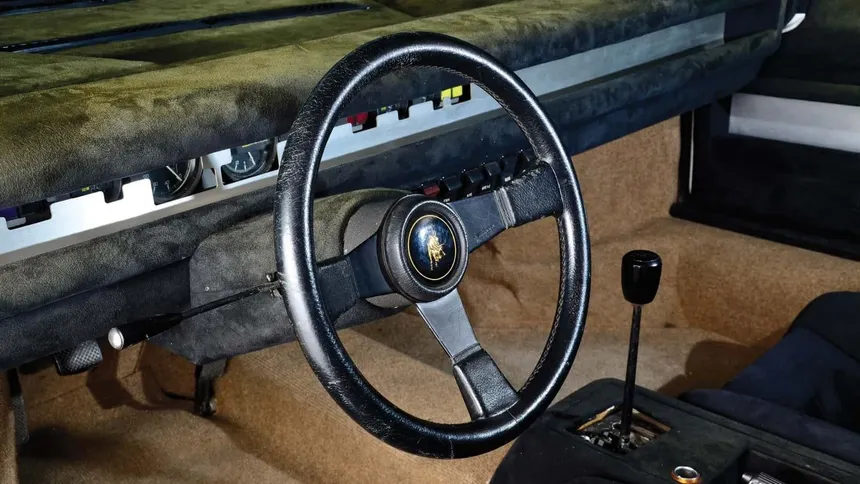
Inside: Alcantara on the seats and instrument panel, a new material at the time, and an almost supine driving position.
Aesthetically, the Bravo is an evolution of the Countach, not of the Urraco that gave it its mechanicals. Lamborghini was looking at a car with half the build cost of its flagship and the same visual language.
The Bravo did reach production — look at a Countach’s wheels
Lamborghini launched the Countach LP400 S in 1978. That car changed the model’s face permanently: Pirelli P7s in 345/35R15, the widest production tires available at the time, plus fiberglass wheel-arch extensions that the Countach would keep to the end of its life. A V-shaped rear wing was optional, improving high-speed stability at the cost of at least 16 km/h of top speed.
And the Series I LP400 S wheels, those Campagnolo rims with the deep rim holes? Their catalog name is “Bravo”.
The wide Countach — the one on every bedroom wall in the eighties — wears wheels named after the prototype that was never built, on the tires Bertone had widened that prototype to accommodate back in 1974.
Lamborghini built 157 LP400s between 1974 and 1978, and 237 LP400 S across three series. The model that carried Sant’Agata through the eighties was built in part on decisions made by a car that stayed in the showroom.
Follow the tire alone and you have the whole chain. Bertone widens a prototype in 1974 to fit a new Pirelli. That Pirelli reaches production on the Silhouette in 1976. Two years later the same tire, now in 345/35R15, forces the fiberglass arches onto the Countach and creates the shape every kid on earth would have on a wall. Three cars, one decision, and the car that started it never got built.
Four years promising a car they could not build
With the Bravo shown and tested for three and a half years, in April 1978 there was still talk of another three or four years to a production version. Seven or eight years from debut to a hypothetical customer.
Meanwhile the oil crisis wrecked the company’s finances and the project was cancelled.
Look at what Lamborghini had in hand in those same years. The Urraco, which never came close to its planned thousand cars a year. The 1976 Silhouette, which stopped at 54 cars and was never certified for the United States. And the Countach LP400, in production from 1974, at 157 cars through 1978.
With that picture, opening a new line for a fourth model was impossible. The Bravo was not a bad car. The company showing it had stopped being capable of building anything new.
What Maranello did with the same opening
To measure the scale of the miss, look at what Maranello was doing in the same months.
The Bravo was shown in Turin in October 1974 as the logical Urraco replacement. Eleven months later, at the Paris show in 1975, Ferrari unveiled the 308 GTB. Same segment, mid-engined, eight cylinders, 2.9 liters, 255 horsepower in European trim.
The difference is that the Ferrari went on sale. Maranello built it through 1985 and, across all its variants, passed twelve thousand cars.
Lamborghini showed its prototype a year before Ferrari showed its production car, with more claimed power, less weight and a body that still looks modern. And sold none.
There is no design problem and no engineering problem here: one of the two had a functioning factory behind it and the other did not.
What a prototype like this cost
Putting a price on the gesture explains why it does not get repeated.
A normal show car is a shell: mould, paint, wheels and an interior that does not work. The Bravo was none of that. It had a chassis shortened to order, running gear installed and operational, transmission, brakes, tuned suspension, a complete interior in a material that was new at the time, and tens of thousands of test miles on it, with the wear and the replacement parts that implies.
That does not come out of a marketing department’s petty cash. It comes out of a company that has decided the car is going to exist. Bertone built it believing it would be produced, and Lamborghini left it in the window for four years saying another three or four were needed.
From the stand to the auction block
The Bravo left the factory in light metallic yellow. It was later repainted in a darker metallic green, and a recent light restoration left it in pearlescent white.
It stayed in the Bertone S.p.A. collection until that collection was sold. At Villa d’Este, on 21 May 2011, it went for €588,000.
At the same sale, on the same day, the Marzal — the first of Bertone’s three Lamborghini dream cars — sold for €1,512,000. The first of the line was worth nearly three times the third.
This was not a mock-up
The Bravo gets filed under concept cars, and it does not belong there.
A concept is a sculpture on wheels, shown for a week and parked forever. This is something else: a car with tens of thousands of miles on it, road-tested by the international press, with suspension chosen to be cheap to manufacture, on the tires the production models were about to adopt, wearing a body that solved the Countach’s language in a smaller and more sellable format. That is a product, not a model.
And that is what stings. Sant’Agata spent the seventies getting the products right and the company wrong. The Urraco arrived two years late. The Silhouette could not enter America. And the Bravo, a better car than either and more finished than both, sat in the window for four years while somebody kept repeating that the road version was three or four years away.
Promising a car you cannot build, for four years, is not patience: it is refusing to say out loud that you cannot do it. And the factory still shows the Bravo in prototype retrospectives alongside mock-ups that never turned a wheel, as if they were the same thing. Of all of them, it is the only one that earned the right to exist and never got it, not for being bad, but for reaching that company in that year.
Check you’re still alive.