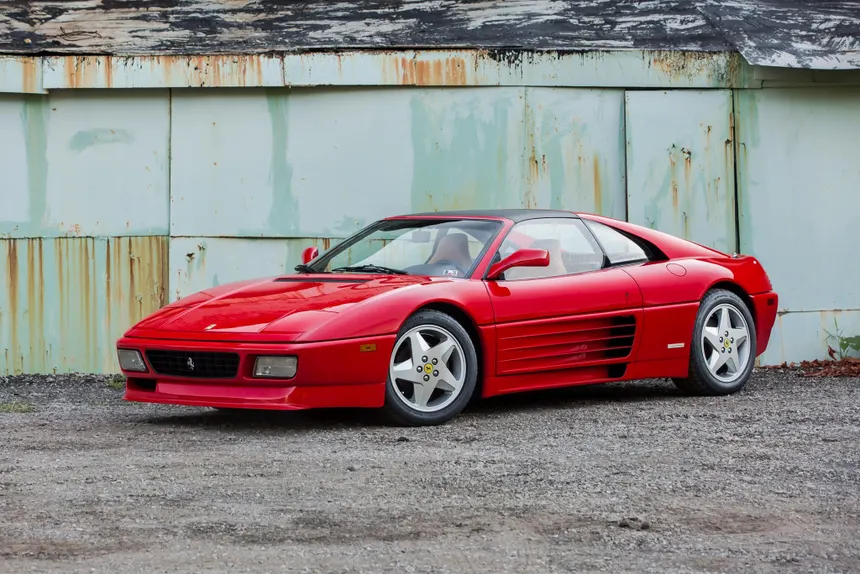
Ferrari 348: Condemned for Arriving Without Enzo
In the two previous pieces in this series, the 348 plays the villain. In the F355 article it is the car that nearly sank Ferrari. In the 360 article it is the one carrying a grille that cooled nothing.
It has earned its own page, because the sentence it carries is heavier than its faults. And because there is one line in its record that makes a good share of Maranello’s mythology look silly.
The first one without him
Enzo Ferrari died in August 1988. The 348 was shown at the Frankfurt Motor Show in 1989, and it is the first entirely new model the company launched after his death.
It was also the last mid-engined V8 developed under his supervision, and the last project Leonardo Fioravanti led as the company’s design chief.
Think about the position that car occupied. It reached the market with the entire industry asking whether Ferrari could exist without the man who founded it, and with the world’s press hunting for exactly the answer a new car was about to give them. Any flaw in the 348 was never going to read as a flaw in the 348. It was going to read as proof the whole thing was over.
And the 348 had flaws. I am not going to defend it there.
The name tells you where the gearbox is
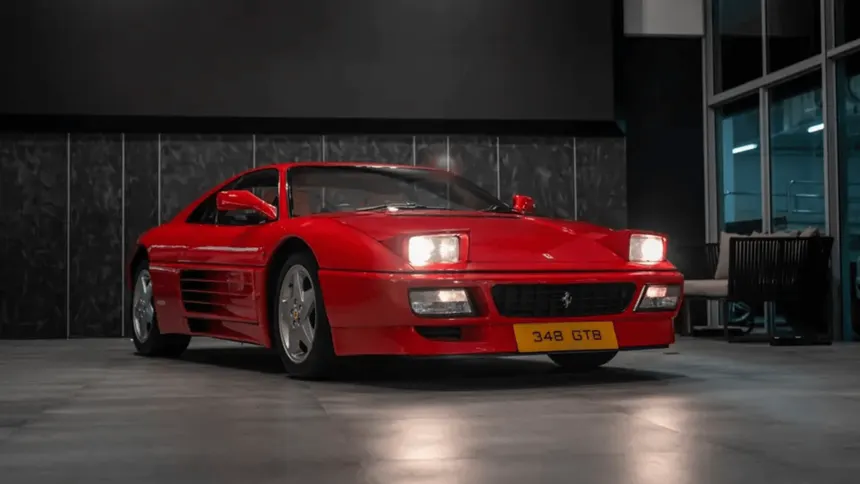
The 34 is the 3.4 liters of displacement, the 8 is the cylinder count, the t stands for trasversale after the gearbox position, and the last letter is the body: b for berlinetta on the coupe and s for spider on the targa.
That is the ninth entry in this series on how Maranello names its cars, and the only one that puts the mechanical architecture inside the badge.
Why the gearbox sits sideways
This is the technical decision that defines the car and deserves explaining.
Up to the 328, Ferrari’s entry-level V8s carried the engine mounted transversely, a configuration that began with the Dino 308 GT4 shown at the Paris Salon in October 1973. When 328 production ended in the autumn of 1989, that era closed.
The 348 turns it around: the engine goes longitudinally amidships and the gearbox crosses behind it in a transaxle layout, with the clutch after it and the differential above.
The reason is packaging. Turning the gearbox sideways instead of stringing it out behind the engine shortens the whole powertrain considerably, which allows the engine to sit lower and further forward without stretching the car. It is the same packaging logic we saw on the 512 BB stacking engine over gearbox, solved the other way around and with a better center-of-gravity result.
The V8 is the Tipo F119, 3,405 cc, twin cams per bank, four valves per cylinder, spark plugs between the camshafts and Bosch Motronic M2.5 management, later M2.7. It makes 300 hp at 7,200 rpm and 324 Nm at 4,200, for 171 mph and about 5.6 seconds to 62.
The first Ferrari without a tubular chassis
Here is the structural change that shaped the next fifteen years of the brand, as told by Ferrari itself.
The 348 was the first series-production Ferrari without a separate tubular steel chassis. Instead it used a pressed steel chassis with a separate tubular subframe bolted to it to carry the engine, and body panels robot-welded and bolted to the main structure.
That architecture is what allows the whole powertrain to drop out from underneath. And it is also the origin of the expense that has defined eight-cylinder Ferrari ownership for two decades: on the 348, changing the timing belts requires removing the engine from the car.
The F355 inherited it, with the figures we covered in that article, and it stayed that way until the 360 Modena introduced the removable panel allowing access to the timing gear without dropping the engine. Three articles in this series hang off a decision taken in 1989.
The wheelbase grew to 2,450 mm, 100 more than the 328’s.
The baby Testarossa
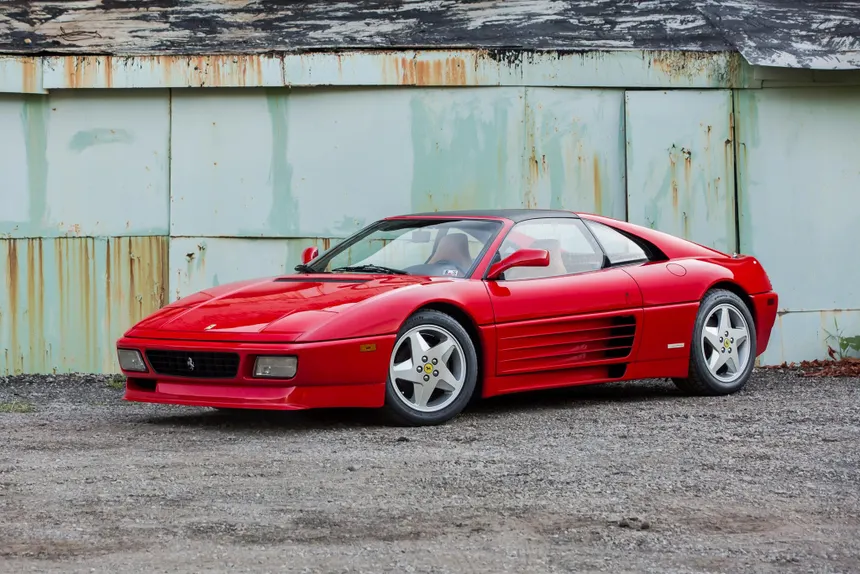
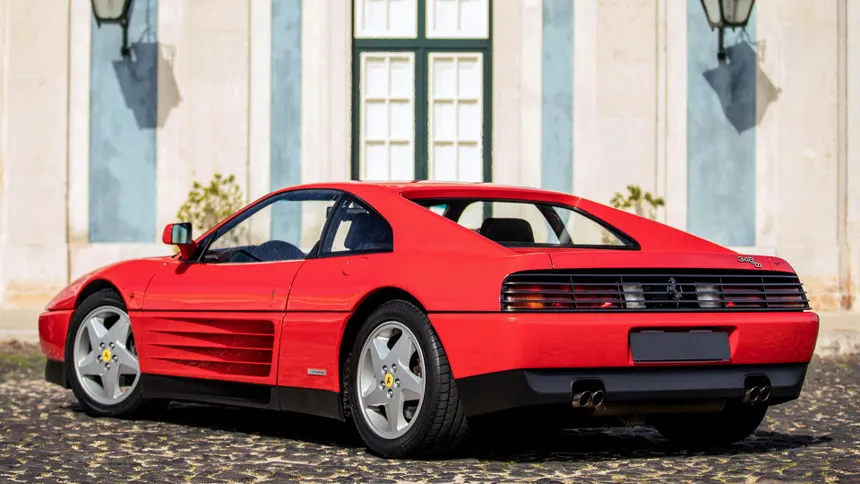
Pininfarina did the design under Fioravanti’s supervision, and the Testarossa reference is deliberate and obvious: the horizontal air intakes in the doors feeding the side radiators, and the treatment of the taillights.
Those strakes are the same ones that on the Testarossa were born from a legal prohibition, as we covered in that piece, and that on the 348 no longer cool the same thing or serve the same purpose. It is the first time Ferrari copied one of its own solutions purely as a styling gesture, and it would not be the last.
What they criticized with good reason
The handling. Early cars had a very sensitive setup and a tendency toward abrupt oversteer at the limit. The specialist press of the period was harsh: one Italian magazine described it as a bad-tempered little horse, and faulted it for feeling unsafe on twisting or broken surfaces and for punishing any clumsiness.
Ferrari listened. In 1993 the GTB and GTS arrived with a stiffer chassis, revised suspension mounts, reworked geometry and dampers, and Pirelli P Zero tires in place of the P 700 Z. The engine became the F119H, with higher compression and a new exhaust, rising to 320 hp. Outside, body-colored sills and engine cover, and a chromed rear prancing horse. Later cars also gained nearly two inches of rear track.
The result is a noticeably more forgiving car. Which is why, on the used market today, a 1993-onward GTB or GTS is a different product from an early tb or ts, and it is worth knowing which one you are looking at.
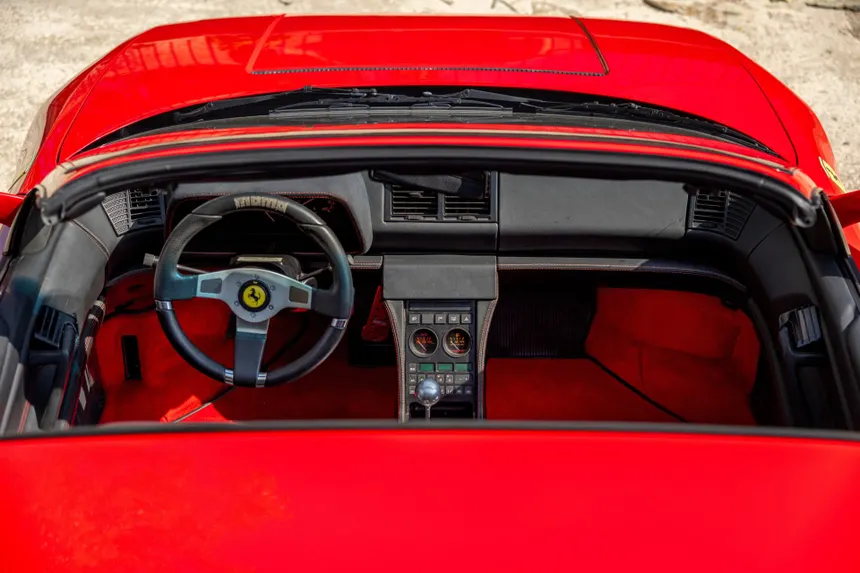
The 348 Spider is a company first
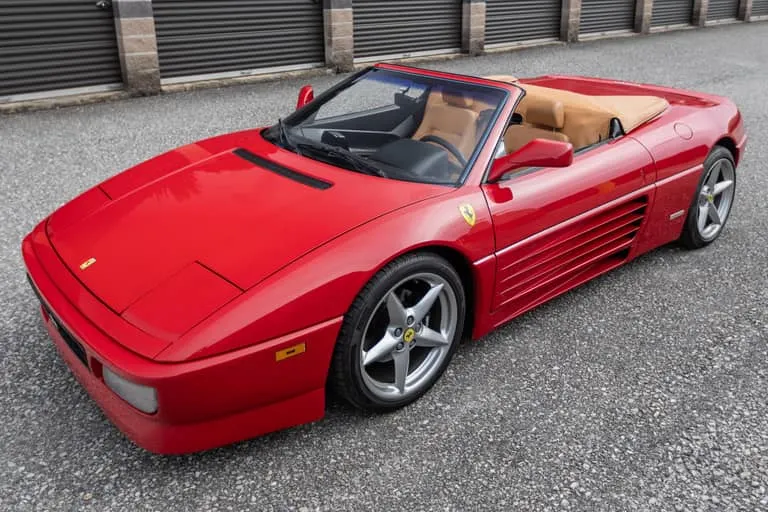
The 348 Spider also arrived in 1993, and this rarely gets told properly: it was the first mid-engined two-seat convertible in Ferrari’s history.
Its chassis was designed specifically for it and keeps the same bending and torsional stiffness as the coupe, with a central section of pressed steel panels welded together, supplemented front and rear by tubular structures carrying the suspension and engine.
Every mid-engined convertible Ferrari has sold since, including the 360 Spider we covered in its own article, starts here.
The Ferrari Challenge was born with the 348
This is the second finding that changes how you read this car.
In late 1992, with Jean Alesi as its figurehead, Ferrari launched a one-make championship born from listening to what customers were asking for: the chance to race their own cars on track. It started in 1993 and the car was the 348 Challenge.
It was really a conversion kit that let the tb and the ts go racing, and which could be removed to return the car to road specification. It included straight-through exhausts, carbon seats, a roll cage, a lowered stance, 18-inch magnesium wheels and about twenty more horsepower, up to 320.
The first champion was Roberto Ragazzi. That championship has been running for more than three decades, with series in Europe, North America and Asia-Pacific, and it is one of the pillars of Ferrari’s commercial relationship with its customers. In the 360 article we took it for granted. It was born here.
Le Mans, 1994
And now the fact I find the most devastating of all.
In 1993 Oscar Larrauri contested the Italian Supercar GT Championship in a Michelotto-prepared, factory-supported 348 run by Jolly Club. He took the GT2 class title with eight wins from thirteen starts, including four outright victories against far more powerful Class 1 machinery.
Michelotto built eleven competition cars, plus two specially prepared for the GT2 class at the 24 Hours of Le Mans. And one of them finished eleventh overall at Le Mans in 1994.
That was the first Ferrari to finish the 24 Hours of Le Mans since 1982.
Read it again. Twelve years without a Ferrari crossing the line at La Sarthe, and the car that broke the drought is the model much of the industry considers the worst the company ever built. In the 512 BB article we covered how in 1976 there was not a single Ferrari at Le Mans and how much that stung in Maranello. This is the other end of that story.
The GT Competizione cost more than the F355
The range closed at the Turin Motor Show in December 1993, when Ferrari announced the 348 GT Competizione. It was not a homologation special, whatever many accounts say: it was a celebration of Larrauri’s results.
Exactly 50 road cars were built during the spring and summer of 1994, all in Rosso Corsa and numbered. Dry weight of 1,180 kg after deleting air conditioning, carpets and anything else surplus. Short, close-ratio 25/27 gearing, a competition clutch with reinforced discs, brakes derived from the F40 Evoluzione with no ABS and larger discs and calipers, suspension with stiffer joints, and 18-inch Speedline wheels replacing the standard 17s. Carbon-shelled seats, like the F40’s.
And the detail that finishes it: it appeared just before the F355 was announced, at a higher list price. In the United Kingdom, £84,874 for the 348 GT Competizione against £83,031 for the F355 that came to replace it.
The last 348 cost more than the car that would bury it.
It was never sold in North America, blocked on emissions grounds.
What America got, and what to check
That emissions block on the GT Competizione is worth noting because it is the exception. Unlike the Berlinetta Boxer and the 400 family covered earlier in this series, the standard 348 was a federalized car sold new through official US channels, so a 348 here is not a gray-market puzzle. What you are checking is service history, not import archaeology.
And the critical item is the major service with the engine out, due every three to five years regardless of mileage, which is where the bill lands. A cheap 348 without that service documented is not a bargain, it is a deferred invoice, exactly as with the F355.
The second thing is knowing which series you are buying. The early cars, 2,894 tb and 4,228 ts, are the ones that built the nervous reputation. The 1993-onward GTB and GTS are more forgiving and more predictable. In total Ferrari built a little under 9,000 348s across all iterations.
And it is a demanding car by definition: no power steering, basic ABS and not a single electronic driver aid.
The verdict
The 348 proves that a car’s reputation is settled in its first six months and after that it never moves again.
It arrived with the worst possible assignment: being the first Ferrari without Enzo, at a moment when the whole industry was waiting to see whether Maranello would fall over. It had a very sensitive chassis and a setup that punished the average driver, and that is what got written. What happened afterward did not get written with the same ink.
Because afterward that car introduced the structural architecture Ferrari used for fifteen years, founded the one-make championship that is still a pillar of the business thirty years later, launched the first mid-engined convertible in the company’s history, and put Ferrari back across the finish line at Le Mans after twelve years of not getting there.
All of that was done by the worst Ferrari ever built, according to the people who drove it in 1989 and never looked at it again.
The sentence suited Ferrari, incidentally. The F355 was sold as redemption after the disaster, and that narrative needed a disaster. If the 348 had gotten better press, the car that saved the company would have simply been the next model.
How many bad cars are actually bad, and how many just had the bad luck to arrive at the wrong moment?
Check you’re still alive.