Ferdinand Porsche Sold the Same Idea for 45 Years
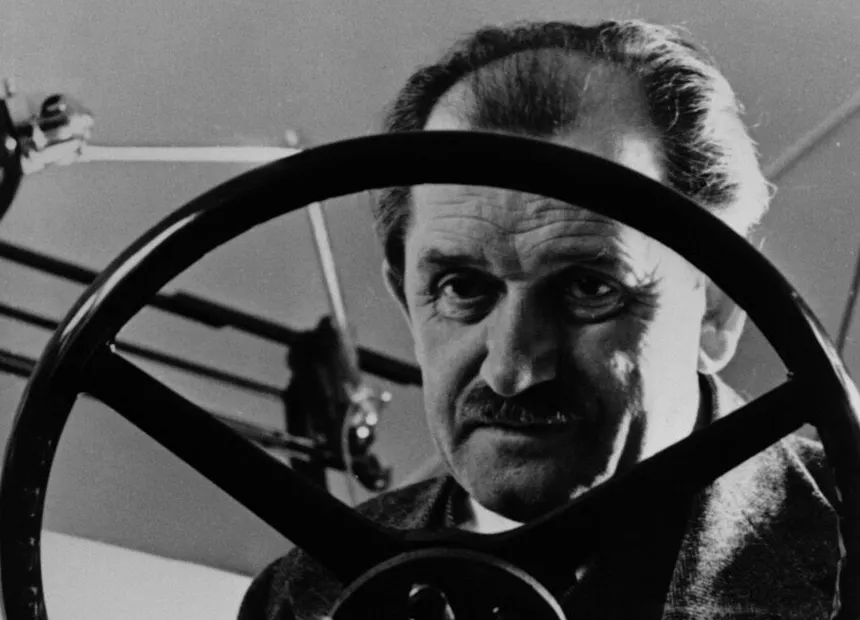
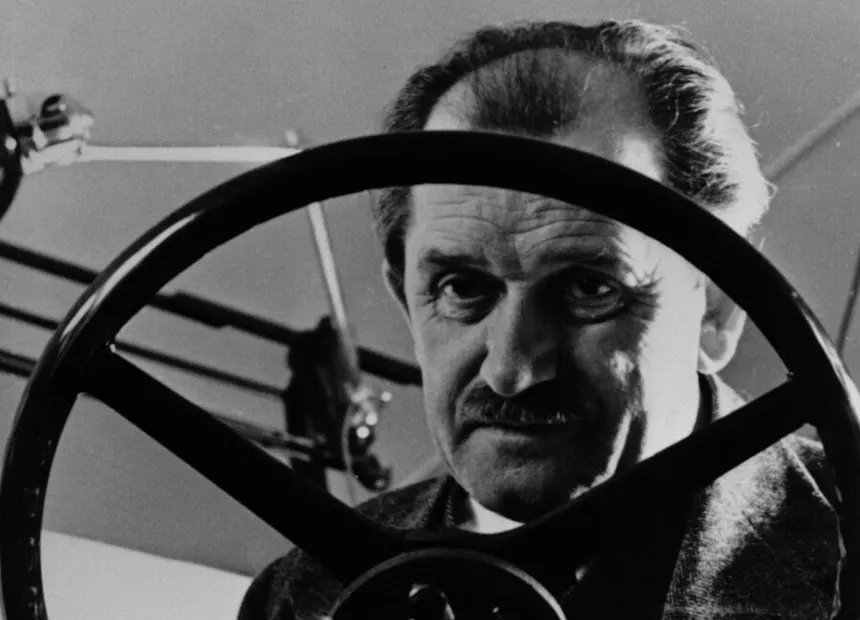
Ferdinand Porsche was not an engineer. He held no degree. The “Dr. Ing.” still baked into the company’s legal name carries an “h.c.” that nobody bothers to read: honoris causa. Honorary. The “Professor” is no better earned: the Stuttgart Technical University handed him an honorary chair in 1940, by which point he was the regime’s favourite engineer. The man the industry crowned as the car engineer of the century came up through his father’s sheet-metal shop and learned electricity in night classes.
That is what makes him worth a second look. With no degree, no formal training and no factory of his own until he was 55, he built one idea at the age of 25 and then sold that same architecture for four and a half decades. To a Viennese coachbuilder. To the Austro-Hungarian artillery corps. To the Wehrmacht.
The idea was electric transmission. Follow it and you get a far more useful picture of the man than any anniversary hagiography.
The kid who wired his parents’ house
He was born on 3 September 1875 in Maffersdorf, northern Bohemia, then part of Austria-Hungary and today Vratislavice nad Nisou in the Czech Republic. Third of five children of Anton Porsche, a master metalworker, and Anna Ehrlich. An ethnic German Bohemian family, the community later known as Sudeten Germans.
The father’s plan was the workshop. The kid’s plan was electricity. At eighteen he installed electric lighting and an electric bell in the family home, making it the second building in Maffersdorf with an electrical installation, behind the Ginzkey textile mill. That same year he left for Vienna and a job at Béla Egger & Co., the electrical firm that would eventually become part of Brown Boveri. Barely into his twenties, he was running the test department.
And there he developed the electric wheel-hub motor. He took it with him to Jakob Lohner’s carriage works.
The idea, patented
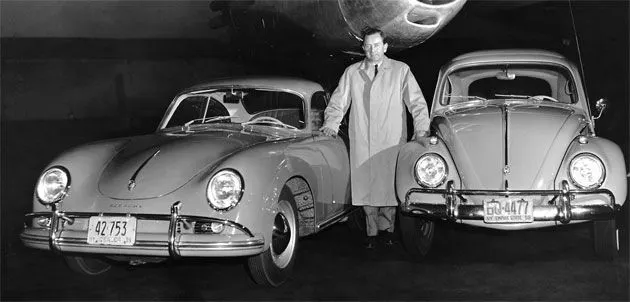
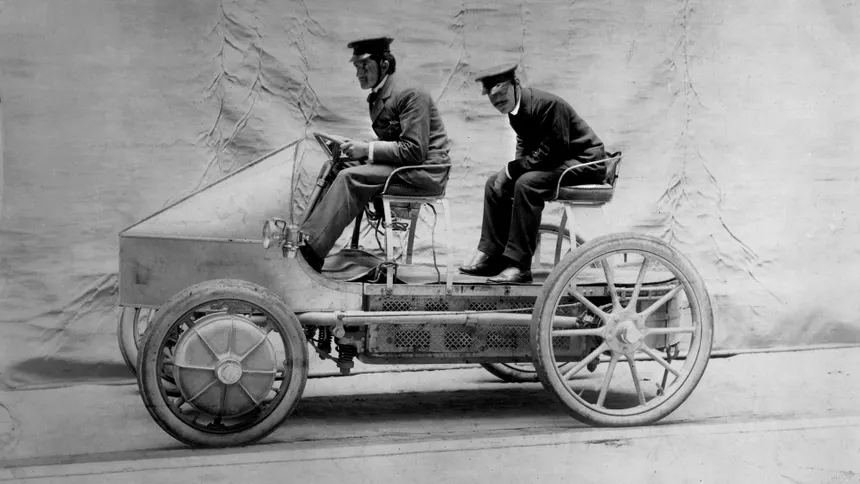
What Porsche patented at the turn of the century was not a car. It was a component: Austrian patent AT19645B, “drive steering wheel with electric motor.” It sounds like nothing. It was everything. Put the motor inside the hub and the car loses its gearbox, its clutch, its driveshaft, its entire transmission. In 1900, while the rest of the industry was fighting chains, belts and gear teeth that shattered every other Sunday, that was science fiction.
The electric Lohner-Porsche appeared at the 1900 Paris World’s Fair as the first automobile without a transmission. The racing version commissioned by Englishman E. W. Hart carried four hub motors, one per wheel, rated at 1,500 watts each, making it the world’s first all-wheel-drive car. Six kilowatts total. Under eight horsepower.
Here is the part the brand brochures skip. The batteries weighed roughly 1,800 kilos, around 4,000 pounds. A Benz Velo from 1894, a complete gasoline car with a driver aboard, weighed about 280 kilos. Porsche’s electric hauled six entire contemporary cars’ worth of lead just to move itself.
His fix was the series hybrid: a combustion engine that never touches the wheels and does nothing but spin a generator feeding the hub motors. First the Semper Vivus, then the production Mixte.
What matters here is the architecture. Combustion engine to generator to electric motor is exactly how a modern range extender works, the logic Chevrolet sold America as the Volt a hundred and ten years later. Porsche never let go of it.
The same idea, now towing artillery
He joined Austro-Daimler in July 1906 as chief engineer, aged thirty, and brought the hybrid with him. The car industry would not buy it. Too heavy, too expensive, too strange for private customers. The army bought it.
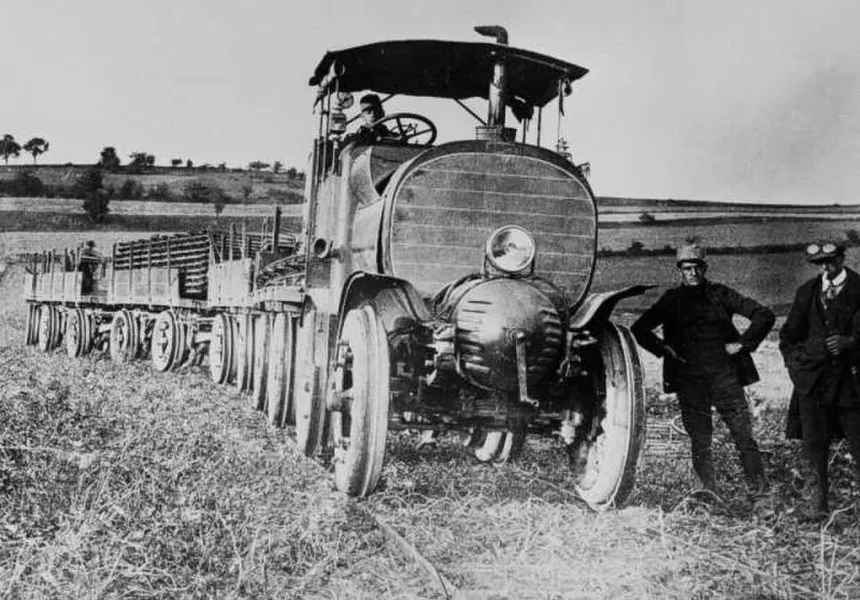
Out came the Daimler-Landwehr-Zug road trains: a gasoline tractor that functioned as a rolling power station, pulling a line of trailers with motors in the wheels. The A-Zug was built in 1908. The updated B-Zug entered series production in 1914, and 73 sets were built in Wiener Neustadt. The big one, the C-Zug, used a 150 hp M.16 tractor that towed nothing at all. It only generated current. Loaded, one of those trains could weigh 38 tonnes and still run at 24 km/h, roughly 15 mph.
Towing what? Škoda 30.5 cm siege mortars. Artillery pieces of 380 to 420 mm, broken down into five separate trains: left platform, right platform, carriage, barrel, ammunition.
That is the leap almost nobody spells out. Porsche’s hybrid did not fail and fade away. It found its market, and its market was heavy artillery. His military career started in 1908, not 1933. He was made general manager at Wiener Neustadt in 1917 and collected his first honorary doctorate from the Technical University the same year. Twice a doctor, never a graduate.
The car they painted red on the train so it wouldn’t get stolen
With the war lost and the empire dismantled, Porsche built the opposite of an artillery train: a tiny car.
The Austro-Daimler board wanted nothing to do with it. The money came out of the pocket of Count Alexander Kolowrat-Krakowsky, film producer, part-owner of the company, known to everyone as Sascha. Hence the car’s name.
The ADS-R weighed 598 kilos and ran a 1.1-litre four with twin bevel-driven overhead camshafts, eight inclined valves and 50 hp at 4,500 rpm. Lightness over brute power, the recipe Zuffenhausen has been repeating for a century, invented here by a man who had spent the previous decade moving 30.5 cm mortars.
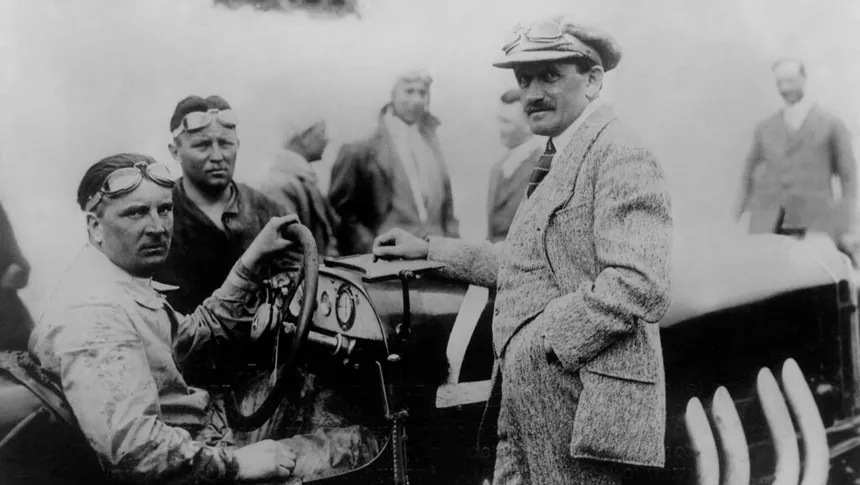
The four prototypes were finished barely in time for the Targa Florio of 2 April 1922, and one detail says more about the era than any spec sheet: they painted the aluminium bodies red on the train down to Sicily so the cars would attract less attention and not get stolen. To tell them apart at a distance, Kolowrat marked them with playing card suits. Hearts for himself. Diamonds for a young Alfred Neubauer, later the racing director of Mercedes and the man behind the Silver Arrows.
Four laps of 108 kilometres, 432 in total, some 6,000 corners and gradients up to 12.5 per cent. Of the three entered in the 1,100 cc class, Kolowrat’s retired with engine trouble and the other two finished one-two in class. The best of them came 19th overall against cars with three times the engine.
There is a Spanish footnote too: a few weeks later, on 21 May 1922, Neubauer was racing a Sascha at the Trofeo Armangué in Tarragona.
Fired for being too brilliant
From 1923 he worked at Daimler-Motoren-Gesellschaft in Stuttgart-Untertürkheim, with a seat on the board. He signed off the Mercedes S, SS and SSK, some of the most violent machinery of the 1920s.
After the merger with Benz, his contract was not renewed in 1928. The story that survives is a good one: the board wanted a less ingenious and more economical designer, somebody who would draw simple, solid things. He did a short stint as technical director at Steyr and returned to Stuttgart in 1930.
Mid-fifties, two honorary doctorates, a career full of race winners, and unemployed.
The three partners of 1931, and the one cropped out of the picture
The office was founded in 1931 under the name the brand still carries: “Dr. Ing. h.c. F. Porsche GmbH, design and consulting for engines and vehicles.” That is not a car manufacturer. It is an engineering consultancy, and Porsche would not sell a car with his own name on it until he was past seventy.
Three men set it up. Ferdinand Porsche put in the name and much of the capital. His son-in-law Anton Piëch brought the law practice. The third was Adolf Rosenberger: racing driver, businessman, the partner responsible for raising finance and turning drawings into running prototypes, holding ten per cent of the firm.
Rosenberger was Jewish. Remember him, because he comes back four sections from now and it does not end well.
Meanwhile, in 1932 came an offer of the kind that redirects a life. A delegation arrived from Moscow at the Stuttgart office and shortly afterwards Stalin invited him to the Soviet Union. They walked him through aircraft and car factories and offered him the job of running the development of the entire Soviet auto industry, with a villa, a salary, sweeping powers and unlimited funds to build a small car. He said no. Had he said yes, the Beetle would have been the Soviet people’s car.
The patent drawer nobody opens
This is where the man gets genuinely interesting, and where legend has no room to operate, because the filings are scanned, dated and signed.
- DE623747A: torsion bar suspension. Springing that fit where nothing else fit.
- DE583522A: shock-insensitive spindle steering.
- DE692180A: chassis for racing cars with the engine ahead of the rear axle. That is the mid-engine patent. There is not a single-seater on any grid today that ignores it.
- DE695718A: a system that in practice describes traction control. Anti-slip. In the 1930s.
- Plus a folding steering wheel to make getting in and out easier, because the man also worked on small useful things.
The Beetle’s two dress rehearsals
Before Hitler said a word about a car for the people, Porsche had already built the Beetle twice.
The first was project number 12 for Zündapp, the motorcycle maker: an “Auto für Jedermann,” a car for everybody, commissioned by Fritz Neumeyer. Porsche wanted an air-cooled flat-four and a swing rear axle; Zündapp forced a water-cooled five-cylinder radial on him. Three prototypes were running in 1932, 900 kilos, rounded shape, engine in the back. All three were lost in the war, the last of them in a bombing raid on Stuttgart in 1945.
The second was the Type 32 for NSU in 1933, this time with the flat-four he had wanted all along. NSU walked away from car manufacturing and the project died as a prototype.
So when the German auto industry association formally handed him the Volkswagen contract in 1934 on the regime’s instruction, Porsche was not starting from a blank sheet. He had the car already, paid for twice over by two motorcycle firms that never got to sell it. The Type 60 grew out of that, and the first two prototypes, V1 and V2, were ready in October 1935.
The visit to the Chancellery
The Auto Union story deserves telling in full, because it is the precise moment an engineer turns into something else.
At the 1933 Berlin Motor Show, newly in power, Hitler announced two programmes: a people’s car, and a state racing programme funded with 500,000 Reichsmarks a year. That money was earmarked for Mercedes.
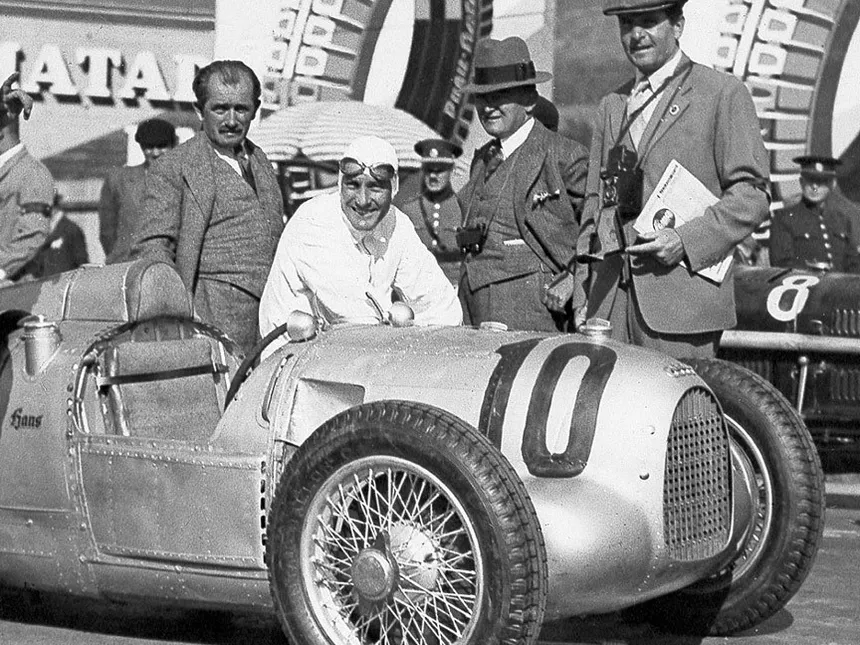
Porsche had the P-Wagen drawn and nothing to build it with. So he turned up at the Reich Chancellery accompanied by Auto Union chairman Baron Klaus von Oertzen, by driver Hans Stuck, who knew Hitler from before, and by his partner Adolf Rosenberger. They left with the subsidy split in two.
Hold that image: Porsche’s Jewish partner was part of the delegation that went to ask Hitler for money.
On track the result was carnage. A supercharged 4.4-litre V16 with the engine ahead of the rear axle, debut at Avus on 27 May 1934, and Stuck winning the German Grand Prix that same year. By 1936 the European Championship went to Auto Union three wins to one against Mercedes, and the Italians, who had owned racing through 1933 with Alfa Romeo and Maserati, were reduced to spectating.
That architecture had a Spanish tail, too. When engineer Wifredo Ricart designed the Alfa Romeo Tipo 512 for 1939-1940, with a twelve-cylinder boxer behind the driver, every account points back to the Auto Union example. First mid-engined Italian single-seater, two cars built, zero races run.
What happened to the third partner
Back to Rosenberger.
With the Nazis in power, the man who had put up the money and the contacts became a liability. He left the management board in 1933. In the summer of 1935 he was arrested on a charge of “Rassenschande,” racial defilement, over his relationship with a non-Jewish woman, and interned in the Kislau concentration camp in Baden. He was out within days thanks to the intervention of a company associate.
By the end of July that year he was pushed out as a partner. He had to hand over his ten per cent at nominal value, and the man who took the shares was Ferry Porsche. The final break came in 1937. Rosenberger went into exile, first to Paris and then to the United States, where he changed his name to Alan Robert and never got back on his feet. He died in Los Angeles in 1967.
He did file claims. A restitution settlement was reached in 1950, which the company acknowledges today: Rosenberger sought compensation on the grounds that he had been forced to leave Porsche because he was Jewish. That settlement closed the matter permanently. When Porsche went public in 2022 and the descendants of Ferdinand and Piëch were among the principal beneficiaries, Rosenberger’s family had no remaining claim to anything.
Porsche has since commissioned historian Joachim Scholtyseck to produce a full study of him, with the company archive and the family estate opened up, published in 2025. The company now acknowledges Rosenberger as a co-founder. At the 75th anniversary celebrations, the official story started in 1948.
The Beetle has too many fathers
Big successes attract relatives, and in this case the relatives have paperwork.
Josef Ganz had already developed the Maikäfer and the Standard Superior, which frame the whole concept. Béla Barényi, later the inventor of the crumple zone at Mercedes, claimed the conceptual package and ended up in court after the war. Karl Rabe, Porsche’s right hand for decades, contributed what chief engineers contribute, which is most of it. Erwin Komenda is named as inventor on Porsche’s 1936 body patent DE744982A, and the drawings in that document are the Beetle’s silhouette, full stop. Even the swing rear axle was not in-house: Edmund Rumpler invented it.
Then there is Hans Ledwinka. The Czech Tatra 97, with its air-cooled rear boxer four and central structural tunnel, anticipated far too much of the KdF-Wagen. Tatra sued for patent infringement. The German occupation of Czechoslovakia in 1939 made the lawsuit disappear and forced Tatra to stop building the 97 into the bargain.
This is where precision matters, because the story gets stretched in both directions. The case reopened after the war and Volkswagen paid Ringhoffer-Tatra three million marks in an out-of-court settlement in 1961. That was not a verdict for copying the whole car: the Düsseldorf court threw out part of the patents invoked, and what survived turned on air cooling.
What is not in dispute is how each man ended up. Postwar Czechoslovakia arrested Ledwinka for collaboration and gave him six years of hard labour. He was released in 1951, offered the top job at Tatra, turned it down and retired to Austria. Porsche walked out of prison into a contract paying him a fee on every Beetle built anywhere in the world.
The largest pre-order scam in automotive history
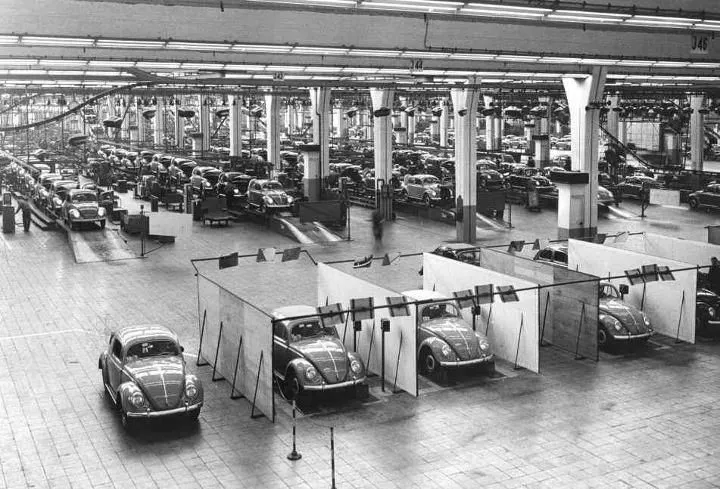
The people’s car cost 990 Reichsmarks against an average wage of about 32 a week. Since the German Labour Front had no money to build the factory, it asked the future customers for it.
It worked like this. You bought a Sparkarte for one mark and stuck five-mark stamps on it, at least one a week. Four cards of fifty spaces each. You needed 198 stamps, close to four years of discipline, and then you still had to add 200 marks of compulsory insurance and 60 more if you wanted the car delivered.
Around 700,000 people signed up. About 336,000 completed their payments. More than 380 million marks were collected.
Not one civilian ever received a car. The handful of KdF-Wagen that did leave the plant went to military officers and party officials, who were seen out in them precisely so the savers would keep buying stamps. The money sat in the Labour Front treasury, in a bank that ended up in the Soviet zone, and vanished.
The savers sued after the war and the case dragged on for more than a decade. The settlement came in October 1961: they would be paid according to what they had put in, but converted at the value of the Deutsche Mark rather than the Reichsmark. The ceiling was a 600-mark credit against a new car, roughly twelve per cent of the price. The last payments went out in 1970.
Four years of stamps for twelve per cent of a Beetle, three decades late. That was the people’s car.
The referee who was also a bidder
Porsche renounced his Czechoslovak citizenship in 1934 at Hitler’s insistence and took German nationality. He joined the Nazi party in 1937, membership number 5,643,287. He collected the German National Prize for Art and Science in 1938, the award Hitler created to rival the Nobel, alongside Messerschmitt, Heinkel and Todt. He publicly backed the Anschluss. He was named Wehrwirtschaftsführer, a leader of the war economy, in 1939. He joined the Allgemeine SS as an Oberführer in January 1942 and received the SS death’s-head ring in March 1944.
But the appointment that matters is a different one. A secret decree of 21 June 1941, signed by armaments minister Fritz Todt and army ordnance chief Friedrich Fromm, created the Panzerkommission, the body that decided which tanks Germany developed, produced and tested. Its chairman: Ferdinand Porsche.
Read that again. The man chairing the body that handed out armour contracts was, at the same time, one of the contractors bidding for them. Historians who have worked the records are blunt about it: members represented their own firms and expected an edge in the awards, Porsche above all, and some argue outright that he used the chair to kill off rival designs.
It lasted until 31 December 1943, when he was removed and replaced by Gerd Stieler von Heydekampf. The reasoning is textbook: the genius who designed without regard for how things get manufactured was swapped for a production specialist. Across two and a half years in the chair, his own projects had been a rout.
The VK 30.01 (P) went nowhere. The VK 45.01 (P) lost the Tiger contract to Henschel, and something had to be done with the 91 hulls already built, so they became turretless tank destroyers with a fixed 88 mm gun, 65 tonnes apiece, thrown into Kursk in 1943. The original nickname of that thing was Ferdinand. It is the only vehicle in history to carry his first name, and it was a 65-tonne failure. Then came the Maus, an absurdity of nearly 190.
And what was inside them? Electric transmission. Combustion engine, generator, electric motors driving the tracks. The same architecture as the Paris carriage of 1900, forty years and a world war later.
Fallersleben
At Fallersleben, the KdF-Wagen town now called Wolfsburg, out came Kübelwagen, Schwimmwagen, aircraft parts, bombs and later the V1. His son-in-law Anton Piëch ran the factory. The family firm became a limited partnership in 1937 with Ferry, Louise and Piëch inside, which is where the ownership web that still governs Volkswagen and Porsche begins.
The labour was supplied by the regime. Around 20,000 people performed forced labour in that plant between 1940 and 1945. Roughly 4,800 were Ostarbeiter deported from the Soviet Union, and some 850 were Soviet prisoners of war. Concentration camp prisoners followed.
Porsche did not simply accept what was sent to him. In October 1941 he was among the first industrialists to personally ask Himmler for Soviet POWs as forced labourers, and in 1942 he asked Hitler directly for concentration camp prisoners. He asked. In writing. Both of them.
And there is a corner of that factory that never appears in a car story. Pregnant deportees stopped being sent home in December 1942 because the plant needed hands. Babies were born in the barracks and, from June 1944, taken to a home in Rühen, separated from their mothers within days of birth so the women could be put straight back to work. 365 infants died there of neglect and malnutrition. The factory doctor, Hans Körbel, was sentenced to death by the British and executed in 1947.
Volkswagen does not hide any of this. It commissioned independent research from historian Hans Mommsen in 1986, placed a memorial stone on the site in 1991, opened a humanitarian fund in 1998 and has run a permanent memorial in a former air-raid bunker under the plant since 1999. Porsche has a plaque for forced workers in front of its historic factory.
None of it is a footnote to his technical biography. It is his technical biography. The cars that came out of there were built by those people.
Dijon, the Italian ransom and the deal of the century
French authorities arrested him on 15 December 1945 along with Ferry and Piëch. Baden-Baden first, then Paris, held in the porter’s lodge of a Renault villa, then jail in Dijon. Ferry got out after six months. Ferdinand and his son-in-law served close to twenty.
The war crimes case collapsed on its own. Porsche’s own historians now hold that the detention had an economic basis, with Renault and Peugeot fighting over who got the man capable of designing them a people’s car. He was formally acquitted in May 1948.
Italy paid the bill. Piero Dusio wanted a Grand Prix car for Cisitalia and advanced contract money; one million francs of it ended up with the French authorities as bail. Bail is the polite word. He walked out in the summer of 1947 at seventy-one, and the first thing he did was study the drawings of the Type 360 his son and Karl Rabe had produced while he was inside, concluding that he would have done it the same way.
And then, at seventy-three, he signed the best deal of his life.
At Bad Reichenhall in September 1948, Ferdinand, Ferry, Louise and Anton Piëch signed a contract with Heinrich Nordhoff, the new managing director of Volkswagenwerk, covering four things: a licence fee on every Beetle manufactured, permission to series-produce a sports car based on the Beetle, sales and service through the Volkswagen network, and the general Volkswagen import concession for Austria.
Translated: a cut of every single unit of the most-produced car of the twentieth century. A car whose authorship was contested by Ganz, Barényi, Komenda and Tatra. A car built in a factory raised on slave labour. A car 336,000 Germans had paid for in advance and never received.
That licence and that Austrian franchise are the financial floor under both halves of the empire: the Zuffenhausen factory and Porsche Holding in Salzburg, which grew into the largest car distributor in Europe. Draw a straight line from there and you arrive at today, with the Porsche-Piëch family controlling the Volkswagen Group through Porsche SE.
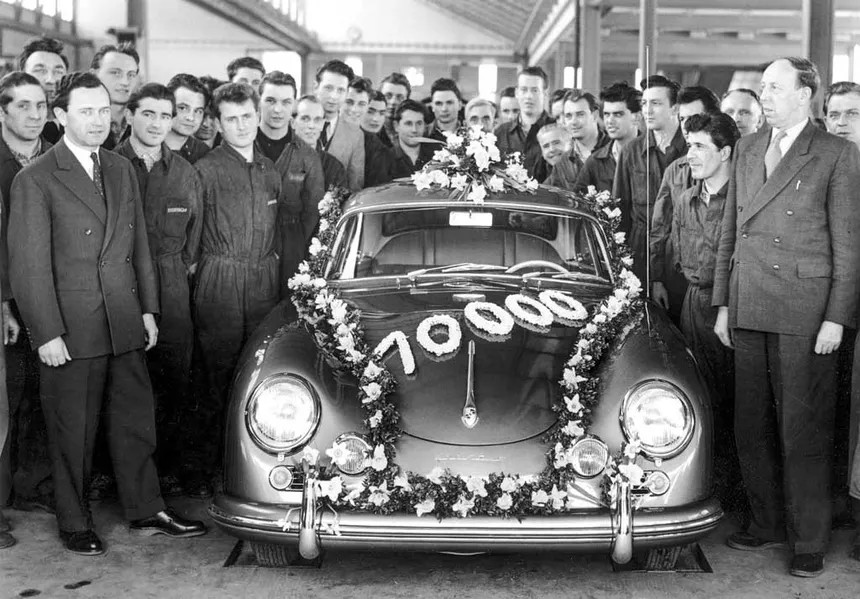
In a converted sawmill in Gmünd, Carinthia, 49 units of the 356 were built by hand. Ferdinand lived to see series production start in Zuffenhausen. He died in Stuttgart on 30 January 1951, aged seventy-five.
The verdict
Ferdinand Porsche has been sanded down into a saint of engineering because the sanding sells. The visionary who invented the hybrid in 1900 is a better product than the consultant who spent forty years shopping the same electric transmission to the highest bidder, and whose highest bidder was almost always an army. It is worth remembering who started manufacturing that myth: the national-genius story was assembled from regime prizes and regime propaganda in the 1930s, and the postwar years inherited it and changed the wrapper.
For the record: the torsion bar, the mid-engine layout, anti-slip control and that 598-kilo Sascha are his, and they are enormous. But run down the list of who put in what and who walked away with what. Rosenberger put up the money and ended up in Kislau, signing away his ten per cent at nominal value and dying in Los Angeles under another name. Ledwinka, who only ever built cars, served six years of hard labour. The 336,000 KdF savers collected twelve per cent of a car three decades later. And the man who chaired the commission awarding the contracts he was bidding for walked out of prison to sign a royalty on every Beetle on the planet, the money that ended with his family controlling Volkswagen.
That is not bad luck and it is not the circumstances of the age. That is a business model.
Check you’re still alive.
2 thoughts on “FERDINAND PORSCHE”