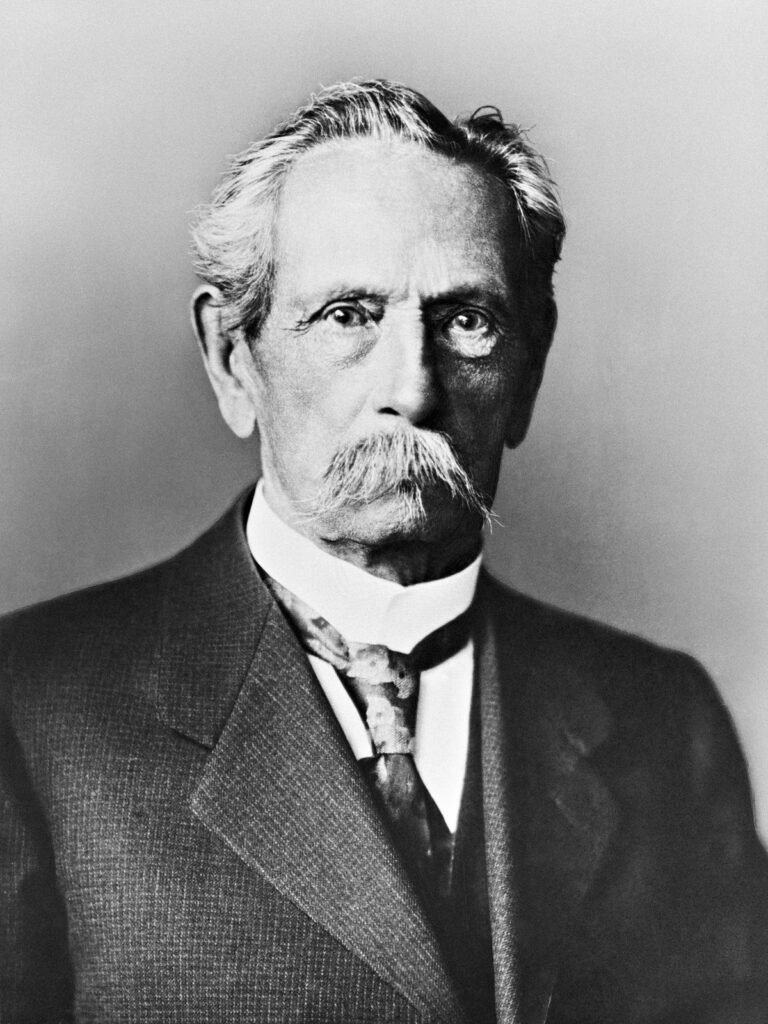
Carl Benz: pushed out of his own company for being too slow
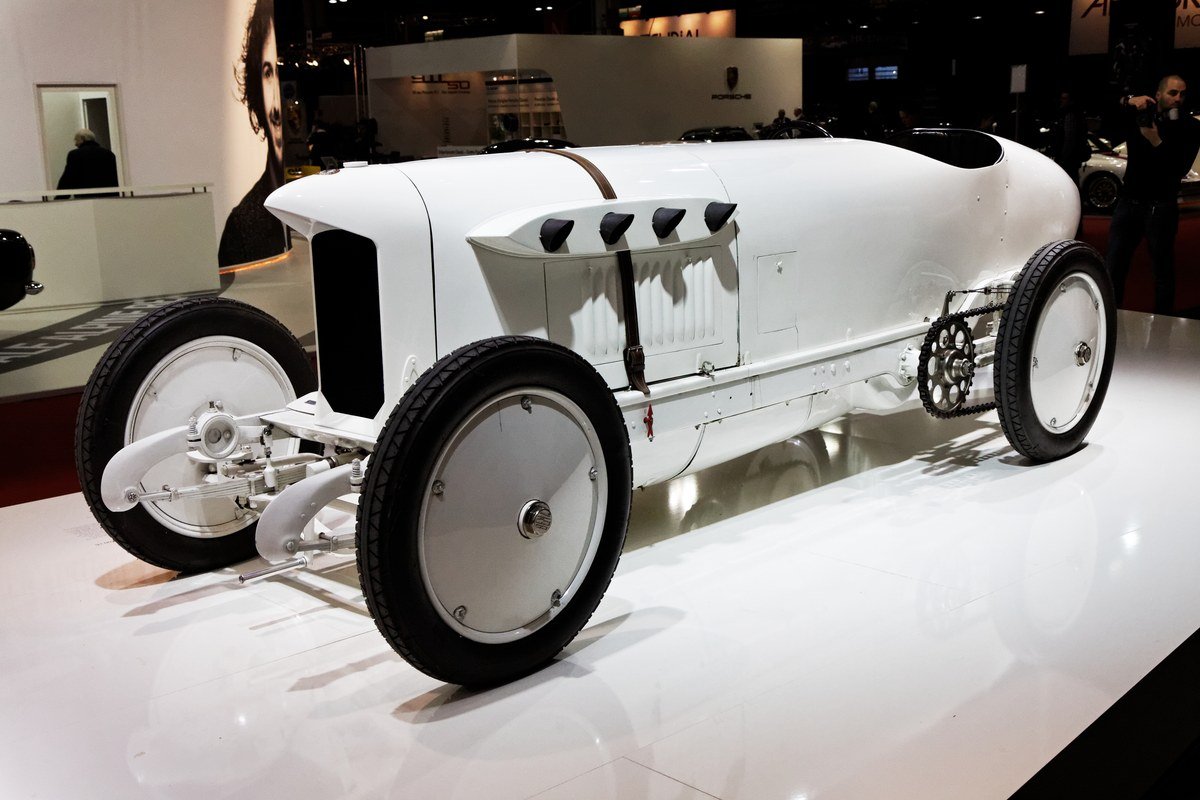
On 23 April 1911, on the hard sand at Daytona Beach, Bob Burman ran a flying mile at an average of 228.1 km/h, about 141.7 mph. No human being had ever traveled faster on land, at sea or in the air. The car was a German monster with a 21.5-liter four-cylinder engine and a nose shaped like a bird’s beak, and it had the word BENZ painted on the side.
Carl Benz had nothing to do with it. Eight years earlier, the board of the company that carried his name had hired a 25-year-old Frenchman to redesign its cars, presented him to the public as the man behind the new Benz range, and watched the founder walk out the door. Benz thought cars were getting too fast and wanted nothing to do with racing. Daytona was the answer from the company he’d left.
The 1886 tricycle is what everybody remembers about him. The firing in 1903 doesn’t get told.
Henry Ford’s story, reversed
Americans already know a version of this story, just reversed. In March 1902 Henry Ford walked out of the Henry Ford Company in Detroit after a fight with his financial backers, William Murphy and Lemuel Bowen. Their complaint was that Ford was spending too much time on racing and his 999 race car. He left with his name and $900. The investors brought in Henry Leland, renamed the firm after the founder of Detroit, and it became Cadillac.
Ten months later in Mannheim, the same kind of argument ended the other way round. Benz’s partners wanted racing, speed and a modern lineup. The founder said no, and the founder was the one who had to leave.
Born Karl Vaillant
The man whose name sits on half the luxury sedans in Beverly Hills wasn’t born with it. He came into the world on 25 November 1844 in Mühlburg, now a district of Karlsruhe, registered as Karl Friedrich Michael Vaillant. His mother, Josephine Vaillant, was unmarried. His father, Johann Georg Benz, was a locomotive driver who married her a few months later, which under Baden law gave the boy the Benz surname. The father died when Karl was two. Benz’s own memoir says it was pneumonia, and some later accounts tell a railway-accident story. We’re going with his memoir.
Karl or Carl? Both, and it’s his fault. Birth records, his enrollment at the Karlsruhe Polytechnic, which he passed into at fifteen, and his first engine patent of 1880 all say Karl. Later, when the French spelling became fashionable among German businessmen, he started signing Carl. Writers have been stuck with both versions ever since.
Bertha’s dowry
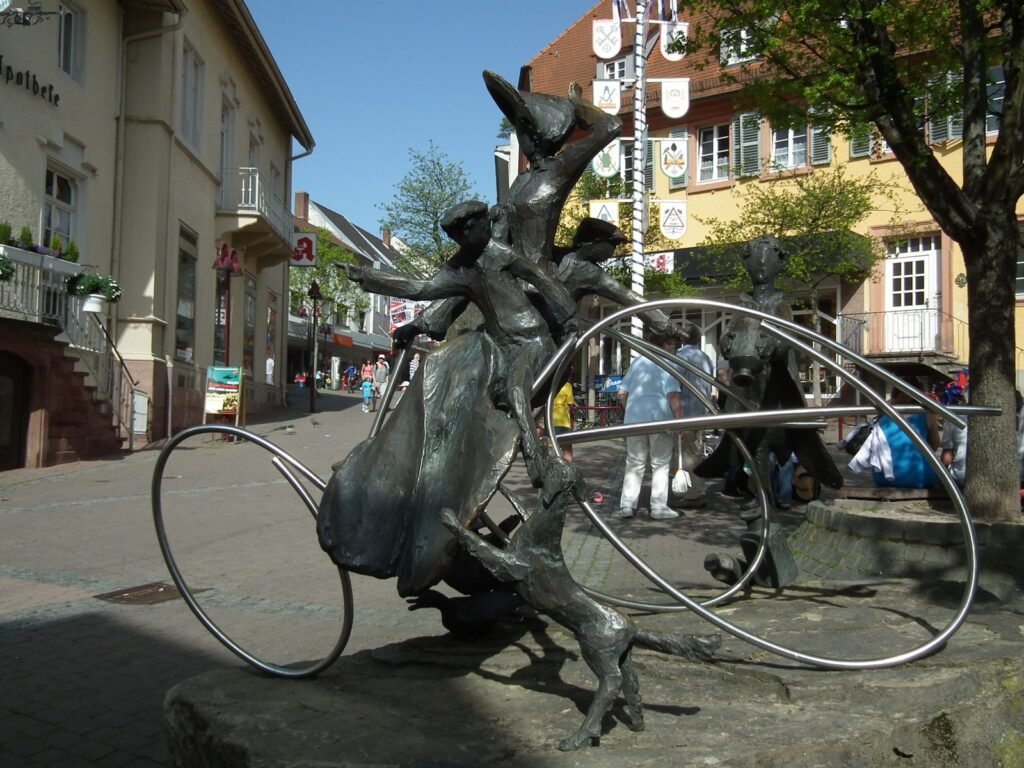
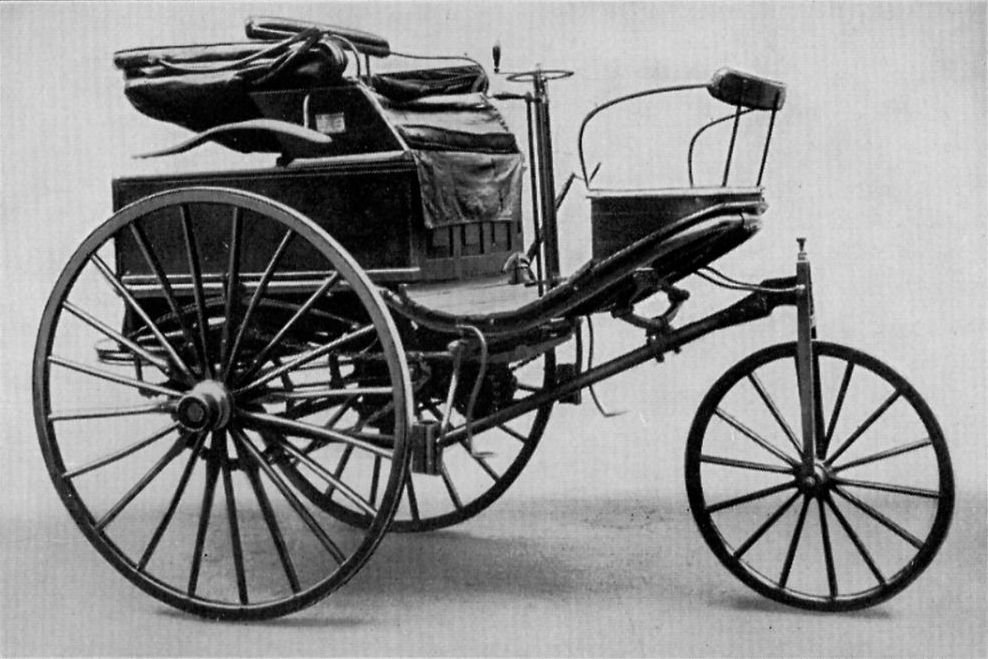
The money wasn’t his either. Bertha Ringer, born in Pforzheim on 3 May 1849 into a wealthy family, put part of her dowry into Karl’s struggling iron construction business in 1870, two years before they married. As a single woman she could invest. Once she married him in July 1872, German law took away her power to act as an investor in her own right. She kept funding the work anyway. Women weren’t allowed into university in Baden, so the engineering she knew she learned at his side. When Benz filed patent DRP 37435 for his motor car on 29 January 1886, her name couldn’t legally go on it.
Then on 5 August 1888 she took the car without telling him. She drove a Patent-Motorwagen with her sons Eugen, fifteen, and Richard, thirteen, from Mannheim to her hometown, Pforzheim, about 106 kilometers (66 miles), the first long-distance drive in automotive history. The car had no fuel tank: about 4.5 liters of fuel sat in the carburetor. The fuel was ligroin, a petroleum solvent sold by pharmacists, so she refilled at the town pharmacy in Wiesloch, which now calls itself the world’s first filling station. The boys pushed the car up the hills because two gears weren’t enough. A blacksmith fixed a chain. When the wooden brake blocks wore down, a cobbler nailed leather onto them, and that was the first brake lining. She reached Pforzheim after dark and sent her husband a telegram.
For scale, Benz’s own memoir describes his first production car of 1888 as having 1.5 horsepower, two speeds, a top speed of around 16 km/h (10 mph) and a price of 3,000 marks. The original 1886 machine had two-thirds of a horsepower at 400 rpm. A modern riding lawn mower has more than ten times as much. That’s what Bertha took over the hills of Baden.
Germany didn’t want it
The part German industrial mythology skips is that Germans didn’t buy the car. The French did.
Benz’s first sale went to Émile Roger, a Paris bicycle maker who had been buying Benz stationary engines for years. In 1887 Roger came to Mannheim, rode in the motor car and bought one. He became Benz’s agent in France, and as far as historians can tell, until about 1890 almost every Benz sale went through Roger in Paris. Panhard & Levassor got a Benz from him as early as 1888. In a 1914 letter to the director of the Science Museum in London, Benz wrote that production only took off after Roger made the car known in Paris. He also summed it up himself: Germany was the father of the automobile, and France was the mother.
The early production numbers are a mess, and some American automotive writers argue that the tidy 1886 birthday is more marketing than history, laid over a century of earlier tinkering. You don’t need to buy that argument completely to see that the official story has been cleaned up quite a bit.
The engineering that got forgotten
The tricycle story also hides that Benz kept inventing after 1886, and some of his best work came later.
Why three wheels in the first place? Because nobody had solved steering for two front wheels. When a car turns, the inside wheel follows a tighter circle than the outside one, so each wheel needs its own angle. Benz worked out a double-pivot steering system, patented it in 1893, and put it in the Victoria that same year. The following year came the Velo, a light, cheap four-wheeler built from 1894 to 1902 in more than 1,200 units. Most historians count it as the world’s first standardized production car. A Velo also took part in the 1894 Paris-Rouen, the first motor competition ever held.
Then the boxer. In 1896 Benz patented an engine with two cylinders lying flat, facing each other, so their pistons punch outward and inward at the same time and cancel out each other’s vibration. A year later Benz & Cie. unveiled it as the “contra engine.” It’s the horizontally opposed layout later used by the Volkswagen Beetle, the Porsche 911, BMW’s motorcycles and Subaru. The first patent belongs to the man his own board considered an obstacle to progress.
The numbers in Mannheim
By 1900 Benz & Cie. was the largest car manufacturer in the world, building around 600 cars a year. Then Stuttgart shipped the Mercedes 35 hp.
Designed by Wilhelm Maybach and Paul Daimler for Emil Jellinek, an Austrian businessman and diplomat living in Nice, the 1901 Mercedes was low, long, with a honeycomb radiator and a pressed-steel frame. It made every Benz look like a horse cart with an engine. Jellinek had named his racing entries after his ten-year-old daughter, Mercédès, and Daimler-Motoren-Gesellschaft adopted the name for the cars. DMG had a practical reason too: it had sold exclusive license rights abroad and couldn’t use the Daimler name everywhere. So the most famous badge in the business exists partly because Daimler couldn’t legally call itself Daimler.
The Mercedes cars won races from 1901 on, and the damage in Mannheim was quick. According to the Mercedes-Benz archive, Benz & Cie. built just 198 cars in 1903, a third of its 1900 output, while DMG went from 133 to 181. The two rivals ended up with practically the same market share. Carl Benz still refused to go racing.
Julius Ganß, a partner since 1890 and commercial director since 1899, stopped waiting for him. In late 1902, on his own authority, he hired Marius Barbarou, born in Moissac in the south of France on 28 October 1876, a blacksmith’s son who had learned his trade at Panhard & Levassor in Paris and designed engines for Clément. Five French engineers came with him and set up a design office of their own, alongside the German office Benz still controlled. Their brief was a modern range plus a racing car that could beat Mercedes.
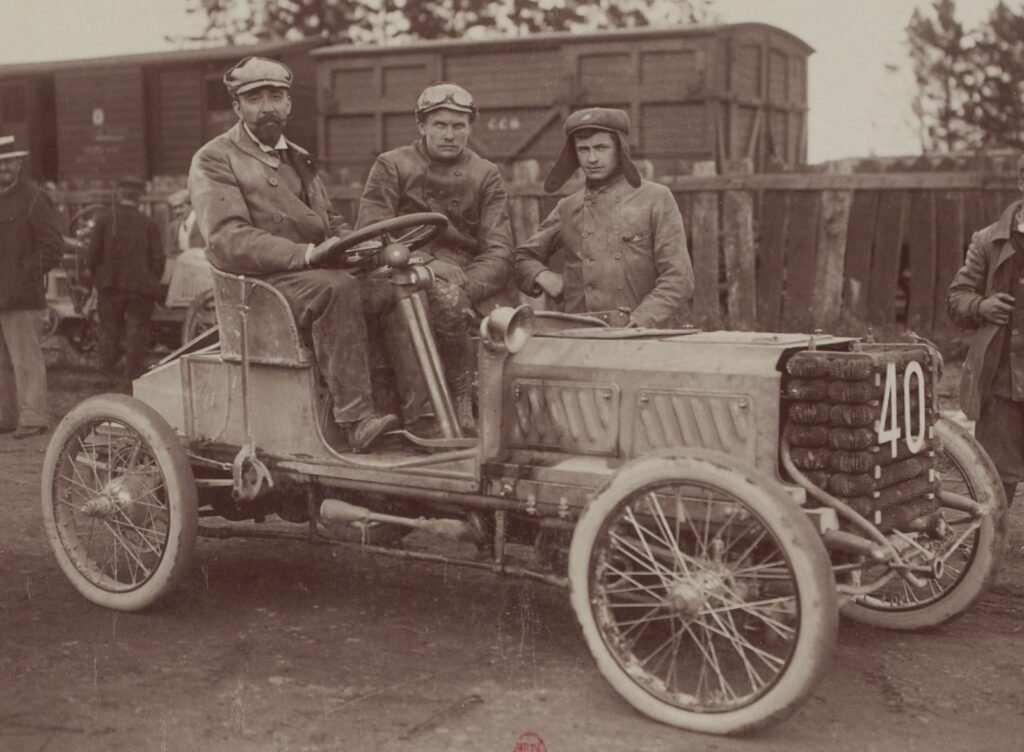
The result was called Parsifal. The racing version had a new four-cylinder engine of 11,260 cc with dual ignition, 60 hp, three speeds and a driveshaft instead of chains. When Barbarou was presented to the public as the designer of the new Benz cars, Carl Benz took it as an insult and left. The Mercedes-Benz archive says it openly: the modernization backlog was “caused primarily by Benz himself.” On the exact date, the company archive gives 24 January 1903 for the end of his work at the firm, while some German sources say April.
The race to Madrid
The Parsifal’s first big outing was the most notorious motor race in history. Paris-Madrid was planned as three stages and 1,307 kilometers, with stops in Bordeaux after 552 kilometers and in Vitoria, in the Basque Country, before the finish in the Spanish capital. Of 315 entries, 224 cars started from Versailles before dawn on 24 May 1903, the first at 3:45 a.m. Crowds stood in the road. Half the field didn’t make Bordeaux. Marcel Renault, co-founder of the company, died near Couhé-Vérac, and spectators and mechanics died along the route. The French government stopped the race in Bordeaux, declared those results final, and wouldn’t even let the cars drive themselves to the train station. They went home by rail. Spain never saw a single car arrive. City-to-city racing on open roads was finished in Europe.
Barbarou drove the 60 hp Parsifal, race number 33. It turned out to be heavier than its weight class allowed, and he finished 46th. Later that year the team stripped off the hood panels, bodywork and fenders and drilled holes in the suspension to save weight, and Barbarou won a hill climb at Huy and a class at Spa in Belgium. But the picture that stays is May 1903: a car with the Benz name racing toward Madrid with a Frenchman at the wheel, while the man whose name was on it had already left his own company.
The Parsifal didn’t save Benz & Cie. Barbarou went back to France after the 1903 season and designed luxury cars for Delaunay-Belleville and aero engines for Lorraine-Dietrich. Ganß left too. In 1904 Benz came back, but only as an advisory member of the supervisory board. They gave him a seat once there was nothing left for him to run.
Ladenburg, then Daytona
In 1906 Benz, Bertha and their sons Eugen and Richard started over in Ladenburg, a small town about ten kilometers from Mannheim, with a family firm called C. Benz Söhne, with no outside shareholders this time. They built their own cars, separate from the Mannheim factory, and some ended up as London taxis. Benz handed the business to his sons in 1912.
Mannheim, meanwhile, went all in on speed. In 1909 Benz & Cie. built the 200 hp Benz, a four-cylinder of 21,504 cc, still the largest engine ever put in a car by Mercedes-Benz or its predecessors, with a 407-kilogram engine producing 200 hp at 1,600 rpm. The goal, in the factory’s own words, was to beat 200 km/h and go faster than any airplane or train. In November 1909 at Brooklands in England, Victor Hémery did 202.6 km/h over the flying kilometer. Airplanes that year topped out around 77 km/h.
Europe didn’t have a place to run it any faster, so the car went to America. Promoter Ernie Moross traded in his 150 hp Benz Grand Prix car, added $6,000 and had chassis number one shipped over in January 1910. He named it the Lightning Benz. In mid-March 1910 Barney Oldfield took it to Daytona and raised the world record over the flying mile to around 211 km/h, about 131 mph. Then Bob Burman, who had made his name on the Buick factory team, took it back to the sand and set the 228.1 km/h record on 23 April 1911, his 27th birthday. The Paris authorities never ratified it, but it stood as the fastest speed on record until 1919. A month later Burman lined up for the first Indianapolis 500 in a Benz, after exhibition runs in the Lightning Benz that got him crowned “speed king” before the start. He died racing in Corona, California, in 1916.
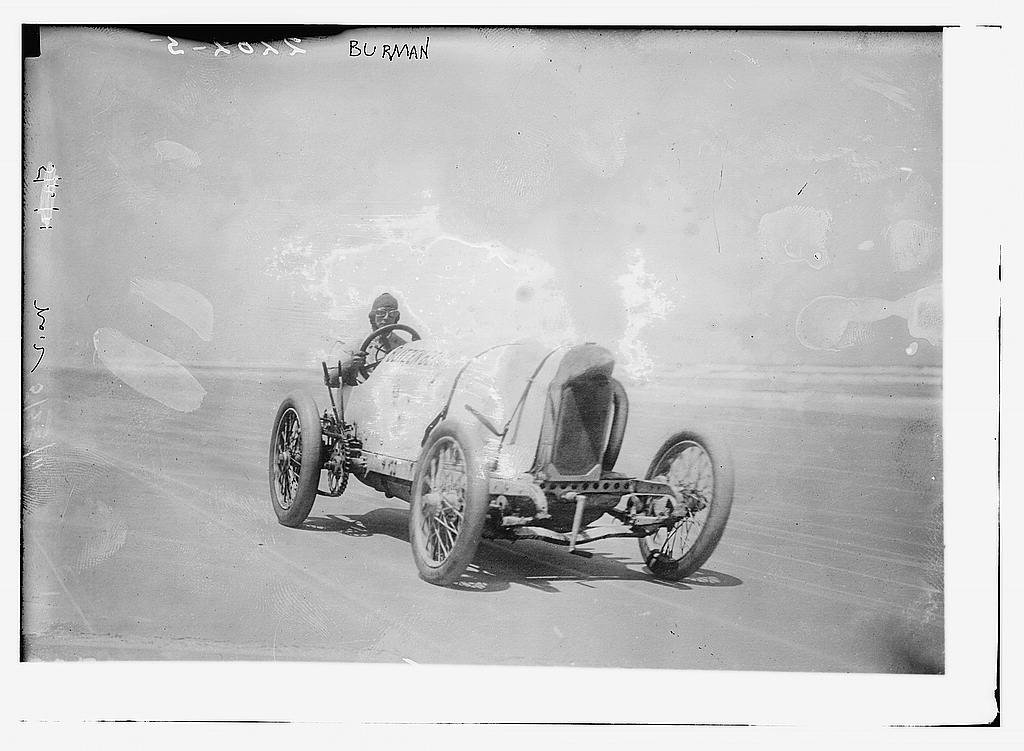
The man who left because he refused to chase speed lived to see his name on the fastest machine in the world.
Daimler-Benz
The two old rivals signed a cooperation agreement in 1924 and merged on 28 June 1926 as Daimler-Benz AG. Carl Benz sat on the board for the rest of his life. There’s no evidence that Benz and Gottlieb Daimler, who worked a little over a hundred kilometers apart, ever met. Daimler had died in March 1900. In 1925, at eighty, Benz published his memoir, Lebensfahrt eines deutschen Erfinders (“A German inventor’s journey through life”). He died at home in Ladenburg on 4 April 1929, aged eighty-four, of bronchial inflammation. Bertha lived until 1944.
NEC verdict
Benz & Cie. was right to do it. In 1902 the products were old, Mercedes was taking their customers and their headlines, and the founder wouldn’t budge. Hiring Barbarou was cold and brutal, and it was the correct call, the same call Ford’s backers made in Detroit, only from the opposite side.
Today’s Mercedes doesn’t hide it either: the archive page for a 1903 racing car says plainly that Benz walked out and that the delay was his fault. The problem is where that page lives. The founder’s story that gets the anniversaries, the museum hall and the commercials stops in 1886, with a tricycle and a patent. The company’s racing archive is where you find out Benz lost the argument about the future of his own company and that his name was on the fastest car in the world eight years after he left.
Check you’re still alive.
Photos: 1909 Blitzen Benz at Rétromobile, Thesupermat (CC BY-SA 3.0); Bertha Benz monument in Wiesloch, 4028mdk09 (CC BY-SA 3.0); portrait of Carl Benz, production Patent-Motorwagen, Marius Barbarou in 1902 (Jules Beau) and Bob Burman with the Blitzen Benz (Library of Congress), public domain. Via Wikimedia Commons.