Spyker 60HP: the 1903 Dutch race car that had a straight-six, 4WD and four-wheel brakes first
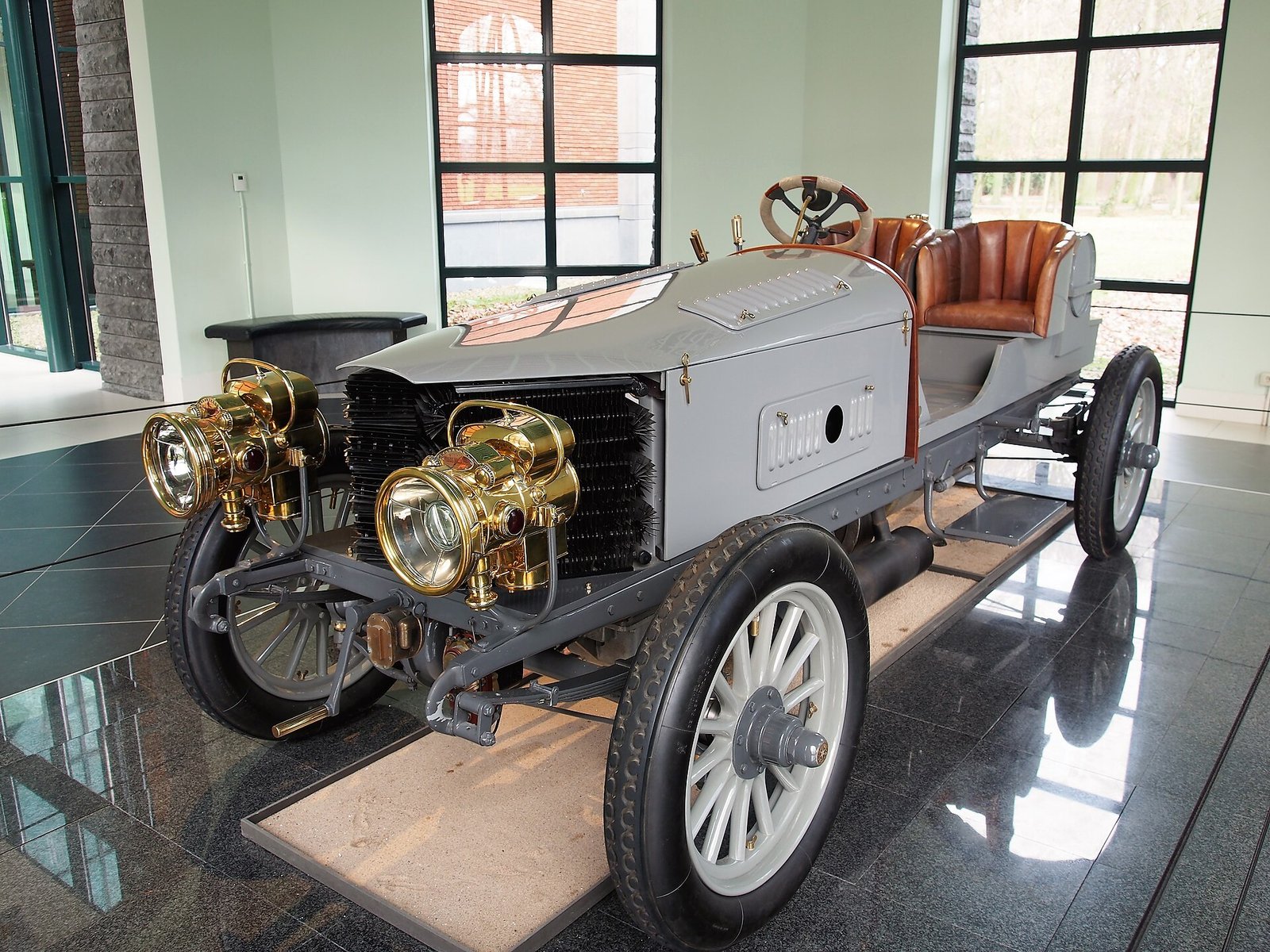
Ask an American where four-wheel drive came from and you’ll hear the same answers every time. The Jeep that won World War II. Maybe the Wisconsin trucks of the FWD Auto Company. Ask where the straight-six came from and somebody will mention Ford or Chevy’s old Stovebolt. Ask who put brakes on all four wheels first and you might get Duesenberg. All of those answers are wrong by years, in some cases by decades. The car that did all three first was built in Amsterdam by two coachbuilding brothers and a young Belgian engineer, and it was finished in 1903, the same year the Wright brothers flew at Kitty Hawk. It’s called the Spyker 60HP, there’s exactly one of it, and almost nobody outside the Netherlands has heard of it.
Coachbuilders to a queen
The Spijker brothers, Jacobus and Hendrik-Jan, started out in 1880 as blacksmiths and carriage builders in Hilversum. Two decades of careful work for wealthy customers earned them a reputation, and in 1898 it paid off in the most visible way possible. The brothers built the Golden Coach, the Gouden Koets, a gilded ceremonial carriage presented to the young Queen Wilhelmina. The Dutch royal family still uses it for state occasions. For a carriage shop it was the equivalent of building the presidential limousine.
The same year, the brothers made two smart moves. They moved to Amsterdam and changed the spelling of the name to Spyker, with a y, because nobody outside the Netherlands could pronounce Spijker. And they started looking at the horseless carriage. Their first efforts used Benz engines under bodywork they built themselves. By 1900 they were making complete cars. Within two years Jacobus had decided he wanted to build the most advanced racing car in the world.
The Belgian with a six-cylinder in his notebook
The man who made that possible was Joseph Valentin Laviolette, a young Belgian engineer who joined Spyker in 1902. He brought a design that the rest of the industry considered impractical: six individual cylinders standing on a common crankcase, fed by a single Zenith carburetor, with camshafts on either side of the crankshaft driven by exposed chains, and one spark plug per cylinder.
Context matters here. In 1902 most cars ran one or two cylinders. Four was ambitious. The Model T was still six years away, and Henry Ford was busy trying to keep his second company alive. The 60HP’s engine displaced 8,676 cc, according to the Louwman Museum, which owns the car. That’s 529 cubic inches, about the same as a modern big-block V8, split across six cylinders of roughly a liter and a half each. Spyker claimed 60 horsepower, which gave the car its name, and a top speed around 110 km/h, or 68 mph.

To put that number in perspective: in July 1903 Arthur Duray set the world land speed record at about 84 mph in a Gobron-Brillié, and in January 1904 Henry Ford himself drove his 999 racer across the frozen surface of Lake St. Clair at 91 mph to take the record. Those were cars built for nothing but straight-line speed. The Spyker was meant to race on open roads across two countries.
A driveshaft that went both ways
The engine was only the beginning. Every car of the period sent its power to the rear wheels and nothing else. Laviolette took the propeller shaft coming out of the gearbox and ran it forward as well, to a driven front axle. The car had three differentials, one at each axle and one in the center, so the front and rear could turn at different speeds through corners. It was permanent four-wheel drive, on a gasoline-powered car, in 1903.
Steam vehicles had experimented with driving more than one axle, and people had sketched the idea on paper. What Spyker did was build it and make it run in a car meant for racing. The FWD Auto Company of Clintonville, Wisconsin, which supplied thousands of four-wheel-drive trucks to the US Army in World War I, wasn’t founded until 1909. The Jeep came in 1941.
Then Laviolette added brakes. Most cars of the day stopped with a brake acting on the rear axle or the transmission, while the front wheels rolled freely. The Spyker had drum brakes on all four wheels plus a transmission brake. In America, the Duesenberg Model A of 1921 is usually credited as the first production car with four-wheel hydraulic brakes. The Spyker had four-wheel brakes eighteen years earlier.
What it took to make it work
Building a four-wheel-drive car in 1903 wasn’t just a matter of adding a second driveshaft. The front wheels had to steer and be driven at the same time, which means the power has to reach a wheel that is turning left and right while the suspension moves up and down. Modern cars solve that with constant-velocity joints. Laviolette had nothing of the sort available off the shelf, and the details of how he arranged the front drive are one of the things the Louwman restoration team had to reconstruct from period evidence.
Then there’s the center differential. Without one, a car with both axles locked together fights itself in every corner, because the front wheels travel a longer path than the rears. Tires scrub, the drivetrain winds up, and on a paved road something eventually breaks. Spyker’s third differential let the front and rear turn at different speeds, which is exactly what a modern full-time four-wheel-drive system does. It’s the same basic arrangement the Audi Quattro used in 1980.
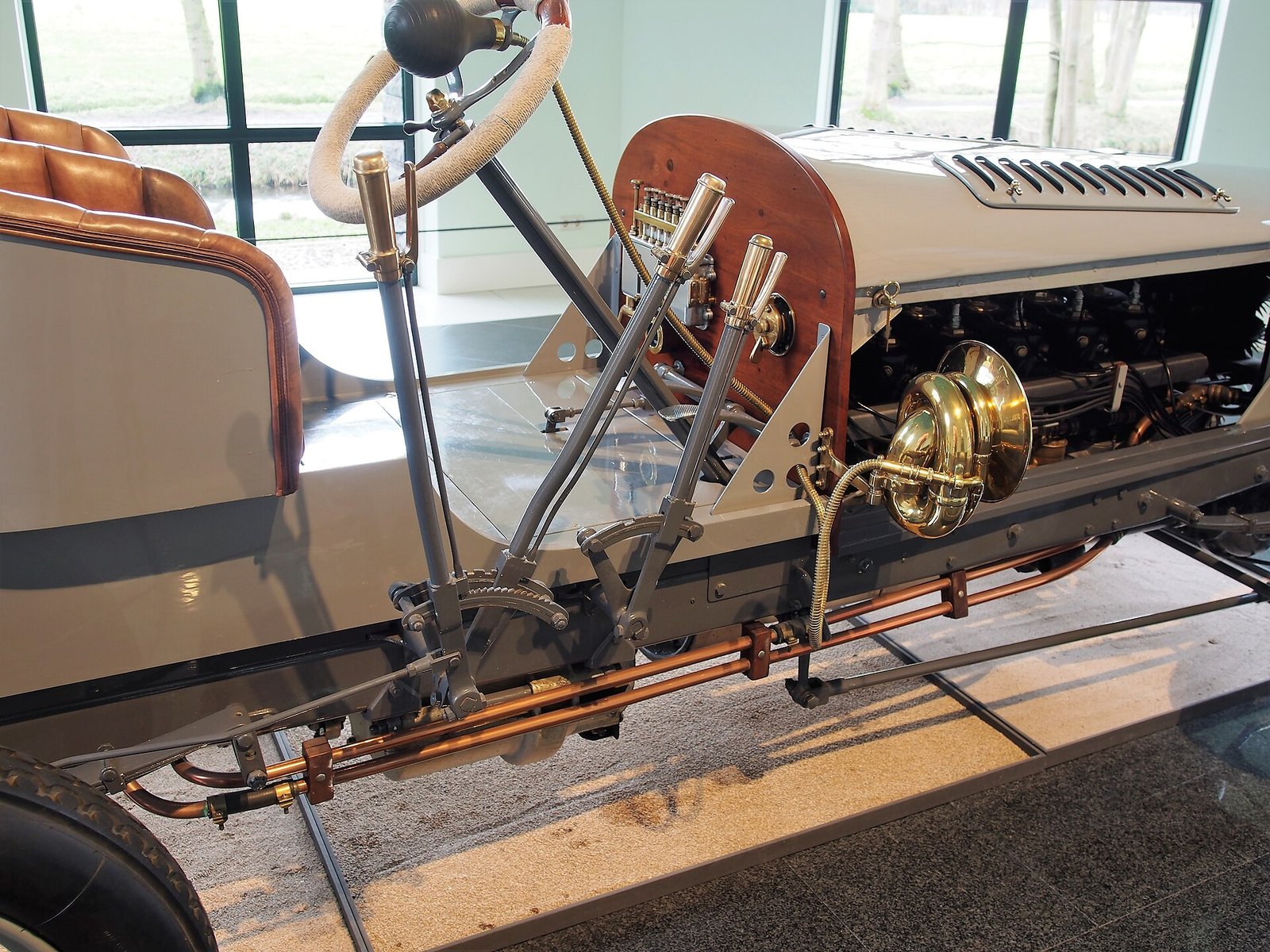
The suspension was conventional for the time, semi-elliptic leaf springs front and rear, and early cars like this didn’t have shock absorbers as we know them. Put an 8.7-liter six, all-wheel drive and narrow tires on unpaved roads, and the driver of the 60HP was effectively a test pilot. There was no electronic help, no power steering and no roll cage, just a wooden steering wheel, a long hood full of cylinders and a riding mechanic sitting beside him.
Why these three things mattered
Each of those ideas went on to define a part of the car business.
The straight-six became one of the great engine layouts of the twentieth century. Ford tried one in the Model K of 1906 and hated it. Chevrolet’s Stovebolt six carried the brand for decades. Jeep’s 4.0-liter six powered Cherokees and Wranglers into legend, and BMW built its whole identity on smooth inline-sixes. Spyker showed the first one at the Paris Salon in December 1903. Napier in Britain began selling sixes in 1904, which gave Napier the claim to the first one in series production, but the Dutch car came first.
Four-wheel drive needs no introduction to an American audience. Every pickup with a transfer case, every rally car, every Subaru on a snowy Colorado road traces back to the same basic idea: send power to all four wheels and you can use all four tires to move the car. The Audi Quattro made it a performance weapon in the 1980s. The Spyker did it eighty years earlier.
Four-wheel braking matters for an even simpler reason. A car that brakes only at the back can’t stop quickly, because under braking the weight shifts forward and the front tires are doing most of the work. Engineers in 1903 understood the physics. Most manufacturers just didn’t want to pay for the extra hardware. Spyker did.
The race it never ran
The 60HP was built for one event, the Paris to Madrid race of May 1903. It was a city-to-city road race on public roads, across France and into Spain, with crowds standing right at the edge of the dirt roads.
The Spyker wasn’t ready in time. And the race itself turned into one of the darkest days in motorsport. On May 24, 1903, 224 cars left Paris. Before the field even reached Bordeaux, Motor Sport magazine counts at least ten dead: six drivers and riding mechanics and four spectators. Marcel Renault, one of the three brothers behind the Renault company, lost the road in a cloud of dust near Couhé-Vérac, hit a tree and died two days later without regaining consciousness. His brother Louis won the light car class that same day. The French government stopped the race at Bordeaux that night, and the cars were hauled back to Paris by horse and rail. The fastest man to Bordeaux, Fernand Gabriel in a streamlined Mors, averaged about 65 mph over dirt roads lined with spectators, close to the Spyker’s claimed top speed. That tells you how brutal the competition was, and how little margin anyone had when a tire burst or a dust cloud swallowed the road. Even if the Spyker had started, it would never have reached Madrid. That disaster ended the era of open-road city-to-city racing in Europe.
The 60HP finally appeared at the Paris Salon in December 1903, then at the Crystal Palace in London in February 1904. It raced exactly twice. It finished third at the Blackpool speed trials in 1904 and won a hill climb in Birmingham in 1906. That was it. Tires of the day struggled with the weight and the torque, maintenance was expensive, and Spyker needed to sell ordinary cars to make payroll. The most advanced car in the world was retired as a showpiece.
Spyker’s other adventures
The 60HP wasn’t the only time the little Dutch company turned up somewhere unexpected. In 1907 a Spyker took part in the Peking to Paris race, one of the most absurd motoring events ever staged, a drive of roughly 9,000 miles across Mongolia, Siberia and Russia with almost no roads. The car was entered by the Frenchman Charles Godard, a charming adventurer with a talent for borrowing money. He was arrested along the way for fraud, and another driver took the Spyker on to Paris.
Fifteen years later Spyker had one more moment of glory. In 1922 the British driver Selwyn Edge took a Spyker C4, powered by a Maybach six-cylinder engine, to the Brooklands track in England and set a 24-hour endurance record, running two twelve-hour sessions because night racing wasn’t allowed there. It was a fine way to show off a luxury car, but by then the company’s money problems were too deep to fix with a record.
Tragedy and decline
In February 1907 Hendrik-Jan Spijker was returning from England after meeting potential investors. His ship, the SS Berlin, went down off the Hook of Holland in a storm. He was 42. The company, already in financial trouble, went bankrupt soon after. New investors restarted it under a much longer name, Nederlandsche Automobiel- en Vliegtuigfabriek Trompenburg, the Dutch Automobile and Aircraft Factory Trompenburg, and Jacobus was no longer part of it.
Laviolette stayed. Just before World War I he designed a small, cheap two-cylinder car rated at 7 horsepower, aimed at buyers who could never afford a big Spyker. One director thought they could sell at least a hundred. The board said no, and the project was shelved. The engineer who had put three world firsts into one car watched his economy car go into a drawer.
The Netherlands stayed neutral during World War I, and Spyker built airplanes and aircraft engines. That’s where the propeller in the brand’s badge comes from, a wheel with a propeller through it, and the company motto, Nulla tenaci invia est via, roughly "for the tenacious, no road is impassable." After the war it added trucks and buses. It still built luxury cars, but nothing as daring as the 60HP. Production ended in 1925 after roughly 1,500 cars in total, and the company went bankrupt the following year.
How the one survivor made it
When the company was liquidated, the 60HP was bought by a former director. It then received a restoration in the 1920s that the Louwman Museum describes bluntly as incompetent. Bodywork was changed, parts went missing, and for years it was a museum curiosity that nobody had the money or the knowledge to fix. Between 1953 and 1993 it moved between Dutch museums.
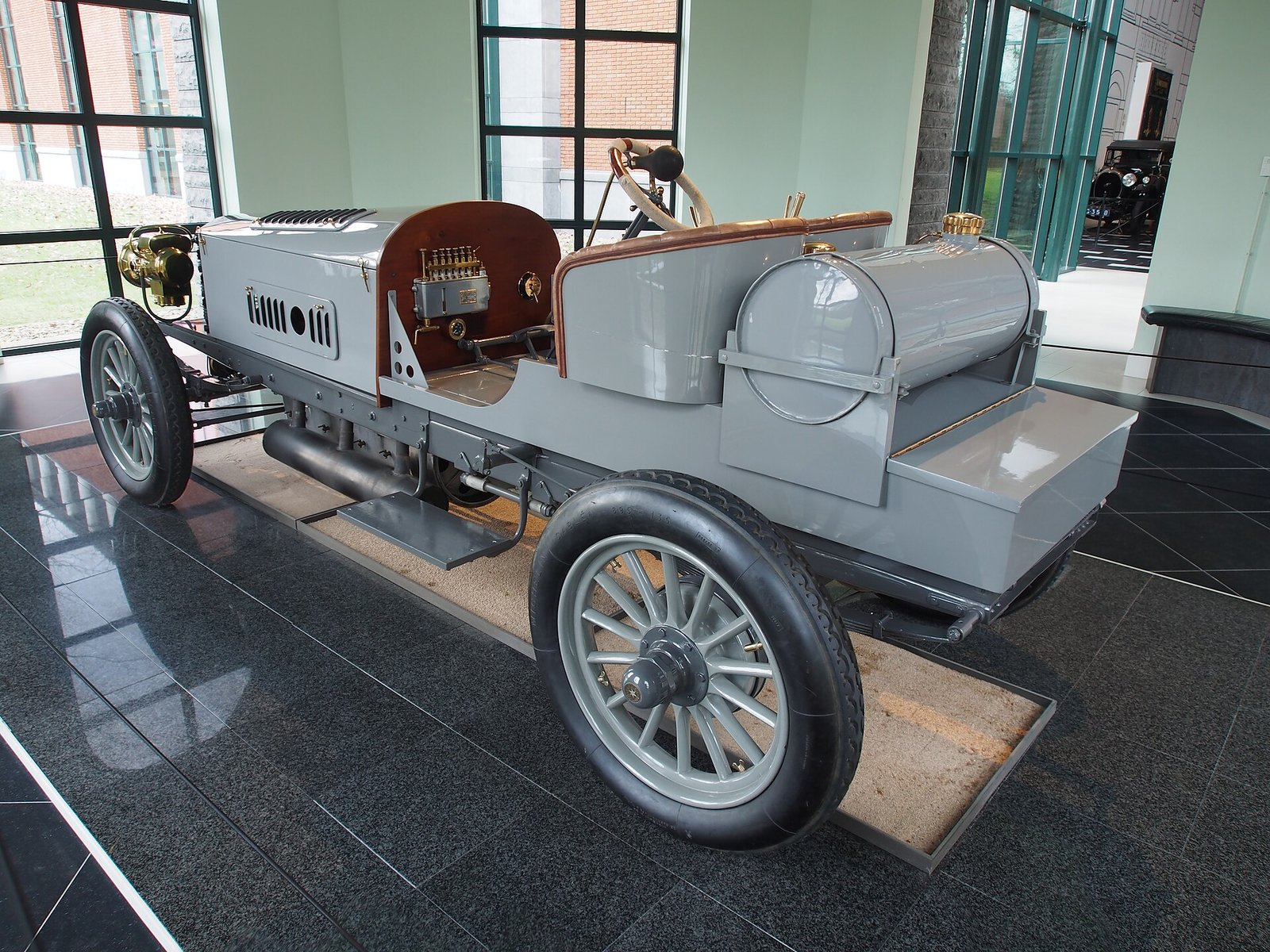
In 1993 Evert Louwman bought it for his museum in The Hague and spent five years restoring it to the way it looked at the Crystal Palace in 1904. The team used period photographs and archive documents to rebuild details earlier restorers had lost. The museum calls it the Mona Lisa of its collection, and it runs. It sits today among some of the most important early cars in Europe, in a collection that started with Evert Louwman’s father, a Dodge importer in the Netherlands, which gives the story one more small American connection. In 2003, the car’s centenary year, it was shown at Pebble Beach, where it is reported to have received top honors; we couldn’t find the class confirmed in the official records.
The name that came back
Most Americans who know the Spyker name know it from a completely different era. In 1999 Dutch entrepreneurs Victor Muller and Maarten de Bruijn revived the brand as a maker of hand-built supercars with aircraft-inspired details, starting with the C8. In 2007 Spyker even ran its own Formula 1 team, using Ferrari engines. And in 2010 the tiny Dutch company bought Saab from General Motors, a deal that ended with Saab’s bankruptcy in 2011. That story is one of the strangest corporate chapters in recent car history, and you can read about the brand Spyker tried to save in our piece on the Saab 900 Turbo.
None of those modern cars had anything to do with Laviolette’s racer, apart from the name and the propeller on the badge. But the propeller badge was a reminder of the original company’s real legacy: it was a business run by people who kept trying things nobody else would.
Credit where it’s due
The rest of the automobile industry eventually caught up with all three of the Spyker’s ideas. Four-wheel brakes became normal on expensive cars in the 1920s, helped along by cars like the Hispano-Suiza H6 with its servo-assisted brakes. Inline-sixes powered everything from Toyota’s 2JZ in the Supra to Detroit’s family sedans. Four-wheel drive went from military trucks to rally stages, where the Audi Quattro and the Lancia Delta Integrale made it unbeatable.
Hardly anybody remembered where it started. The early automobile world was full of inventors who got there first and didn’t get the credit, from Carl Benz, who was pushed out of his own company, to a Belgian engineer whose name doesn’t even appear in most histories of four-wheel drive.
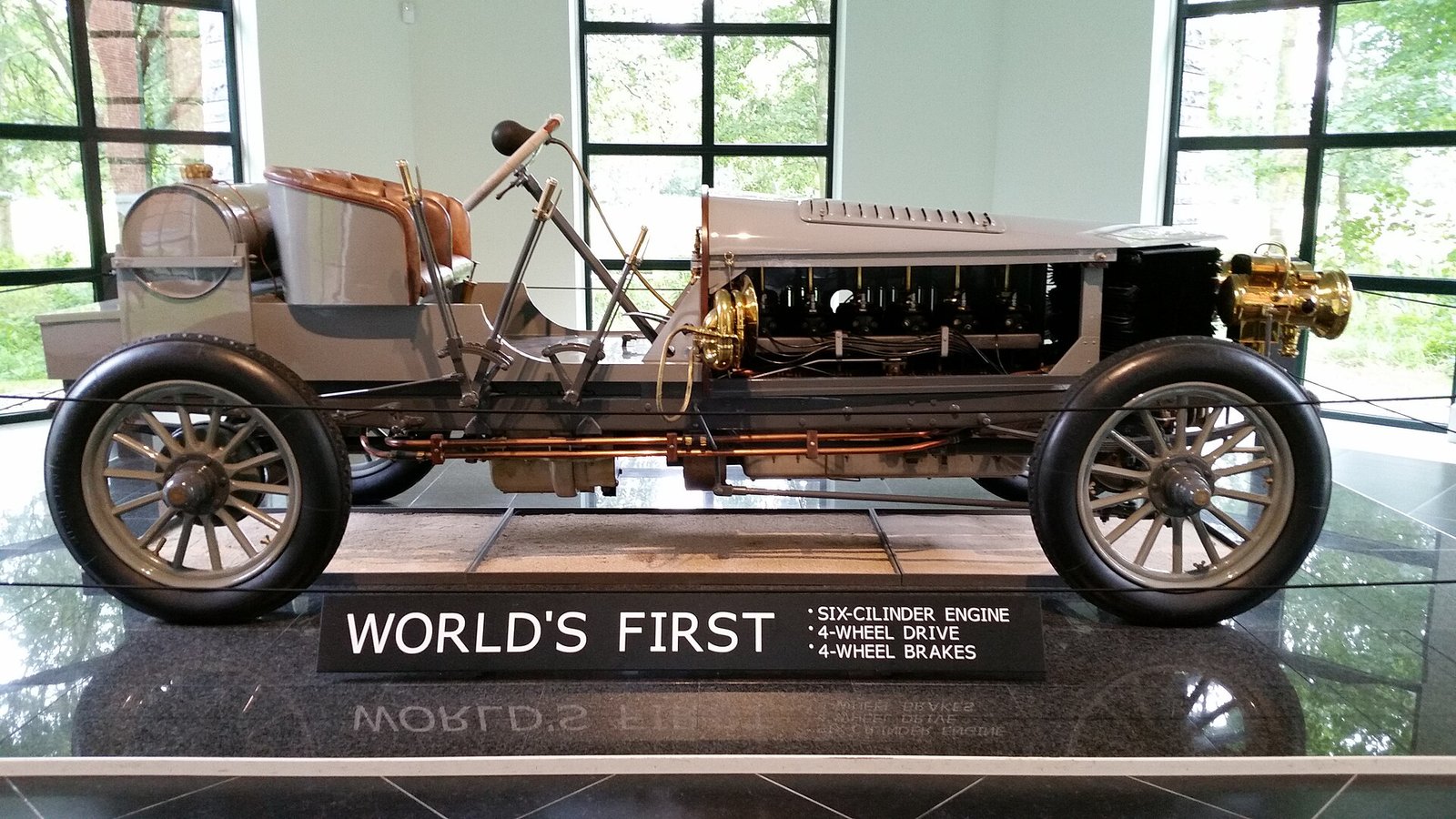
You can still see the 60HP today at the Louwman Museum in The Hague, a gray race car with brass headlamps and a long hood with louvers down the side. The plaque in front of it says "World’s first," and lists the six-cylinder engine, the four-wheel drive and the four-wheel brakes. For once, the marketing line is simply true.
Check you’re still alive.
Photos via Wikimedia Commons: Spyker 60HP front, engine, rear and cockpit, Alf van Beem (public domain); side view, Michel Curi (CC BY 2.0).