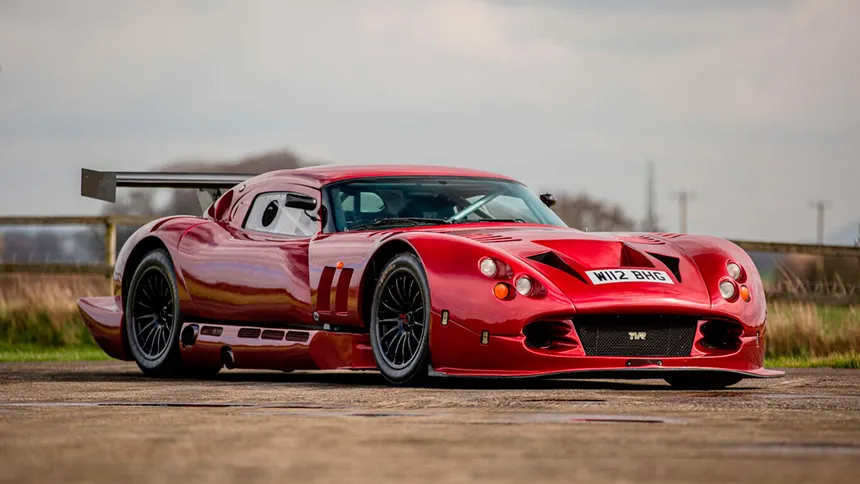
TVR CERBERA SPEED 12: THE CAR ITS OWN BOSS CANCELLED AFTER ONE DRIVE HOME
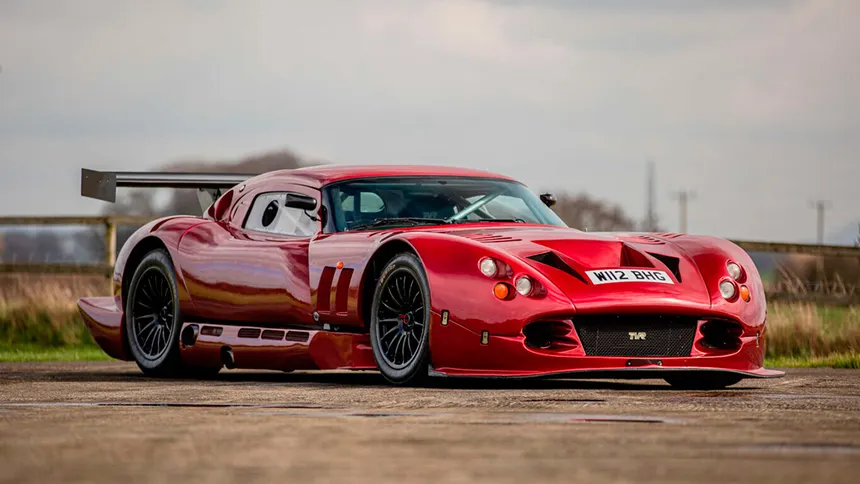
Blackpool, late 2000. A wet evening on the Lancashire coast. Peter Wheeler, owner of TVR, slides into the driver’s seat of a prototype he’s been waiting four years to drive. The car costs £245,000. It’s been promoted as the machine that will dethrone the McLaren F1. Deposits are already paid. Customers are already lined up.
Wheeler turns the key. Pulls out of the factory. And before he’s reached the end of the road, he knows the project is dead.
His exact words, given to EVO magazine years later: “I knew within 300 yards that it was a silly idea.”
300 yards. The length of two football pitches. That’s how long it took the man who built Tuscans and Sagarises without ABS, without airbags and without traction control to look at his own creation and decide it had no business being on a public road.
That’s the Speed 12. A car so violent that even TVR, the wildest British car company ever to draw breath, couldn’t make peace with what it had built.
TVR ALWAYS DID THINGS DIFFERENTLY
To understand the Speed 12 you have to understand TVR. Founded in 1946 by Trevor Wilkinson in Blackpool, the company spent half a century making lightweight sports cars with fibreglass bodies and tubular steel chassis, sold to people who wanted something Britain’s mainstream wouldn’t dare build. No central locking. No power steering. No driver aids. Just engine, gearbox, chassis and a steering wheel that talked to you in a language nobody else spoke.
When Peter Wheeler bought TVR in 1981 he doubled down on the philosophy. Petroleum engineer by trade, racer by hobby, owner of a labrador called Ned whose teeth marks were preserved as a styling cue on the Chimaera’s nose, Wheeler ran TVR with the conviction of a man who genuinely believed ABS was a crutch for cars that had been set up badly. He thought airbags promoted overconfidence. He sold the Sagaris without either of them well into the 2000s, when every other manufacturer on the planet was racing to add electronic safety nets.
So when Wheeler decided in the mid-90s that TVR should build a car to take on the McLaren F1, you could already see the trajectory. This was never going to end with a polite, well-mannered grand tourer.
The project was called 7/12. Seven litres, twelve cylinders. It debuted at the Birmingham Motor Show in 1996.
TWO STRAIGHT SIXES ON A SHARED CRANKSHAFT
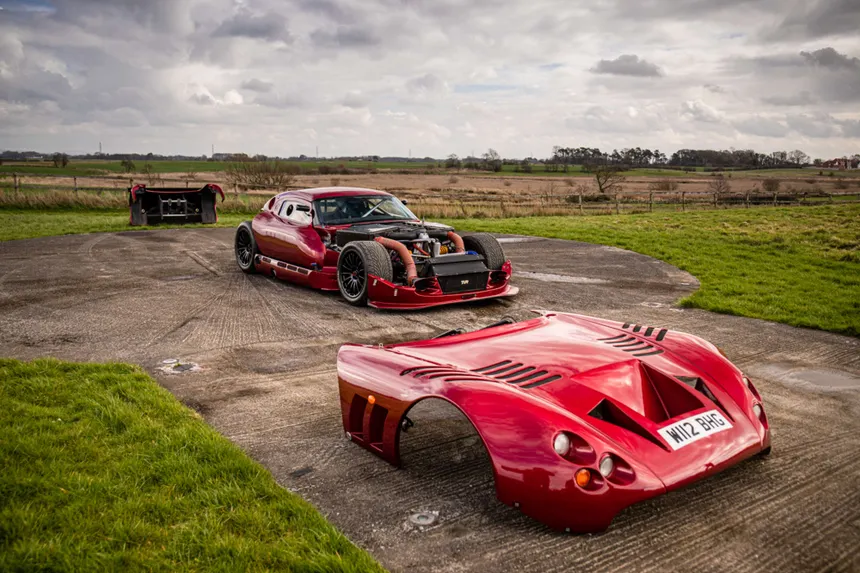
The Speed 12 engine came from a piece of workshop logic any mechanic understands. TVR’s Speed Six straight-six engine was a solid, race-bred unit. So Wheeler’s team took two of those Speed Six blocks, joined them at a 90 degree angle on a shared crankshaft, and called the result a V12.
Displacement: 7,730 cc. Cylinders: twelve. Block construction: welded steel. Welded. Steel. Not cast iron, not aluminium alloy. A welded steel block in a road car engine, which alone tells you everything about how this thing was put together.
The cylinder heads were redesigned from the Speed Six original. The straight-six had a finger-follower valve actuation system. The V12 got bucket tappets instead. That’s a small detail with a big meaning. Bucket tappets are what you fit when you intend to spin an engine hard and abuse it for a long time. You don’t bother with that level of complication on a road engine unless you mean to use it.
And the noise it makes is its own argument. Anyone who has heard the surviving road car fire up at Goodwood or in a private workshop describes it not as a song but as a detonation. There’s no flat-plane Ferrari sweetness here, no Formula 1 wail. The Speed 12 sounds like an American endurance racer crammed into a British body shell, closer to a 1971 Le Mans car than to any other V12 of the era. At idle it thunders. Past four thousand RPM it stops thundering and starts howling, as though there really were two angry engines trapped under the bonnet fighting over the same crankshaft. Which, given the construction, is more or less the truth.
NOBODY ACTUALLY KNOWS HOW MUCH POWER IT MADE
Here the folklore starts. And here I have to slow down and separate what’s verifiable from what’s pub talk.
What’s verifiable first. In race trim, with intake restrictors mandated by the regulations, the engine made approximately 675 horsepower. Unrestricted road specification, TVR officially quoted around 800 horsepower. The factory peak figures published were 880 BHP at 7,250 RPM and 881 Nm of torque at 5,750 RPM. Those are the numbers you can defend in a court of law.
The pub talk is more interesting. The Cerbera Speed 12 was reportedly placed on a dyno rated for 1,000 horsepower and broke it. The output shaft, or the input shaft depending on which version of the story you hear, allegedly snapped under the load. Estimates after the fact suggested actual output could be anywhere from 800 to over 1,000 horsepower depending on which version of the engine, which prototype, and which witness you trust.
What does that tell you, sitting at the workbench? It tells you the official figure is conservative. It tells you that when a manufacturer announces a number and the dyno snaps before reaching it, there’s somebody in that room who knows the real figure starts with a one and chooses to keep it quiet. It tells you TVR wasn’t going to print a number in the brochure it couldn’t legally defend if a customer turned up angry at delivery.
Which leaves us with a road car that on paper made 800 horsepower, and probably made more.
A POWER-TO-WEIGHT RATIO THAT MAKES NO SENSE
Kerb weight, factory claimed: 975 kg. Verified running weight at the heaviest: 1,145 kg. Power-to-weight ratio at the factory figures: roughly 1.3 kg per horsepower.
Put that in context against its peers from 2000. The McLaren F1, the reigning king, weighed 1,140 kg with 627 BHP, giving 1.82 kg per horsepower. The Ferrari F50 of the same era, 1,230 kg with 520 BHP, 2.37 kg per horsepower. The Porsche Carrera GT, which arrived a few years later, 1,380 kg with 612 BHP.
On paper, the Speed 12 promised a power-to-weight figure that made the McLaren F1 look measured. And the McLaren F1 was the car that had recorded 240 mph and stood as the fastest production car in the world.
A CHASSIS THAT WASN’T BUILT FOR THAT MUCH GRUNT
This is where any mechanic starts to sweat. The Speed 12 chassis was a tubular steel frame derived from the standard road-going Cerbera. The standard Cerbera was already a serious car. Speed Six or Speed Eight V8 powerplants, 360 to 440 BHP at most, in the same basic structure.
Take that chassis. Strengthen it. Lengthen it. Drop double the cylinders and double the power into it. That’s not the way Stuttgart or Maranello or Woking would have approached the problem. They would have started from a clean sheet of paper. TVR didn’t have the budget for a clean sheet of paper. So Blackpool did what Blackpool always did. Reinforce the weak spots. Triangulate where you can see flex. Carry on.
And then there was the rest. No ABS. No traction control. No airbags. No electronic intervention of any kind between your right foot and a 335-section rear tyre. In a car that probably made over 1,000 horsepower, sending all of it to the back wheels through a six-speed manual, on a damp British road.
You can imagine what happened the first time it rained.
THE NIGHT WHEELER SHELVED IT
Late 2000. Three prototypes complete. Deposits taken. Brochures printed. Auto magazines around the world breathlessly previewing the British supercar that was going to embarrass the McLaren F1.
Then Wheeler took one home.
By his own account, 300 yards was enough. His own car. His own project. His own engineering team. His own dream of beating the McLaren F1. All of it collapsed in less than half a minute of real-world driving.
The orders were cancelled. The deposits were refunded. The prototypes were broken up, their components fed into TVR’s GT racing programme where less powerful, restricted versions of the engine continued to compete in the British GT Championship. And here’s the twist: the car its own creator had declared undriveable actually won races. A single Speed 12 took victory at Silverstone in the wet during the 2000 season. The 2001 campaign saw two cars entered and two more wins. By 2002, with parts supply dwindling, TVR consolidated into one car which still managed podium finishes in seven of the twelve championship rounds. That lone survivor carried a slogan painted across its rear bodywork: “If you can read this the pace car must be out.” That’s the kind of confidence Blackpool had in its own monster, even if the monster couldn’t make it through a season without breaking something. The dream of taking on McLaren died without a press release. It just stopped existing.
Pause on that for a second. Wheeler wasn’t a man given to corporate caution. This is the executive who refused to fit ABS or airbags to cars that customers routinely lost on damp roundabouts. This is the man whose engineering philosophy was that if you couldn’t handle the car, you shouldn’t be driving it. This is the man whose Sagaris was, even on its best day, a car you had to respect.
And that man, after one drive in the Speed 12, called the whole thing off.
If Wheeler says it’s too much, it’s too much.
THE ONE CAR THAT GOT BUILT
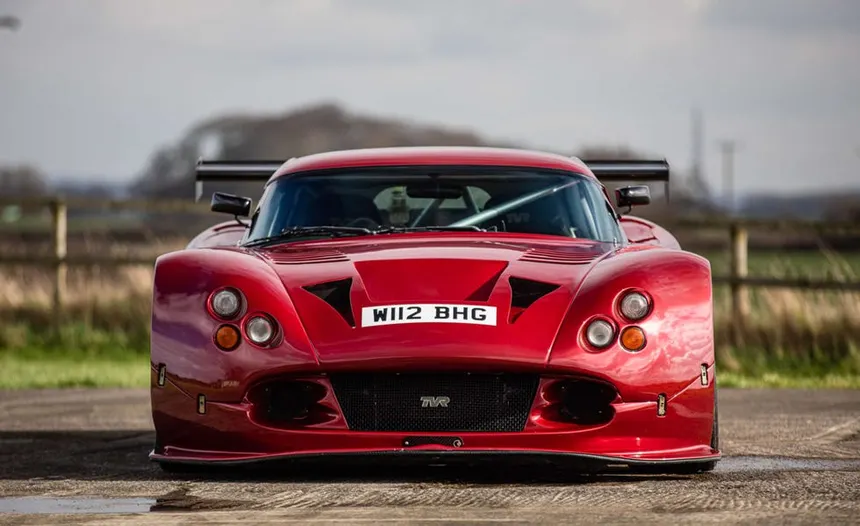
Two and a half years later, TVR needed money. In August 2003 the company placed a small ad in Auto Trader offering one Cerbera Speed 12, registration W112 BHG. The plan was to rebuild one of the dismantled prototypes from spares and sell it to a private buyer.
But owning the car wasn’t a transaction. It was an interview. Wheeler insisted on personally vetting every potential customer. Not a sales manager. Not a lawyer. The owner of the company, in person, sitting across from you, deciding whether you were the kind of human being who deserved the keys to the only Speed 12 in the world.
That’s the most TVR thing I’ve ever heard. An Auto Trader classified, like any used Cerbera. And then a job interview with the founder to be allowed to buy it.
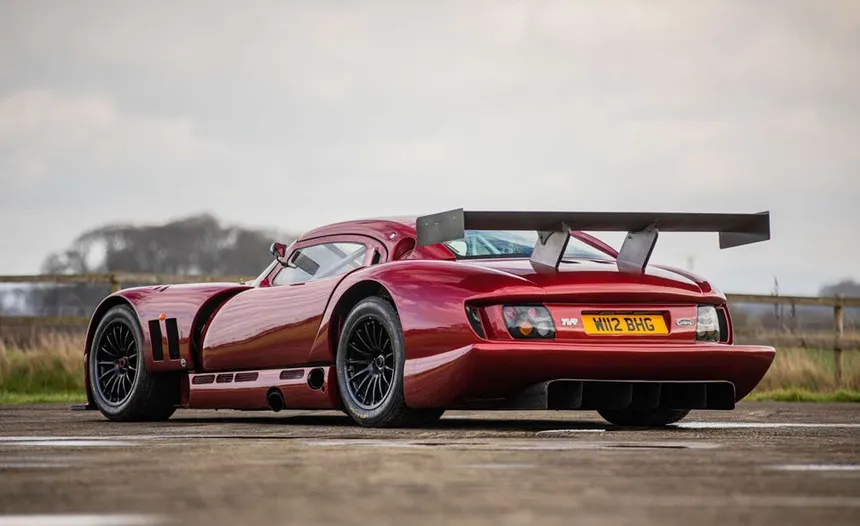
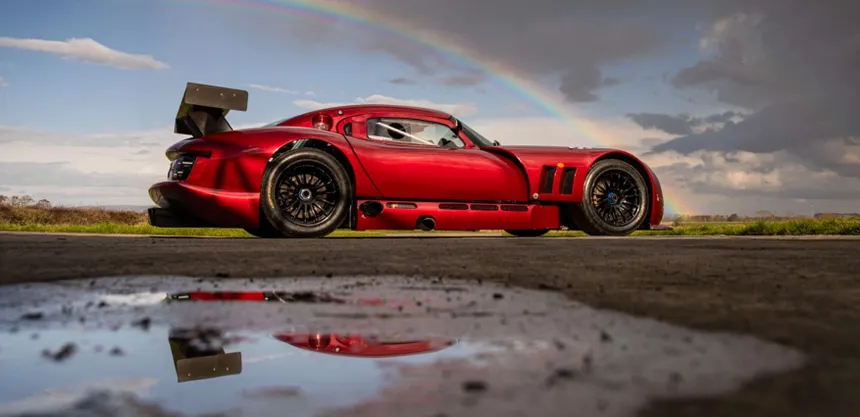
That car still exists. It’s the only road-going Cerbera Speed 12 on Earth. Carbon fibre and Kevlar bodywork. Flat floor. 7.7-litre V12 quoted at over 800 horsepower. Roughly 2,425 pounds. It’s appeared at Goodwood, at the Concours d’Élégance Style et Luxe, in auction houses, on YouTube. Each time it surfaces, the asking price climbs and the legend grows.
WHAT THE SPEED 12 ACTUALLY TEACHES YOU
Three things, from the bench.
The first is that unfiltered engineering exists and sometimes works. You can take two road-car engines, weld them together, build a V12 with a steel block and make it run. The workshop logic isn’t always the worst logic. Sometimes it produces something a 200-strong R&D department in Germany would never have dared to draw.
The second is that there’s a limit. Not a regulatory limit. Not a customer-feedback limit. A limit set by the conscience of the person who signs off on the car leaving the factory. Wheeler sold cars that killed people for a living. He defended that philosophy publicly until the day he sold the company. And even he, after one prototype drive of the Speed 12, said no. That’s not a corporate decision. That’s a mechanic looking at a finished part and deciding it doesn’t leave the workshop.
The third is that legends survive on what could have been, not on what was. The Speed 12 was officially rated at 800 horsepower. It probably made over a thousand. Nobody alive knows the real figure. And that ambiguity is exactly what keeps us talking about the car twenty-five years after it died in an Auto Trader classified.
The McLaren F1 kept its crown. The Speed 12 never made it to the table. And in this business, sometimes the contender who never showed up is more interesting than the one who won the fight.
Check you’re still alive.