
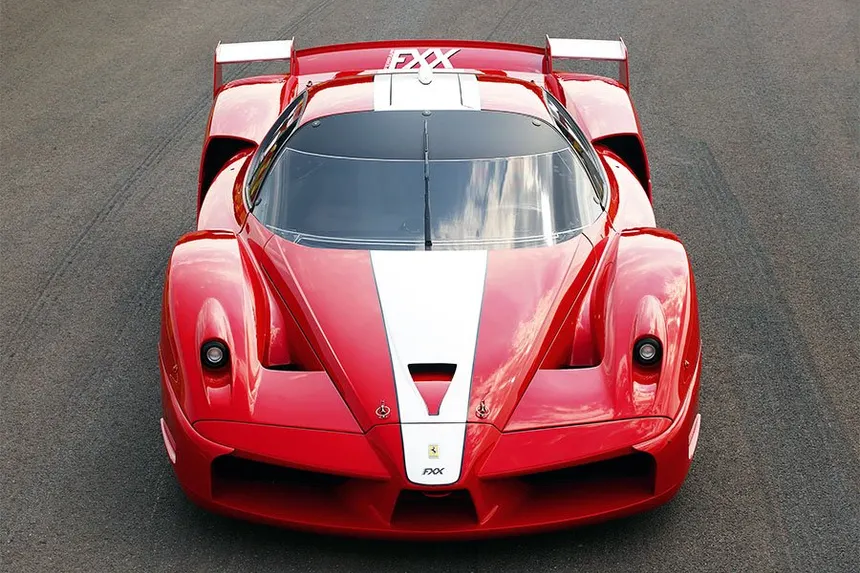
Ferrari FXX: the most elegant scam in motoring history
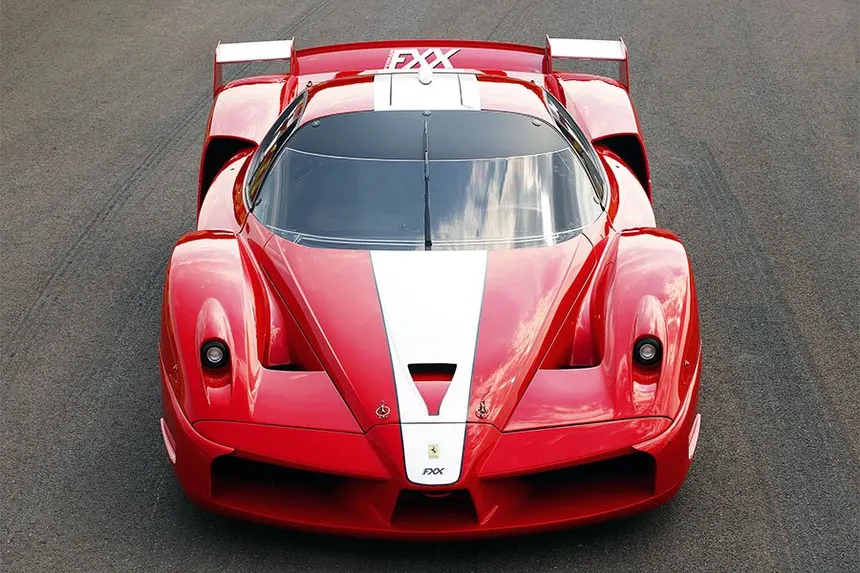
Run the numbers. In 2005 Ferrari pulled off a move that, attempted by anyone else, ends in a courtroom. They sold you a car for over a million euros. Then they kept it. They stored it at their place. They charged you separately for the privilege of driving it. And they decided when, where and how many laps. You signed, you paid, you went home without a car, and you thanked them for it.
That’s the FXX. And the wild part isn’t that Ferrari did it. It’s that there was a waiting list.
Let’s be clear up front, because “scam” is about where it stings, not where it sues: there was no deception here. The contract spelled it all out. Every buyer knew exactly what they were signing: that the car stayed in Maranello, that it ran when Ferrari said so, that there’d be dues. Nobody was conned. And that’s precisely why it stings more. Because the real scam isn’t the one slipped past you without your noticing. It’s the one you accept with a smile, knowing full well what you’re giving up, because what you get back feels worth it.
Most coverage of this car files it under “engineering triumph” or “marketing masterstroke.” Both are true. But there’s a third truth nobody likes to say out loud: the FXX was the moment Ferrari worked out that you don’t sell the genuinely rich a product. You sell them obedience dressed up as privilege. And the rich will pay more for the obedience than the product.
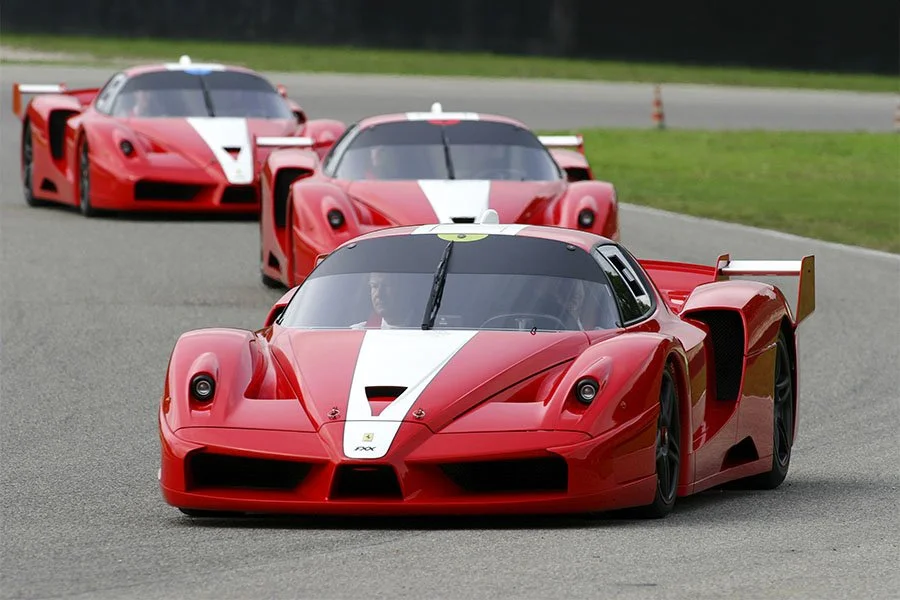
The pitch: get the customer to work for free, and pay for it
There was a seed. The story goes that Pininfarina fancied a special supercar on the Enzo platform and went looking for a backer. What’s solidly documented is what Ferrari did with it: instead of building a car to sell, it built a rolling laboratory to learn from. And had the customers foot the bill.
That’s the XX Programme, and the FXX launched it. The pitch, stripped of the gloss: Ferrari takes what it learns in Formula 1, pours it into a machine with no homologation rules and no regulations to obey, and hands it to a tiny circle of the chosen to drive and generate data. Data that then feeds into the road Ferraris of the future. The customer drives. Ferrari learns. Ferrari sells what it learned in its production models. And the customer, who put up the money, the time and the information, doesn’t see a penny of it.
Put plainly: the FXX buyer was a test driver who paid for the job instead of being paid for it. The best employee in history. The only one who begs to work for free.
I don’t say that with bitterness. I say it with admiration for the sheer nerve. Because it worked. And because two decades on it still works, line for line.
What it was, without rounding the numbers in the myth’s favour
The FXX started with the Enzo, but they didn’t leave it alone. The road Enzo’s V12 is a 5,998cc unit making 650 horsepower. For the FXX, Ferrari bored that same block out to 6,262cc and pushed it to 800 horsepower at 8,500rpm. So it isn’t “the Enzo engine” as people casually claim. It’s the Enzo block, grown and beaten into something else. The distinction matters, because the gap between 650 and 800 horsepower is not a freebie.
The gearbox was an F1-derived unit shifting in under 100 milliseconds. Dry weight, no fluids, came in at 1,155kg; with oil and coolant aboard it sat nearer 1,230. Aero generated 40% more downforce than the Enzo. Bespoke 19-inch Bridgestone slicks. Brembo brakes. And sensors everywhere.
Because the FXX was drowning in telemetry, logging every lap, every braking point, every degree of steering input. They called it “Big Brother,” and the name wasn’t affectionate. It was literal. It watched you always. Not to protect you. To extract your performance and convert it into usable data.
The reference lap at Fiorano, Ferrari’s private circuit, dropped under 1 minute 18 seconds. For scale: the road Enzo ran around 1:24-1:25 there. The FXX ate six or seven seconds a lap. A gulf. Although, so we don’t fall for the same hype machine, worth remembering where it sits now: a LaFerrari runs 1:19-1:20 and the later FXX-K dips to 1:14-1:15. Savage for 2005, yes. Untouchable, no.
And one telling detail. Ferrari never gave you an official top speed or a 0-60 figure. The press threw numbers around (2.8 seconds, 227mph), but Maranello never confirmed them. Why? Because it genuinely didn’t care. The FXX wasn’t about being fast in a straight line. It was about the lap, the data, and above all the belonging. Top speed was irrelevant to what they were actually selling.
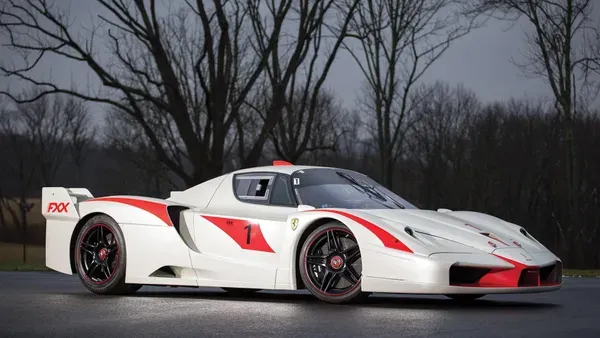
The real price, and the small print nobody reads to you
Careful here, because the figures bounce around and people quote them like scripture. The FXX’s initial price sat around 1.3 million euros per the most reliable documentation. Other sources say 1.5, others higher still in dollars. Take this away: over a million euros, and the exact figure was never transparent.
But the upfront cheque was just the cover charge. What almost nobody mentions is the subscription. The Corse Clienti programme, of which the FXX is the crown jewel, isn’t a one-off payment. It’s a membership. Ferrari runs eight events a year, and the owner pays annual maintenance on the car plus a fee for each event attended. In the programme’s current structure, maintenance starts around $20,000 and each outing runs $20,000-30,000. Multiply by the year’s dates and do the maths.
So you didn’t pay a million-odd once. You paid a million-odd, and then kept paying every year to remain a member. Stop paying, stop playing. That isn’t owning a car. That’s paying dues at a stupidly expensive gym where the gym keeps the machine and you use it when they open the doors.
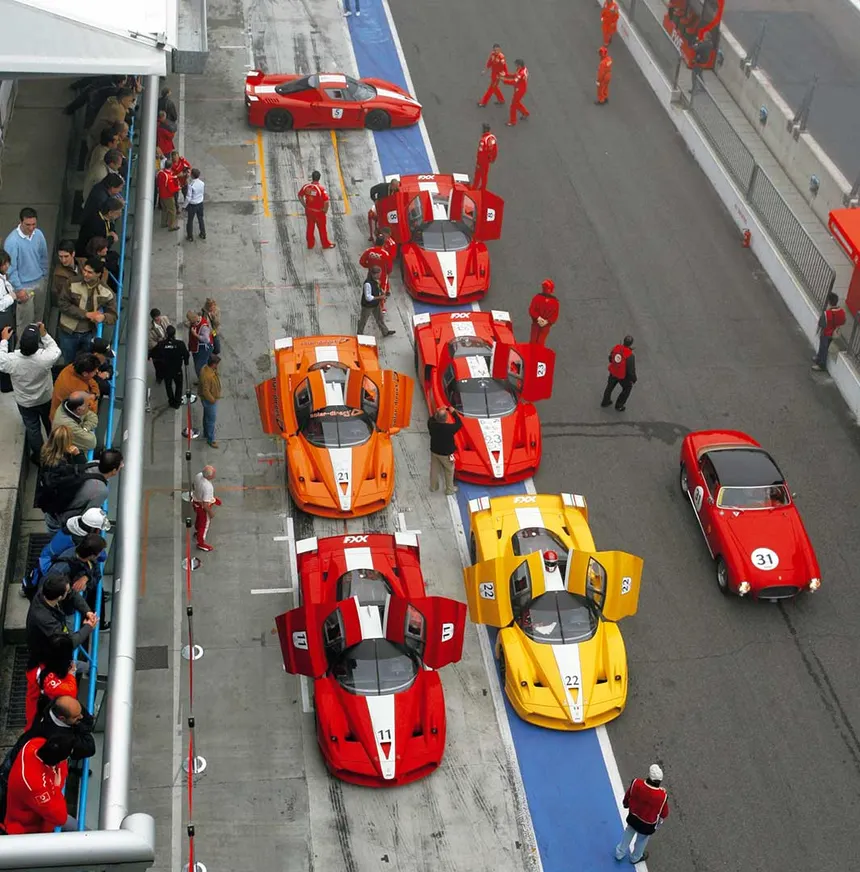
And here’s the heart of it. Unlike the Enzo, the FXX buyer didn’t take delivery. Ferrari maintained it, guarded it, and brought it out on the dates it organised. You signed the biggest cheque in your garage and the car slept in Maranello. Owner on paper, tenant in practice. You bought the right to visit your own car by appointment.
The customer as luxury labour
Across 2006 and 2007 a staggering mileage piled up: over 16,500km the first year, over 18,500 the second. All of it flowed back to Maranello to be dissected. To be fair, though: that mileage wasn’t the clients alone. Ferrari’s own test drivers logged plenty too. The customer supplied money and data; the factory did the fine work.
Then Schumacher turned up. Freshly retired from F1, he joined the programme as just another test driver. Seven-time world champion, lapping alongside businessmen and collectors. His input wasn’t decoration. Thanks to FXX learnings, Ferrari applied real solutions to a road car: the 430 Scuderia of 2007.
Out of it came “Base Bleed,” which isn’t magic: it’s a duct that vents the overpressure building in the wheel arch to improve aero efficiency and cut the nose’s tendency to lift. And an ignition ECU clever enough to read the combustion’s ionisation currents and adjust the spark timing in real time. Translated: things a handful of millionaires and a world champion honed at Fiorano, that you took home buying a 430 Scuderia without knowing who’d done the dirty work.
The whole play in one line: Ferrari turned its richest customers into its external R&D department, charged them for the privilege, kept the cars, kept the data, and sold the results in its production models. If a Silicon Valley firm ran this, it’d hit the papers as a user-exploitation scandal. Ferrari runs it, and it hits the magazines as a wet dream. That’s the difference a badge with enough legend behind it buys you. Even Chris Harris, who’ll happily savage a car that deserves it, talks about the XX programme with something close to reverence. That’s the spell.
The Evoluzione: same cage, more horses
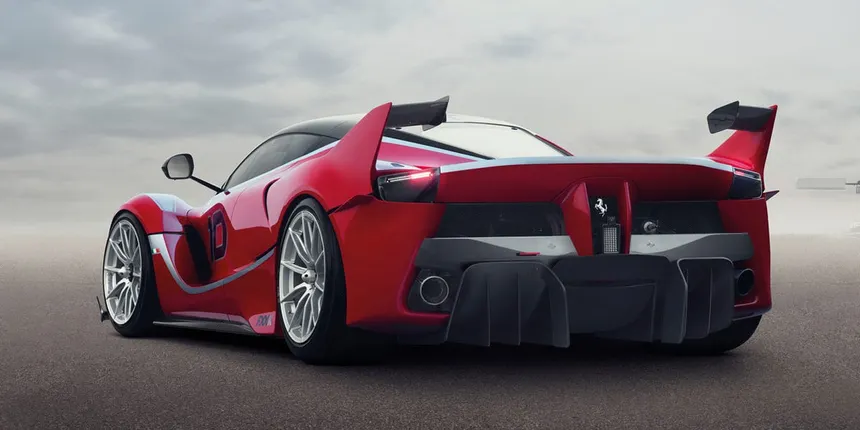
With all that data in hand, Ferrari did the obvious thing: improve the FXX itself and charge for the improvement all over again. The 2007 Evoluzione kit landed for around $300,000 extra. Because of course the upgrade was billed separately.
The V12 went to 860 horsepower at 9,500rpm. Shift time dropped to 60 milliseconds, twenty less. The Brembo ceramic brakes got so efficient the pads lasted twice as long. The aero was sharpened again. The Fiorano lap fell under 1 minute 16 seconds. The traction control, developed with the racing division, offered nine settings plus off, worked via a manettino on the console. The driver could change the car’s behaviour corner by corner, F1-style. All so a gentleman who isn’t a pro could feel, for a few minutes, exactly like one.
And here’s the anecdote that nails everything. In 2009, Top Gear wanted an FXX round their track. But because that day’s Stig wasn’t a selected client, Ferrari sent Schumacher to wear the white suit. He set a 1:10.7 that demolished the lap board, a time the show then scrubbed because the car wasn’t deemed road-suitable. They wouldn’t even let it loop a TV test track without one of their own guardians at the wheel. The control was total. Always.
The dynasty built on the same mould
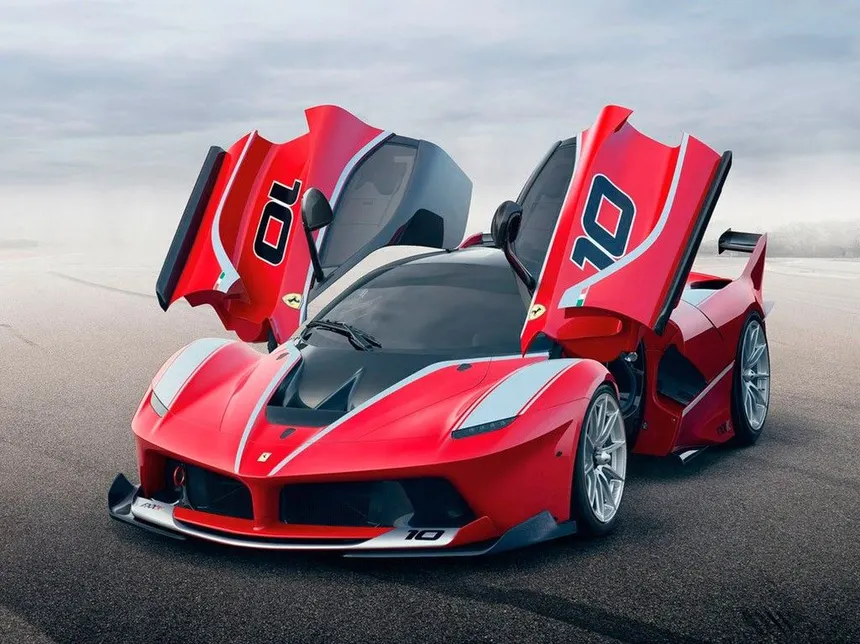
What began as an experiment became a business line. After the FXX came the 599XX in 2010. Then in 2014 the FXX-K on the LaFerrari hybrid base, 1,050 combined horsepower (860 from the V12, 190 electric); the “K” comes from the KERS lifted off F1. And in 2017, the FXX-K Evo, with downforce nudging GT3 territory.
I won’t drag the list out, because the list is the least of it. What matters is they all share the same commercial DNA: cars with no plates, no rulebook, guarded by Ferrari, reserved for a handful of the chosen who pay fortunes plus annual dues for the privilege of being the factory’s test drivers. Twenty years on, the model hasn’t changed a comma. Because it doesn’t need to. It works.
The guardian of the soul, twenty years later
There’s a thread almost nobody ties together, and it changes everything. The FXX was born in 2005 under the chairmanship of Luca Cordero di Montezemolo, president of Ferrari from 1991 to 2014. Almost twenty-three years. The man who dragged Ferrari out of the financial gutter, signed Schumacher, and repeated like a mantra that Ferrari isn’t a car factory but a family, a soul, a religion with a prancing horse on the crest. The FXX is his creation. The purest expression of his creed: Ferrari doesn’t sell you a product, it sells you membership of something sacred. And it bills you accordingly.
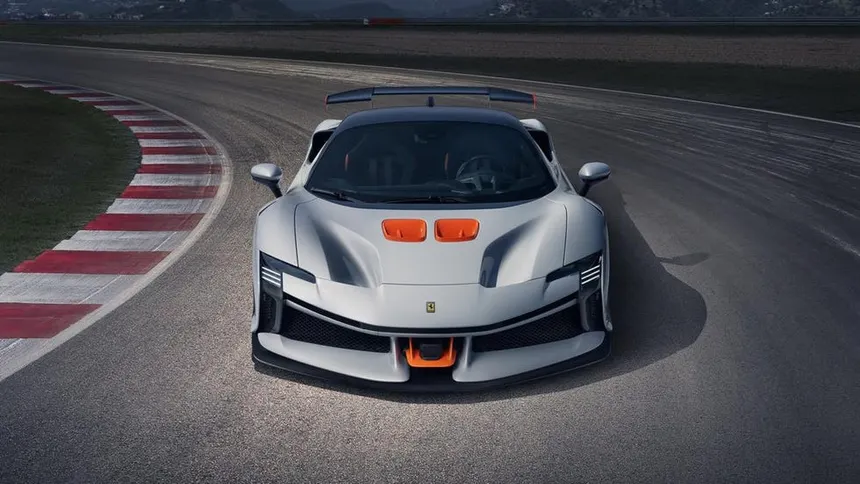
Fast-forward to now. In May 2026 Ferrari unveiled the Luce, its first production EV. And Montezemolo, far from biting his tongue to protect the brand of his life, came out swinging in public. Alongside Briatore, he put the project through the wringer. The line that’ll outlive him: that the Luce should have the cavallino taken off it. The horse. The crest. That this car, in his view, doesn’t deserve to wear the Ferrari badge.
And here’s what the lapdog press won’t write, because too many paddock dinners depend on staying friendly. The same man now playing guardian of Ferrari’s soul, deciding which car is worthy of the badge and which isn’t, has since June 2025 been sitting on the board of McLaren Group Holdings. The historic rival. The lifelong enemy. Firing at the electric Ferrari from the opposition’s box.
So let’s be clear. Before you crown yourself custodian of Ferrari’s soul, it’s worth remembering who put a price tag on that soul first. The FXX wasn’t a car, it was a subscription to the legend with an annual fee. Montezemolo took the most intangible thing Ferrari owns (the belonging, the myth, the blood) and turned it into a luxury financial product that charged you for the privilege of believing you were family. He monetised the soul like no one in the brand’s history.
The question, then, isn’t whether the Luce betrays Ferrari’s soul by failing to roar. The question is who betrayed it first. Because an electric car, at the very least, is yours when you pay for it. The FXX never was. And it was sold, dues included, by the very man now clutching his pearls from the McLaren boardroom. Ferrari’s soul has been for sale since 2005. Montezemolo is just annoyed that somebody else is selling it now, and selling it with a plug.
What they were really buying
Take away the horsepower, the 60-millisecond shifts, the telemetry, the slicks. Keep the essence.
The FXX was the most expensive membership card on earth, annual dues included. A fortune for Ferrari to let you believe, a few times a year, that you were part of the legend. And the real masterstroke is this: it wasn’t entirely a lie. Your data did matter. It did end up in future Ferraris. You really were part of the process. Ferrari didn’t sell you a hollow fantasy. It sold you a real one, which is vastly more expensive and far harder to argue with.
Which is why almost nobody complains. Because when the fantasy is true, the submission stops stinging and starts feeling like an honour. Ferrari understood that before anyone. It didn’t sell you a car. It sold you the privilege of obeying. And thirty people queued up, paid, and went home without a car convinced they’d won.
Maybe they did. Maybe belonging to something bigger than you is worth more than any title deed. Or maybe it’s the most expensive way ever invented to pay for an illusion. You decide. Maranello decided twenty years ago, and it’s paid off beautifully.
Check you’re still alive.