Mercedes-Benz T80: The Six-Wheeled Nazi Speed Machine Porsche Designed That Never Turned a Wheel
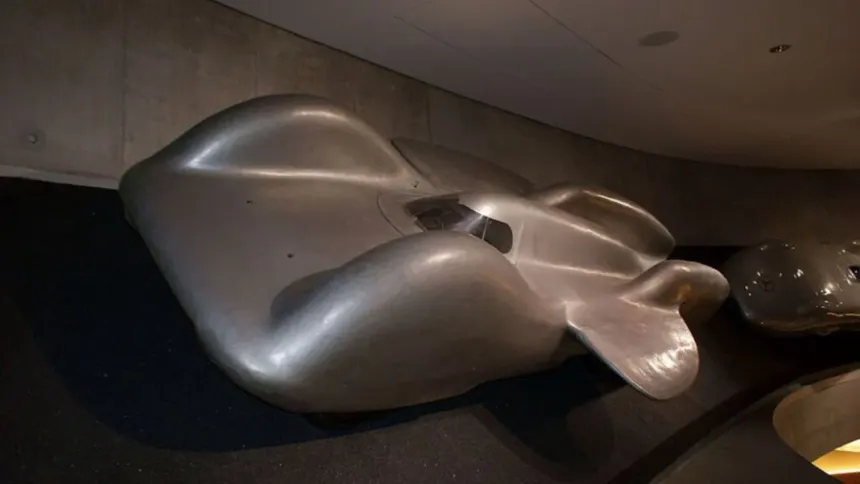
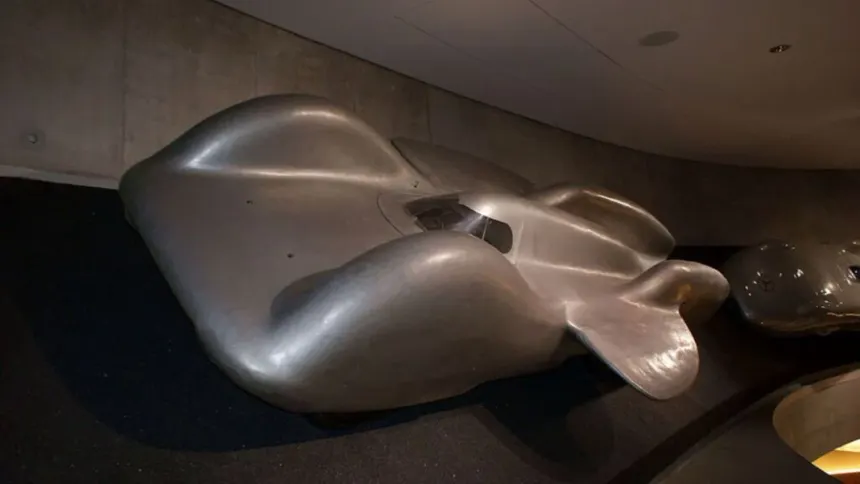
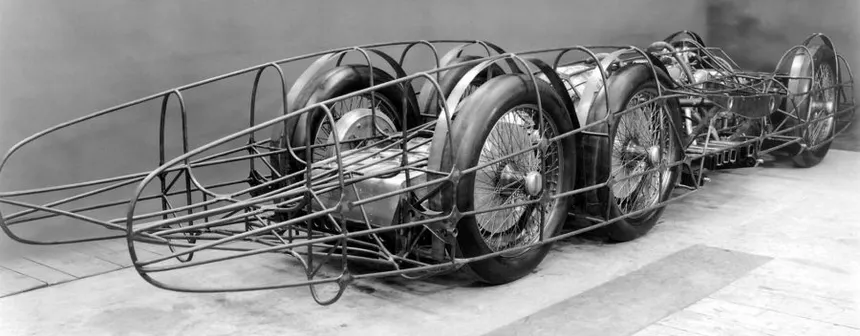
Walk into the Mercedes-Benz Museum in Stuttgart and you’ll find a black car nearly 27 feet long. Three axles, six wheels, two small stubby wings, an aluminum body built by an aircraft plant. No engine in the bay. No odometer to read either, and no point in reading one if there was: zero miles. Not one. The Mercedes-Benz T80, designed by Ferdinand Porsche between 1937 and 1939 to snatch the absolute land speed record from the British, never turned a wheel under its own power. Not one foot. And yet for more than eighty years, gearheads have talked about it as if it did.
The T80 is one of those rare cases where an entire myth stands on a hypothesis. A car whose every spec we know — weight, horsepower, coefficient of drag, exact fuel blend, wing patent — and about which we know nothing that counts. Because knowledge, real knowledge, only exists when a claim gets submitted to the real world. The T80 never got that chance.
The Day Rosemeyer Died
To understand why the T80 existed, you have to rewind to January 28, 1938, on the Frankfurt–Darmstadt autobahn. That morning, Rudolf Caracciola climbed into the Mercedes-Benz W125 Rekordwagen — a fully enclosed streamliner with a 5.6-liter V12 producing roughly 765 hp — and ran 268.9 mph over the flying kilometer on public road. That record stood untouched until November 2017, when Koenigsegg finally beat it with the Agera RS at 276.9 mph.
Hours later on the same road, on the same day, Bernd Rosemeyer — the Auto Union prodigy, mid-engine V16 tamer, favorite of the crowds — climbed into the Auto Union Stromlinienwagen to try and beat what Caracciola had just done. It was his third run of the day. The wind was picking up. His team knew. He knew. Somewhere around 268 mph, the car went sideways, hit a bridge embankment, cartwheeled through the air. Rosemeyer was thrown out and killed at the roadside.
That single day burned two lessons into Germany’s brain. Open-road records were now too dangerous — Mercedes never attempted another one. And the absolute land speed record, the one the British owned with their twin-aero-engine leviathans on the Bonneville Salt Flats, still didn’t have a German name on it. Hans Stuck had been working that idea for two years. Now every spotlight in the country was on him.
Hans Stuck: The Driver Who Refused to Come Second
Hans Stuck wasn’t a nobody. He was Auto Union’s original number one, multiple German champion, one of the few racers alive who could man-handle the mid-engine V16 monsters of that era. But Rosemeyer, a kid who’d graduated up from motorcycles and had no bad habits from front-engine cars, had begun to eclipse him. Stuck saw his slide to second-tier coming and did what drivers in that regime did about it: worked his political contacts.
A personal friend of Hitler with direct access to the top of the Third Reich, Stuck moved as early as 1936. He convinced Wilhelm Kissel, chairman of Daimler-Benz AG, to build the car. He convinced Göring’s Reichsluftfahrtministerium — the Air Ministry — to loan out aviation engines. He convinced Hitler himself, who saw every land speed run as free propaganda, to bankroll the whole thing with state money. In March of 1937, Ferdinand Porsche’s office formally presented the concept. Eight weeks earlier, on January 13, 1937, the design contract was officially placed with Porsche. That’s the verifiable starting gun for the T80.
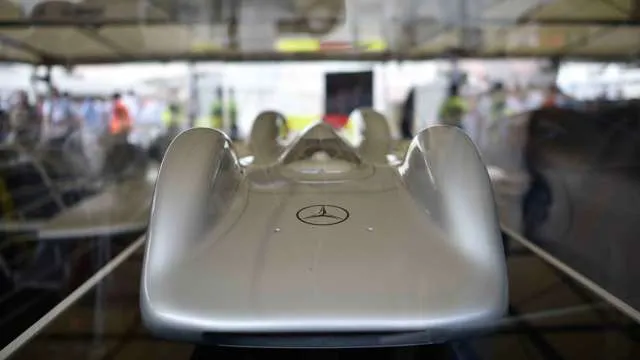
Porsche Before Porsche AG Existed
Worth pausing here. When Ferdinand Porsche designed the T80, Porsche AG the car manufacturer didn’t exist. Wouldn’t exist until after the war. What existed was Porsche Konstruktionen GmbH — an independent engineering consultancy contracted by half the German automotive industry. Auto Union came to Porsche for the mid-engine V16 Grand Prix cars. The Reich came to Porsche for the KdF-Wagen, the “People’s Car” that after the war became the Volkswagen Beetle. And now Daimler-Benz came to Porsche for a car that wouldn’t even carry the three-pointed star as its lead branding — it would just be Type 80.
Porsche was in the most fertile stretch of his career. Grand Prix cars, a peoples’ car, and now a machine whose only job was to go one direction faster than any wheeled object ever had. Initial target: 550 km/h. Rough power estimate: 2,200 hp minimum. Even in 1937, that sounded like fiction.
Josef Mickl and the 0.18 Drag Coefficient
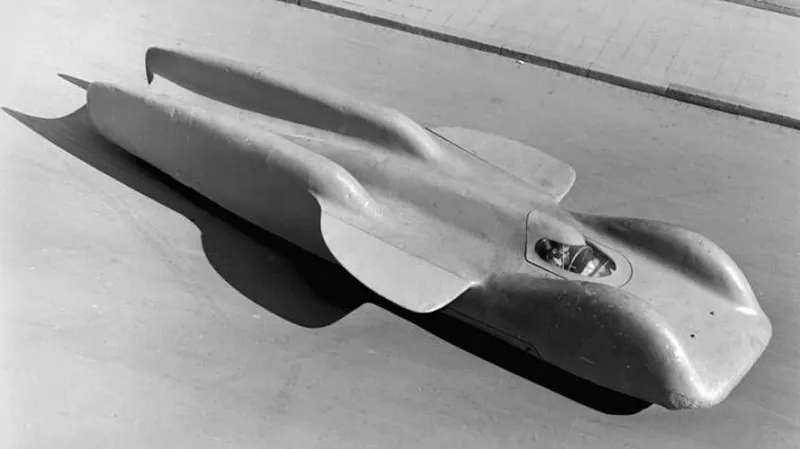
If Porsche put together the architecture, the man who drew the bodywork was Josef Mickl, an Austrian aircraft aerodynamics specialist. Mickl gave the T80 a twin-tail streamlined body — the elongated pontoons wrapping the rear tandem wheels doubled as directional stabilizers — with a drag coefficient of 0.18. That figure is corroborated in Wolf-Heinrich Hucho’s Aerodynamik des Automobils, the standard aerodynamics reference in the industry since 1997.
Let that number sit for a second. A modern Tesla Model S — designed with supercomputer CFD, wind tunnels, and eighty years of accumulated knowledge — has a Cd around 0.208. A current Chevy Corvette Stingray sits around 0.32. A Toyota Prius, the pinup child of efficient aero, hovers near 0.24. Mickl, working with a slide rule in 1939, drew a body with less aerodynamic drag than almost any car sold in America today. In a vehicle nearly 27 feet long. No supercomputers. No full-scale in-house wind tunnel. Just calculation, aviation intuition, and years spent shaping fuselages.
Mickl didn’t stop at the body. In 1939 he patented the two small fixed wings mounted midway down the flanks — one per side — designed to generate downforce and keep the T80 pinned at high speed. That’s twenty-five years before Jim Hall bolted moveable wings onto the Chaparral 2E at Bridgehampton, and thirty years before Colin Chapman started raising the wings on his Lotus F1 cars. The only earlier automotive precedent is Fritz von Opel’s Opel-RAK 2 rocket car, which in 1928 ran small wings on the AVUS speedway at 238 km/h to keep the wheels loaded. A precedent T80 partisans cite and skeptics debate, but it exists.
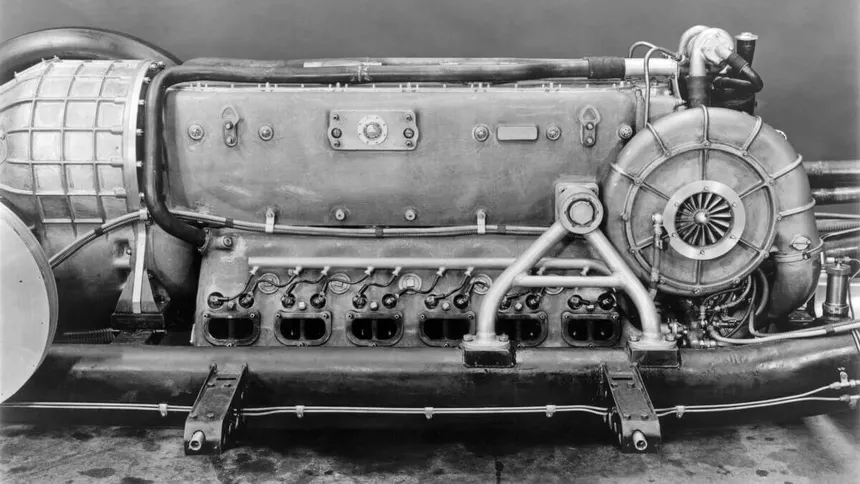
The Engine: A Prototype DB 603 Handed Over by Ernst Udet
The Daimler-Benz DB 603 was the largest inverted V12 in the German aviation inventory. A descendant of the DB 601 — the engine that powered the Messerschmitt Bf 109 — bored out to 44.52 liters by thinning the cylinder walls. Displacement 44,520 cc, bore 162 mm, stroke 180 mm. When the DB 603 finally entered series production in May 1942, its operational outputs ran between 1,750 and 2,260 hp depending on variant.
The T80 didn’t get a production DB 603. It got the third prototype, the V3 unit, handed over personally by Ernst Udet — WWI ace turned director of Luftwaffe procurement — and tuned to somewhere around 3,000 hp at 3,200 rpm. Roughly double the operational power of the standard aviation setup. Most sources quote 3,000 hp; Wikipedia and a few technical references push the figure as high as 3,500 metric horsepower, without any verified dyno chart to nail it down. This is where the story starts sliding from history toward myth.
How was it supposed to make that kind of power? A fuel cocktail that would look at home in a Top Fuel dragster today: 63% methanol, 16% benzene, 12% ethanol, 4.4% acetone, 2.2% nitrobenzene, 2% aviation gasoline, 0.4% ether. Combined with methanol-water injection to cool the intake charge and kill detonation — a direct precursor of the MW-50 injection system the Luftwaffe would later fit to its late-war fighters.
The Engineering That Was Decades Ahead
The real chill of the T80 isn’t its size or power. It’s the stack of technical solutions Porsche packed into the chassis:
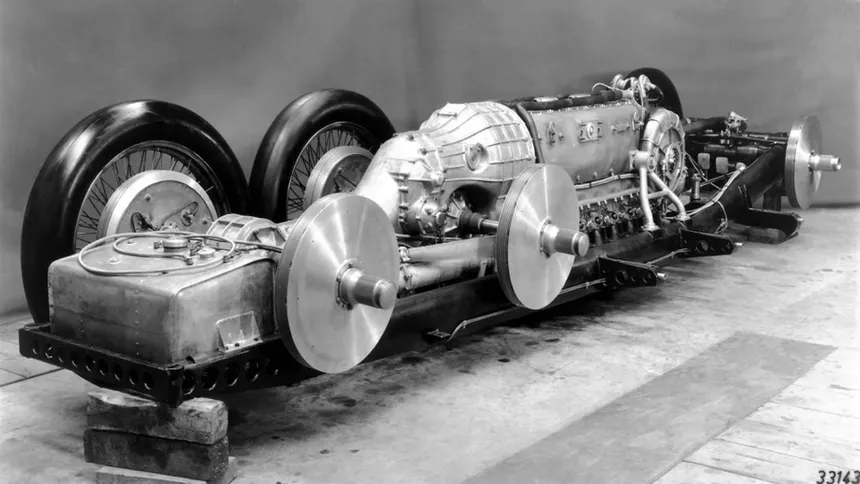
A hydraulic torque converter feeding a single-speed final drive. On a land speed record car. In 1939. The same technology that today sits at the heart of every automatic transmission — used here to multiply torque at launch and let the car settle into direct drive above a certain speed. No gearbox. No shifting. Just fluid coupling on the way up.
A mechanical anti-spin device. Rotational sensors on both the front and rear wheels. If the driven rear wheels started spinning faster than the front — meaning they were losing grip — a mechanical linkage automatically cut fuel to the engine. A crude traction control system, mechanical rather than electronic, forty years before the first Bosch ABS module hit production.
Three axles, six wheels, all-wheel drive on the two rear axles. Not a party trick. Pure contact math: split the colossal torque across four driven tires, each 7 by 32 inches, so the rubber patch talking to the pavement could actually deliver 3,000 hp without shredding. The British rivals — George Eyston’s Thunderbolt with twin Rolls-Royce R V12 aircraft engines, John Cobb’s Railton Special with twin Napier Lion V12s — stacked their power with dual engines. Porsche chose one giant engine and multiplied the driven wheels. Different solution, same problem.
Bodywork built by Heinkel Flugzeugwerke — the same aircraft manufacturer producing bombers for the Luftwaffe. Aluminum, aircraft-forming techniques, fuselage-grade craftsmanship. While the British were fighting Bonneville with essentially industrial-fabricated bodies, Porsche walked the shape into a Heinkel hangar.
Kerb weight: 2,896 kg — approximately 6,385 lb. Or, in Daimler-Benz’s own archive phrasing, “almost exactly 3,000 kg without driver or fuel.”
Every piece of this went into a car that Hitler personally nicknamed the Schwarzer Vogel — the Black Bird — and that was to be painted in German nationalist colors, complete with the Reich eagle and the swastika. The ambition was propaganda; the engineering was pioneering. Both facts are true and both have to be stated together.
The Dessauer Rennstrecke: An Autobahn with the Median Paved Over
Stuck’s original plan was Bonneville, Utah. Break the record where the British broke everything. By 1939, politics had killed that option — the Third Reich and Britain weren’t exactly swapping travel visas. So Germany decided to run it at home. A section of the Reichsautobahn Berlin–Halle/Leipzig, just south of Dessau, was chosen. It’s part of today’s A9 autobahn between exits 11 and 12. The median was concreted over to create a continuous surface 82 feet wide and just under 6.2 miles long. They called it the Dessauer Rennstrecke — the Dessau race stretch.
That’s where Stuck was going to attack. The target speed calculated by Porsche’s design office, according to the Mercedes-Benz public archive, was 600 km/h — about 373 mph — at 3,000 hp. The archive also notes the target was raised to 650 km/h in the final rounds of the project as the British kept setting new records. The 750 km/h figure — 465 mph — that has appeared in books, magazines and documentaries for eight decades? It shows up only in postwar secondary sources, without any documented calculation by Porsche or Daimler-Benz. It originated from figures reportedly quoted to the Allies after the T80 was discovered in Austria. It’s not a calculated number. It’s a spoken one.
Even the popular claim that “the attempt was set for January 1940” doesn’t survive contact with primary sources. Daimler-Benz’s own archive states that the Oberste Nationale Sportbehörde had scheduled the Rekordwoche for October 1940. The timeline lines up: war breaks out on September 1, 1939. The experimental DB 603 gets returned to the Air Ministry in February 1940. The chassis is stored away in June 1940. If the record week had been scheduled for January, none of that sequencing would make sense. It was October. An October that never happened.
The War Ate It
September 1, 1939: Germany invades Poland. Every aviation resource — including the experimental DB 603 — gets redirected to the Luftwaffe. Porsche’s engineers move to other programs. The chassis sits nearly finished, waiting for an engine that would never come back. February 1940: the DB 603 V3 goes back to the aircraft engine test facilities. June 1940: the chassis is archived. During the war, the T80 gets evacuated to Kärnten — Carinthia, in Austria — to keep it safe from Allied bombing raids on Stuttgart. There it sits until 1945.
When the Allies discover it in Austria, engine-less, someone asks how fast it would have gone. Someone answers 750 km/h. That “someone” has never been named in any primary source. And that figure — with no dyno test, no full-scale wind tunnel, no meter of running, no complete power plant install on the chassis — enters the historical record as if it were data.
What Modern CFD Actually Says
In 2020, the British simulation firm TotalSim ran the T80 through modern computational fluid dynamics for a documentary. The result, published with conservative assumptions: the car could realistically have reached about 400 mph — 644 km/h. That would have been enough to beat John Cobb’s absolute record, which stood at 369.7 mph in August 1939 and would climb to 394.2 mph in 1947. The T80 probably would have been the fastest wheeled thing on Earth for a stretch of years. But not by the fantasy margin. Nowhere near 465 mph.
TotalSim also flagged something almost no partisan account mentions: the T80’s body generated lift at the front axle at high speed, while Mickl’s patented wings only pushed the rear down. Practical translation: above a certain velocity, the nose wanted to come up. The rear wings compensated for part of that. Not all. Rosemeyer died over less.
It would have been a record car. With today’s numbers on it, it would also have been a dangerous car. Genuinely so.
An Object Physically Intact, Empirically Empty
The T80 survived the war hidden in an Austrian valley. Came back to Stuttgart. It’s sat for decades in Untertürkheim and now in the Mercedes-Benz Museum in Bad Cannstatt. Fully assembled. Visitable. You can see the chassis, the empty engine bay, the patented wings, the twin-tail streamlined shell. Every major piece is there except the DB 603 V3, which stayed inside the Luftwaffe system and never came home.
It exists. Physically, it exists. As a record car — as proof of anything — it doesn’t. Because a record car isn’t defined by its spec sheet. It’s defined by what it does on the ground. And this one did nothing.
NEC’s Take
The T80 pisses me off, and it pisses me off in a good way. It pisses me off because for eighty years the automotive press has sold it as the most advanced machine of its era based on a number — 465 mph — that never came off a dyno or a timing beam, only off a postwar conversation. It pisses me off because modern CFD, which none of the myth’s defenders wants to bring up, says the nose was pitching up and 400 mph was the realistic ceiling. It pisses me off because the whole legend of prewar German technical supremacy has been sold too many times on hardware that arrived too late, flew too little, or never got tested at all. The T80 is the extreme case: pure reputation, zero pavement. Potential. A slippery word.
And still — when you stand in front of the bare chassis at the museum and see that hydraulic torque converter, the mechanical anti-spin linkage, and wings patented in 1939, you realize Porsche and Mickl were operating on a technical wavelength most of the world wouldn’t reach for decades. The ambition wasn’t fake. The engineering wasn’t either. What was fake was the propaganda framing around it — a framing that got fed round numbers and has survived intact into 2026 because nobody has ever had the guts to roll the car out of the museum and put it on a proving ground. Mercedes never will. And they’re right not to: if the T80 came out today and couldn’t crack 465 mph, the entire myth would collapse in a single afternoon. Better to leave it as it is: beautiful, black, silent.
I’ll take a car that runs over a car that gets talked about. Every time.
Check you’re still alive.
NEC · Not Enough Cylinders