Horch 930 S Stromlinie 1939: Germany’s Streamliner With a Sink in the Fender
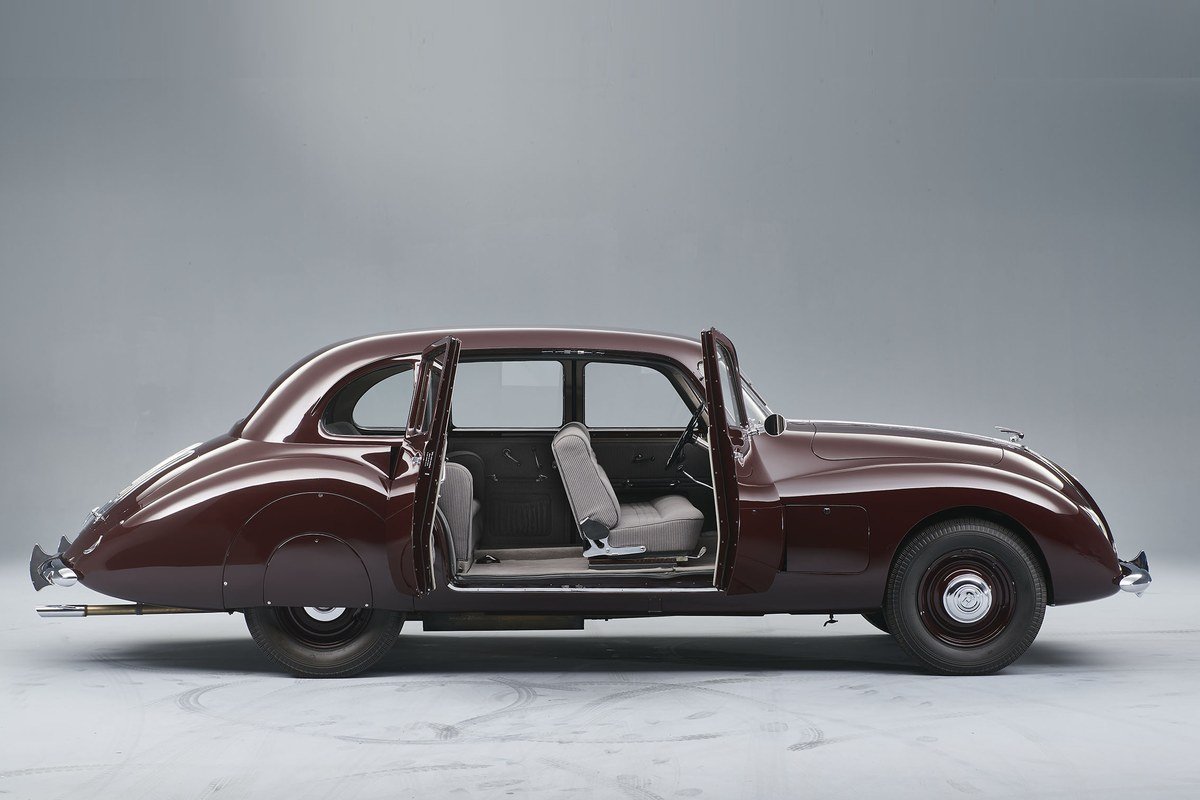
The most advanced luxury sedan Germany put on a show stand in 1939 had a washbasin with hot and cold running water folded into the front fender, and it never reached series production. The Horch 930 S was unveiled in Berlin in February of that year as the future of the chauffeur-driven limousine. The war that started later in 1939 ended the project, and what came afterward is stranger than the sink: a handful of cars assembled on Soviet orders, from prewar parts, in the same factory the Soviets had stripped.
The sink got the headlines. The real work was in the shape. The Horch 930 S was an 18-foot sedan with a 3.8-liter flathead V8 making 92 PS, about 91 hp, and the engineers who built it left the engine alone. They changed the body.
A Name That Became Audi
You can’t read this car without knowing whose name was on the hood. August Horch founded his company in 1899 in Cologne-Ehrenfeld, moved it to Saxony a few years later, and left in 1909 after a fight with the financial board. He started a new car company in Zwickau and could not put his surname on it, because the old firm still owned the name. His fix was to translate it. In German, “horch” means “listen.” In Latin, “audi” means the same thing. Audi was born in 1910.
In 1932 the Saxon state bank forced a merger of Horch, Audi, DKW and the car division of Wanderer into one group, Auto Union, and the four rings became its badge. The man who walked out of one company slamming the door ended up with both of his companies under one roof. Horch was the luxury brand of the group. By 1938 Horch output had doubled from its 1932 level, and one in four cars registered for the first time in Germany that year came from Auto Union.
A Flathead V8 From the Wrong Decade
Americans know the flathead layout from Ford. The Horch V8 used the same basic idea, with the valves sitting beside the cylinders instead of above them. If you’ve never opened a flathead, here is the short version, and it ties back to the first chapter of our induction series: an engine is an air pump, and anything that slows the air on its way into the cylinder costs horsepower. In a modern engine the valves sit in the cylinder head, directly over the piston. In a flathead they sit in the block, to the side, lying down. It’s cheap to build, compact, and simple. The price is that the gas has to take a detour on the way in and out, so the cylinder fills poorly. That fill problem, along with the shape of the combustion chamber, keeps the compression ratio low and caps the power. The Horch ran 6.0 to 1 and made roughly 24 PS per liter.
Fritz Fiedler started the engine by cutting the big Horch V12 of 1931 down to a more compact V8. When Fiedler left for BMW in Eisenach in the summer of 1932, Werner K. Strobel took it into production. It reached the market in 1933 at 3.0 liters and 70 PS, grew to 3.5 liters, and in 1938 reached its final size: 3,823 cc (about 233 cubic inches), with a 78 mm bore (3.07 in) and a 100 mm stroke (3.94 in), making 92 PS. Even the rpm of that peak isn’t settled: some data sheets say 3,600, others 3,200.
The stroke is longer than the bore, and that has a mechanical consequence. With a long stroke the piston travels farther on every turn, so at the same rpm it moves faster than a short-stroke piston would. An engine like that is laid out to turn slowly.
For comparison, the Tatra 87 of 1937, a rear-engined air-cooled V8 with overhead cams, made 75 PS from 2,969 cc, around 25 PS per liter, from nearly a liter less displacement. Horch’s older straight-eight had run an overhead cam and ten main bearings. The V8 was shorter and cheaper to make, with three main bearings. Its two cylinder banks sat at 66 degrees, the same angle as the V12, and the joint between block and head had a kinked profile that needed specially shaped head gaskets. Two Solex carburetors fed it, and a ZF four-speed with synchromesh sent the power to the rear wheels. The sedan version of the Horch 930 V, which shared this machinery with the 930 S, burned about 19 liters per 100 km, which works out to roughly 12.4 miles per US gallon.
So the most advanced Horch of 1939 ran an engine from a generation that was already on its way out. Everything modern about the 930 S was on the outside.
The 930 V Chassis
Underneath sat the Horch 930 V chassis. The V stands for “verkürzt,” shortened, and it gave the car a 3.10 m (122 in) wheelbase, a little shorter than the long 830 versions. The front suspension was independent, with leaf springs, and the brakes were hydraulic drums. The four-door 930 V sedan was listed at 8,850 reichsmarks, weighed around 1,960 kg (about 4,320 lb), and Horch gave it a top speed of 130 km/h, about 81 mph.
Keep that number in mind. The standard 930 V, with the same 92 PS engine, was advertised at 130 km/h. For the 930 S, much higher top speeds are published, and they are laid out below with the source of each. What changed from the 930 V was the body.
The Airship Engineer
Aerodynamics comes down to something simple. A moving car has to push the air out of its way. How hard that is depends on two things: how big the car’s frontal area is, and how well the shape lets the air slide by. The second part is measured with the drag coefficient, Cd, which German sources of the period wrote as Cw. The lower the number, the easier the car slips through. Drag grows with the square of speed, and the power needed to overcome it grows with the cube. Double the speed and you need eight times the power. That means each extra horsepower buys less speed than the one before, and past a certain point it pays more to fix the shape.
The shape of the 930 S came from an airship engineer. Paul Jaray, from a Hungarian family, worked at Zeppelin, where he learned to draw bodies that cut through air in the wind tunnel. In 1922 the first car with his body appeared, built on a 2-liter Ley chassis, and in the tunnel it showed a Cw of 0.28. A Jaray-bodied Ley won a German race in 1923 at 130 km/h. Jaray moved to Zurich and set up a company to sell licenses for his patents. Maybach and Apollo bought one.

Chrysler signed with him in June 1935, after the Airflow was already out, for $5,000 plus a small royalty on every Airflow exported to Europe. The only maker that took Jaray’s principles into real series production was Tatra, with the T77 and then the T87 that started in 1937.
Horch used part of those patents for the 930 S. The body was to be built by Gläser in Dresden. The result was a car 5.53 m long (18 ft 2 in), 1.95 m wide (6 ft 5 in) and 1.465 m tall (4 ft 10 in), with a long tail that sloped down and that, seen from behind, looks like the DKW F9 of that same year.
A figure circulates for the 930 S Cw, 0.42, but it isn’t backed by any factory document. Comparing it with the 0.28 of the 1922 Ley, or with any other car, doesn’t mean much without knowing which test produced each number, because at the same speed drag also depends on frontal area.
There’s a footnote on credit. For decades the Mercedes-Benz 540 K Stromlinie of 1938 was attributed to Jaray, but Daimler’s own historians say no Jaray patent was used on that body. That was the house built on the merger of Carl Benz‘s and Gottlieb Daimler’s companies, and in the 1930s it chased the same buyer Horch did. To build it, Daimler had hired Hermann Ahrens, a coachbuilder who came from Horch.
What Was Inside
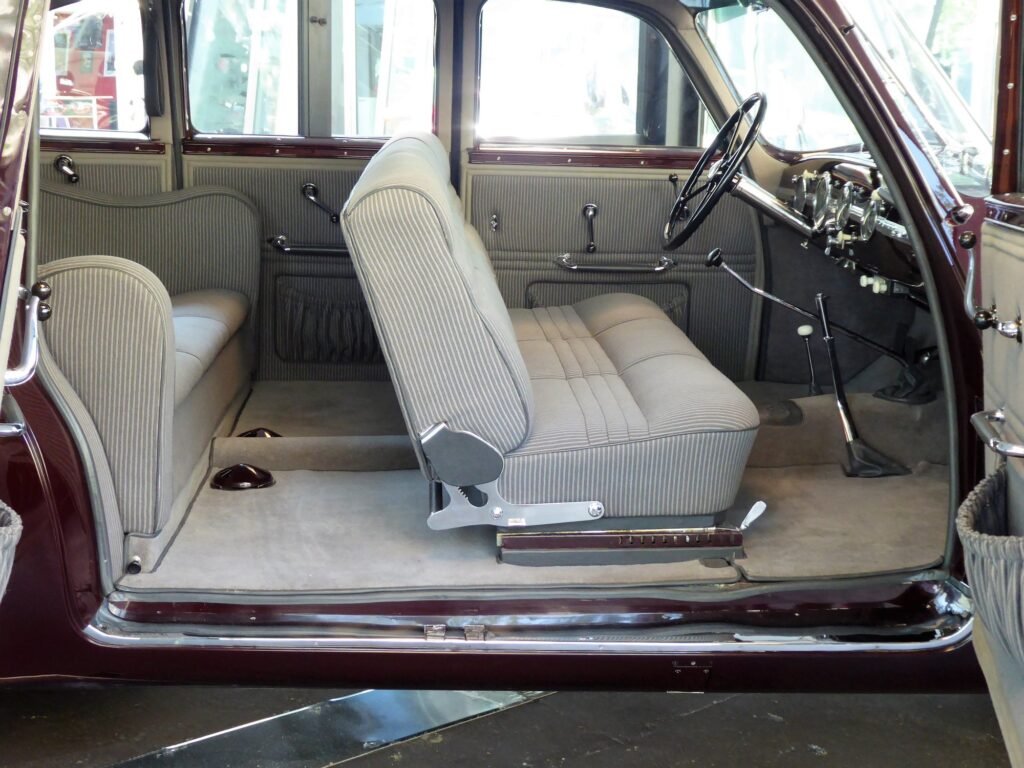
This is where the 930 S gets odd. It had no center pillar, the B-pillar that normally sits between the front and rear doors. Without it, the front door closed flush against the rear door, which was hinged at the back, and getting into the rear seat took no contortions. A hot-water heater fed warm air to the footwells front and rear and to the windows. The seats folded down into a bed. The dash was built to take a factory radio. It was a sedan for long runs on the autobahns Germany was building.
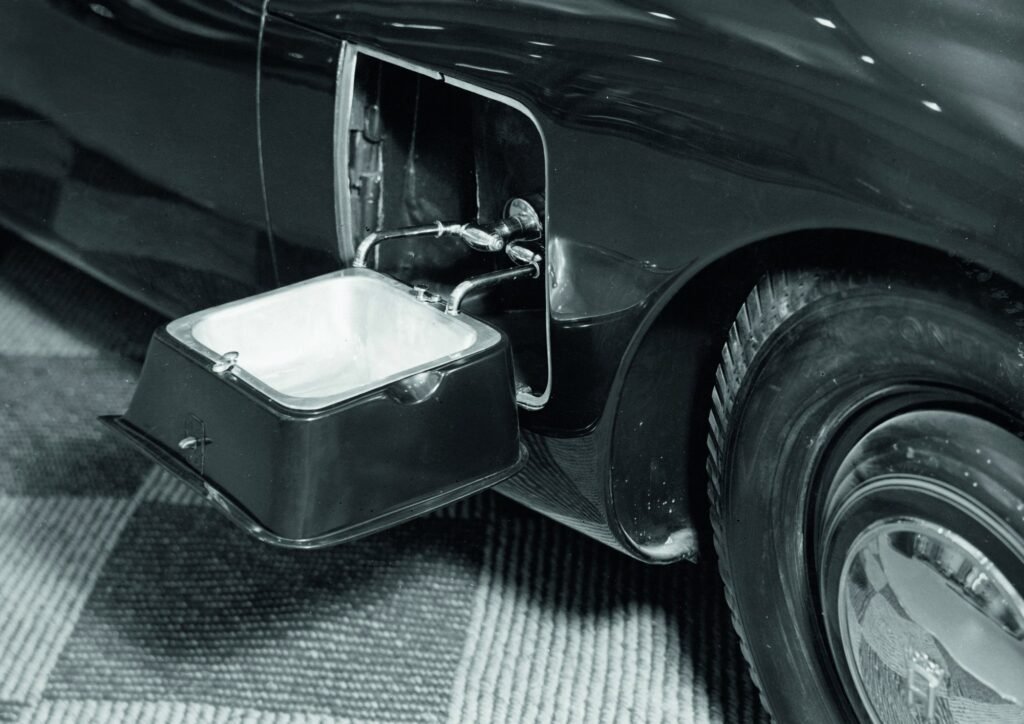
The equipment list reads like something from the 1970s: a steering lock, a fan to clear the windshield, and a built-in jacking system so the chauffeur never had to hunt for a jack point. And in the right front fender, behind a flap, sat a washbasin that swung outward with hot and cold running water. At the same height on the driver’s side was a first-aid kit. The basins were white enamel originally and later stainless steel.
Berlin, February 1939
Auto Union showed the 930 S at the Berlin motor show in February 1939. It was supposed to replace the 930 V in 1940, with a 930 L taking the place of the 830 BL. The club magazine AufgeHorcht puts its price at 17,000 reichsmarks, almost double the 8,850 of the 930 V with the same engine and the same chassis. Everything that separated one car from the other was sheet metal, shape and equipment, and Horch charged for it as if it were a different car. Two cars were shown. It has been said that a third existed and that Tazio Nuvolari drove it. That claim is unconfirmed.
On top speed there are three figures, and each one has its own origin. The August Horch Museum and the city of Zwickau say 187 km/h, about 116 mph. Motor Klassik credits 178 km/h (about 111 mph) to the first tests at the Dessau track and mentions 187 as an alternative figure. The club magazine AufgeHorcht gives 160 km/h (about 99 mph), the figure for the 1939 model shown in Berlin. None has been checked against the original test record, so all three stay unconfirmed. What can be said is that the 930 S had a published top speed above that of the 930 V, with the same 92 PS nominal.
Numbers That Don’t Add Up
With this car almost every number has two versions, and it’s worth writing that down. Curb weight is listed as 1,850 kg (4,079 lb) in some data sheets and 2,300 kg (about 5,070 lb) in others, with no factory document to settle it. The unit count moves too. For the prewar cars people give two, or three if you count the one attributed to Nuvolari, still unconfirmed. The chronology published by the city of Zwickau adds up to nine (two from 1939, three from the first postwar batch and four from the second), although its own text says seven, and other sources read six and eight. For the 930 V, production figures run between 1,991 and 2,054 cars from 1937 to 1940, and until spring 1940 Zwickau built 11,625 civilian cars in the 830/930 family.
What is on record is that the war stopped any series. Since the mid-1930s Horch had also been building for the army, and 4,536 units of the military 830 R came out of that. The last civilian Horch left the factory in September 1941.
Zwickau, 1946
The best part of this story comes after the war. The Horch plant in Zwickau came through the bombing almost undamaged, but Saxony fell into the Soviet occupation zone and the factory was stripped. The Soviets took 98 percent of the machine park, around 3,800 machines. In 1948 the plant started producing again as VEB Horch, a state-owned company in the Soviet zone.
Before that, in 1946, Major Sewerjanz, the plant commandant, ordered three 930 S built. They were assembled from stocks of prewar parts, and the bodies had to be rebuilt from drawings. The cars went to the Red Army, one to its headquarters in Berlin-Karlshorst and another to Wendenschloss, near Berlin, and one to the minister Fritz Selbmann. The Austrian club ÖAMTC attributes a 1946 930 S to Seworjanz himself, so where each car went depends on the source. A second batch of four followed, assembled in 1947 and 1948 with a reworked front end, more modern, that no longer matched the 1939 tail.

By then the Auto Union executives, with Richard Bruhn at their head, had left for the West and started a new Auto Union in Ingolstadt. Bruhn didn’t give up Zwickau luxury either. In June 1953 he got a company car rebuilt on a Horch 830 BL Pullman sedan from the last prewar series. An American soldier later took it to the United States, and it has been in Audi’s collection since 2008. It isn’t a 930 S, but it says a lot about what a Horch meant to the people who had built them.
The car conceived in 1939 for industrialists and the notables of the regime ended up built for the army that had dismantled its factory.
The Two That Are Left
Two 930 S are said to survive. One is chassis 931002, from the postwar run, with the new front. It ended up in Riga, Latvia, where its last owner had it restored between January 1993 and November 1994 at Andrejs Rode’s shop. It took 5,800 hours. Today it belongs to the August Horch Museum in Zwickau, which the city and Audi founded in December 2000. The other, according to Motor Klassik, is kept by Audi Tradition in Ingolstadt, with the 1939-style body. When that car was assembled remains open, and it shouldn’t be confused with Bruhn’s Horch, which is a different story.
The Sink Matters Least
Horch took a chassis and an engine that were already in the catalog, with a flathead design that was getting old, and left them alone. It put over them a body built on the patents of an airship engineer and got a published top speed above the 930 V with the same 92 PS nominal. Changing the shape is cheaper than changing the engine, and past a certain speed it pays back more. Jaray knew it in 1922, Chrysler learned it the hard way with the Airflow, and every EV on sale today proves it again, scraping hundredths off its drag coefficient to win back miles of range.
The problem was timing. A car with beds, hot-water heat and a washbasin, built for a chauffeur and the autobahn, arrived when the factory had spent years putting much of its work into military vehicles. What Horch could do with a real 930 S was show it in Berlin and assemble a few more later, from prewar parts and rebuilt bodies, for the people who ran Zwickau in 1946.
Half a century later Luigi Colani tried the same trick on a twin-turbo Testarossa, aiming at Caracciola’s 1938 record: the Ferrari Testa d’Oro at Bonneville.
Check you’re still alive.
Photos: Audi AG (press photo), Audi AG (press photo), Fridolin freudenfett (CC BY-SA 4.0), Audi AG (press photo), Derbrauni (CC BY 4.0).