
Ferrari Testa d’Oro Bonneville: Colani’s 218 mph Testarossa
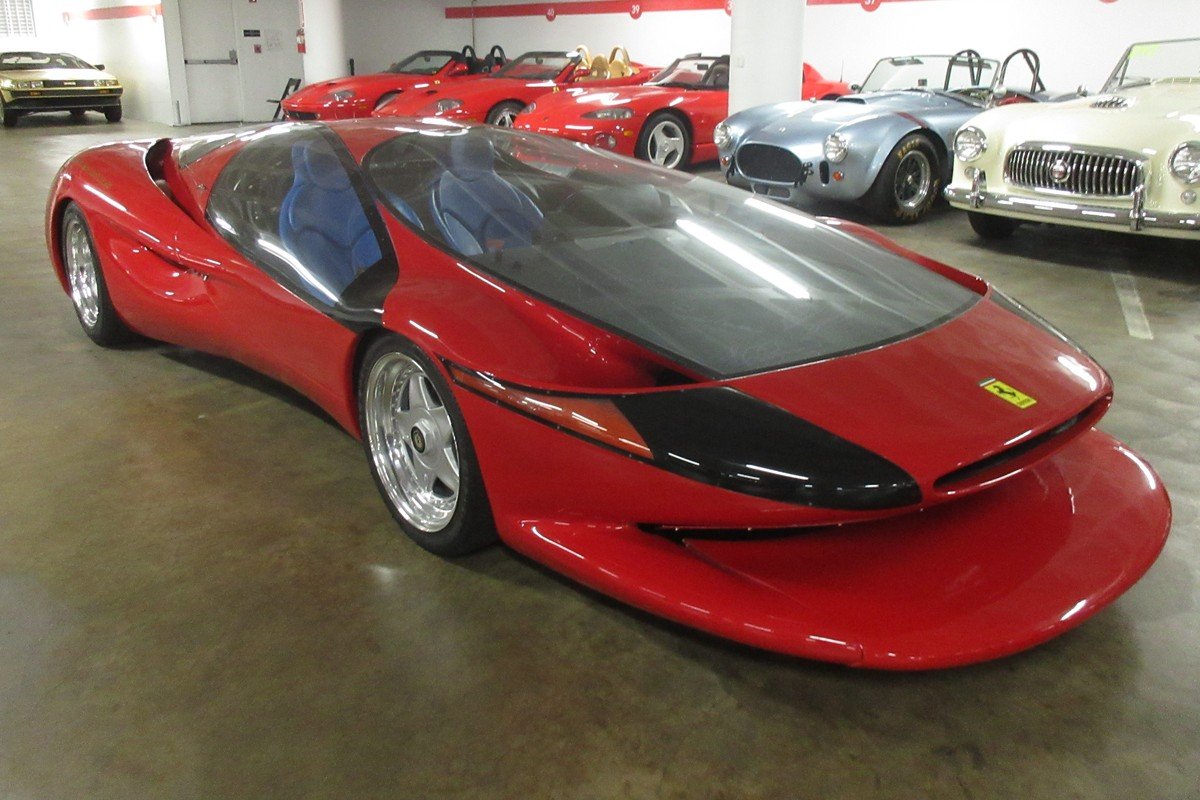
A German designer brought a Ferrari to Utah to beat a Mercedes, and an American drag racer drove it. That alone should make the Ferrari Testa d’Oro a staple of every Speed Week story. Instead it’s a footnote, partly because it didn’t beat the Mercedes, and partly because almost every number attached to it comes in two versions. Ferrari never built it. Luigi Colani drew it, Lotec of Bavaria built the engine, and the car has had a stranger life since Bonneville than most record cars have on the salt. One-off, twin-turbo, 750 hp on paper, and a paper trail that falls apart the moment you put two sources side by side.
The man who renamed himself
Luigi Colani was born Lutz Colani in Berlin on August 2, 1928, and died in Karlsruhe on September 16, 2019, at 91. He designed trucks, teapots, pianos, cameras and sunglasses, and he sold all of it with one line: nature has no straight lines, so neither should anything you make. He called it biodynamic design. In practice that means soft, continuous surfaces with no hard edges, shapes closer to a river stone or a dolphin than to anything that came off a Detroit drafting board in the ’70s.
Speed wasn’t new to him. In 1959 he built the Abarth 1300 Berlinetta with Carlo Abarth, around a 1,300 cc Alfa Romeo engine making 110 hp in a car of roughly 780 kg, about 1,720 lb. The 210 km/h, roughly 130 mph, quoted for it has no solid source behind it. It stayed a one-off. In 1980 he brought a record car built from a Chevrolet Corvette to Bonneville, so the salt was not a first date. He had also re-bodied a Ferrari Daytona.
In 1989 Ford invited him to speak at its design center in the Detroit area, and he turned the invitation into a U.S. tour with close to a dozen prototypes that looked like they had landed rather than been built. The donor Testarossa for the Testa d’Oro is a 1989 car too.
Stripping a Testarossa
Colani wanted a record car built on a Lamborghini, a Porsche or a Ferrari. He picked a 1989 Ferrari Testarossa, the car Miami Vice had just turned into the poster on every American teenager’s wall.
The stock car ran a 4.9-liter twelve with the two banks of six laid flat at 180 degrees. People call it a flat-12 or a boxer. It isn’t a true boxer. In a boxer, each piston gets its own crankpin, the spot on the crankshaft where the connecting rod attaches, and opposing pistons move out and in together like two fists punching. In Ferrari’s 180-degree V12, opposing pistons share a crankpin. The engine was the Tipo F113, four valves per cylinder. European cars without a catalytic converter made 390 PS at 6,300 rpm and roughly 480 to 490 Nm, about 354 to 361 lb-ft, depending on which Ferrari spec sheet you trust. U.S. cars, all catalyzed, made around 380 hp. Ferrari quoted a top speed of about 290 km/h, around 180 mph, and Hagerty puts the weight at 1,506 kg, about 3,320 lb.
Colani threw the body away. He kept the points where it mounts to the chassis and built a new composite shell on top. Per Hagerty, Colani said he drew the outline by hand and used no computer and no wind tunnel. That’s his claim, and nobody has checked it. Colani was his own best publicist, so read it as a manifesto, not an engineering report.
There was an earlier body before the Bonneville car, a bulky grand tourer with a kit-car look that barely resembles what ended up on the salt. Hot rodders know the formula: big power underneath, somebody’s dream on top. The difference here was the goal. This one was meant to go after a world record.
Lotec and the boost
The engine went to Lotec in Kolbermoor, Bavaria, founded in 1962 by Kurt Lotterschmid, a onetime hillclimb racer whose shop built short-run supercars and turbocharged Porsches, Mercedes-Benz and Ferraris. In 1991 Lotec also built the TT 1000, another Testarossa, this one wearing F40-style bodywork. Hagerty credits the TT 1000 with anywhere from 780 to 1,000 hp depending on spec. That range belongs to the TT 1000, not the Testa d’Oro, and plenty of websites have blended the two cars into one.
A turbocharger is a turbine spun by exhaust gas that would otherwise just leave through the tailpipe. The turbine drives a compressor that forces extra air into the cylinders. More air lets the engine burn more fuel, and more fuel burned means more power. We break it down in our turbo chapter. On the Testa d’Oro, two turbochargers ran 1.25 bar, about 18 psi, according to Rosso Automobili. Hagerty credits the engine work to Ferdinand Pietz of TTP Automotive, a longtime Lotec partner. The figure everyone repeats is 750 hp at 6,400 rpm, close to double stock, sent to the rear wheels through a five-speed manual.
Torque is where it gets fun. Hagerty and Rosso say 900 Nm, 663 or 664 lb-ft, at 5,000 rpm. Morton Street Partners, the New York firm handling the car today, says 600 lb-ft, which is 813 Nm. That’s where both numbers floating around the internet come from. One of them is a typo that got copied a thousand times, and there’s no published dyno sheet to settle it. Horsepower isn’t much better: 739, 750, 780, “700bhp-plus” in Classic Driver. Nobody has ever shown a dyno chart.
The name comes from the engine, and the sources can’t agree on what was gold. Classic Driver says the cam covers. Car Design News says the cylinder heads were painted gold. Rosso Automobili points to gold thermal insulation in the engine bay, the same trick as the McLaren F1. Italy’s Motorbox says gold manifolds. Testarossa means red head. Testa d’Oro means gold head. Which part counts as the head depends on who you ask.
A body against the air
Three pieces defined the shape. Up front, a splitter: a lip sticking out under the nose that divides the oncoming air, some over the car and some under. Air moving faster underneath drops the pressure there and pulls the nose down. At the back, a diffuser: a ramp under the tail that lets that air exit without dragging the car backward. Up top, a wing with longitudinal panels that, on the 1991 body, routed air over the roof.
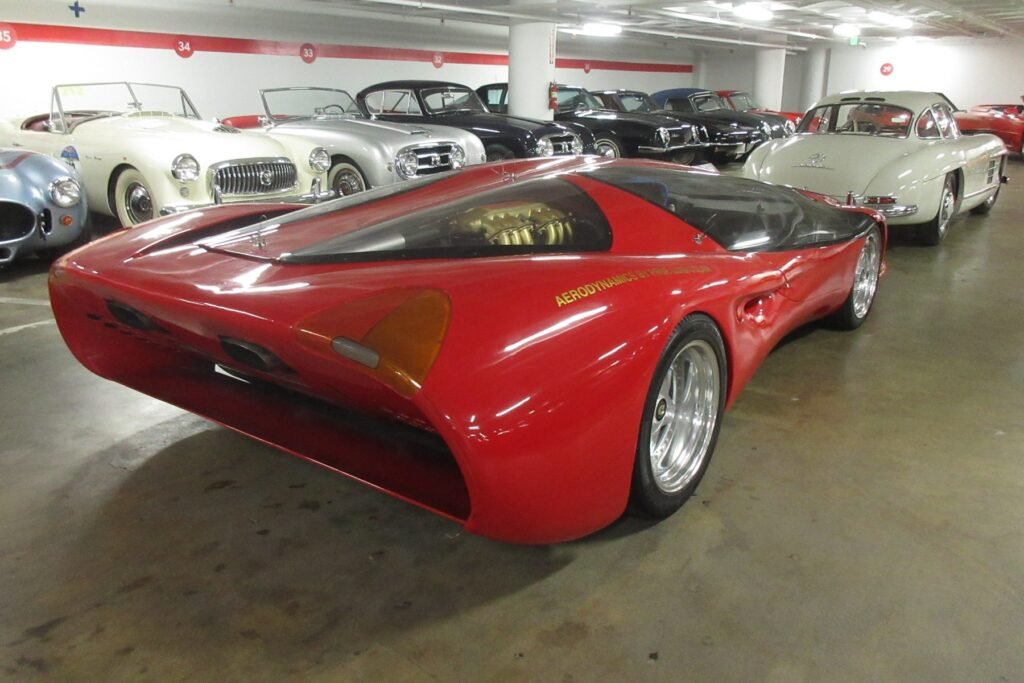
All of it exists because at very high speed the curved shape of a car acts like an airplane wing and tries to lift. In a car, lift is poison, because less weight on the tires means less grip. Hagerty reports that the Testa d’Oro had a reputation for front-end lift and for tires skating on the salt. That’s reputation, not telemetry. For an earlier, very German fight against the same physics, see how the Horch 930 S Stromlinie took on the wind in 1939.
Tires were 235 front and 335 rear, the same thinking as the F40. Then there’s the weight: 1,650 kg, about 3,640 lb, per Hagerty and Rosso, against 1,506 kg for the Testarossa. A car rebuilt with lightweight composite panels that ends up 144 kg, some 320 lb, heavier than the donor deserves a second look. Nobody says whether both figures were measured the same way, dry or wet, with or without the ballast and parachute a record car carries. So the gap is a rough guide.
There’s no drag coefficient on record. That number, Cd, tells you how hard a car has to work to push through the air, and lower is better. A car built to break a speed record with no published Cd in 35 years tells you plenty.
Speed Week, August 1991
The target was 200 mph at the Bonneville Salt Flats, the dry lake bed in western Utah where land-speed racing has lived for more than a century. At Speed Week in August 1991, Mike Strasburg drove it. Hagerty describes him as a second-generation drag racer, which is about as American a casting choice as you can make for a German-designed Italian car. The Testa d’Oro won its class.
Now the numbers. Rosso Automobili gives 340 km/h, 211 mph, for 1991, and puts 351 km/h, 218 mph, in 1992 with the same driver and a largely unchanged body. Hagerty, Classic Driver and Motorbox put 218 mph straight into 1991, and Motorbox narrows it to 350.7 km/h. Hagerty adds that it came from a standing start, meaning the run began from zero rather than with a long rolling approach. Nobody has published a timing slip, so both timelines stay open.
The headline is a world record for a car with a catalytic converter. The converter cleans exhaust gas before it leaves the car, and because it sits in the gas path, it costs power. A car running one has a harder time going fast. Hagerty and Morton Street call it a world record. Classic Driver and Car Design News call it a class record or a class win. Those aren’t the same thing, and the gap matters because the stated goal was much bigger.
The 1938 number
That goal was Rudolf Caracciola’s 432.7 km/h, 268.9 mph, set on January 28, 1938, on the autobahn between Frankfurt and Darmstadt in the Mercedes-Benz W125 Rekordwagen. Mercedes lists a 5.6-liter V12 with 736 hp. That’s 53 years earlier, on nearly identical power: the Testa d’Oro’s most repeated figure is just 14 hp higher. It came up more than 50 mph short.
Physics doesn’t negotiate. The power needed to overcome air resistance rises with the cube of speed. Going from 351 to 432.7 km/h with the same shape and frontal area takes 1.87 times the power, roughly 1,400 hp instead of 750. The W125 did it on 736 because Mercedes measured a drag coefficient of 0.157, a staggering figure even now. A slippery modern sedan sits around 0.25. The 1938 Mercedes was a raindrop on wheels. Colani’s shape, however pretty, had no measurement to show.
Showroom cars that ran with it
The road-going exotics of the day put it in perspective. Bugatti’s EB110 GT, unveiled in September 1991, was rated at 342 km/h, 212.5 mph, and Auto Motor und Sport measured 336. The 1992 EB110 Super Sport was rated at 355 km/h, and Sport Auto clocked 351 km/h, 218 mph. Same number as the Testa d’Oro, from a car you could order. How that Bugatti story eventually ended up at 400 km/h is in our piece on the Bugatti W16.
Here’s the detail almost nobody connects. The Jaguar XJ220 hit 217.1 mph, 349 km/h, at Nardò in Italy with Martin Brundle driving. To get there, Jaguar pulled the catalytic converters and raised the rev limit to 7,900 rpm. So the fastest road car of its day did its record run without a cat, while the Testa d’Oro was billed at 218 mph with one. Nardò’s banked ring and a standing-start pass on Bonneville salt are different worlds, so it’s not a clean comparison. But it explains why Colani wanted the words “catalytic converter” in the headline.
The McLaren F1 ended the argument. In 1993 McLaren calculated 231 mph from the XP3 prototype’s data at Nardò, and on March 31, 1998, Andy Wallace averaged 240.1 mph, 386.4 km/h, at Ehra-Lessien, peaking at 243. That mark stood until 2005. Today even an EV clears 400 km/h: the Rimac Nevera hit 412 km/h, 256 mph, in 2022.
Three bodies, one car
Rosso Automobili says Colani brought the Testa d’Oro and three other cars to Bonneville. Morton Street says three in total. The 1991 body had a sharper nose, flatter flanks and the paneled wing. The 1992 body was close to identical. Then came the big change: a much rounder shell, an enormous windshield, an exaggerated splitter, Rosso Corsa paint and a blue interior with blue race seats. Rosso Automobili dates that version to 1993. Hagerty says the new outline arrived in time for the 1996 Essen Motor Show. That final body never went back to Bonneville, and no source says why. There’s also a story about a Momo wheel carrying Colani’s face. I haven’t found it in any serious source, so it stays a garage legend.
There was only ever one Testa d’Oro. A few websites claim 350, and Hagerty bothers to shoot that down.
Two owners at once
After Bonneville the car lost its decals and its parachute and went up for sale at $480,000, per Hagerty. No takers. Hagerty, writing in October 2025, says Colani kept the car until his death in 2019 and drove it on the road whenever he felt like it, well into his eighties. It was road-legal under German rules of the time.
That story runs head-on into the Italian press of 2015. On July 18 that year, Il Resto del Carlino in Modena laid it out. Colani Design Corporation, the designer’s company, had filed a theft complaint with the carabinieri of Cremona. Its managing director, Roberto Guerini, said the car had been stored in a warehouse in Pero, outside Milan, and that they had learned it spent a year on display at the Ferrari Museum in Maranello and was then offered for sale at a dealership, with a suggested price around $1.7 million.
On the other side stood Enrico Bertone, a former rally driver living in Monte Carlo and a collector. Bertone said he bought the car in 2013 from Alessandro Bruni, a classic-car dealer in Florence, and produced the paperwork: a swap of his Fiat Abarth 1400 Millemiglia Touring for the Testa d’Oro. He said the car had been rusting and abandoned since Bonneville, and that he had it restored in Modena. The Ferrari Museum confirmed it signed the display agreement with Bertone, who presented himself as owner, and that the car was there from mid-2014 to March 2015. When the museum rotated its collection, the car went to the Purosangue dealership in Maranello, which had written authority to sell it. Bertone changed his mind and took it back. La Gazzetta dello Sport ran the same story on July 19.
That’s the contradiction nobody seems to check. Either Colani owned the car until 2019 and was driving it around Germany, or in 2013 it was rusting in Florence and changed hands for an Abarth. Both can’t be true. And in the middle sits a Colani company claiming in 2015 that the car was in a Milan warehouse. Classic Driver photographed it in Maranello that same year with a freshly rebuilt engine, which fits Bertone’s version.
The endings floating around are worse. Automoto.it wrote in 2024 that Italian police seized the car before it could be sold. Rosso Automobili says it sold in 2015 for $1.7 million, which happens to be the suggested price Il Resto del Carlino reported. I found no record of a seizure and no record of a sale. Both stay rumors.
New York
In 2022 the car surfaced in the U.S. Marqued wrote in December 2022 that it had fallen off the radar nearly ten years earlier before Morton Street Partners rediscovered it. Morton Street is a Manhattan advisory for collector cars that specializes in one-offs, design studies and concepts, founded by Jake Auerbach and Tom Hale. Ten years off the radar sits awkwardly next to a car displayed at the Ferrari Museum in 2014 and photographed in Maranello in 2015, but that’s the line. Classic Driver says it’s now with an American collector. It was reported as part of the Colani Collection, with conservation work due to wrap in 2025. I found nothing saying that work is done.
What holds up
The solid part fits in two lines: the car exists, it’s Colani’s design with a Lotec engine on a 1989 Testarossa, and it ran at Bonneville in August 1991 with Mike Strasburg, where it won its class. Everything else comes in two or three versions. The speed is 211 or 218 mph, sometimes both in the same year. The achievement is a world record with a cat or a class win. Torque is 600 or 663 lb-ft. The last body is 1993 or 1996. And from 2013 to 2015 two parties claimed the car at once, with Ferrari’s own museum caught in between.
Salt doesn’t read manifestos
Colani preached curves because nature doesn’t do straight lines. Lovely idea. But the judge of whether a shape cuts the air is a wind tunnel or a stopwatch, and at Bonneville the stopwatch said 218 mph on 750 hp, more than 50 mph behind a 1938 Mercedes on the same power with a measured drag figure.
As an object, the Testa d’Oro is priceless. It’s a composite sculpture on a Ferrari that Maranello never ordered, which ended up on display in Ferrari’s own museum thanks to a man who said he’d traded an Abarth for it, with a theft complaint along the way and a collector in New York at the end of the chain. No class record on the salt comes with a biography like that.
Check you’re still alive.