
The Wall You Can’t See: Why Your Car Won’t Go Any Faster (AeroNEC · 1)
There’s a moment in the old Top Gear Veyron film where James May, flat out at Ehra-Lessien, tries to explain what it actually takes to push a car past 400 km/h. The numbers stop making sense. The engine is drinking fuel fast enough to empty the tank in twelve minutes. And almost none of that violence is going into making the car heavier, or grippier, or louder. It’s going into one thing: shoving the air out of the way.
That’s the part nobody tells you when you buy a car. Most of what your engine does at speed isn’t moving you. It’s fighting an invisible wall that rebuilds itself in front of the nose every single metre, and gets harder the faster you go.
This is AeroNEC. No jargon for the sake of sounding clever. Just why things are the way they are. And we start with the most basic, most ignored force in the whole game: aerodynamic drag. The tax you pay and never see on the bill.
Why doubling your speed costs eight times the power
Here’s the only equation you’ll ever need to understand this:
Force = ½ × air density × Cd × frontal area × speed²
Ignore most of it. Look at the end: speed squared.
Double your speed and the air doesn’t push twice as hard. It pushes four times as hard. Go from 50 to 100 and resistance quadruples. That alone would be bad enough. But it gets worse, because keeping a steady speed isn’t about force, it’s about power, and power is force times speed.
So if force already scales with the square of speed (v²), and you multiply that by speed again (× v), you get v² × v = v³. The power needed to beat the air scales with the cube. Double your speed, you need eight times the power — because two cubed is eight. Not double. Eight times.
That single fact explains almost everything. It’s why a car that hits 200 km/h on 100 horsepower would need something like 800 just to fight the air near 400. It’s why modern hypercars carry 1,000-plus horsepower and it isn’t showing off — it’s the bare minimum the cube law demands when you want to brush 450. The manufacturer doesn’t set this rule. The universe does.
It’s the same reason a naked motorbike’s fuel consumption rockets at speed despite its small size, and why a cyclist, past a certain point, spends almost all their effort just punching a hole in the air.
When air turns to concrete
The hard part to accept is that air weighs almost nothing. You wave a hand through it without a thought. So how does it become the biggest obstacle a 1,000-horsepower car will ever face? The answer is that the rules change with speed.
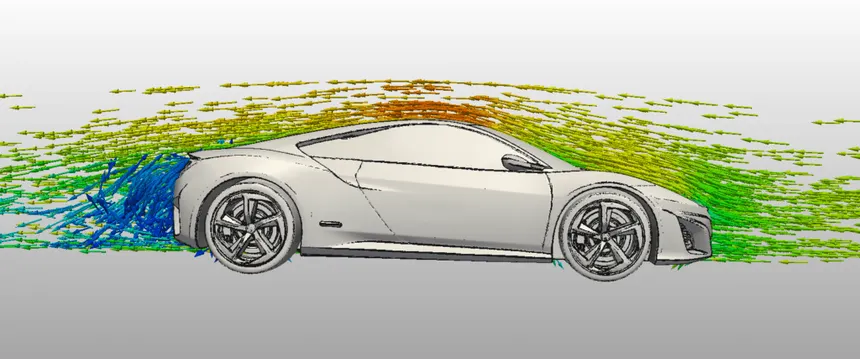
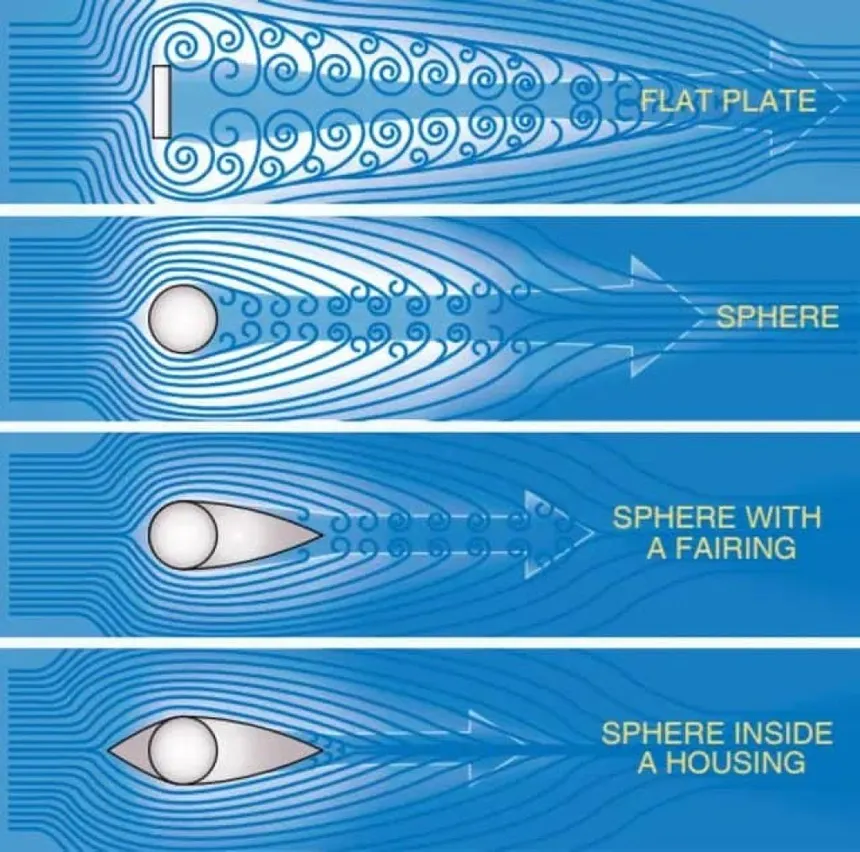
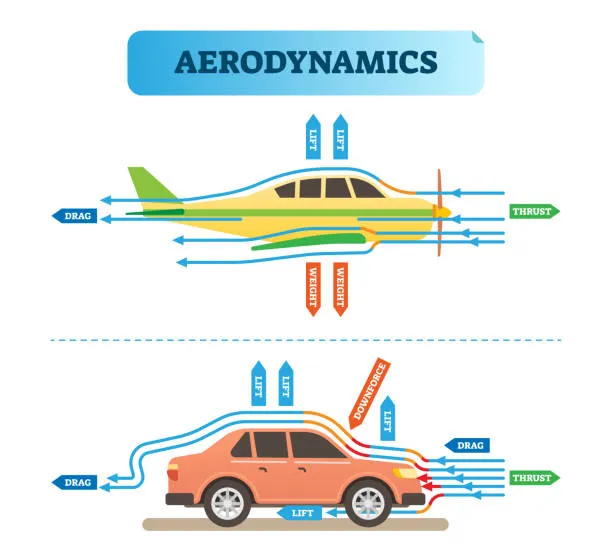
Drag the back of your hand slowly through a bathtub and the water just slides aside. Slap it hard and it stings, because the water hasn’t had time to move out of the way. Air does something similar at car speeds, but for a different reason. It isn’t that air compresses like water — at these speeds air is a perfectly ordinary fluid, nowhere near the point where compressibility matters. It’s that the air can’t part cleanly. It piles up at the nose as a zone of high pressure, and behind the tail it leaves a low-pressure wake that literally drags the car backwards. That pressure difference, front to back, is the real force slowing you down. As far as what you feel, the distinction doesn’t matter: the air shoves like a solid. But it’s worth knowing why, because that wake behind the car is half the story, and almost nobody tells it.
Physically, this is about how the air parts at speed. Crawl through it and the air slides aside neatly, and resistance climbs gently. Push past a certain threshold — which any moving car does instantly — and the air no longer has time to get out of the way. It piles up in front, tumbles into chaos behind, and resistance stops climbing politely and starts climbing with the square of speed. That’s what turns a harmless breeze into a wall — not the air “hardening,” but the way pressure stacks up around the body.
The bill lands in your fuel tank
Sit at a steady motorway cruise. Physics textbooks put it bluntly: at highway speed, more than half your engine’s power is spent beating air resistance. The taller and bigger the car, the worse it gets — a boxy SUV can throw 70% of its power at simply shoving air aside, while a low saloon sits closer to 45–50%. The most efficient cruising speed for almost any car sits around 70–80 km/h — which is exactly why, during the 1970s oil crisis, the United States dropped its national limit to 55 mph. That wasn’t politics. That was somebody reading the cube law.
Below that speed, other losses dominate: tyres, transmission, mechanical friction. But lean on the throttle and the air wakes up and eats everything. By 120 km/h it’s your number one enemy. By 140 it’s a beating. Every extra 10 km/h costs far more than the previous 10, because you’re climbing a curve that rises with the square.
That’s why two cars with the same engine can return wildly different motorway economy. It isn’t the mechanicals. It’s the shape. It’s how much wall of air each one has to shove aside.
It also explains a thing every driver has noticed without understanding it: a car that feels thirsty in town can sip fuel on a steady cruise, and another that’s frugal around the city drinks hard the moment it hits a motorway. In stop-start traffic the air barely matters — you’re fighting weight, braking and acceleration, and a slippery shape does almost nothing for you. Open road is the opposite world. There the air is the whole game, and a clean shape is worth real money at the pump. Same car, same engine, two completely different enemies depending on where the needle sits.
The Cd myth: a Prius beats a Bugatti
This is where almost everyone, including half the motoring press, gets it wrong. You’ve heard a car praised for its “brilliant drag coefficient” — the famous Cd. Sounds efficient. It often isn’t, and here’s why.
Cd is only a shape number. It measures how cleanly air slides over the body without tearing away. It says nothing about how much air there is to move. That’s the frontal area — the size of the hole the car punches in the air, seen head-on.
What actually counts is the two multiplied together. Engineers call it CdA: coefficient times area. That’s the number that matters, and once you get it, the myths fall over one by one.
Try this one: a Toyota Prius has a better drag coefficient than a Bugatti Veyron. The Prius sits around 0.24. The Veyron — that thousand-horsepower monster that cracks 400 km/h — manages only 0.355. On the Cd sheet alone, the hybrid hatchback is the “more aerodynamic” car.
So how does that work? Easy. The Veyron is wide, low and enormous head-on, and it’s riddled with intakes to cool that thousand-horsepower engine. Its 0.355 isn’t actually bad for something that wide with that many holes punched in it — and its shape is meticulously worked to stay planted and generate controlled grip at insane speed without taking off. But its job was never the cleanest body on earth — it was brute power and composure. The Prius, by contrast, is narrow, tall and teardrop-shaped because its only job is sipping fuel. The Veyron passes 400 not because its shape beats the Prius, but by throwing an obscene amount of power at the cube law to force its way through. The Prius never would, not even with that power, because it was never built to. Two opposite philosophies, and Cd only tells half of each story.
Next time somebody brags about their car’s Cd, ask them about the frontal area. Watch the face.
The champion almost nobody remembers
If CdA is what truly counts, then the most efficient car in the world isn’t the one with the slickest shape — it’s the one that pairs a low Cd with a small body seen head-on. Which brings up a car most people have forgotten: the original Honda Insight of 1999. Its Cd was 0.25. Good, not jaw-dropping. The killer number was the rest of it: impossibly narrow, low, tapered to a teardrop tail, even the rear wheels skirted over. Tiny frontal area. The result was the lowest CdA of any mass-produced car up to that point.
In other words, a car with a worse Cd than plenty of modern sports cars pushed aside less air than almost anything on the road. Because the figure that matters isn’t how clean the shape is — it’s how much wall of air you open in total. Years later the VW XL1 would drop the bar even lower, with a smaller CdA still, thanks to its tiny body — but again, that was a two-hundred-unit experiment. Among cars ordinary people could actually buy, the Insight was king, and it was king because of area, not coefficient. A big car with a beautifully clean body can still shove more air than a small car with a mediocre one. Size, in the end, nearly always wins.
This is the line between genuinely efficient cars and merely pretty ones. An SUV can wear a Cd that looks respectable on paper, yet it’s so big head-on that its real CdA is enormous. That’s why a low saloon almost always beats a tall crossover for motorway economy even when their brochure coefficients look similar. The shape lies. The area doesn’t.
The war over a hundredth
None of that means Cd is worthless. In the real world — especially now, with EVs — every hundredth is gold. Mercedes has the maths: shaving just 0.01 off the coefficient adds roughly 2.5% to long-distance range. On a car covering 15,000 km a year, that’s hundreds of free kilometres, bought purely by smoothing the shape.
So manufacturers have spent decades in a war of decimals. The car that set the marker was the 1982 Audi 100 C3: it hit a Cd of 0.30 and became the most aerodynamic production saloon in the world at the time, with its flush windows and tapered tail. The Mercedes W124 arrived two years later, in 1984, and edged below that to 0.29. Today the record for a true series-production car belongs to the Mercedes EQS at a flat 0.20. A handful went lower — the VW XL1 nudged 0.19 — but those were built in tiny numbers, a couple of hundred units, closer to experiments than real production cars.
That gap between the Audi’s 0.30 and the EQS’s 0.20 is forty years of engineers fighting the air one hundredth at a time. Flat underbodies, redesigned mirrors, grilles that shut themselves, sealed panel gaps. Invisible work you never see and quietly pay for every time the car drinks less than its size says it should.
And watch one detail that looks trivial and isn’t: a huge slice of that fight lives in the small things that stick out. A badly resolved wing mirror, an exposed wheel, a gap where air sneaks in and tumbles — any of them can undo hours of work on the rest of the body. Air doesn’t care about pretty details. It cares about continuity. Anything that breaks the clean flow costs the car money. But that’s a world of its own — what happens behind and around the car, not just in front of it — and it gets its own chapter in AeroNEC.

What to actually take away
Air is a wall. A wall that gets four times harder every time you double your speed, and costs eight times the power to push through. At motorway speed it’s the single biggest drain on your tank, ahead of everything else. And the famous Cd everyone brags about is only half the truth — without frontal area beside it, it means almost nothing.
The good part is you’ll never look at cars the same way again. You’ll see why a supercar is wide and low while an efficient car is narrow and teardrop-shaped. You’ll understand why your mate’s rear wing might do absolutely nothing, and why the aero engineers at Ferrari, Dallara and McLaren fight for grams of grip without giving away top speed.
Because air isn’t only something that slows you down. Used right, it’s also what glues a car to the road and lets it take a corner at a speed that looks impossible. But that’s a different war — the downforce war — and we’ll fight it in the next chapter of AeroNEC.
For now, hold onto this: no horsepower escapes the air’s bill. Not yours. Not Bugatti’s.
Check you’re still alive.