How to Glue a Car to the Ceiling: Downforce Explained (AeroNEC · 2)
Remember the bit in Men in Black where Agent K flips the Crown Vic onto the roof of the Queens-Midtown tunnel and just keeps driving, upside down, lights flashing? Sci-fi nonsense, obviously. Except the physics underneath the gag is real, and a Formula 1 car gets genuinely close to it.
At around 150 km/h, a modern F1 car generates as much aerodynamic force pressing it into the track as the whole car weighs. Push the speed up and that force grows to two, three times the car’s weight. Which means, in pure theory, that car could drive along the ceiling of a tunnel and stay stuck to it — the air pinning it up harder than gravity pulls it down. Nobody’s quite done it for real yet, but the numbers say it’s sound.
That’s the same wall of air from chapter one. Same physics. Only this time, instead of slowing the car down, it’s mashing it into the tarmac. I closed that chapter with a promise — that used right, the very same air glues a car to the road. This is the chapter where that promise gets paid. That’s downforce. And it’s the single thing that separates a car that’s fast in a straight line from a car that’s fast where it actually counts — in the corners.
Welcome to chapter two of AeroNEC. Today we work out why a wing that slows you down is the thing that lets you go quicker. Sounds like a contradiction. It isn’t.
An aeroplane wing, turned upside down
Start with the basic shape, because most people picture it backwards. An aircraft wing is built so air travels faster over the top than underneath. Faster flow means lower pressure on top, higher underneath, and the net result is a force upward — lift. That’s what hauls a few hundred tonnes of airliner off the runway.
A car wing is that exact same shape, flipped over. Higher pressure on top, lower underneath, force pointing at the ground instead of the sky. That’s why downforce gets called “negative lift.” The plane wants to fly; the race car wants the precise opposite — to bury itself into the road.
And here’s the thread back to chapter one: that downward force grows with the square of speed, just like drag does. At low speed a wing does almost nothing. The faster you go, the more savagely it shoves the car into the ground. It’s why a racing car feels like it’s on rails at 250 km/h and goes vague and skittish through a slow first-gear hairpin — the air that was gluing it down has gone away with the speed.
Why this isn’t the same as adding weight
This is the big misunderstanding, the one worth killing properly. Plenty of people think: if I want more grip, why not just make the car heavier? A heavier car presses the tyres into the road harder, and that’s grip, right?
Right — but you pay through the nose for it. Because all that extra weight has to be hauled up to speed, dragged back down under braking, and wrestled into every corner. Whatever you gain in grip you hand straight back in inertia. Weight is grip bought on credit, and you settle the bill on every throttle squeeze and every brake pedal.
Downforce is the magic because it dodges exactly that. It gives you the grip of a heavy car without the weight of one. It presses the tyres into the tarmac just as if the car were heavier, but it adds no mass at all. The car corners as though it weighs double, yet accelerates and stops like the lightweight it actually is. You get the upside of both. That’s why a competition car doesn’t chase weight — it chases lightness, and then makes its grip out of air.
This is the line between an aerodynamicist and somebody who only reads the scales. Weight is dumb grip. Downforce is clever grip.
It’s not just the wing: splitter, diffuser, balance
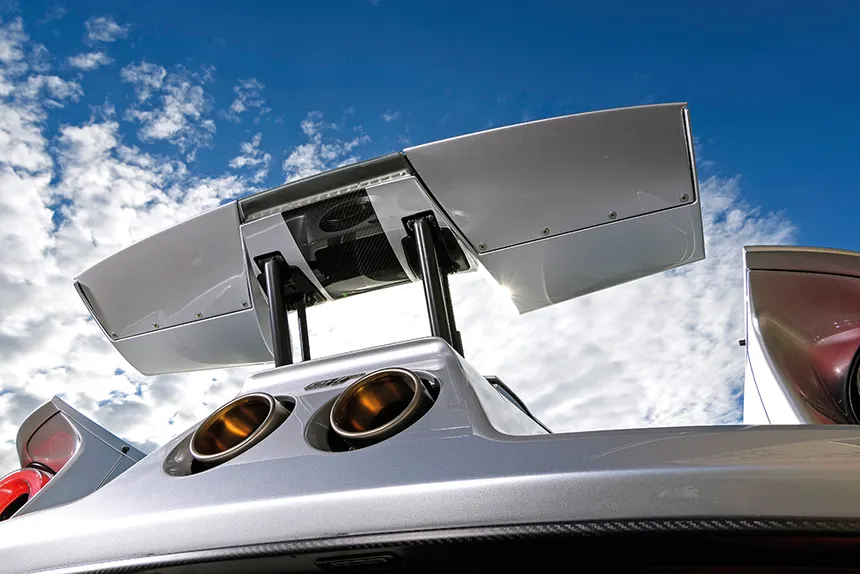
When you picture downforce you picture the rear wing, because it’s the bit you can see. But it’s only one of three places a race car manufactures grip — and not even the cleanest one.
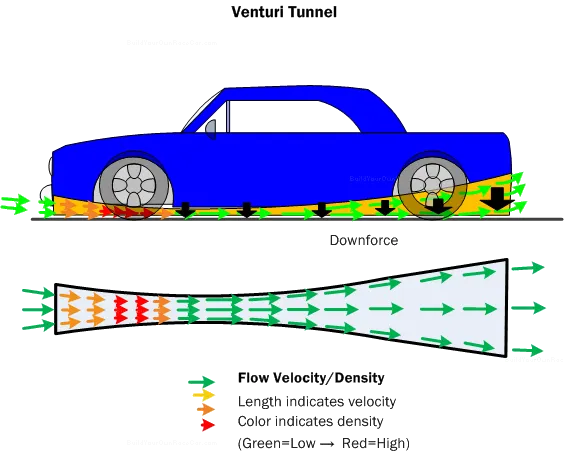
Up front sits the splitter, that flat lip jutting out under the nose almost scraping the ground. It works by splitting the airflow: the air going over it stacks up and presses the nose down, while the air slipping underneath speeds up. That’s what pins the front axle. Underneath, towards the back, lives the diffuser: a tunnel that widens as it goes rearward, accelerating the air running along the floor and sucking the car onto the road. And up top, the wing — the bluntest of the three and the one that charges the most drag.
The catch is that all three have to be in balance, and that’s where a danger lurks that a lot of tuning fans miss entirely. Load up too much grip at the front and not enough at the back — a monster splitter with a puny rear wing, say — and the car turns into a weapon at speed: the rear runs out of grip just when you’re going fastest, and that’s oversteer at 200 km/h. The car trying to spin itself, in the worst possible place. That’s why engineers don’t chase “more downforce” full stop — they chase balanced downforce. The front-to-rear split decides whether the car is friendly or whether it’s trying to kill you in every fast corner.
The catch: no downforce is free
But the universe hands out nothing for nothing, and here’s the small print almost nobody reads aloud. Every time you make downforce, you make drag. They come from the same act — bending the airflow, forcing it to change direction. You cannot ask the air to push the car down without it also shoving the car backwards. They arrive welded together, two faces of one coin.
And the exchange rate is brutal. It isn’t one-for-one. The drag a wing creates climbs faster than the downforce it makes: roughly speaking, double a wing’s downforce and its induced drag goes up fourfold. Ask for twice the grip, pay four times the braking effect. So the game was never to bolt on the biggest wing alive — it’s to make maximum grip for minimum penalty. That’s where the salaries at Ferrari, Dallara and McLaren get earned.
It explains something a single-seater driver feels and the rest of us struggle to believe: at top speed, an F1 car slows down so hard just from lifting off the throttle that the deceleration tops 1g. Lifting off, flat out, brakes the car about as hard as a road sports car standing on the brake pedal. All that drag riding shotgun with the downforce doesn’t vanish. It’s there, biting, the whole time.
And there’s a cruel irony buried in the physics. Because grip grows with the square of speed, a wing hands you enormous force exactly where you least need it — on the straights, where all you want is to go straight and fast — and almost nothing in a slow corner, which is precisely where you’d kill for more grip. In the slow corner the air is crawling and the wing is half asleep. So race cars lean on mechanical grip — tyres and suspension — through the slow stuff, and save the aerodynamic magic for the fast corners, where the air is finally working flat out. Downforce is a glorious ally, but it shows up late to the very corners where you’d shout loudest for it.
Monaco vs Monza: the compromise made into a circuit
Once you grasp that downforce buys cornering and sells away straight-line speed, you instantly understand why teams turn up with a different car weekend to weekend. And nowhere lays it out cleaner than Monaco and Monza.
Monaco is a street track — narrow, slow, one corner stacked onto the next, no real straight worth the name. Top speed is useless there because you never reach it. What you want is grip, grip and more grip to thread corner after corner. So teams bolt on the steepest wings they’ve got. The straight-line penalty barely matters — there’s hardly any straight to be penalised on.
Monza is the mirror image. Vast straights where the cars fly and only a handful of corners. There the big wing is dead weight: it would haul you back on the straights, which is exactly where the lap time lives. So teams strip the car down, trim the wing off, accept they’ll be a touch worse through the few corners in exchange for flying down the straights.
Same car, same engine, two opposite personalities — and though I’m boiling it down to the wings here because they’re the visible bit, the team actually re-tunes the whole car for each place: suspension, brakes, the lot, all orbiting that one aerodynamic decision. But the heart of the change sits right there, in how much wing you run. That’s the eternal aerodynamic compromise boiled down to two place names: you either glue the car to the road or you let it run. Both at once isn’t on the menu.
Or almost isn’t, because engineers have spent years hunting for ways to cheat the choice. The most visible trick is DRS: a flap in the rear wing that opens on the straights to dump drag and let the car run, then snaps shut at the corner to claw the grip back. Aerodynamics that changes on the move. And F1 keeps leaning harder that way — the idea of a wing that flips from a low-drag mode on the straight to a high-load mode in the corner, automatically, is exactly the direction the rulebook is pushing. Because if the eternal compromise is choosing between grip and top speed, the dream answer is to stop choosing — to have both, each where it belongs.
What comes next: grip with less of the bill
By now any engineer would point out the obvious: if a wing buys grip but charges a fortune in drag, isn’t there a way to make downforce that pays a smaller toll? There is. And it rewrote racing.
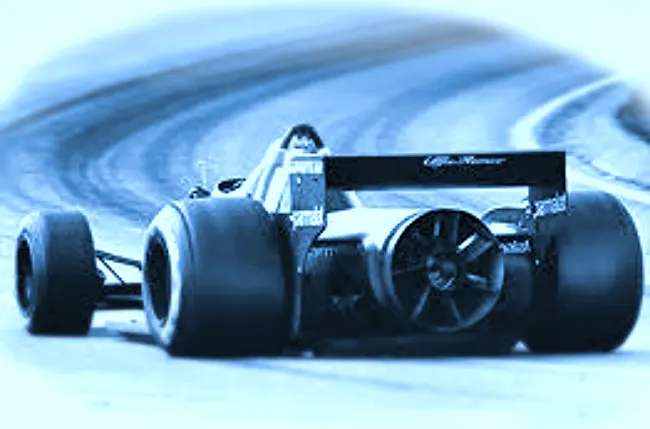
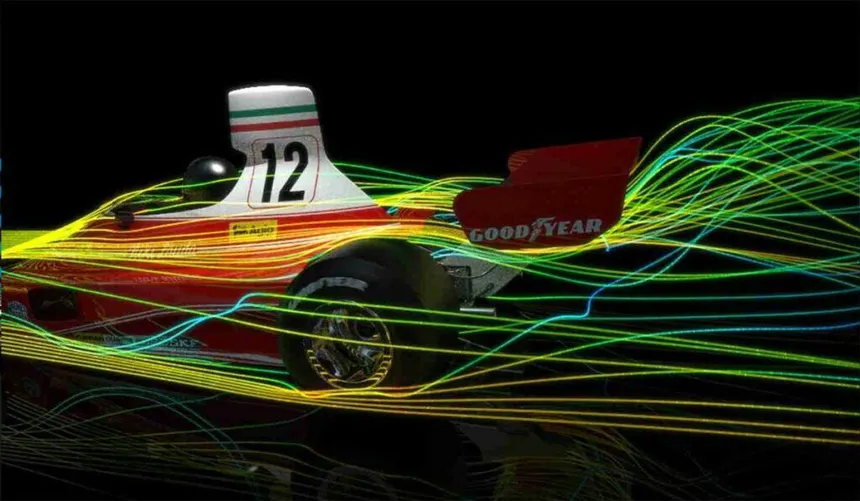
Instead of hanging a huge wing out in the airflow, you can use the car’s own floor to speed the air up underneath it and create a low-pressure zone that sucks the car onto the road. Loads of grip, far less drag. It’s called ground effect — the trick the Lotus 78 and 79 first turned into race wins in Formula 1 — and it was so devastating that the sport banned it, buried it for decades, and finally came crawling back to it. Some machines pushed the idea to its absolute limit, generating grip even at a standstill with fans physically hauling the air out from under the floor, like the Brabham BT46B that won its only Grand Prix and was pulled straight afterwards. But that’s another war — chapter three’s war.
For now, hold the essentials. Downforce is the air working for you: the very force that slows you on the straight is the one that pins you down in the bend. It hands you the grip of a heavy car without the heavy car. But it’s never free, because it always drags its bill along behind it. And the whole art of racing aerodynamics is deciding how much of one you’ll pay for the other — corner by corner, straight by straight.
A road car barely dips a toe in this world. Your mate’s giant rear wing almost certainly makes nowhere near the downforce its shape is promising. But that particular disappointment can wait.
Check you’re still alive.