Ford Crown Victoria: The Car No One Could Replace
It’s two in the morning in Manhattan. Raining. A yellow cab double-parks outside a deli on Eighth Avenue. The driver doesn’t get out. He waits. Engine idling, wipers on intermittent, the rooftop sign reflecting in the puddle.
You don’t need to walk closer to know what car that is.
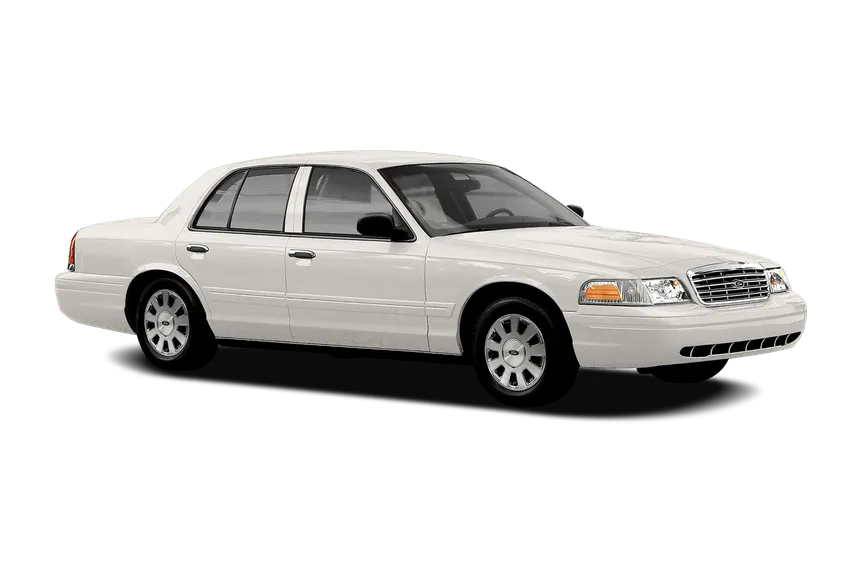
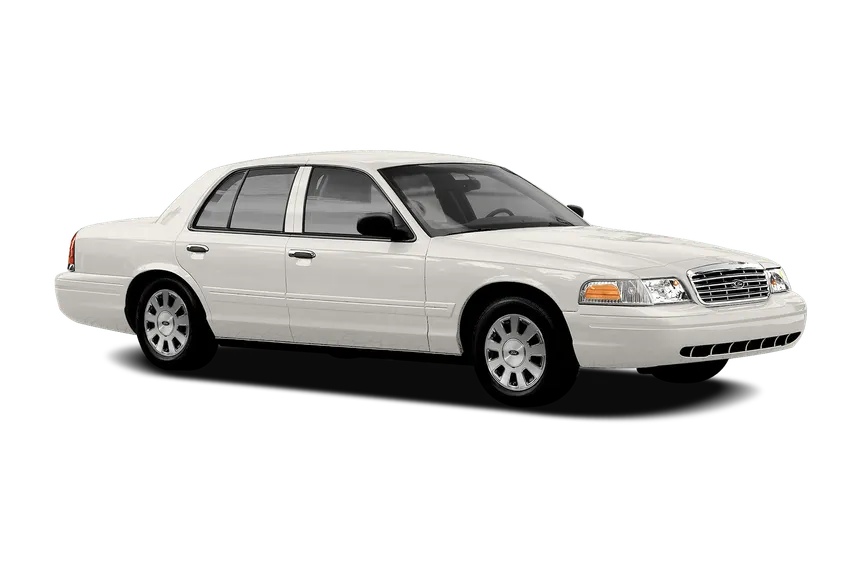
You know it from the silhouette. The long hood, the nearly flat roof, the straight beltline, the square rear end. You know it because for twenty years that car was the only thing that seemed permanent in a city that changed every single day. Buildings went up, neighborhoods gentrified, mayors came and went, twin towers disappeared. And the yellow cab, always the same.
A Ford Crown Victoria.
Nobody ever stuck a poster of one on a wall. Nobody dreamed about driving one as a kid. Nobody remembered it as the car that changed their life. And yet, you saw it every single day without noticing — in films, in TV shows, in the news, in the real streets. The street furniture of the American landscape. When Ford closed the St. Thomas plant in Ontario in September 2011 and the last Crown Vic rolled out the door, half the professional automotive world in America stood looking at their shoes, not quite sure what they were going to do the next morning.
That’s what it means to be indispensable.
The platform that wasn’t supposed to still exist
When Ford launched the modern Crown Victoria in 1992, the automotive world had already voted. Front-wheel drive was the future. Unibody construction was the future. Compact V6s were the future. The Panther platform underpinning the Crown Vic was the exact opposite of all of that.
Body-on-frame. Rear-wheel drive. A 4.6-liter longitudinal V8. An architecture that dated back to 1979, refined over decades without any radical structural changes. It shared its platform with the Mercury Grand Marquis and the Lincoln Town Car, and between 1997 and 2011 those three cars were the only four-door sedans built in North America with a full frame, rear-wheel drive and a standard V8.
The obvious question is: why did Ford keep building this when nobody else would?
The obvious answer is: because it worked.
But that answer is too short. What worked wasn’t just the car. It was the whole equation. Any random shop in South Dakota knew the Panther by heart. Parts were cheap and everywhere. Known problems had known solutions. The 4.6L V8 was mechanically simple — no turbos, no tricky timing chains, no direct injection fussy about fuel quality. You could hammer it and it let itself be fixed.
For a private owner, none of that mattered much. For a fleet, it was everything.
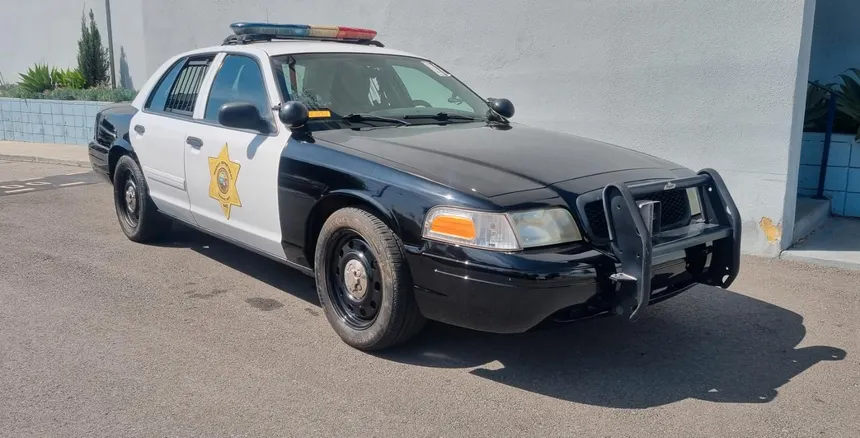
The P71 — the default police car
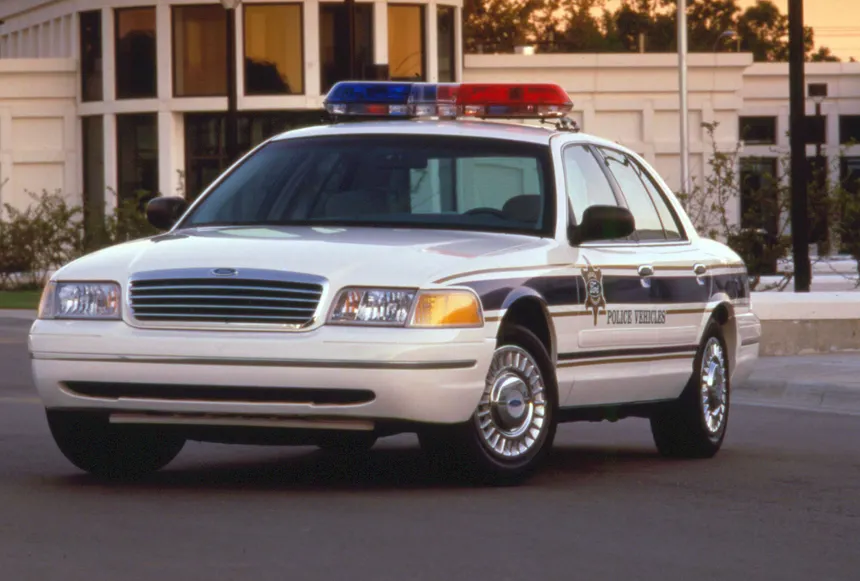
The police version was internally called the P71, though the old-timers still said P72 from the older naming. It was built from 1992 to 2011, and it wasn’t a street Crown Vic with a decal and a light bar. It was a different car underneath.
Reinforced transmission to survive repeated hard launches, the mechanical gesture that wrecks any ordinary automatic when you do it fifty times a shift. Stiffer suspension. Higher-output alternator feeding the radio, the onboard computer, the light bar, the radar, the dash cam and everything else an officer plugged in. Oversized cooling system ready to endure hours of idling with the A/C at full blast in August in Houston while the driver filled out a report.
The 4.6L V8 put out 250 hp rated in the early cars. Later revisions brought the official number down to 239 hp, but with more torque at low rpm, which was exactly what you needed to leave the shoulder in pursuit or pull away loaded with four occupants and 200 kilos of gear.
Through the nineties and the two-thousands, virtually every mid-sized American police department ran fleets dominated by Crown Victorias. It wasn’t perfect — the rear-mounted fuel tank earned its own case file that we’ll cover separately — but for daily duty, it was right about everything that mattered.
The cab that refused to die
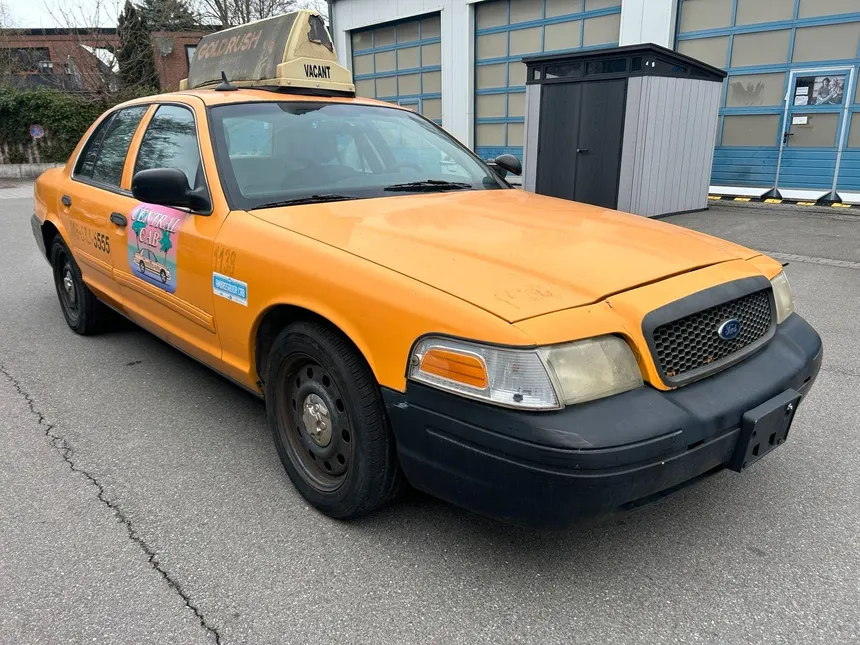
If you want to know whether a car is genuinely reliable, don’t send it to the Nürburgring. Send it to New York as a cab.
Twenty-four-hour operation with two driver shifts. Potholes the size of a wheel. Panic stops every two blocks. Endless idling in hour-long jams. Four thousand stop-starts a day. Passengers slamming doors with their foot. Trunks loaded until the shocks give up. Twenty below in winter, forty above in summer.
The Crown Victoria didn’t just survive New York. It owned it.
In 2002, Ford introduced a long-wheelbase version specifically designed for taxi fleets: 5,563 mm total length, 3,066 mm wheelbase. Enough rear legroom for a tourist with two suitcases and a business suit not to have to negotiate geometry with the front seat.
In 2011, when Ford announced the end of production, 7,400 Crown Victorias were working as cabs in New York City. That was exactly half the entire fleet.
And then there were the diehards.
Ravinder Sharma bought a 2011 Crown Vic and put more than 885,000 kilometers on it before the Taxi and Limousine Commission forced him to retire it. Haroon Abdullah bought in 2013 a 2011 unit that had sat unsold at a dealer for two years, and ran it to 790,000 kilometers. Both were pulled by law, not by breakdown. The TLC service limit is seven years. Neither car intended to die. The legal framework simply hadn’t anticipated that a taxi could last that long.
Sit with that sentence for a second. The car outlived the imagination of its regulator.
The siblings almost nobody remembers
Talking about the Crown Victoria as an isolated car is telling half the story. The Panther platform wasn’t building one model. It was building three.
The Mercury Grand Marquis was the “premium” version for the traditional civilian buyer — same chassis, same 4.6L V8, chromed grille, more equipped interior, the car your American grandfather bought when he retired to Florida. It sold in parallel to the Crown Vic throughout the modern era and lasted until January 2011, built in the same St. Thomas plant.
The Lincoln Town Car was the luxury step. Same architecture underneath, another world on top. It’s the car that took executives to JFK for three decades, the glossy black with tinted glass waiting outside Manhattan hotels, the base on which practically every stretched limousine for American weddings, funerals and politicians was built. Production ended in August 2011, also at St. Thomas.
The three together added up, according to figures from the Canadian plant, to more than 1.5 million units across the modern production years. That volume explains why the Panther was a serious industrial operation: it wasn’t one car, it was a whole family of cars on the same frame, with economies of scale no competitor could match for that kind of use. And why retiring it in 2011 emptied three markets at once — police-taxi, traditional civilian and professional limousine — without any single replacement covering all three with the same efficiency.
The ending nobody managed well
Ford announced the end of the Crown Victoria in 2009. Production officially ended in September 2011, and the last examples were registered as 2012 models. The reasons made sense on paper: fuel economy and emissions rules were tightening, the 4.6L V8 drank too much for what was about to be legal, civilian sales were a rounding error and Ford wanted to free up resources for more modern global platforms.
All of that defends itself in a PowerPoint.
On the street it was a different thing.
American police were left without a direct replacement for years. Ford launched the Police Interceptor Utility on the Explorer and the Police Interceptor Sedan on the Taurus, but neither reached the consensus the Crown Vic had. Departments fragmented across models, brands and configurations. Every city picked differently. What had been a de facto standard turned into a menu.
New York cab drivers took the weirdest hit. On May 3, 2011, the city officially announced the Nissan NV200 as the replacement. A small utility minivan, sliding door, front-wheel drive, no V8, no soul. Drivers hated it from day one. Too tall to park comfortably. Too soft in suspension. Too strange for a city that had spent decades tying the concept of “cab” to one specific silhouette.
And as a dark postscript, Hurricane Sandy destroyed in 2012 the last 200 new long-wheelbase units waiting to ship at Manhattan Ford. Two hundred Crown Vics that never picked up a single passenger. Drowned in a parking lot.
The culture that landed on it uninvited
The Crown Victoria never tried to be a cultural icon. There’s no memorable ad campaign, no calculated film scene, no Super Bowl spot designed to make you tear up. The Crown Vic shows up in hundreds of movies and shows because it was the car that was there when the art department needed “an American police car” or “a New York cab.” They didn’t pick it. They found it.
It’s the generic cop car in any nineties or two-thousands viewer’s head. It’s the yellow cab in the background of any Manhattan establishing shot. It’s the dark sedan driven by the FBI agent in any thriller. Its presence in popular culture is inversely proportional to the effort Ford put into placing it there.
That’s something Lamborghini can’t buy and Ferrari can’t manufacture. A car that becomes visual language without asking for it, just by being in the right places long enough, is a car that transcends the object.
Why it worked, without dressing it up
The answer is anticlimactic, and that’s why it’s perfect.
It worked because Ford didn’t try to reinvent it. The Panther platform, introduced in 1979, kept getting refined for three decades without radical structural changes. Every year brought small tweaks, incremental improvements, corrections of whatever had failed. Nothing dramatic. Nothing that forced anyone to throw away the accumulated knowledge.
Mechanics knew it cold. Parts were everywhere and cheap. Problems had proven fixes. The weight distribution, V8 up front and rear-wheel drive, soaked up impacts and loads without cumulative structural fatigue. The huge trunk let you stuff in radios, auxiliary batteries and weaponry without touching the cabin. The full frame absorbed side impacts better than any contemporary unibody.
It wasn’t sophisticated. It was right about everything that mattered to the person signing the invoice.
Compare it with what was around in 2010. A front-wheel-drive Chevrolet Impala with a V6 that was asking for a new transmission at 400,000 km. A police Dodge Charger built on Mercedes bones that cost an eye every time you touched the electronics. A Toyota Camry that was lovely for a private owner but incapable of handling double shifts for seven years straight.
The Crown Vic didn’t win on any single metric. It won on the sum.
A legacy measured in absence
In 2023, the last two Crown Victoria cabs in New York were finally retired by the TLC. The commission’s spokesperson said the car would be remembered. He compared it to the Ford Model T, the Checker Marathon and the Chevrolet Caprice before it. Four cars that defined what “American taxi” meant across four different eras.
None of the four was a sports car. None had teenage-bedroom posters. None won Le Mans.
The four did something harder: being there all the time until people forgot that somebody had, at some point, to design them.
Ford built the Crown Victoria for twenty years without changing what didn’t need changing. Enthusiasts never loved it. Critics buried it as obsolete every five years. Rival manufacturers tried to kill it with more modern products and failed.
When it finally died, nobody celebrated. There was just silence in the fleets, confusion in procurement departments and an empty space on the corner of Eighth Avenue that the Nissan NV200 never managed to fill.
That space is still there. Fifteen years later.
That’s the exact definition of indispensable: it’s not the car you love. It’s the one you miss when you realize you had been taking it for granted.
Check you’re still alive.
1 thought on “FORD CROWN VICTORIA”