
Honda did it, Ferrari just patented it
Quick question for you. Sit down with a coffee.
Picture a three-litre, six-cylinder inline, non-circular pistons in oval form, eight valves per cylinder, two spark plugs per cylinder, two connecting rods per piston, redline at 15,000 rpm. Why does that engine not exist in any car anywhere on Earth?
Short answer: because almost nobody has dared try it. Long answer is the one I’m about to walk you through, because it has three layers and the last one will pull your eyes off the screen. Fair warning.
Let’s start from the start.
Honda NR500 — the first madness, 1979
The year is 1979. Honda wanted to return to the 500cc motorcycle World Championship after a decade away. The FIM, motorcycling’s international governing body, dictated two technical rules. One: four-stroke engine. Two: maximum four cylinders.
Honda’s problem was that four-strokes were getting destroyed by two-strokes for a simple physical reason. For the same displacement, a two-stroke fires once per revolution; a four-stroke fires every other revolution. To match a two-stroke, a four-stroke would need to spin at twice the speed. And spinning at twice the speed means breathing twice the air — more air in, more fuel in, faster. More air means more valves. More valves means more space in the cylinder head. And that’s where a round piston runs out of geometry. On a circle, pure mathematically, you can’t fit more than four decent valves around a spark plug.
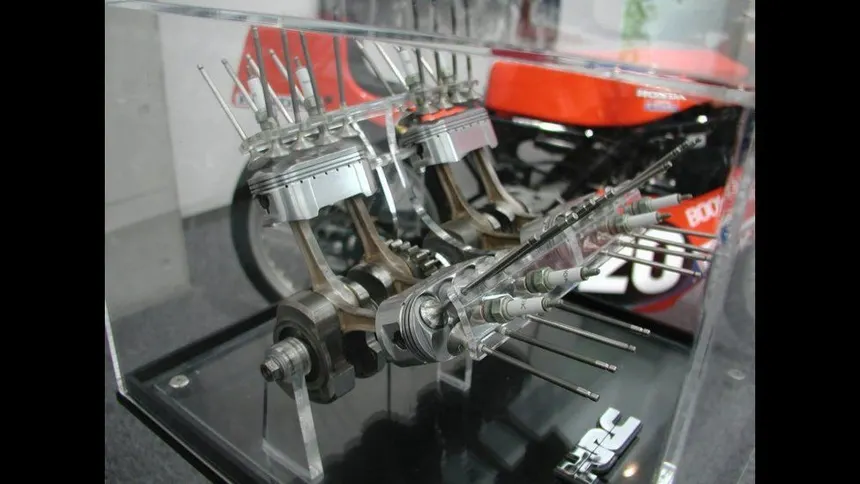
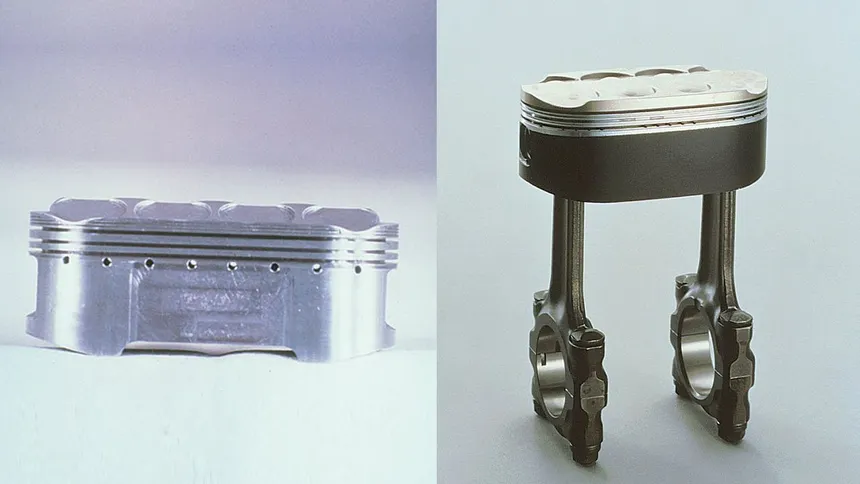
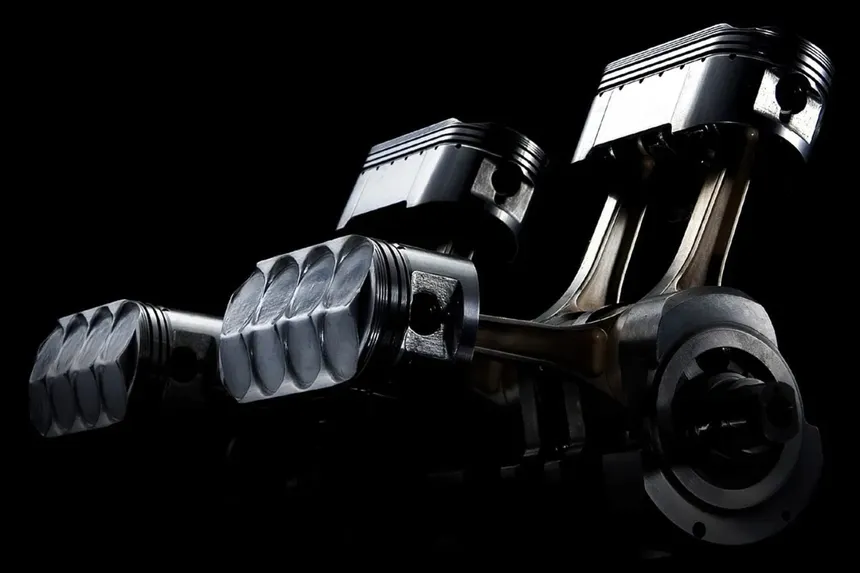
Honda came up with an idea that in the Sakura engineering office sounded like heresy: if we can’t have eight cylinders, let’s build four cylinders that behave like eight. The way to do that was to fuse two round cylinders into one, leaving an oval cross-section. On that oval piston you can fit eight valves, two spark plugs, two connecting rods. A V8 hidden inside the bodywork of a V4.
The engine was called NR (New Racing). 499 cc. 100-degree V4. 11:1 compression. The first iteration, called 0X, debuted in 1979 making around 100 horsepower at 16,000 rpm. Honda kept refining the motor over the following seasons, and the final evolution, the 3X of 1983, reached 130 horsepower at 19,500 rpm. Yes, you read that right. Nineteen thousand five hundred. With no serious electronics. No sensors. Carburettors.
What happened on track? A disaster. The NR500 debuted at the 1979 British GP and after two seasons Honda withdrew it without scoring a single championship point. The motorcycle press of the era started joking that NR didn’t stand for “New Racing” but for “Never Ready”. The idea was brilliant, the execution impossible. The oval piston rings never sealed properly. The engine drank oil in torrents. Reliability was nil. Toshimitsu Yoshimura, one of the engineers on the project, summed it up years later in a phrase that deserves to be framed: “looking back, I’m not sure if we were experimenting with cutting-edge technology or obsessed with foolish ideas.”
Honda put the idea in a drawer. And there it sat for eleven years.
Honda NR750 — the domesticated revenge, 1992
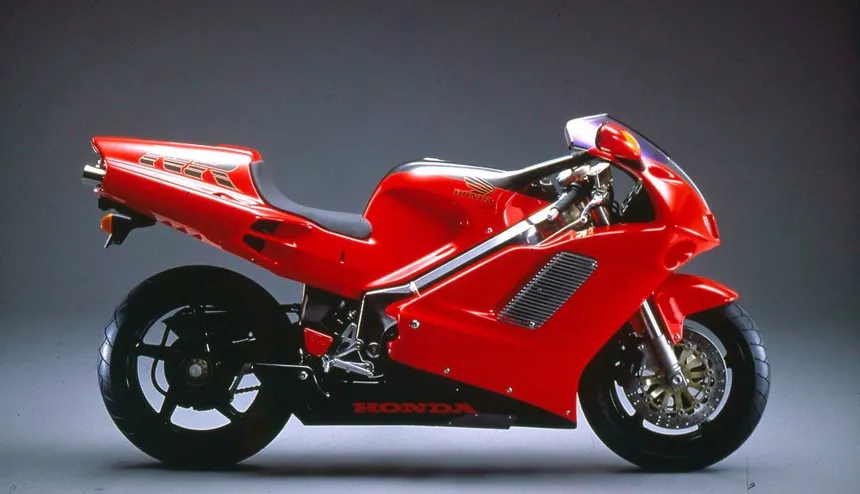
In 1992, with no commercial reason Honda has ever explained publicly, they unleashed the NR750. A street-legal motorcycle, road-registered, sold to the public, with the oval-piston engine resurrected.
The numbers. 747.7 cc officially (normally rounded to 748), 90-degree V4, oval pistons measuring 101.2 x 50.6 mm with a 42 mm stroke, 32 valves (eight per cylinder: four intake, four exhaust), eight 8 mm spark plugs (two per cylinder), PGM-FI electronic injection with seven sensors and a 16-bit CPU, eight titanium connecting rods, nickel-plated and Teflon-coated pistons, 11.7:1 compression ratio, 115.8 horsepower at 14,500 rpm, redline at 15,000.
Each piston ring required 27 separate machining operations. That figure has to land in your head to understand what came afterwards. A modern conventional piston ring needs three or four machining operations. Honda needed 27 because the rings weren’t circles, they were ovals, and machining an oval ring with micron-grade tolerance in 1990 was jeweller’s work.
Honda built around 322 NR750s (sources vary between 300 and 322 depending on whether pre-production and prototype units are counted). The retail price: £38,000, which inflation-adjusted to today is roughly £82,000. In the United States it sold for $50,000 of period money. At the time, it was the most expensive production motorcycle ever sold. And Honda still lost money on every unit. It wasn’t a business. It was an engineering manifesto.
What Honda was saying with the NR750 was one thing: we can build what nobody else can build. And they proved it.
The question that matters: why not in a car?
And here we get to the part that gives the NEC angle. If Honda fitted oval pistons to a 750cc motorcycle in 1992, why have we never seen oval pistons in a road car?
The answer has three layers, each more interesting than the last. In order.
Layer one: manufacturing was impossible. Machining a round cylinder is trivial. A rotating drill bit spins on its axis and produces a perfect cylinder. Machining a cylinder with an oval cross-section requires five-axis CNC machines, with heads that move in X, Y and Z while simultaneously rotating. That technology, today standard in any serious workshop, was science fiction in 1992. Honda did it because Honda had infinite R&D budget and because the motorcycle was a showcase, not a product. No mass-production carmaker could absorb that cost, because selling a Ford Mondeo with NR750 internals would have put it on a £200,000 sticker.
Layer two: piston sealing. The piston ring is the most critical part of any engine. It’s the ring of metal sitting in a groove on the piston that seals the combustion chamber from the crankcase. If it doesn’t seal, combustion gases escape into the crankcase, the engine loses compression, drinks oil and blows blue smoke. On a round piston, the ring is a circle: a relatively simple part that expands uniformly with heat. On an oval piston, the ring is an oval that has to seal with different pressures at different points around its perimeter, because thermal dilation isn’t uniform along a non-circular curve. Honda never fully solved this. The surviving NR750s still drink oil at a rate any pub mechanic would call concerning.
Layer three: regulation killed the incentive. When the FIA — the body that governs Formula 1 and most car competition — saw Honda’s NR500 in 1979, it did something quick and decisive: it banned non-circular pistons in F1 before any carmaker had even tried. That ban is still in force: Article 5.3.3 of the 2026 F1 Power Unit Technical Regulations states literally that “the normal section of each cylinder must be circular”. Because F1 was the main R&D driver pushing technology into road cars, the FIA decision killed the industrial incentive. If you can’t race it, why spend €50 million developing it for a Ford Mondeo? Nobody did. And that’s why, for 33 years, oval pistons stayed as a Japanese motorcycle oddity with no automotive descendants. One important nuance: the FIA ban only applies to competition. For a road car, there’s no regulatory obstacle to fitting non-circular pistons. Which is why Ferrari can patent the design and, if it chooses, take it to production.
Until March 2025.
And now, hold tight: Ferrari, March 2025
Let me tell you how I found this, because the feeling lands the same way.
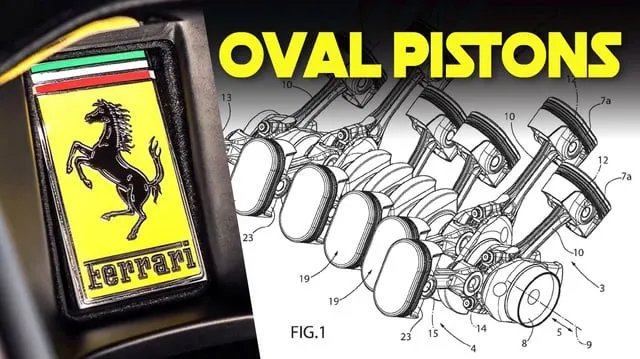
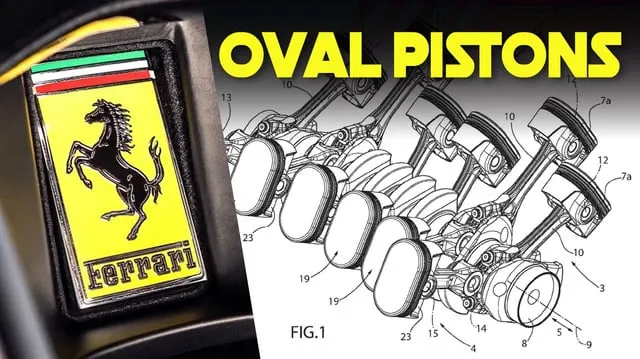
On 12 March 2025, AutoGuide makes public something that had been sleeping for months in the European Patent Office database: application number 24197835.2, filed by Ferrari S.p.A. in the autumn of 2024. What is it? A patent for a V12 engine with oval pistons.
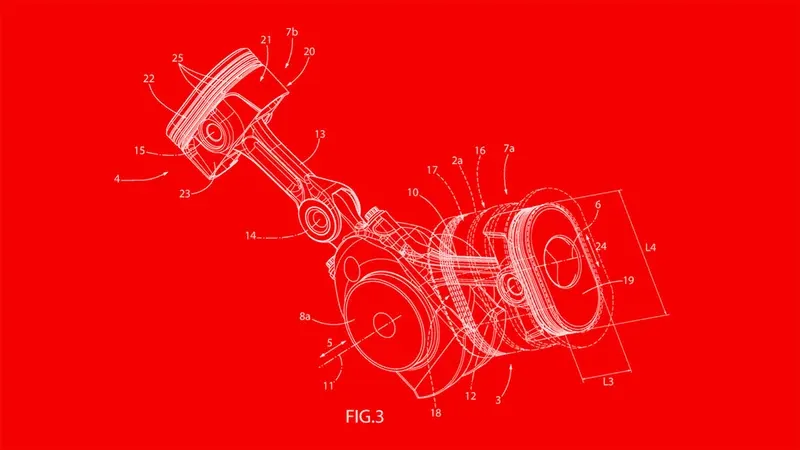
Not strict ovals. The technical form Ferrari claims is “stadium shape”: a rectangle with the two short sides rounded. Like a NASCAR oval seen from above. The difference from Honda’s true oval isn’t aesthetic, it’s functional: the stadium shape is far easier to machine than a pure oval (the straight sides can be worked with conventional machinery) and the ring sealing is more predictable because only the curves at the ends need special treatment.
But there’s more, and this is where the patent gets serious. Ferrari has changed the orientation versus Honda. Honda placed the long axis of the piston parallel to the crankshaft. Ferrari places it perpendicular. Why? Because by turning the piston ninety degrees, the long axis now sits in the transverse dimension of the block, which allows you to shorten the overall engine length dramatically. A conventional Ferrari V12 measures around 690 mm long. With perpendicular stadium pistons, based on the rough proportions in the patent, that length can be cut by between 15 and 20%. That’s brutal.
There’s a third detail, the wildest. Ferrari has designed a connecting rod shared between two pistons on opposing banks. In a conventional V12, each piston has its own conrod, connected to a separate journal on the crankshaft. What Ferrari proposes is a conrod that splits with a multi-link system, similar in philosophy to the Nissan VC-Turbo variable-compression engine. That allows two opposing pistons to share a single point on the crankshaft, shortening the assembly even more.
Why a V12? This is where strategy enters. Ferrari hasn’t put a V12 in a mid-engined car since the LaFerrari in 2013. The last mid-engined car they launched, the F80, uses a hybrid V6. The purists who form Ferrari’s core customer base have grumbled openly. Ferrari’s patent makes it possible to reintroduce the mid-engined V12 in a chassis that until now couldn’t physically accept one. Or hybridise it by placing electric motors in the space freed up by the new geometry. Or both.
Why try this now, and not ten years ago? Two reasons, both verifiable.
One: metal 3D-printed pistons. Porsche has been mass-producing 3D-printed pistons since 2020 for the 911 GT2 RS. That solves most of the manufacturing headache Honda had in 1992. A stadium shape can be printed today without drama.
Two: five-axis CNC machining. What was science fiction in 1990 is now standard kit in any serious machine shop. A stadium form can be produced in industrial volumes with micron-grade tolerance.
Thirty-three years after the NR750, the technology has finally caught up with the idea.
What’s left to see
Now temper the excitement, because NEC doesn’t sign promises. I’ll tell you straight.
A patent isn’t a production engine. Ferrari patents things every month. Some make it into a car, some don’t. The oval-piston patent could end up in the V12 of the next Ferrari hypercar, or it could end up in a drawer. What a published patent proves is that Ferrari is investing serious money in exploring that path, and that on its own is news.
It’s also not yet clear whether the multi-link shared conrod works under real conditions. Multi-links add joints, joints add friction, and friction is the number-one enemy of any high-revving engine. Nissan has been mass-producing the VC-Turbo for seven years and it still hasn’t reached Formula 1, where friction matters every gram. Ferrari has to demonstrate that its multi-link system survives sustained 9,000 rpm in a V12 without bleeding efficiency.
And the hardest part remains: ring sealing. If the stadium shape doesn’t seal better than Honda’s pure oval, every other advance is worth nothing. Ferrari has not published bench data. Only patent drawings. We have to wait.
The connection to the rest of the NEC combustion hub
If you’ve read the six articles in the combustion hub and the BMW M Ignite piece, this fits into a larger story worth naming.
BMW patents a pre-chamber in 2024 and drops it into the M3 from July 2026. Bosch, MAHLE and AVL pour billions into European combustion engines. Toyota pours hydrogen R&D into a road car. [INTERLINK: Mazda SkyActiv-Z Iconic SP] Mazda resurrects the rotary. And now Ferrari lifts a 1979 Honda idea out of a drawer, modernises it with 21st-century manufacturing and patents it for a V12.
The pattern is clear: the European premium industry isn’t abandoning combustion. It’s reinventing it from the inside, piece by piece. Each manufacturer on its own. Each with its own patent. Each in its own niche. But all of them at once, in silence, while European regulation tightens the calendar.
What Ferrari is doing with oval pistons is exactly what BMW is doing with the pre-chamber, what Mazda is doing with the rotary, and what Toyota is doing with hydrogen: pulling technical ideas that have spent decades in drawers, making them viable with modern manufacturing, and putting them into production before Euro 7 closes the door.
The answer to your original question
Back to the coffee at the start. Why has nobody built a car with oval pistons for 33 years? Because manufacturing couldn’t, sealing didn’t work, and the FIA killed the racing incentive. But that answer expired in March 2025, when Ferrari decided the technology was finally ready and patented the idea.
If the patent makes it to production, within three or four years there’ll be a Ferrari rolling around Maranello with a V12 that’s shorter, more compact and more efficient than any V12 ever built. And inside it: pistons that look like NASCAR ovals, shared conrods, and a multi-link system no competitor is yet preparing.
Thirty-three years after Yoshimura staring at NR500 parts in his drawer, somebody has finally dared to take those parts out of the drawer and put them into a car.
And like almost every revolution in the world of combustion engines, this one starts with a patent drawing very few people are reading.
Check you’re still alive.
1 thought on “OVAL PISTONS”